海洋经济

Search documents
上涨不放量,小心大盘回踩
Chang Sha Wan Bao· 2025-06-04 08:51
长沙晚报掌上长沙6月4日讯(全媒体记者 刘军)A股三大指数4日集体收涨。截至收盘,沪指涨 0.42%,收报3376.20点;深证成指涨0.87%,收报10144.58点;创业板指涨1.11%,收报2024.93点。沪深 两市成交1.15万亿元,较3日放量116亿元。 固态电池4日涨幅靠前,板块上多只个股涨停。行业方面,从下游需求看,新能源汽车+低空经济+机器 人,多重场景提振固态电池需求。新能源汽车领域普遍预期全固态电池在2026年装车、2027年小批量生 产。据介绍,新一代固态电池将采用锰酸锂/镍锰酸锂体系,具备较强的成本优势,并可提升能量密 度。据相关方面预计,2030年全球固态电池市场规模将超过2500亿元。据此判断,固态电池概念以后还 会有机会,投资者可以多加关注。 行业板块呈现普涨态势,珠宝首饰、美容护理、包装材料、家用轻工、电池、小金属、能源金属、食品 饮料、旅游酒店、多元金融板块涨幅居前,航空机场、物流行业、航天航空板块逆市下跌。个股方面, 上涨股票3944只,涨停86只;下跌股票1238只,跌停2只。 4日大盘最大的特点就是热点轮换此起彼伏。大盘在银行、券商等蓝筹股拉升的带动下集体高开。早盘 ...
新天绿色能源(00956.HK):河北海风龙头 看好公司增长弹性
Ge Long Hui· 2025-06-01 02:12
Short-term Outlook - In 2024, the company's performance is under pressure due to factors such as warm winter affecting gas supply, lower-than-expected wind resources, and asset impairment impacting earnings [1] - For 2025, the company has a net profit target of approximately 2.8 billion yuan under the stock incentive plan, with potential earnings growth driven by normalized wind utilization hours and improved asset impairment [1] Mid to Long-term Outlook - The company holds a significant first-mover advantage in the offshore wind sector, having secured 1 million kilowatts out of the 1.8 million kilowatts planned for Hebei Province [2] - The development of the marine economy and supportive policies across multiple provinces are expected to benefit the offshore wind sector, positioning it for high growth [2] - The tight electricity supply-demand balance in Hebei Province suggests optimistic long-term project profitability for offshore wind projects [2] - The company has a robust project reserve, including approximately 3 GW of gas units and 1 GW of offshore wind projects under construction, which supports long-term growth [2] Dividend and Valuation - The company is projected to have a dividend payout ratio of approximately 52.81% in 2024, with a potential dividend yield reaching nearly 9%, enhancing shareholder confidence [3] - Profit forecasts for 2025-2027 estimate net profits of 2.4 billion, 3.1 billion, and 3.5 billion yuan, reflecting year-on-year growth rates of 46.0%, 26.8%, and 13.3% respectively [3] - The company is assigned a target price of 6.2 HKD, representing an upside of approximately 48% from the current price, with a "strong buy" rating for its Hong Kong stock [3]
深海机器人产业跃迁:从特种装备到规模化工业工具的商业闭环
3 6 Ke· 2025-05-30 02:14
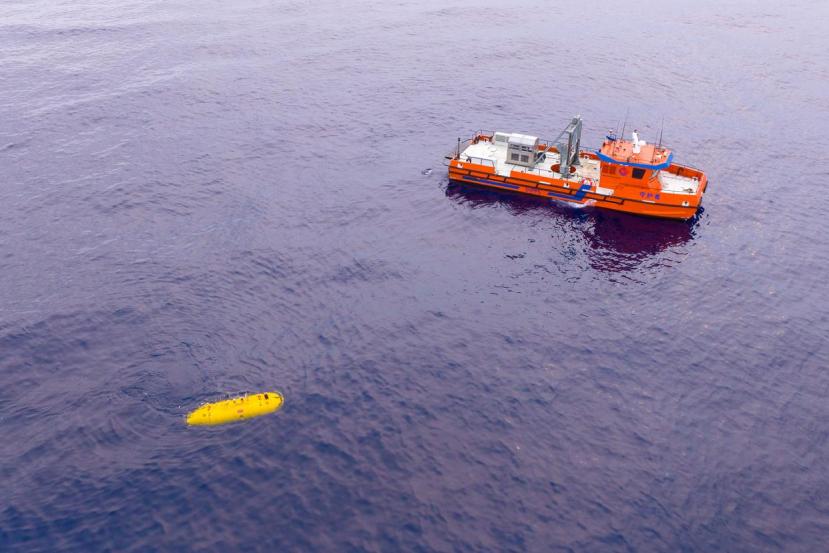
Group 1 - The article highlights the significant advancements in China's deep-sea robotics industry, particularly the successful sea trials of the "Haiwei" system, which utilizes innovative technologies for deep-sea communication and automation, positioning China among the global leaders in this field [2][5] - The deep-sea robotics market is projected to reach 8.7 billion yuan by 2025, driven by increasing demand in energy development, national defense, and ecological restoration [6][23] - The article emphasizes the shift from traditional underwater operations to intelligent ocean monitoring and the emergence of new application scenarios, such as underwater data centers and ecological restoration [17][22] Group 2 - The deep-sea robotics industry is experiencing a transformation from specialized equipment to large-scale industrial tools, with a market size expected to exceed 300 billion yuan by 2030 [23][24] - Key technological breakthroughs include the modular design and autonomous navigation capabilities of deep-sea robots, which enhance operational efficiency and reduce costs significantly [11][17] - The article discusses the importance of policy support and capital investment in accelerating the development of deep-sea technology, with China's marine economy projected to surpass 10 trillion yuan by 2024 [13][14] Group 3 - The competitive landscape of the deep-sea robotics industry is evolving, with a focus on integrating technology, understanding application scenarios, and building ecosystems [44][48] - Companies with core technological innovations, data monopolies, and ecosystem integration capabilities are expected to dominate the market, particularly those involved in military-civilian integration and digital twin technologies [45][48] - The article identifies three types of companies in the industry: technology-driven firms, those focused on specific application scenarios, and platform companies that facilitate ecosystem collaboration [49][50]


向海图强 另一个山东正在崛起
经济观察报· 2025-05-27 13:15
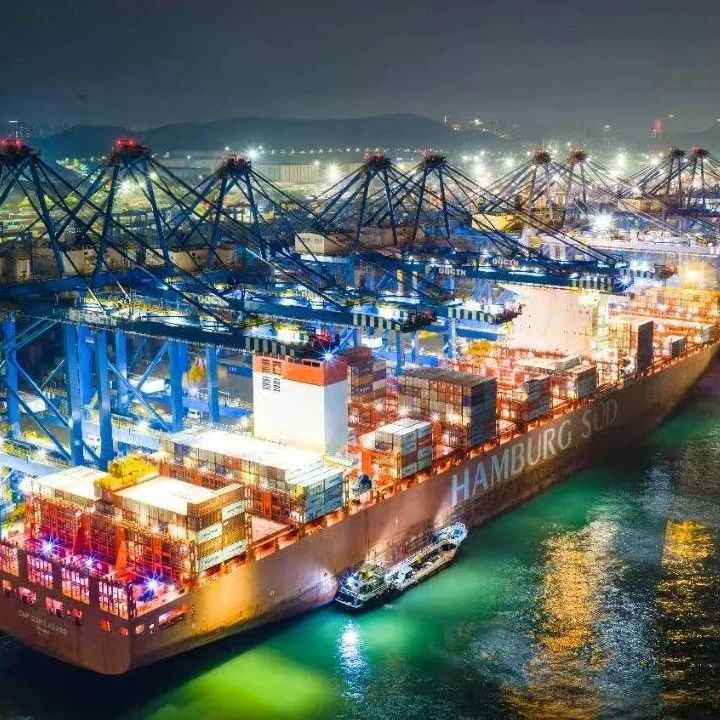
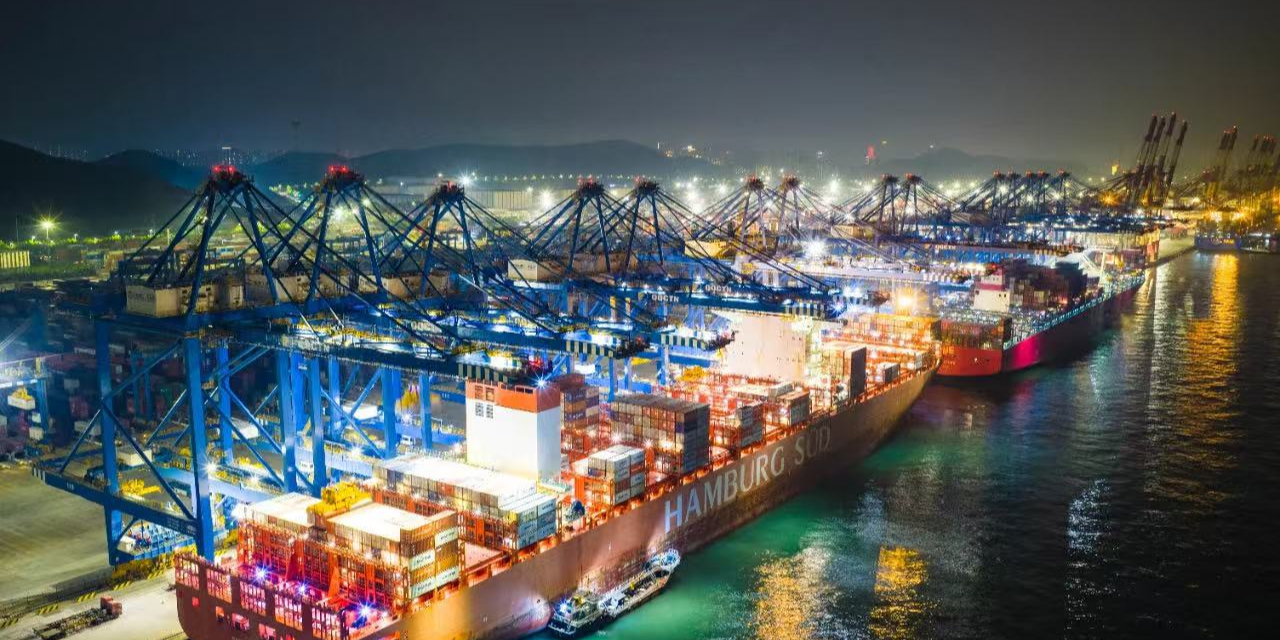
Core Viewpoint - Shandong Port is constructing a world-class port cluster to support the rise of industrial clusters in the Yellow River Basin and northern China, leveraging its logistics capabilities to connect production and consumption [1][8]. Group 1: Port Efficiency and Capacity - On May 22, 2025, Shandong Port Qingdao achieved a world record in container handling efficiency at an automated terminal, with an average efficiency of 62.62 natural boxes per hour, marking the 13th record-breaking event [2]. - In 2024, Shandong Port's total cargo throughput exceeded 1.8 billion tons, and container throughput surpassed 44 million standard containers, ranking first globally [2]. - The construction of a 400,000-ton ore terminal at Qingdao Port is nearing completion, with a designed annual capacity of 16 million tons, further enhancing Shandong's port capabilities [6]. Group 2: Marine Economy Development - Shandong's marine economy has seen significant growth, with the marine production value reaching 1.80118 trillion yuan in 2024, a 6.1% increase from the previous year, contributing 23.9% to the province's economic growth [15]. - The province aims to enhance its marine industry clusters by 2027, with a focus on increasing the added value of 15 major marine industries at a rate higher than the overall GDP growth [3][12]. - Shandong has established itself as a hub for marine technology, housing 50 national marine research platforms and a significant portion of the country's marine talent [10]. Group 3: Logistics Integration and Infrastructure - The establishment of the Shandong Port Logistics Group has facilitated the integration of logistics resources, covering various cargo types and enhancing inland logistics capabilities [7][8]. - The group has launched multiple inland port projects to improve the logistics network and better serve inland market demands, with a total of 54 inland ports and 104 new train routes established [8]. - Shandong Port's logistics network includes over 360 shipping routes, connecting to more than 700 ports globally, solidifying its position as a leading northern port [8]. Group 4: Technological Innovation and Future Plans - Shandong is focusing on transforming its technological advantages into industrial strengths through initiatives like the Marine Industry Technology Innovation Action Plan [13]. - The province aims to enhance its marine economy by integrating cutting-edge technologies and fostering collaboration between academia and industry [14]. - Future plans include significant investments in marine biotechnology and sustainable practices to drive high-quality development in the marine sector [16].
前瞻全球产业早报:深圳成立首个药械产业出海联合体
Qian Zhan Wang· 2025-05-27 02:17
Group 1 - China's aviation engine "Taihang 2" pure hydrogen gas turbine has achieved a cumulative operation time of over 7000 hours for the first unit and over 5000 hours for the second unit, marking a successful commercialization of the 2MW pure hydrogen gas turbine [2] - The low-altitude economy is driving the popularity of drone pilots, with over 225,000 registered drone pilot licenses in China as of June 2024, and more than 2000 training institutions available [3] - Shenzhen has established its first pharmaceutical and medical device industry overseas joint venture, aiming to create a platform for local companies to connect with global markets [4] Group 2 - China's marine economy has surpassed 10 trillion yuan for the first time, showing a growth of 5.9% compared to the previous year, with the marine engineering equipment manufacturing sector maintaining the largest global market share for seven consecutive years [5] - The first large-scale lithium-sodium hybrid energy storage station in China has been put into operation, with a capacity of 400 MWh and a green energy ratio of 98% [6] - The Yukun high-speed railway's Ningjingli tunnel has been safely completed, contributing to the construction of the railway with 40 tunnels already completed in the Yunnan section [7][8] Group 3 - Yunding Technology has launched an industrial vision intelligent all-in-one machine in collaboration with Ascend, featuring high computing power and supporting over 100 channels of 1080P video processing [9] - A Chinese team has overcome challenges in the large-scale production of third-generation photovoltaic technology, achieving stable mass production of perovskite solar cells [10] - QQ Browser has introduced an AI tool named "AI Gao Kao Tong" to assist students in exam preparation and college application processes [11] Group 4 - Market rumors suggest that Sais Technology's humanoid robot prototype is ready for demonstration, although the company has not confirmed this information [12] - U.S. President Trump has threatened to impose tariffs of 50% on the EU and 25% on Apple, causing declines in Apple stock and U.S. stock futures [13] - Experts have commented on the impracticality of relocating iPhone production to the U.S., citing high costs and potential price increases for consumers [14] Group 5 - Japan's consumer price index for rice has seen a dramatic increase of 98.4% year-on-year in April, marking the highest increase since 1971 [15] - Nissan is considering selling its Yokohama headquarters as part of its restructuring plan, which may incur an additional 60 billion yen (approximately 418 million USD) in costs [16] - Elon Musk praised Google's new AI video generation model, Veo 3, during a developer conference, while also announcing his return to a 24/7 work schedule [17]

向海图强 另一个山东正在崛起
Jing Ji Guan Cha Wang· 2025-05-26 15:15
Group 1: Port Efficiency and Capacity - Shandong Port Qingdao's automated terminal set a new world record for container handling efficiency at 62.62 natural boxes per hour, marking the 13th time it has achieved this feat [2] - In 2024, Shandong Port's total cargo throughput exceeded 1.8 billion tons, with container volume surpassing 44 million standard boxes, ranking first globally [2] - The construction of a new 400,000-ton ore terminal at Qingdao Port is nearing completion, which will enhance its capacity to accommodate ultra-large ocean vessels [6] Group 2: Marine Economy Development - Shandong's marine economy has seen significant growth, with the marine production value reaching 1.80118 trillion yuan in 2024, a 6.1% increase from the previous year, contributing 23.9% to the province's economic growth [4][14] - The province aims to enhance its marine industry clusters by 2027, with a focus on increasing the value-added growth of 15 major marine industries [3][11] - Shandong has established itself as a hub for marine technology, housing 50 national marine research platforms and a significant portion of the country's marine talent [10] Group 3: Logistics and Infrastructure - The establishment of Shandong Port Logistics Group has integrated logistics resources, expanding inland port networks and enhancing service capabilities [8] - The group plans to connect inland and maritime transport, facilitating better logistics solutions for inland enterprises [9] - Shandong's logistics network includes over 360 shipping routes, covering more than 700 ports globally, maintaining its position as a leading northern port [8] Group 4: Technological Advancements - Shandong has launched initiatives to boost marine technology innovation, focusing on key areas such as artificial intelligence and marine biomedicine [12] - The province's marine economy is characterized by a leading primary industry, supported by secondary and tertiary industries, with significant contributions from traditional sectors [13] - Recent technological projects, including the "Deep Sea No. 1" and high-resolution marine models, have been recognized nationally, showcasing Shandong's commitment to marine innovation [4][10]
10万亿深蓝财富揭秘!帮主郑重解码海洋经济投资密码
Sou Hu Cai Jing· 2025-05-25 01:53
Core Insights - China's marine economy is projected to exceed 10 trillion yuan in 2024, equating to approximately 7,000 yuan per person in marine wealth [1] - The marine engineering equipment manufacturing industry has maintained the largest global market share for seven consecutive years [1] Investment Opportunities - The first investment opportunity is "Deep Sea Mining," with significant reserves of combustible ice and polymetallic nodules, which are essential for new energy batteries, indicating a potential for substantial growth [3] - The second opportunity lies in "Equipment Upgrades," where the technological barriers in deep-sea equipment surpass those in chip manufacturing, highlighting the importance of companies like BaoTi Co., which has achieved 100% domestic substitution [3] - The third opportunity is the "Policy Tailwind," as the government has recognized deep-sea technology as a strategic emerging industry, which is expected to accelerate the commercialization of marine energy projects [3] Market Dynamics - By 2025, the number of deep-sea technology companies is expected to triple, yet market concentration remains low, suggesting that many leading companies in niche areas have yet to emerge [4] - Investment in deep-sea industries should focus on companies that possess core materials, have integrated capabilities across the entire supply chain, and are located in government-supported regions like Hainan and Shandong [4]

广东“28条”促进“百千万工程”
Guang Zhou Ri Bao· 2025-05-21 20:09
Core Viewpoint - The Guangdong Provincial Committee has issued measures to promote the "Hundred Counties, Thousand Towns, and Ten Thousand Villages High-Quality Development Project," focusing on enhancing county-level development mechanisms and promoting rural revitalization [1][2]. Group 1: Reform Measures - The measures include 28 reform initiatives aimed at improving county-level high-quality development through management system reforms, financial incentives, and investment mechanisms [2]. - The reform emphasizes a menu-style empowerment approach, allowing counties more economic and social management authority through delegation and decentralization [2]. - Financial incentives are enhanced by optimizing revenue sharing ratios to increase local fiscal autonomy [2]. Group 2: Industrial Development - Developing and strengthening county-level industries is a priority, with measures focusing on nurturing characteristic industries, promoting industrial integration, and enhancing technological capabilities [2]. - The measures highlight the importance of modern marine ranching, offshore wind power, and marine equipment development, alongside the establishment of high-quality marine economic demonstration zones [2]. Group 3: Urbanization and Infrastructure - The measures propose initiatives for new urbanization, including urban planning, city renewal, and housing security, with a focus on improving county-level urban infrastructure [3]. - A collaborative mechanism for old city renovation and new city construction is emphasized to address weaknesses in county-level urban development [3]. - The implementation of these reforms is expected to yield substantial breakthroughs within 1-2 years and noticeable results within 3 years [3].
28条措施出炉!广东以改革更好促进“百千万工程”
Nan Fang Nong Cun Bao· 2025-05-21 07:01
28条措施出炉! 广东以改革更好 促进"百千万工 程"_南方+_南方 plus 近日,中共广东 省委全面深化改 革委员会印发 《关于以改革更 好促进"百县千 镇万村高质量发 展工程"的若干 措施》,围绕健 全县域高质量发 展动力机制、县 域产业发展体制 机制、推进新型 城镇化体制机 制、推动乡村全 面振兴长效机 制、城乡区域协 调发展体制机 制,以及强化组 织保障提出28条 改革措施(下 称"28条"),助 力"百千万工 程"走深走实、 取得扎实成效。 深化扩权强县改 革 增加地方自主财 力 县域是"百千万 工程"的主战 场。"28条"指 出,要健全县域 高质量发展动力 机制。具体措施 包括深化县镇管 理体制改革、强 化财政体制激励 导向、健全县域 投融资机制、打 造高水平县域营 商环境。 在深化县镇管理 体制改革方面, 深化扩权强县改 革,完善县 (市)"点菜" , 省、市"上菜"的 菜单式赋权方 式,通过下放、 委托等方式赋予 县(市)更多经 济社会管理权 限。深化"县直 报省、省直达 县"改革。深化 人口小县机构改 革,推进人口小 镇集约集聚发 展。推进赋予特 大镇同人口和经 济规模相适应的 经济社会管 ...

智研咨询发布:海洋经济行业市场动态分析、发展方向及投资前景分析报告
Sou Hu Cai Jing· 2025-05-19 02:54
Core Viewpoint - The marine economy in China is showing strong growth, with the total economic output expected to exceed 10 trillion yuan for the first time in 2024, reaching 10.5 trillion yuan, representing a year-on-year increase of 5.9% [2]. Industry Definition and Classification - The marine economy refers to the production activities that develop marine resources and rely on marine space, including marine fisheries, marine transportation, shipbuilding, salt production, marine oil and gas, and coastal tourism [4]. Industry Policies - Recent government policies aim to optimize the spatial layout of the marine economy, ensure ecological protection, and promote green transformation. For instance, the "Three-Year Action Plan for High-Quality Development of Marine Economy" (2024-2026) emphasizes green technology innovation and the establishment of low-carbon industrial parks [6][7]. - The "Guiding Opinions on Promoting the Large-Scale Utilization of Marine Energy" encourages provinces to focus on developing tidal, wave, and temperature difference energy as key tasks in marine economic development [7]. Development History - The development of the marine economy in China has gone through four stages since the founding of the People's Republic of China, evolving from a focus on political and military functions to a more comprehensive economic strategy that includes various marine industries [8]. Industry Barriers - **Technical Barriers**: New entrants face challenges due to the high technical requirements in deep-sea exploration and marine biotechnology, necessitating significant R&D investment [10][11]. - **Financial Barriers**: The capital-intensive nature of the marine economy creates high entry costs, with long investment return cycles making it difficult for new companies to secure funding [12]. - **Market and Resource Barriers**: The market is concentrated among leading firms, making it difficult for newcomers to compete and access quality marine resources [13]. Industry Chain - The marine economy's industry chain can be divided into upstream (marine equipment and materials manufacturing), midstream (marine fisheries, oil and gas, salt production, marine transportation, and coastal tourism), and downstream (marine product processing and retail) [14].