碳达峰碳中和

Search documents
建设更加有效、更有活力、更具国际影响力的全国碳市场
Xin Hua Wang· 2025-08-25 21:44
Core Viewpoint - The article emphasizes the importance of establishing a more effective, dynamic, and internationally influential national carbon market in China as a key policy tool for addressing climate change and promoting green transformation in the economy and society [1]. Group 1: Current Status of National Carbon Market - China has established a national carbon emissions trading market and a voluntary greenhouse gas reduction trading market, which together form a comprehensive national carbon market system [2]. - As of July 2025, the cumulative trading volume of carbon emission allowances reached 681 million tons, with a total transaction value of 46.784 billion yuan, indicating the market's growing effectiveness [2]. - The completion rate for allowance compliance among the 2,096 key emission units included in the trading market for 2024 is nearly 100% [2]. Group 2: Development Goals and Strategies - The document outlines a roadmap for the medium- and long-term development of the national carbon market, with specific targets set for 2027 and 2030 [4]. - It emphasizes the need to enhance market functions, expand the coverage of industries and greenhouse gases, and establish a transparent carbon allowance management system [4]. - The strategy includes a gradual shift from intensity control to total control of carbon emissions and the implementation of both free and paid allocation methods for carbon allowances [4]. Group 3: Market Dynamics and Governance - The construction of the national carbon market aims to create a low-carbon development awareness among society, emphasizing that carbon emissions have costs while reductions yield benefits [3]. - There is a focus on balancing market vitality with effective government regulation to ensure a healthy and orderly development of the carbon market [7]. - The role of local pilot carbon markets will continue as "policy testing grounds" to innovate regulatory methods and contribute to the national market's development [7]. Group 4: International Cooperation and Standards - The national carbon market is positioned as a mechanism for international cooperation in green and low-carbon development, adhering to international standards and facilitating cross-border collaboration [8]. - The design of the carbon market aims to enhance its international influence while promoting domestic green technologies and industries to expand globally [8].
杭汽轮B: 2025年半年度报告(英文版)
Zheng Quan Zhi Xing· 2025-08-25 17:14
Company Profile & Financial Highlights - Hangzhou Turbine Power Group Co., Ltd. is a leading provider of turbo machinery equipment in China, specializing in the design and production of industrial steam turbines and gas turbines [10][11] - The company reported an operating revenue of approximately RMB 2.45 billion for the first half of 2025, a decrease of 6.30% compared to the same period last year [10][23] - The net profit attributable to shareholders decreased by 18.75% to RMB 0.13 per share [10][17] Management Discussion & Analysis - The company's main business model remains unchanged, focusing on customized solutions for clients in various industrial sectors [10][12] - The company has maintained a leading market share in the domestic industrial drive sector, with a strong reputation and brand influence [16][20] - The gas turbine business has expanded through collaboration with Siemens, enhancing the company's capabilities in distributed energy solutions [12][15] Financial Performance - The cash flow generated by business operations improved by 49.77%, indicating better recovery of goods payments [10][17] - The company experienced a significant increase in income tax expenses, rising by 403.94% due to deferred income tax expenses [10][17] - The total operating revenue composition shows that industrial steam turbines accounted for 80.99% of revenue, while gas turbines saw a significant decline of 65.94% [23] Key Events and Developments - The company has established strategic partnerships with major customers, enhancing its market position and customer value [20][22] - The company is actively involved in technological innovation and has established collaborations with universities and research institutions to advance its R&D capabilities [18][22] - The company has implemented cost control measures and optimized business processes to improve profitability amidst declining product margins [17][19]

事关全国碳排放建设 重磅文件来了!
Zhong Guo Ji Jin Bao· 2025-08-25 15:41
Core Viewpoint - The document outlines the "Opinions on Promoting Green and Low-Carbon Transition and Strengthening National Carbon Market Construction," emphasizing the importance of carbon markets as a policy tool to address climate change and facilitate a comprehensive green transition in the economy and society [3][13]. Summary by Sections 1. Main Goals - By 2027, the national carbon emission trading market will cover major emission industries in the industrial sector, and the voluntary greenhouse gas reduction trading market will achieve full coverage in key areas. By 2030, a national carbon emission trading market will be established based on total quota control, combining free and paid allocation, with a transparent and unified method that aligns with international standards [3][13]. 2. Carbon Emission Trading Market Development - The coverage of the national carbon emission trading market will be expanded based on industry development status, pollution reduction contributions, data quality, and carbon emission characteristics [8][16]. - A quota management system will be established to ensure transparency and stability, with a gradual shift from intensity control to total control of carbon emissions [16]. 3. Support for Financial Institutions - Financial institutions, including banks, will be encouraged to engage in carbon pledge financing and participate in the national carbon market under compliant and risk-controlled conditions [5][19]. 4. Pilot Market Encouragement - Carbon emission trading pilot markets will be encouraged to expand their coverage and innovate regulatory methods, contributing to regional green and low-carbon transitions [6][17]. 5. Voluntary Reduction Trading Market - The establishment of a scientific and complete methodology system for the voluntary reduction trading market will be accelerated, focusing on areas with significant sustainable development benefits [18]. 6. Market Vitality Enhancement - The development of green financial products related to carbon emissions will be promoted, and the introduction of various trading entities will be supported to enhance market activity [19]. 7. Capacity Building - A management system that aligns with the development stages of the national carbon market will be established, enhancing management capabilities and ensuring data security [20][21]. 8. Regulatory Framework - The document emphasizes the need for a robust legal framework to support carbon market construction, including the establishment of rules for registration, trading fees, and clearing mechanisms [23]. 9. International Cooperation - The document calls for active participation in international carbon market mechanisms and the promotion of global green and low-carbon transitions through dialogue and cooperation [24].

中办、国办重磅文件!事关全国碳市场建设
Zhong Guo Zheng Quan Bao· 2025-08-25 15:41
Core Viewpoint - The document outlines the Chinese government's strategy to enhance the national carbon market as a crucial tool for addressing climate change and promoting a green low-carbon transition in the economy [4][6]. Summary by Sections Overall Requirements - The strategy emphasizes the importance of adhering to Xi Jinping's thoughts on socialism with Chinese characteristics and aims to balance green low-carbon transformation with economic development needs [7]. - Key goals include achieving basic coverage of major industrial sectors in the national carbon emission trading market by 2027 and establishing a comprehensive carbon pricing mechanism by 2030 [7]. Accelerating the National Carbon Emission Trading Market - The plan includes expanding the coverage of the carbon emission trading market based on industry development, pollution reduction contributions, and carbon emission characteristics [8]. - A transparent carbon emission quota management system will be established, transitioning from intensity control to total control of carbon emissions by 2027 [8]. Developing the National Voluntary Greenhouse Gas Reduction Trading Market - The document calls for the establishment of a comprehensive methodology system for voluntary reduction projects, focusing on areas with significant sustainable development benefits [10]. - It encourages the use of certified voluntary reduction credits in various sectors, including government and enterprises, to offset carbon emissions [10]. Enhancing Market Vitality - The strategy promotes the development of financial products related to carbon emissions and encourages financial institutions to participate in the carbon market [11]. - It aims to expand the range of trading participants, including individuals and financial institutions, while ensuring regulatory oversight to maintain market order [11]. Strengthening Carbon Market Capacity - A robust management system will be established to support the development of the carbon market, including digital and intelligent management systems [12]. - The document emphasizes the need for accurate carbon emission accounting and reporting, with a focus on improving data quality and regulatory oversight [13]. Organizational Implementation Support - Local governments are tasked with implementing the strategy and providing policy support for carbon market operations [14]. - The document highlights the importance of legal frameworks to support carbon market development and the need for international cooperation in carbon market mechanisms [15][17].

建设更加有效、更有活力、更具国际影响力的全国碳市场——解读中办、国办《关于推进绿色低碳转型加强全国碳市场建设的意见》
Xin Hua Wang· 2025-08-25 15:03
Core Viewpoint - The document outlines China's commitment to building a more effective, vibrant, and internationally influential national carbon market as a key policy tool for addressing climate change and promoting green transformation in the economy and society [1] Group 1: Current Status of the National Carbon Market - China has established a national carbon emissions trading market and a voluntary greenhouse gas reduction trading market, which together form a comprehensive national carbon market system [2] - As of July 2025, the cumulative trading volume of carbon emission allowances reached 681 million tons, with a transaction value of 46.784 billion yuan, indicating the market's growing effectiveness [2] - The number of key emission units included in the national carbon emissions trading market is 2,096, with a compliance rate of nearly 100% for allowance surrender [2] Group 2: Development Goals and Roadmap - The document sets a clear roadmap for the medium- and long-term development of the national carbon market, with specific targets to be achieved by 2027 and 2030 [4] - It emphasizes the need to enhance market functions, expand the coverage of industries and greenhouse gases, and establish a transparent carbon allowance management system [4] - The focus will be on gradually shifting from intensity control to total control of carbon emissions, while implementing a combination of free and paid allocation of allowances [4] Group 3: Market Dynamics and Governance - The construction of the national carbon market aims to create a low-carbon development awareness among society, emphasizing that carbon emissions have costs while reductions yield benefits [3] - The government plays a crucial role in establishing the regulatory framework and risk prevention systems, while the market focuses on resource allocation efficiency [7] - Balancing market vitality with regulatory oversight is essential to ensure the healthy and orderly development of the carbon market [7] Group 4: International Cooperation and Standards - The carbon market is seen as a means to enhance international cooperation in green and low-carbon development, with an emphasis on aligning with international standards [8] - The design of the national carbon market will include provisions for international engagement, aiming to boost its global influence and facilitate cross-border cooperation in green technology and industries [8]
事关全国碳市场建设,中办、国办重磅文件对外公布
中关村储能产业技术联盟· 2025-08-25 12:04
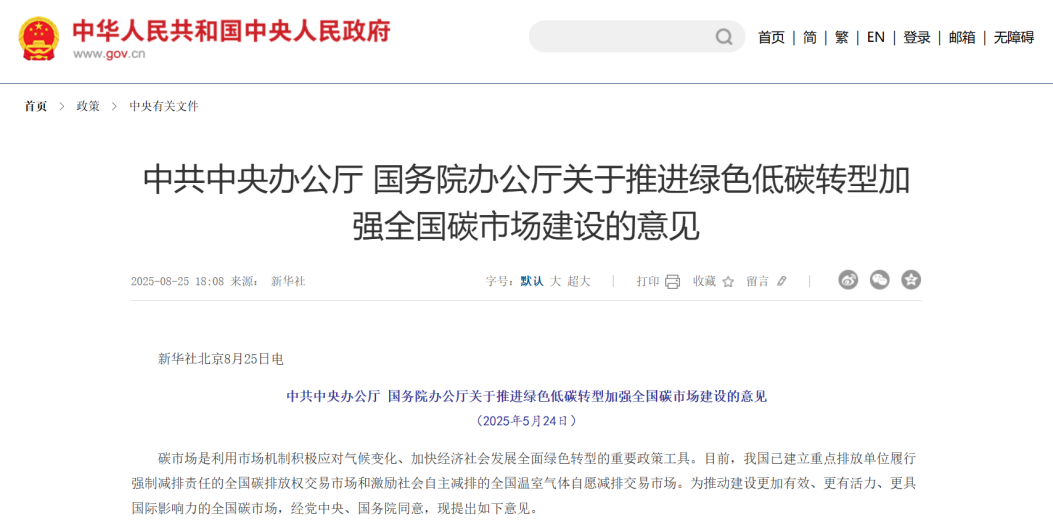
文 | 新华社 8月25日,中共中央办公厅、国务院办公厅《关于推进绿色低碳转型加强全国碳市场建设的意 见》对外公布。 这份意见明确,碳市场是利用市场机制积极应对气候变化、加快经济社会发展全面绿色转型的重 要政策工具。目前,我国已建立重点排放单位履行强制减排责任的全国碳排放权交易市场和激励 社会自主减排的全国温室气体自愿减排交易市场。 这份意见提出,到2027年,全国碳排放权交易市场基本覆盖工业领域主要排放行业,全国温室 气体自愿减排交易市场实现重点领域全覆盖。到2030年,基本建成以配额总量控制为基础、免 费和有偿分配相结合的全国碳排放权交易市场,建成诚信透明、方法统一、参与广泛、与国际接 轨的全国温室气体自愿减排交易市场,形成减排效果明显、规则体系健全、价格水平合理的碳定 价机制。 中共中央办公厅 国务院办公厅关于推进绿色低碳转型加强全国碳市场建设的意见 (2025年5月24日) 碳市场是利用市场机制积极应对气候变化、加快经济社会发展全面绿色转型的重要政策工具。目 前,我国已建立 重点排放单位履行强制减排责任的全国碳排放权交易市场 和激励社会 自主减排 的全国温室气体自愿减排交易市场 。为推动建设更加有效、 ...
新华社权威快报丨事关全国碳市场建设,中办、国办重磅文件对外公布
Xin Hua Wang· 2025-08-25 11:30
新华社权威快报 中共中央办公厅 国务院办公厅 《关于推进绿色低碳转型 加强全国倾行场建设的意见》 8月25日对外公布 新华社国内部出品 8月25日,中共中央办公厅、国务院办公厅《关于推进绿色低碳转型加强全国碳市场建设的意见》 对外公布。 碳市场是利用市场机制积极应对气候变化、加快经济社会发展全面绿色转型的重要政策工具。目前,我 国已建立重点排放单位履行强制减排责任的全国碳排放权交易市场和激励社会自主减排的全国温室气体 自愿减排交易市场。为推动建设更加有效、更有活力、更具国际影响力的全国碳市场,经党中央、国务 院同意,现提出如下意见。 一、总体要求 这份意见明确,碳市场是利用市场机制积极应对气候变化、加快经济社会发展全面绿色转型的重要 政策工具。目前,我国已建立重点排放单位履行强制减排责任的全国碳排放权交易市场和激励社会自主 减排的全国温室气体自愿减排交易市场。 这份意见提出,到2027年,全国碳排放权交易市场基本覆盖工业领域主要排放行业,全国温室气体 自愿减排交易市场实现重点领域全覆盖。到2030年,基本建成以配额总量控制为基础、免费和有偿分配 相结合的全国碳排放权交易市场,建成诚信透明、方法统一、参与广泛、 ...

中共中央办公厅 国务院办公厅关于推进绿色低碳转型加强全国碳市场建设的意见
国家能源局· 2025-08-25 11:24
Core Viewpoint - The article emphasizes the importance of establishing a national carbon market in China as a crucial policy tool for addressing climate change and promoting a green and low-carbon transformation of the economy [3][4]. Group 1: Overall Requirements - The national carbon market aims to cover major industrial sectors by 2027 and establish a comprehensive trading market by 2030, focusing on effective market mechanisms and government involvement [4]. - The goals include optimizing resource allocation for carbon emissions and fostering a transparent market environment to support carbon neutrality and ecological civilization [4]. Group 2: National Carbon Emission Trading Market - The coverage of the national carbon emission trading market will be expanded based on industry development, emission reduction contributions, and data quality [5]. - A transparent carbon emission quota management system will be established, transitioning from intensity control to total control by 2027 for stable emission sectors [5]. - Guidance and supervision will be strengthened for existing pilot carbon trading markets to ensure they contribute to regional low-carbon transitions [6]. Group 3: Voluntary Greenhouse Gas Reduction Trading Market - The development of a voluntary reduction trading market will focus on creating a comprehensive methodology to support sustainable development and ecological benefits [7]. - There will be an emphasis on the integrity of project owners and verification agencies in managing voluntary reduction projects [8]. Group 4: Enhancing Market Vitality - Financial institutions will be encouraged to develop green financial products related to carbon trading, enhancing support for greenhouse gas reduction [9]. - The introduction of new trading participants, including individuals and financial institutions, will be promoted to diversify market engagement [9]. - Regulatory measures will be implemented to prevent market manipulation and ensure a stable trading environment [9]. Group 5: Strengthening Market Capacity - A management system will be established to support the development of the national carbon market, focusing on digital and intelligent management systems [10]. - The carbon emission accounting and reporting system will be improved to ensure accurate emissions data from enterprises [10]. - Strict regulations will be enforced for carbon emission verification to maintain high-quality reporting standards [11]. Group 6: Organizational Implementation Support - Local governments are tasked with supporting the implementation of carbon market policies and managing emissions quotas effectively [12]. - Legal frameworks will be developed to support carbon market operations and ensure compliance with regulations [13]. - International cooperation will be encouraged to align with global carbon market mechanisms and share best practices [13].

刚刚,利好来了
中国基金报· 2025-08-25 11:00
Core Viewpoint - The article discusses the release of a significant document by the Central Committee of the Communist Party of China and the State Council, titled "Opinions on Promoting Green and Low-Carbon Transition and Strengthening National Carbon Market Construction," which outlines the framework for China's carbon market development and its role in addressing climate change and promoting economic transformation [1][12]. Summary by Sections 1. Overall Requirements - The carbon market is identified as a crucial policy tool for addressing climate change and facilitating a comprehensive green transition in economic and social development. The main goals include achieving basic coverage of major industrial sectors by 2027 and establishing a robust carbon trading market by 2030 [15][12]. 2. Accelerating the Construction of the National Carbon Emission Trading Market - The coverage of the national carbon emission trading market will be expanded based on industry development, pollution reduction contributions, data quality, and carbon emission characteristics [16]. - A transparent carbon emission quota management system will be established, with a focus on balancing supply and demand in the market [17]. - Guidance and supervision will be strengthened for pilot carbon trading markets to ensure they contribute to regional green and low-carbon transitions [18]. 3. Actively Developing the National Voluntary Greenhouse Gas Reduction Trading Market - A comprehensive methodology system will be established to support voluntary reduction projects, ensuring effective management from project development to verification [18]. - Encouragement for various entities, including government and enterprises, to utilize certified voluntary reduction credits to offset emissions [18]. 4. Enhancing Market Vitality - Financial institutions will be supported in developing green financial products related to carbon emissions, including carbon pledges and repurchase policies [19]. - The introduction of new trading participants, including individuals, will be facilitated in the voluntary reduction trading market [19]. 5. Strengthening Carbon Market Capacity Building - A management system that aligns with the development stages of the national carbon market will be established, enhancing supervision and operational efficiency [21]. - The carbon emission accounting and reporting management will be improved, with a focus on accurate measurement and verification of emissions [21]. 6. Strengthening Organizational Implementation Support - Local governments are urged to enhance leadership and policy support for carbon market construction, ensuring effective management of emission quotas and data quality [23]. - Legal frameworks will be developed to support carbon market operations, including regulations for voluntary reduction trading [24].

事关全国碳市场建设,中办、国办重磅文件公布
第一财经· 2025-08-25 10:57
Core Viewpoint - The article discusses the Chinese government's policy to advance green and low-carbon transformation through the establishment and enhancement of a national carbon market, aiming for comprehensive coverage of major industrial sectors by 2027 and a robust carbon pricing mechanism by 2030 [1][5]. Group 1: Overall Requirements - The policy emphasizes the importance of a unified national carbon market as a tool for controlling greenhouse gas emissions, balancing economic development with green transformation [4]. - The goals include optimizing resource allocation efficiency and maximizing benefits while fostering deep transformation in traditional industries and nurturing new productive forces [5]. Group 2: National Carbon Emission Trading Market - The plan includes expanding the coverage of the national carbon emission trading market based on industry development status, pollution reduction contributions, data quality, and carbon emission characteristics [6]. - A transparent and stable carbon emission quota management system will be established, with a gradual shift from intensity control to total control of carbon emissions [6][7]. Group 3: Voluntary Greenhouse Gas Reduction Trading Market - The establishment of a comprehensive methodology system for voluntary reduction projects is prioritized, focusing on areas with significant sustainable development benefits [8]. - The government encourages the use of certified voluntary reduction amounts to offset carbon emissions in various sectors, including government and enterprises [9]. Group 4: Enhancing Market Vitality - Financial institutions are encouraged to develop green financial products related to carbon emissions, enhancing support for greenhouse gas reduction [10]. - The introduction of new trading participants, including individuals and financial institutions, is supported to broaden market engagement [10]. Group 5: Strengthening Market Capacity - A robust management system will be established to ensure effective supervision and management of the national carbon market, including digital and intelligent management systems [11]. - The article highlights the need for strict verification of carbon emissions and the establishment of a comprehensive regulatory framework to ensure data quality and integrity [12]. Group 6: Organizational Implementation and Support - Local governments are tasked with implementing the policy effectively, ensuring oversight of key emission units and managing quota allocations [13]. - Legal frameworks will be developed to support carbon market operations, including regulations for voluntary reduction trading and administrative enforcement [13][14].