
AIGC

Search documents
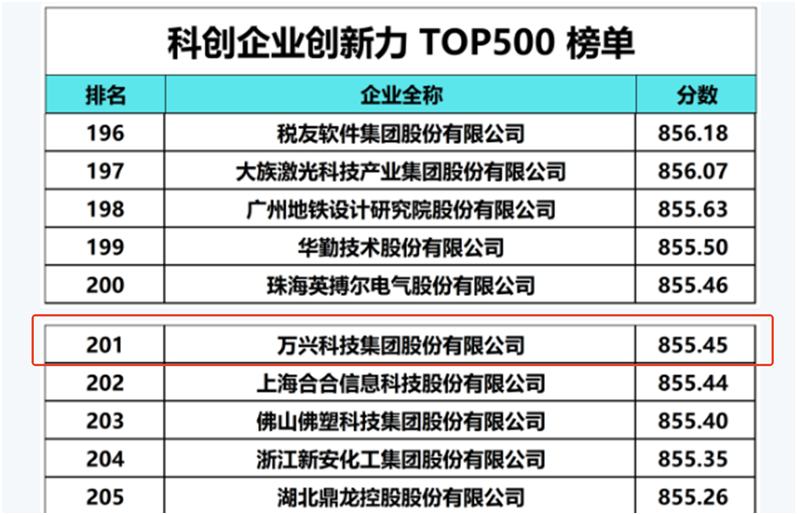
AIGC创新力再获认可 万兴科技(300624.SZ)跻身2025中国科创企业创新力500强
智通财经网· 2025-12-18 00:54
Core Insights - The "2025 China Sci-Tech Enterprises High-Quality Development Conference" was held in Xiong'an New Area, where the "2025 China Sci-Tech Enterprises Innovation Power TOP500 Development Report" and the corresponding list were officially released, highlighting the innovative performance of companies like Wondershare Technology in the digital creative software and AIGC fields [1][2] Group 1: Company Recognition - Wondershare Technology was successfully included in the TOP500 list, alongside major AI companies such as Huawei, Tencent, and Baidu, indicating its recognition as a leader in the new generation of information technology [1][2] - The TOP500 list was compiled by the China Enterprise Evaluation Association based on a comprehensive evaluation model focusing on "industry leadership, original innovation, intellectual property protection, value realization, financial performance, brand influence, and capital activity" [2] Group 2: Industry Trends - The AI industry in China is projected to reach a scale of 17.3 trillion yuan by 2035, accounting for 30.6% of the global market, showcasing unprecedented vitality [3] - Wondershare Technology is maintaining high-intensity investments in the AIGC field, focusing on technological innovation, product innovation, and talent acquisition [3] Group 3: Technological and Product Innovations - In June, Wondershare released the Wondershare Tianmu Multimedia Model 2.0, which boasts a 90% performance improvement over its predecessor, with notable advancements in professional-level shooting and audio effects [3] - The company has launched several AI-enhanced products, including the Wondershare Filmora 2026, which offers a one-stop experience for video creation, and the Wondershare PDF V12, which features new AI functionalities to enhance document processing efficiency [4] Group 4: Talent Acquisition - Wondershare Technology has been recognized as an AI recruitment pioneer and is actively recruiting for the 2026 class, targeting top universities and offering competitive salaries, with average annual salaries for graduates reaching 500,000 yuan and up to 1 million yuan for R&D talents [4] Group 5: Global Presence and Future Plans - As a leading A-share listed company in the digital creative software sector, Wondershare has a global presence in over 200 countries and regions, with more than 2 billion active users, earning the title of "China's version of Adobe" [5] - The company aims to deepen its technological research and product innovation in the AIGC field, collaborating with global partners to build a new intelligent creative ecosystem and support the sustainable development of China's AI industry [5]


超预期的液冷
2025-12-17 15:50
Summary of Liquid Cooling Technology Conference Call Industry Overview - The liquid cooling technology in data centers has seen significant growth driven by NVIDIA (NV) and ASIC, with NV's ML 72 cabinet liquid cooling ratio increasing from 70% in GB 200 to 100% in GB 300, indicating a strong market demand in North America [2][3] - Major tech companies like Meta, Google, and OpenAI are increasing their demand for liquid cooling solutions, leading to a substantial market opportunity [4][8] Key Insights and Arguments - Google has raised its TPU guidance multiple times in 2025, which is expected to create a demand for millions of 1.6T optical modules, resulting in a new liquid cooling demand of 15-20 billion RMB. By 2026, Google's liquid cooling market space could exceed 40 billion RMB, potentially reaching 60-70 billion RMB by 2027 [2][5] - In the liquid cooling sector, Invec is positioned to become a core supplier for Google due to its comprehensive supply chain layout, NV certification, and experience in delivering integrated solutions [6] - Other companies such as Yinlun, Tongfei, Gaolan, Shenling, Feilong, and Far East are also expected to enter the overseas supply chain and benefit from the growth in the liquid cooling market [7] Future Development Prospects - The liquid cooling sector is projected to grow significantly, with an estimated market space of 80 billion RMB from 100,000 cabinets, assuming each cabinet is valued at 800,000 RMB [4][8] - The increase in bidding volumes in the domestic AI and AIGC sectors indicates a positive trend, with significant order growth for related switch companies [9] - Invec's revenue from liquid cooling has rapidly increased, with a fourfold growth in 2022 and threefold growth in 2023, and is expected to exceed 200 million RMB in the first half of 2025 [4][12] Additional Important Points - The liquid cooling market is expected to reach over 20 billion RMB globally this year, with projections of 120-140 billion RMB in the following year [12] - Invec has established itself as a key player in the industry, having entered the NVIDIA supply chain and developed various cooling solutions, including water cooling and indirect evaporative cooling [12][13] - The company is expanding its production capacity and enhancing its competitiveness by building new headquarters and accelerating overseas resource platform development [13] This summary encapsulates the critical developments and insights from the conference call regarding the liquid cooling technology industry and its key players.

天龙集团:公司的主营业务为互联网营销
Zheng Quan Ri Bao Zhi Sheng· 2025-12-17 14:27
Core Viewpoint - Tianlong Group's main business is internet marketing, leveraging AI tools to enhance marketing activities through intelligent content production and precise deployment strategies [1] Group 1: Business Overview - The company operates through its subsidiary, Pinzhong Innovation, which utilizes an AIGC tool matrix to drive the automation of marketing content production and digital management [1] - The integration of third-party platform APIs, such as Baidu's Qingshuda and Tencent's Miaosi, supports cross-platform collaboration and compatibility with major AI models [1] Group 2: Technology and Innovation - The company’s tools are compatible with both domestic and international AI models, including GPT-4o, Kimi, Wenxin Yiyan, Tongyi Qianwen, iFlytek Xinghuo, DeepSeek, as well as image models like MJ, SD, and DALL.E [1] - The technology enables the automated generation of marketing materials, including text, images, and videos, creating a multi-modal intelligent creation ecosystem [1]

微短剧,如何撑起点众科技的亿元分红?
2 1 Shi Ji Jing Ji Bao Dao· 2025-12-17 12:25
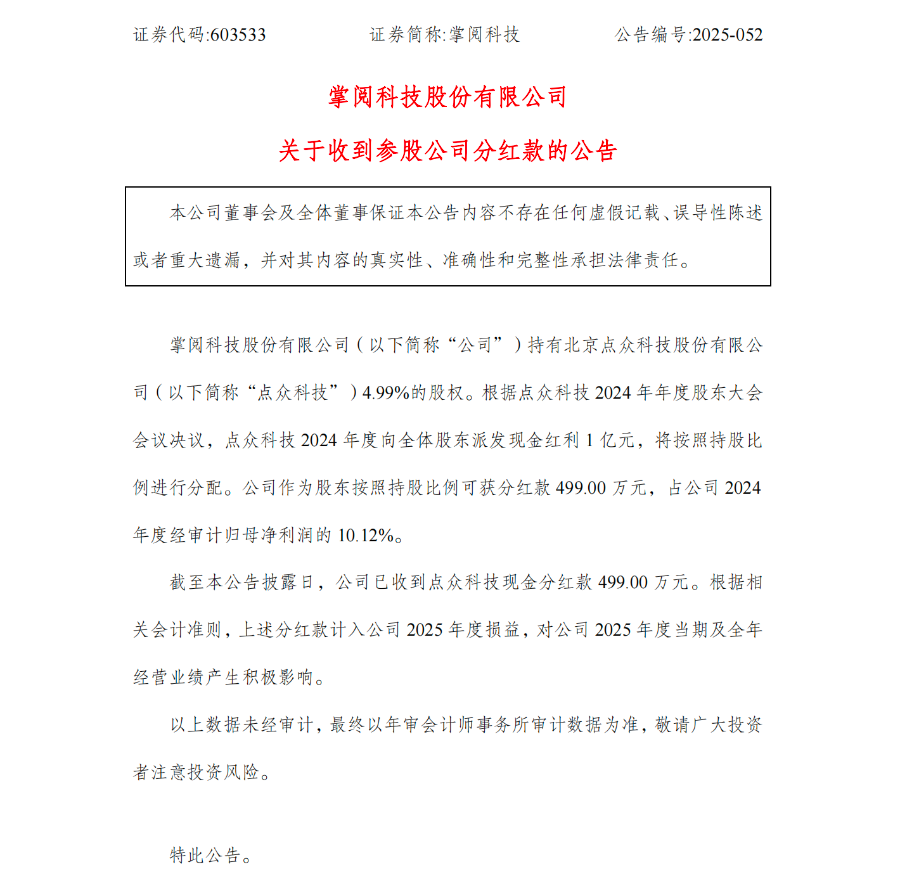
Core Insights - The announcement highlights that Zhangyue Technology (掌阅科技) received a cash dividend of 4.99 million yuan from its stake in Beijing Dianzhong Technology Co., Ltd. (点众科技), which represents 10.12% of the company's audited net profit for 2024 [1] Group 1: Financial Performance - Zhangyue Technology holds a 4.99% stake in Dianzhong Technology, which declared a total cash dividend of 100 million yuan for 2024 [1] - The cash dividend received by Zhangyue Technology amounts to 4.99 million yuan, contributing significantly to its financial performance [1] Group 2: Industry Growth - The micro-short drama industry in China is experiencing rapid growth, with its market size projected to increase from 3.68 billion yuan in 2021 to 50.44 billion yuan in 2024 [4] - Dianzhong Technology has successfully transitioned from mobile reading to micro-short dramas, leveraging its IP advantages for integrated production [4] Group 3: Content Strategy - Content quality is crucial for user engagement, with average daily usage time for micro-short drama apps reaching 120.5 minutes in the first eight months of 2025, a 25.9% increase from January [6] - Dianzhong Technology focuses on enhancing popular genres and addressing potential market gaps, targeting both young audiences and older demographics with tailored content [7] Group 4: Global Expansion - The overseas micro-short drama market generated 1.088 billion USD in revenue in the first half of the year, marking a 249% year-on-year growth [8] - Cultural adaptation is essential for the success of Chinese content in international markets, with Dianzhong Technology emphasizing the need to consider cultural differences in storytelling [8][9] Group 5: Future Outlook - Dianzhong Technology anticipates three major transformations in the short drama industry: consolidation towards leading players, a shift towards localized content, and advancements in technology such as AIGC [9] - The company is exploring AI technologies to enhance content creation and operational efficiency, viewing AI as a significant growth opportunity [9]

微短剧,如何撑起点众科技的亿元分红?丨出海观察
2 1 Shi Ji Jing Ji Bao Dao· 2025-12-17 12:21
(原标题:微短剧,如何撑起点众科技的亿元分红?丨出海观察) 21世纪经济报道记者 董静怡 日前,掌阅科技发布公告,公司收到参股公司北京点众科技股份有限公司(以下简称"点众科技")派发的 2024年度现金分红款499万元。 公告显示,公司持有点众科技4.99%的股权。根据点众科技2024年年度股东会会议决议,点众科技2024 年度向全体股东派发现金红利1亿元,按照持股比例进行分配。公司作为点众科技股东按照持股比例可 获分红款499万元,占公司2024年度经审计归母净利润的10.12%。 这已是点众科技连续第二年实施亿元级别的现金分红。其能持续大额分红,离不开微短剧业务的迅速发 展。《中国微短剧行业发展白皮书(2025)》显示,中国微短剧行业规模从2021年的36.8亿元跃升至 2024年的504.4亿元。 公开信息显示,点众科技成立于2011年,最初从手机阅读业务起家,2022年9月,公司正式开展网络短 剧业务试运营,发挥自有版权网络文学IP优势,实现了剧本改编、影片拍摄、内容宣发一体化制作。其 短剧业态也在逐渐向海外市场拓展,并逐步深入本土。 在微短剧行业从爆发增长迈向精耕细作的拐点上,如何持续平衡规模与品质 ...
为什么一些公开数据不能拿来训练?AI 生成内容的版权到底归谁?
Founder Park· 2025-12-17 02:34
Core Insights - Data is a critical risk point for startups, even if it may not serve as a competitive moat [1] - Different types of user data, AI-generated content, and other data categories have varying legal risks and processing requirements [2] - For companies expanding overseas, prioritizing compliance risks is essential due to frequent litigation and infringement disputes [3] Group 1: Workshop Details - The workshop will feature partners Zheng Wei and Sun Qimin from Beijing Xingye Law Firm, focusing on compliance and high-risk issues faced by AIGC startups during international expansion [4] - The event is scheduled for December 18 at 8 PM and will be held online [5] - Participation is limited and requires a screening process for registration [6] Group 2: Data Usage and Compliance - During model training, it is crucial to determine which types of data, such as synthetic data, copyrighted content, and user behavior data, can be utilized [8] - Different data types, including code, images, and audio/video, present unique infringement risks that need to be addressed [8] - Questions regarding ownership of AI-generated content, as well as the delineation of data usage rights and intellectual property for ToB and ToC applications, are critical [10] - Companies must also consider how to manage cross-border data transfer, local storage, and data isolation when expanding internationally [10]

商汤科技发布多剧集生成智能体Seko2.0 与寒武纪完成适配
Feng Huang Wang· 2025-12-17 02:33
Core Insights - SenseTime officially launched the 2.0 version of its AI video generation tool, Seko, on December 15, positioning it as an integrated multi-episode generation tool aimed at short drama and comic creators [1] User Adoption - Since its launch in July 2025, Seko has surpassed 200,000 users, with short drama and comic creators accounting for 50% of the total user base [3] Technological Advancements - Seko 2.0 introduced SekoIDX technology to address character consistency in multi-episode generation, while the SekoTalk feature supports precise lip-syncing for two or more characters [3] - The tool can reduce traditional comic production cycles by 80% to 90% [3] - To lower generation costs, the company implemented a distillation technology called Phased DMD [3] - The open-source real-time video generation inference framework, LightX2V, has been adapted for domestic chips such as Cambrian and Muxi [3] Application and Collaborations - A real-life short drama generated by Seko, titled "Wanxin Ji," topped the Douyin AI short drama rankings [3] - SenseTime has formed a strategic partnership with Changjiang Film Group to explore the application of AIGC in film production, with plans to launch a series of short dramas and co-incubate theatrical films next year [3]

万兴科技(300624) - 2025年12月16日投资者关系活动记录表
2025-12-17 01:16
Group 1: Company Overview and Strategy - The company adopts a multi-end matrix product strategy, focusing on video, drawing, documentation, and tools, while promoting mobile and AI integration across all product lines [2] - The competitive advantage of the company's AI model, Wanxing Tianmu, is highlighted by its performance in global evaluations, ranking in the top 3 for comprehensive scores and achieving first place in key metrics [2][3] - The company has implemented a "dual-model drive" strategy, balancing self-developed models with high-quality third-party models to meet diverse application needs [3] Group 2: Financial Performance - In the first half of 2025, the company's revenue increased by 7.77%, with a 9.99% growth in the third quarter, indicating accelerating revenue growth [3] - The AI server call volume exceeded 500 million times in 2024, and over 800 million times in the first three quarters of 2025, reflecting a significant increase in user engagement [4] - Despite rising AI server costs, the company's gross margin remains stable above 90%, with a reported gross margin of over 92% in the first three quarters of 2025 [4] Group 3: Product Development and Market Position - The company's video editing product, Wanxing Miaoying/Filmora, was showcased at the 2025 Google Developer Conference, highlighting its "AI one-click video creation" capability and receiving global recognition [3] - The company emphasizes the importance of internal management efficiency, utilizing various AI tools to enhance productivity and reduce sales expense ratios by 5.6 percentage points in the third quarter of 2025 [3] - Over 90% of the company's revenue is derived from overseas markets, with a commitment to global, diversified, and localized marketing strategies [3]
阜博集团(03738):事件点评:IP+AI的范式级合作,迪士尼开启“好莱坞拥抱AI”新时代
ZHESHANG SECURITIES· 2025-12-16 23:55
Investment Rating - The report maintains a "Buy" rating for the company [4] Core Insights - The partnership between Disney and OpenAI marks a new paradigm of "IP + AI," indicating a shift in Hollywood's approach to AI-generated content [7] - The collaboration includes IP licensing, a $1 billion equity investment from Disney in OpenAI, and the application of OpenAI's technology to enhance Disney's creative processes and develop new products for Disney+ [7] - The company is expected to benefit directly from this partnership, particularly through the increase in user-generated content (UGC) on Disney+ [7] Financial Forecast and Valuation - Revenue projections for the company from 2025 to 2027 are estimated at HK$29.9 billion, HK$35.7 billion, and HK$43.0 billion respectively, with corresponding P/S ratios of 4.6, 3.7, and 3.1 [2] - Adjusted profits for the same period are forecasted to be HK$2.1 billion, HK$3.3 billion, and HK$4.2 billion, leading to P/E ratios of 51, 34, and 26 [2] - The company’s revenue for 2024 is projected at HK$2.401 billion, with a growth rate of 20.01%, and net profit is expected to reach HK$143 million, reflecting a significant increase of 1925.62% [8][9]
迪士尼联姻OpenAI 影视与科技融合博弈进入新阶段
Zhong Guo Jing Ying Bao· 2025-12-16 23:39
Core Insights - The collaboration between Disney and OpenAI marks a significant shift in the relationship between Hollywood and Silicon Valley, moving from competition to cooperation in the AI space [1][11] - Disney's $1 billion investment in OpenAI aims to leverage its extensive IP library, allowing users to create AI-generated content using over 200 iconic characters [7][9] - The partnership is expected to enhance user engagement on Disney+ and optimize OpenAI's models through user-generated content (UGC) [5][8] Group 1: Investment and Collaboration - Disney has announced a $1 billion investment in OpenAI, which includes a three-year licensing agreement for the use of its IP in AI-generated content [1][7] - This investment is seen as a strategic move to integrate OpenAI's technology into Disney's ecosystem, ensuring control over the application of AI in content creation [9] - The collaboration is expected to reshape the content production and distribution chain, transforming AI models from mere tools to creative collaborators [5][11] Group 2: Value of Disney's IP - Disney's extensive IP library is considered a "golden training set" for AI models, providing high-quality, well-annotated data that can enhance the aesthetic and logical consistency of AI-generated content [2][4] - The partnership allows for the legal use of Disney's characters, which can significantly lower the barriers for content creators and improve the quality of generated works [3][8] - The integration of classic characters and scenes is anticipated to enhance narrative coherence and emotional resonance in AI-generated content [4] Group 3: Industry Trends - The collaboration reflects a broader trend in the industry where traditional content creators are increasingly embracing AI technology, moving away from previous resistance [6][11] - The shift in Hollywood's attitude towards AI is driven by the recognition that AI applications in film and streaming are inevitable and beneficial [6] - The partnership is expected to lead to a new model of content creation that combines traditional storytelling with AI-driven personalization, enhancing user engagement [11] Group 4: Future Implications - The collaboration may lead to the establishment of a new type of "smart content factory," where AI and traditional content creation methods coexist and enhance each other [11] - As user-generated content becomes more prevalent, it is likely to create new trends and opportunities within the streaming industry, particularly for platforms like Disney+ [8][11] - The partnership sets a precedent for future collaborations between content creators and technology companies, potentially reshaping the competitive landscape of the media industry [11]
