
大数据

Search documents
周月亮:未来是来处,关于2026的关键词
Xin Lang Cai Jing· 2026-01-02 10:13
Group 1: Core Concepts - The future is shaped by the present, emphasizing the importance of awareness, meaning, conscience, and continuous learning [2][10] - The current era is characterized by an abundance of information but a scarcity of self-awareness, leading to a need for "enlightenment" to overcome ignorance [3][4] - Traditional cultural wisdom can provide guidance for personal and organizational governance, promoting clarity and effective execution [4] Group 2: Meaning and Relationships - The digital age creates a paradox where increased information leads to isolation, diminishing the significance of "others" and resulting in a loss of meaning [5][6] - Meaning is derived from the interconnectedness of self and others, highlighting the importance of empathy and responsibility in enriching one's life [5][6] Group 3: Conscience and Ethics - In a utilitarian society, maintaining conscience is crucial, serving as a moral compass amidst technological advancements and data-driven decisions [8] - Conscience involves upholding principles, showing respect in the absence of oversight, and standing against injustice [8] Group 4: Learning Attitude - The rise of AI necessitates a shift in competitive skills towards a continuous learning mindset, fostering an open cognitive framework and cross-disciplinary thinking [9] - Emphasizing humility in learning is essential to navigate the rapid changes in technology and society [9] Group 5: Future Outlook - The cyclical nature of existence suggests that present actions and choices will influence future outcomes, reinforcing the need for balance between progress and reflection [10][11] - The new year symbolizes a chance for renewal, encouraging individuals and organizations to embrace clarity, meaning, conscience, and adaptability [10][12]


智能家居:科技赋能,开启未来智慧生活
Sou Hu Cai Jing· 2026-01-02 07:06
Core Insights - The smart home industry is undergoing transformative changes driven by IoT, AI, and big data, reshaping living experiences into an intelligent ecosystem that is perceptive, interactive, and capable of autonomous decision-making [1] Group 1: Technology and Architecture - Smart home systems are built on IoT technology, utilizing communication protocols like Wi-Fi, Bluetooth, and Zigbee to create a comprehensive smart network [3] - The architecture consists of three layers: the perception layer collects environmental data through sensors, the network layer facilitates data transmission, and the application layer provides user interfaces via smart speakers and mobile apps [3] - Huawei's HarmonyOS Smart Home can connect up to 1,000 devices with a single host and manage 2,500 nodes through multi-host cascading, enhancing stability in complex layouts [3] Group 2: Functionality and Services - Smart home functionalities have evolved from single-device control to comprehensive smart services, including security features like smart locks and real-time intrusion alerts [3] - Environmental control is automated, with smart air conditioners adjusting based on temperature differences and smart curtains responding to light intensity [3] - Huawei's Xiaoyi Butler utilizes 3D modeling for precise command execution, enhancing user interaction with features like whisper mode for late-night commands [3] Group 3: Market Trends and Projections - The smart home market is projected to reach $154.3 billion in 2024 and exceed $269.2 billion by 2030, with whole-home smart solutions accounting for over 60% of the market [6] - The industry is experiencing three major transformations: the shift to wireless connectivity with 5G and Wi-Fi 6, the rise of voice control with over 60% penetration, and the transition from single-device intelligence to whole-home solutions [6] Group 4: Challenges and Future Outlook - Despite the promising market outlook, the smart home sector faces challenges such as fragmented standards and data security issues, with over 30 communication protocols currently in use [7] - The introduction of the Matter protocol aims to unify standards for device interoperability, with major companies like Huawei, Apple, and Google participating in the ecosystem [7] - Future advancements will likely integrate AI and digital twin technologies, enhancing the autonomous learning capabilities of smart homes [7]
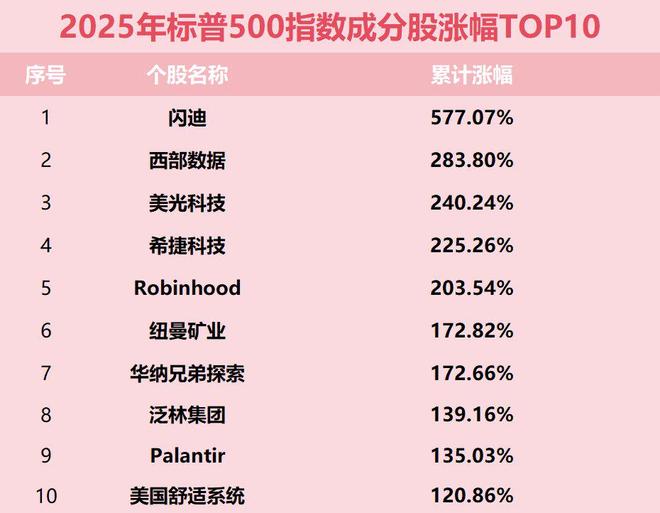
美股2025年收官:标普500指数累涨超16%,存储概念股集体爆发,闪迪暴涨577%
Ge Long Hui A P P· 2026-01-02 03:48
Core Insights - The S&P 500 index experienced a total increase of 16.39% in 2025, driven by a surge in artificial intelligence (AI) demand and supply chain adjustments [1] Group 1: Semiconductor Industry - The global storage chip industry entered a "super price increase cycle" in 2025, with significant growth attributed to AI demand and supply chain changes [1] - SanDisk led the S&P 500 constituents with a remarkable increase of 577% [2] - Other major players in the storage chip sector, including Western Digital, Micron Technology, and Seagate Technology, also showed strong performance with increases of 283.8%, 240.24%, and 225.26% respectively [1][2] Group 2: Mining and Data Analysis - Newmont Corporation, the largest gold mining company globally, saw a total increase of 172.82% due to rising precious metal prices [1] - Palantir Technologies achieved a cumulative increase of 135.03%, marking its third consecutive year of triple-digit growth [1][2]
倒计时开启 | 1月18日,“汇智 • 无界”2026第三届全球健康产业创新大会邀请您参加!
思宇MedTech· 2026-01-02 03:32
Core Viewpoint - The article emphasizes the importance of the "2026 Global Health Industry Innovation Conference" to promote high-quality development in the health sector, driven by innovative technologies like AI and big data, aligning with national strategies for health and innovation [1][3]. Group 1: Conference Overview - The conference titled "汇智·无界" will take place on January 18, 2026, at the Zhongguancun International Innovation Center in Beijing [1][13]. - It aims to gather experts from various fields, including government officials, academicians, and industry representatives, to discuss the future of the health industry and explore innovative solutions [3][13]. Group 2: Key Themes and Topics - The conference will focus on the transformative impact of digital technologies on healthcare, including precision diagnostics, intelligent treatment, and comprehensive health management [3]. - Various parallel forums will address topics such as AI-driven medical services, innovations in urology, and the integration of traditional Chinese medicine with modern technology [15][17]. Group 3: Notable Speakers - Distinguished speakers include academicians from the Chinese Academy of Engineering and the Chinese Academy of Sciences, as well as leaders from major healthcare institutions and pharmaceutical companies [6][19]. - Keynote presentations will cover topics like AI in clinical research, intelligent medical imaging, and the development of new healthcare ecosystems [17][19]. Group 4: Supporting Organizations - The conference is supported by various institutions, including the Beijing Health Commission and several prominent hospitals and universities, highlighting a collaborative approach to healthcare innovation [13][21]. - Strategic partners include major pharmaceutical companies and technology firms, indicating a strong industry backing for the event [13][21].

研之有理|双向奔赴 促进城乡融合发展
Xin Lang Cai Jing· 2026-01-01 22:54
Core Viewpoint - The integration of urban and rural development is a necessary requirement for Chinese-style modernization, with significant achievements noted in Heilongjiang Province during the 14th Five-Year Plan period, although challenges such as regional imbalances and inefficient resource allocation remain [1]. Group 1: Key Strategies for Urban-Rural Integration - Establish a dual-direction flow mechanism for population, enhancing the management of migrant populations and improving policies for urbanization of agricultural workers [2]. - Develop a multi-source funding mechanism to encourage financial institutions to innovate agricultural credit products and attract social capital for rural infrastructure [2]. - Optimize land resource allocation by matching land supply with population growth and enhancing land management practices [2]. Group 2: Public Service Equitability - Create a public resource allocation mechanism based on permanent population, ensuring that educational, medical, and cultural resources are distributed equitably across urban and rural areas [3]. - Improve rural infrastructure to enhance living conditions and establish a long-term maintenance mechanism for facilities [3]. - Promote digital transformation of public services by building a comprehensive digital service platform that bridges urban-rural information gaps [3]. Group 3: Industrial Collaboration - Break traditional barriers between urban and rural industries, promoting deep integration of agriculture with secondary and tertiary industries [4]. - Focus on developing new types of urban-rural industries such as deep processing of agricultural products and rural tourism, leveraging local resources [4]. - Establish a modern rural industrial system that utilizes technology to meet market demands and encourages urban capital and talent to flow into rural areas [4][7]. Group 4: County-Level Development Mechanism - Recognize counties as fundamental units for urban-rural integration, tailoring development strategies based on local resources and industrial foundations [5]. - Strengthen the functional roles of counties by fostering leading industries and enhancing mechanisms that connect agriculture with rural development [6]. - Create modern supply chain systems for agricultural products within counties to facilitate market access for small farmers [6].
一体化培育新型文化业态
Jing Ji Ri Bao· 2026-01-01 22:13
Group 1 - The core viewpoint emphasizes the importance of developing new cultural formats, which leverage advanced technologies like big data and artificial intelligence to reconstruct the entire chain of cultural resource creation, production, dissemination, and consumption [1] - New cultural formats are characterized by cross-industry integration, such as "culture + technology" and "culture + tourism," which open up new growth spaces [1] - The article highlights the need to eliminate barriers through improved intellectual property protection policies, promoting the flow and restructuring of cultural elements across various sectors [1] Group 2 - The digital cultural sector is a strategic competitive area globally, with the U.S. maintaining a monopoly in streaming and online gaming, while South Korea effectively operates its IP through K-POP and film [2] - China possesses the largest and most active digital cultural consumption market, providing a vast stage for industry rooting, technological iteration, and large-scale development [2] - To transition from a large to a strong cultural industry, China must address challenges such as an overemphasis on technology at the expense of content and the need for a collaborative development system that integrates content, technology, ecology, and institutional frameworks [2] Group 3 - The focus on technology-driven innovation includes core technologies like blockchain, cloud computing, and generative AI, with an emphasis on creating collaborative innovation entities [3] - There is a need to deepen demand-driven approaches and expand application scenarios by integrating technology research and scene applications, particularly in cultural tourism and exhibition venues [3] - The article advocates for building a collaborative development ecosystem among enterprises of all sizes, establishing a national cultural gene and material database, and enhancing the protection of intellectual property in the digital cultural sector [3]
华安鑫创出资46万元成立北京华保鑫城汽车技术有限公司,持股46%
Jin Rong Jie· 2026-01-01 14:10
Group 1 - The core point of the article is the establishment of Beijing Huabao Xincheng Automotive Technology Co., Ltd. by Huazhong Xinchang Holdings (Beijing) Co., Ltd. with an investment of 460,000 RMB, holding a 46% stake [1] - Beijing Huabao Xincheng Automotive Technology Co., Ltd. was founded on October 31, 2024, with a registered capital of 1 million RMB and is located in Beijing [1] - The company is involved in various technological services and development, including smart vehicle equipment manufacturing, software development, and artificial intelligence application software development [1] Group 2 - The company operates in the technology promotion and application service industry [1] - The legal representative of the company is He Pan [1] - The business activities include technology consulting, information system integration services, and IoT technology services, among others [1]
坛子售酒机
Sou Hu Cai Jing· 2026-01-01 13:45
在传统零售模式面临深刻变革的今天,一个融合了古老酒文化与前沿科技的业态正悄然兴起——坛子售酒机。这种以智能售酒机为载体 的新型无人自助售酒设备,正以其独特的模式,预示着散白酒行业一场深刻的洗牌,并可能在未来几年内催生新的市场机遇。 引言:从传统桎梏到智能破局 长久以来,散白酒的销售严重依赖层层分销的"传统生意"模式,面临着库存压力大、资金周转慢、终端管控难等诸多痛点。与此同时, 消费者对于购酒便利性、产品新鲜度及消费灵活性的需求日益增长。正是在这种矛盾中,集合了物联网、新零售、大数据与云计算技术 的智能售酒机应运而生,它不仅是设备的革新,更是商业逻辑的重构。 核心优势:为何坛子售酒机代表未来趋势? 1. 消费模式革新:从"按瓶"到"按需" 传统白酒销售以整瓶为单位,无形中设置了消费门槛。而如加乐宝等品牌推出的智能售酒机,彻底 改变了这一规则。它允许消费者通过扫码支付,按毫升购买,实现了"想喝多少就买多少"的自由。这种模式不仅降低了单次尝鲜成本, 吸引了更广泛的消费群体,也减少了因购买整瓶而产生的浪费,契合了现代理性消费的趋势。 行业观察指出,散白酒新零售模式正在洗牌,而智能售酒机正是这场变革的先锋。它通过物联 ...

“晓数点”年终盘点丨2025年美股大数据
Di Yi Cai Jing· 2026-01-01 04:55
Group 1 - The total market capitalization of the US stock market is approximately $68.21 trillion, nearing the $70 trillion mark according to the Wilshire 5000 index [7] - Nvidia has become the world's first company to reach a market capitalization of $5 trillion, marking a significant milestone in the tech industry [9] - The performance of the "Seven Giants" in the tech sector has shown divergence, with Google leading the annual growth at approximately 66%, followed by Nvidia at 38.92%, Microsoft at 15.58%, Meta at 13.09%, Tesla at 11.36%, Amazon at 9.05%, and Netflix at 5.21% [10] Group 2 - Three Chinese companies, Pony.ai, Hesai, and WeRide, are set to return to the Hong Kong market in 2025, utilizing a dual listing strategy of "US stock + Hong Kong stock" [12] - SanDisk, which spun off from Western Digital and went public in February 2025, has seen its stock price surge by 559.39% due to the increased demand for AI-driven NAND flash memory, leading to its inclusion in the S&P 500 index on November 24 of the same year [13]






贵阳高新区三项目 入选省级数字民生示范名单
Xin Lang Cai Jing· 2025-12-31 21:06
Core Viewpoint - Guizhou Province has announced the results of the 2025 provincial-level digital governance and digital livelihood demonstration project selection, with three projects from Guiyang High-tech Zone being recognized as provincial-level digital livelihood demonstration projects [1] Group 1: Selected Projects - The selected projects include: 1. "Love Data" big data intelligent marriage and dating platform by Guizhou Multicolor Treasure Internet Service Co., Ltd. 2. "Artificial Intelligence + Government Services" large model application construction project by Guizhou Big Data Industry Group Co., Ltd. 3. Medical examination and inspection result sharing and exchange information platform jointly constructed by Guizhou Big Data Industry Group Co., Ltd. and Guizhou Provincial Health Commission [1] Group 2: Focus Areas - The projects focus on key livelihood areas such as social services, government affairs, and healthcare [1] - Guiyang High-tech Zone is recognized as a core area for big data development in the province, continuously optimizing the innovation environment and supporting enterprises in applying cutting-edge technologies like big data and artificial intelligence to address real-life issues [1] Group 3: Future Plans - Guiyang High-tech Zone plans to use the selected projects as benchmarks to promote their mature models across the region, continuously improving the industrial ecosystem and implementing targeted measures to encourage enterprises to develop more application scenarios around livelihood pain points [1]