
智能家居

Search documents
装修建材板块午盘微涨 菲林格尔股价涨幅6.58%
Bei Jing Shang Bao· 2025-08-04 07:05
Core Viewpoint - The renovation and building materials sector experienced a slight increase, with the index closing at 14,075.20 points, reflecting a change of 0.31% [1] Group 1: Stock Performance - Filinger's stock closed at 18.96 CNY per share, with an increase of 6.58%, leading the renovation and building materials stocks [1] - *ST Yazhen's stock closed at 24.86 CNY per share, with an increase of 4.98%, ranking second among renovation and building materials stocks [1] - Oppein Home's stock closed at 52.97 CNY per share, with an increase of 2.68%, ranking third in the sector [1] - Huaci's stock closed at 14.44 CNY per share, with a decrease of 4.31%, leading the decline in renovation and building materials stocks [1] - Songlin Technology's stock closed at 28.41 CNY per share, with a decrease of 3.66%, ranking second in the decline [1] - *ST Songfa's stock closed at 45.90 CNY per share, with a decrease of 2.94%, ranking third in the decline [1] Group 2: Industry Trends - The furniture and home furnishing industry in China has experienced a trend of rising revenue and profits followed by a decline [1] - Exporting companies are currently in the phase of channel and brand expansion overseas, with a significant recovery in export value after a decline in 2022 [1] - Growth factors include a rebound in market demand, trends in whole-house customization and smart home technology, and the promotion of cross-border e-commerce [1] - Future growth in export value of Chinese furniture and home furnishing products will be driven by technological innovation, quality improvement, and the internationalization of brands [1]




萤石网络(688475):上半年业绩稳健增长,第二增长曲线持续升级
Ping An Securities· 2025-08-04 06:44
Investment Rating - The report maintains a "Recommended" investment rating for the company, with a current stock price of 35.29 yuan [1]. Core Insights - The company reported a steady growth in its performance for the first half of 2025, achieving an operating revenue of 2.827 billion yuan, a year-on-year increase of 9.45%. The net profit attributable to shareholders reached 302 million yuan, up 7.38% year-on-year, while the net profit excluding non-recurring items was 298 million yuan, reflecting a 7.69% increase [5][9]. - The company's second growth curve, focusing on smart home products, continues to enhance its competitive edge, particularly in AI capabilities and product innovation. The launch of the self-developed AI facial recognition video lock (Y5000FVX) exemplifies this strategy [9][10]. - The company is strengthening its domestic and international channel construction, with domestic sales through e-commerce channels exceeding 50% of total sales for key products. Internationally, revenue from overseas operations grew by 25.42% year-on-year, accounting for 38% of total revenue [10]. Financial Performance Summary - The company’s projected financial performance for 2025-2027 includes expected net profits of 622 million yuan, 748 million yuan, and 905 million yuan respectively, with corresponding EPS of 0.79 yuan, 0.95 yuan, and 1.15 yuan. The P/E ratios for these years are projected at 44.7, 37.1, and 30.7 times [9][10]. - The company is positioned as a leading player in the smart home industry, leveraging its visual technology advantages and expanding its product matrix to solidify its market position [10][12].

割草机器人赛道迎来“奇点”时刻
GUOTAI HAITONG SECURITIES· 2025-08-04 05:53
Investment Rating - The report assigns an "Accumulate" rating for the industry [2]. Core Insights - The lawn mowing robot industry is reaching a "singularity" moment, with companies possessing technological advantages and overseas experience likely to emerge as winners [4]. - The market for lawn mowing robots is vast and mature, with a potential market space of up to 3 million units, driven by the rigid demand for lawn maintenance in private gardens across Europe and the US [6][14]. - The global sales of lawn mowing robots are expected to reach 3 million units in the future, with significant growth anticipated as technology matures and prices decrease [24]. Summary by Sections 1. The Rise of Boundaryless Intelligent Lawn Mowing Robots - The transition from traditional lawn mowers to intelligent robots represents a significant technological evolution, with the average annual cost of intelligent lawn mowing robots around $183 [8][11]. - The mainstream technology route for these robots is RTK + visual fusion, which enhances operational efficiency in complex environments [11][12]. 2. Huge Market Demand and Growing Intelligence - The US and Europe account for 72% of the global private garden market, with a strong cultural emphasis on lawn maintenance [14][15]. - The penetration rate of intelligent lawn mowing robots remains low, particularly in the US, where it is less than 5% [18]. 3. Industry Competition and Key Players - The industry features three main types of players: traditional outdoor power equipment giants, technology-driven companies, and startups focusing on price advantages [27]. - Notable companies include Husqvarna and Worx, which dominate the market but face challenges from innovative tech firms like Ninebot and Ecovacs [28][30]. 4. Investment Recommendations - The report recommends investing in companies with technological leadership and international experience, specifically Ninebot (2025 PE: 22.7×), Ecovacs (23.3×), and Roborock (20.4×) [48].


辰奕智能:智能遥控器应用拓展至汽车、会议系统等领域
Jin Rong Jie· 2025-08-04 04:51
Core Viewpoint - The company addresses concerns regarding the performance of its main product, the smart remote control, and highlights the increasing value and application of smart remotes in various sectors due to technological advancements [1] Group 1: Product Lifecycle and Market Trends - The typical replacement cycle for remote controls is 3-5 years, indicating a stable market demand [1] - The penetration of smart remotes is increasing as various electronic devices become more digital, integrated, and intelligent [1] - The application range of smart remotes is expanding from traditional devices like TVs and air conditioners to automobiles and smart home systems [1] Group 2: Technological Advancements - Recent advancements in smart home technology, artificial intelligence, the Internet of Things, and wireless communication are driving the growth of the smart remote control industry [1] - The transition from infrared remotes to advanced smart remotes featuring voice, touch, and radar control is enhancing the added value of these products [1] Group 3: Company Strategy - The company is actively expanding its product offerings in the smart living ecosystem, including smart cameras, microphones, controllers, and control panels [1] - The company is focusing on broadening the application fields of its smart remote controls to include automotive and conferencing systems [1]
麦思智能引擎上涨10.16%,报4.12美元/股,总市值1.07亿美元
Jin Rong Jie· 2025-08-01 14:38
Group 1 - The core viewpoint of the article highlights the significant stock price increase of MAAS, which rose by 10.16% to $4.12 per share, with a total market capitalization of $107 million as of August 1 [1] - Financial data indicates that MAAS is projected to achieve a total revenue of 716 million RMB by December 31, 2024, representing a year-on-year growth of 1911.86% [1] - The net profit attributable to the parent company is expected to reach 232 million RMB, showing a remarkable year-on-year increase of 798.03% [1] Group 2 - MAAS was established in 2010 and aims to become a leading provider of smart home and enterprise services, focusing on enhancing the quality of life for families globally [1] - The company's mission emphasizes two main drivers: "technological intelligence" and "capital investment," with a global strategic vision to identify high-quality enterprises with global investment and operational potential [1] - Key focus areas for MAAS include asset allocation, education and study abroad, cultural tourism, healthcare and elderly care, as well as family governance [1]
萤石网络(688475.SH):上半年净利润3.02亿元,同比增长7.38%
Ge Long Hui A P P· 2025-08-01 10:10
Core Viewpoint - The company reported a steady growth in revenue and net profit for the first half of 2025, driven by a focus on core strengths and competitive product offerings [1] Financial Performance - The company achieved an operating revenue of 2.827 billion yuan, representing a year-on-year increase of 9.45% [1] - The net profit attributable to shareholders was 302 million yuan, reflecting a year-on-year growth of 7.38% [1] - The net profit attributable to shareholders after deducting non-recurring gains and losses was 298 million yuan, with a year-on-year increase of 7.69% [1] - Basic earnings per share were reported at 0.38 yuan [1] Strategic Focus - The company has been concentrating on its core advantages and strengthening technology research and development [1] - Continuous introduction of competitive products and services has been a key strategy [1] - The company is enhancing its domestic and international channel development and increasing market investments [1] - There is an ongoing optimization of the business structure to build brand influence and market competitiveness for various core product lines [1]
浙江美大涨0.87%,成交额2527.34万元,近5日主力净流入-2.05万
Xin Lang Cai Jing· 2025-08-01 08:20
Core Viewpoint - Zhejiang Meida has shown a stable performance in the market with a recent stock price increase of 0.87% and a total market capitalization of 4.497 billion yuan [1] Company Overview - Zhejiang Meida is located in Jiaxing, Zhejiang Province, and specializes in the manufacturing, processing, and sales of integrated stove products [3] - The company is a leader in the domestic integrated stove market, with a production capacity of approximately 600,000 units and a market share of 25% [3] - The main business revenue for 2017 was 926 million yuan, with the integrated stove segment accounting for 90.2% of total revenue [3] - The company focuses on the research, design, production, and sales of integrated smart kitchen appliances and home products [3] Financial Performance - The company has reported a dividend yield of 5.60%, 7.42%, and 4.09% over the past three years [2] - As of the first quarter of 2025, Zhejiang Meida achieved operating revenue of 98.36 million yuan, a year-on-year decrease of 63.97%, and a net profit attributable to shareholders of 7.79 million yuan, down 89.90% year-on-year [7] - Since its A-share listing, the company has distributed a total of 3.364 billion yuan in dividends, with 1.079 billion yuan distributed in the last three years [8] Market Position and Strategy - The company has established official flagship stores on major e-commerce platforms such as Tmall, JD.com, and Suning, and has opened its own online store and Douyin direct sales store [2] - The company’s product range has expanded to include integrated sinks, overall cabinets, and embedded kitchen appliances, providing a complete solution for healthy kitchens [3] - As of July 18, 2025, the number of shareholders was 63,900, a decrease of 0.87% from the previous period [7] Investment Insights - The average trading cost of the stock is 7.30 yuan, with recent accumulation activity noted, although the strength of this accumulation is weak [6] - The stock is currently near a resistance level of 6.99 yuan, indicating potential for a price correction if this level is not surpassed [6]

华安证券:给予宏发股份买入评级
Zheng Quan Zhi Xing· 2025-08-01 05:45
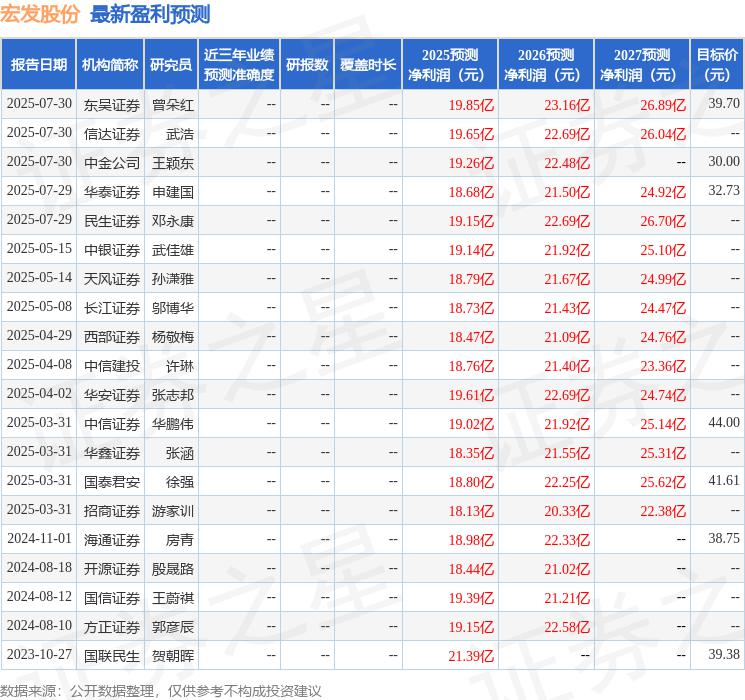
Core Viewpoint - The performance of Hongfa Technology (宏发股份) meets expectations, maintaining a leading global market share, and is rated as a buy by Huazhong Securities [1] Financial Performance - In the first half of 2025, the company achieved revenue of 8.347 billion yuan, a year-on-year increase of 15.43%, and a net profit attributable to shareholders of 964 million yuan, up 14.19% year-on-year [2] - For Q2 2025, revenue reached 4.364 billion yuan, reflecting a 15.51% year-on-year growth, with a net profit of 553 million yuan, a 13.25% increase year-on-year [2] Product Performance - The electromagnetic relay segment generated revenue of 7.614 billion yuan in H1 2025, marking a 17.26% year-on-year growth, with the company maintaining the number one global market share [3] - The high-voltage control box for electric vehicles showed significant growth, driven by the rapid development of the new energy vehicle market [3] New Product Development - The "5+" new product categories, including switches, connectors, capacitors, fuses, and current sensors, are developing steadily, with film capacitors and current sensors seeing year-on-year shipment increases of 31% and 36%, respectively [4] Investment Recommendations - Revenue projections for 2025, 2026, and 2027 are 16.371 billion yuan, 18.892 billion yuan, and 21.770 billion yuan, respectively, with net profits of 1.961 billion yuan, 2.281 billion yuan, and 2.487 billion yuan, corresponding to P/E ratios of 18.3, 15.7, and 14.4 [5]


宏发股份(600885):业绩符合预期,全球份额保持领先
Huaan Securities· 2025-08-01 05:44
Investment Rating - Investment rating is maintained as "Buy" [1] Core Views - The company reported a revenue of 8.347 billion yuan for the first half of 2025, representing a year-on-year growth of 15.43% [2] - The net profit attributable to shareholders reached 964 million yuan, up 14.19% year-on-year, with a non-recurring net profit of 927 million yuan, growing 17.85% year-on-year [2] - The gross margin stood at 34.24%, a decrease of 0.54 percentage points year-on-year [2] Performance Summary - In Q2 2025, the company achieved a revenue of 4.364 billion yuan, reflecting a year-on-year increase of 15.51% [2] - The net profit attributable to shareholders for Q2 was 553 million yuan, up 13.25% year-on-year, with a non-recurring net profit of 546 million yuan, growing 20.52% year-on-year [2] - The gross margin for Q2 was 34.67%, with a slight increase of 0.03 percentage points year-on-year and 0.90 percentage points quarter-on-quarter [2] Product Performance - The company's relay products generated a revenue of 7.614 billion yuan in H1 2025, marking a year-on-year growth of 17.26% [3] - The company maintains the largest market share globally in the relay market, driven by strong growth in smart home, industrial automation, photovoltaic sectors, and the rapid development of electric vehicles [3] - The high-voltage control box project for electric vehicles is progressing smoothly, showing significant year-on-year growth [3] New Product Development - The "5+" new product categories, including switches, connectors, capacitors, fuses, and current sensors, are developing steadily [4] - The shipment of film capacitors increased by 31% year-on-year, and current sensors saw a 36% year-on-year growth [4] - The ceramic block DC fast fuse HPE509 received UL certification, indicating potential for stable growth as new customer projects are introduced [4] Financial Projections - Revenue projections for 2025, 2026, and 2027 are 16.371 billion yuan, 18.892 billion yuan, and 21.770 billion yuan, respectively [5] - Net profit projections for the same years are 1.961 billion yuan, 2.281 billion yuan, and 2.487 billion yuan, respectively [5] - Corresponding P/E ratios are expected to be 18.3, 15.7, and 14.4 times [5]
箭牌家居股价跌近3% 完成工商变更注册资本减少至9.67亿元
Jin Rong Jie· 2025-07-31 19:40
Company Overview - Arrow Home's stock price closed at 8.50 yuan on July 31, 2025, down 2.97% from the previous trading day, with a trading volume of 0.45 billion yuan [1] - The opening price was 8.71 yuan, reaching a high of 8.73 yuan and a low of 8.48 yuan, with a fluctuation of 2.85% [1] Business Operations - Arrow Home specializes in the research, production, and sales of home products such as sanitary ceramics, faucets, and bathroom furniture, including smart home products [1] - The company operates in the renovation and building materials industry, also involving smart home and Huawei concept sectors [1] Corporate Actions - The company announced the completion of the repurchase and cancellation of part of the restricted stock incentive plan for 2023, totaling 1,434,290 shares [1] - Following this cancellation, the total share capital decreased to 967,162,960 shares, with the registered capital reduced to 967 million yuan [1] - Relevant business change registration and company charter filing procedures have been completed [1] Market Activity - On July 31, Arrow Home experienced a net outflow of main funds amounting to 2.6576 million yuan, representing 0.19% of its circulating market value [1]