
食品安全

Search documents
“胖东来超市”出品一款燕麦脆被指无生产日期 售卖超市:已下架
Xin Jing Bao· 2025-09-01 07:36
Group 1 - A consumer reported that a food product purchased at Yonghui Supermarket in Zhengzhou, Henan, lacked a production date [1] - The product in question was an oatmeal crisp with branding from "Pang Donglai Supermarket" and "Donglai Quality," indicating it was commissioned by Xuchang Pang Donglai Supermarket Co., Ltd [1] - Yonghui Supermarket has removed the product from shelves and is conducting further investigations [1] Group 2 - The incident highlights a violation of the Food Safety Law of the People's Republic of China, which mandates that pre-packaged foods must display production dates and other legal information [1]
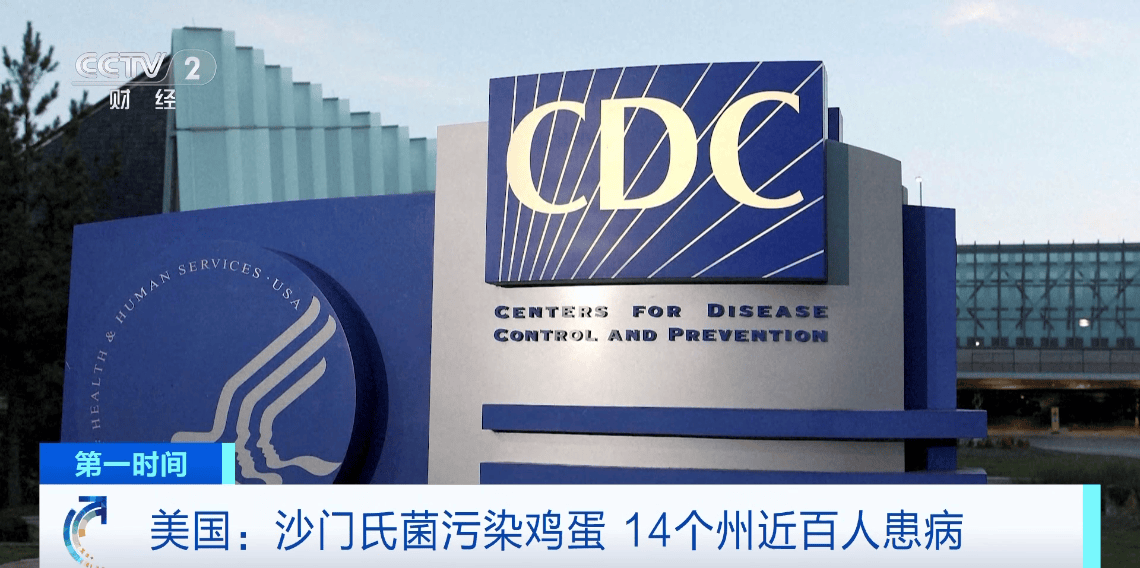
美国:沙门氏菌污染鸡蛋 14个州近百人患病
Sou Hu Cai Jing· 2025-08-30 09:56
Core Points - The recent salmonella outbreak in the U.S. has affected at least 95 individuals due to contaminated eggs, with the source traced back to an egg company in California [1][3] - The affected eggs have been distributed to at least 14 states, including California and Nevada, through supermarkets and food distributors [3] - The egg company has initiated a recall of multiple batches of its products as a precautionary measure [3] Group 1 - The outbreak has resulted in 95 reported cases, with 18 individuals hospitalized, primarily in California [3] - The investigation by health authorities is ongoing, with the potential for more cases as contaminated eggs may have been distributed to additional states [3] - Public health officials are advising consumers to check their refrigerators for recalled eggs and dispose of them or return them to the store [3] Group 2 - Salmonella is commonly found in both domestic and wild animals and can infect humans through contaminated food [5] - Symptoms of salmonella infection include fever, diarrhea, vomiting, and abdominal pain, typically lasting 2 to 7 days [5] - While most individuals recover without special treatment, vulnerable populations such as children and the elderly may experience severe cases or even fatalities [5]

新版《食品安全国家标准 保健食品良好生产规范》即将发布
Zhong Guo Xin Wen Wang· 2025-08-29 16:23
Core Viewpoint - The National Health Commission is revising the national standards for health food production to enhance management and ensure consumer safety, with the new standards expected to be released soon [1][2]. Group 1: New Standards Overview - The revised standards will expand from 10 chapters to 14 chapters, including additional informative appendices [2]. - The revisions aim to improve consumer health protection, promote industry development, and guide regulatory practices [2]. Group 2: Consumer Health Protection - New requirements for raw material management have been introduced, including the need for proof of strain identification, genetic stability, and safety for non-purified fermentation products [2]. - Companies are required to establish production management systems to ensure the safety and efficacy of raw materials [2]. Group 3: Industry Development - The new standards emphasize the responsibility of enterprises to establish comprehensive food safety management systems and improve management levels [2]. - Companies must conduct production process validation to ensure that production techniques and procedures meet expected outcomes [2]. Group 4: Regulatory Guidance - The new standards will serve as mandatory national food safety standards, providing clearer enforcement guidelines for regulatory work [2]. - The standards will closely align with the registration and filing management requirements for health foods, enhancing overall management effectiveness [2]. Group 5: Future Actions - The National Health Commission will continue to improve the standard system, including the production and operation norms, and promote effective implementation in food regulatory practices [3].
中信尼雅: 中信尼雅葡萄酒股份有限公司2025年半年度报告
Zheng Quan Zhi Xing· 2025-08-29 10:25
Core Viewpoint - CITIC Niya Wine Co., Ltd. reported a revenue increase of 4.05% in the first half of 2025 compared to the same period last year, achieving a total revenue of approximately 69.64 million yuan, while net profit turned positive at 671,510.33 yuan, recovering from a loss in the previous year [2][3]. Company Overview and Financial Indicators - The company operates in the wine manufacturing sector, focusing on grape planting, production, and sales, with a procurement model that integrates company and farmer operations [3][4]. - As of June 30, 2025, the total assets of the company were approximately 1.41 billion yuan, a decrease of 1.55% from the previous year, while net assets slightly increased by 0.03% to approximately 1.29 billion yuan [2][3]. Financial Performance - The main financial data for the first half of 2025 includes: - Revenue: 69,635,115.29 yuan, up 4.05% from 66,925,215.43 yuan in the previous year - Total profit: 2,486,049.80 yuan, a significant recovery from a loss of 5,081,380.77 yuan - Net profit attributable to shareholders: 671,510.33 yuan, compared to a loss of 4,995,360.21 yuan [2][3]. - The company reported a basic earnings per share of 0.0006 yuan, an improvement from a loss of 0.0044 yuan per share in the previous year [2][3]. Operational Analysis - The company has enhanced its marketing efforts, particularly through e-commerce, resulting in a 356.28% increase in online sales [3][4]. - The company has focused on technological innovation, obtaining several patents and establishing national-level research platforms to support its development [4][5]. - The company emphasizes food safety and product quality, having established a comprehensive food quality safety system and receiving multiple industry awards [5][6]. Competitive Advantages - CITIC Niya Wine is recognized as a leading wine producer in China, leveraging unique ecological resources from the Tianshan region to enhance its brand reputation [3][4]. - The company has developed a robust marketing network across China, with over a hundred distributors and partners, primarily focusing on the Xinjiang region and key economic circles [3][4]. Main Business Analysis - The company reported a significant increase in revenue driven by higher sales of high-margin products, while operating costs decreased by 10.78% [6][7]. - The company has optimized its product structure and reduced procurement costs, contributing to improved operational efficiency [3][4].

美国暴发新疫情
Zhong Guo Ji Jin Bao· 2025-08-29 09:04
Group 1 - The core issue is a salmonella outbreak linked to contaminated eggs, with nearly 100 reported cases across multiple states [1] - The CDC reported 95 individuals infected with the same strain of salmonella from 14 states, with 18 requiring hospitalization and no fatalities reported [1] - The affected company, "Country Eggs," has recalled potentially contaminated eggs primarily distributed in California and Nevada [1] Group 2 - The CDC advises the public against consuming the recalled eggs and emphasizes the importance of cleaning surfaces that may have come into contact with the eggs [1] - Symptoms of salmonella infection typically include diarrhea, fever, and abdominal cramps, appearing within 6 hours to 6 days after exposure [1] - Vulnerable populations, such as children, the elderly, and immunocompromised individuals, are at higher risk for severe illness [1]
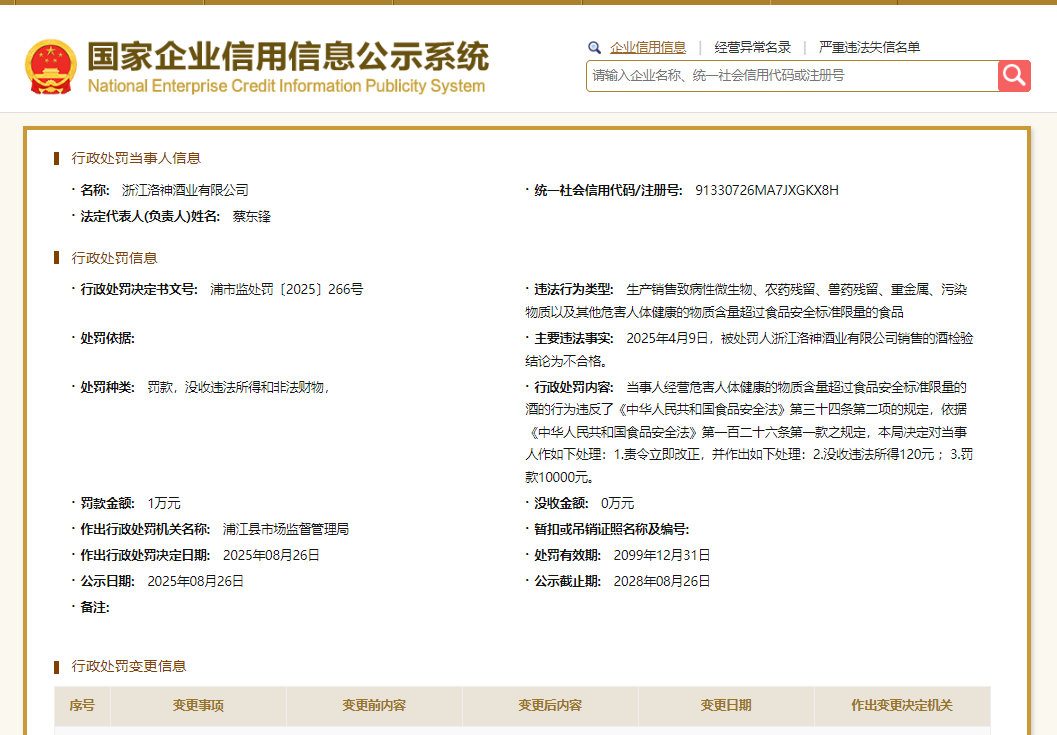
上海老城隍庙食品因生产的花生酥不合格被罚2万元
Qi Lu Wan Bao· 2025-08-28 05:23
Group 1 - Shanghai Lao Cheng Huang Miao Food (Group) Co., Ltd. was fined for producing and selling food that does not meet safety standards, with a confiscation of illegal gains amounting to 2,520 yuan and a fine of 20,000 yuan [1] - The company’s product, a batch of peanut candy, failed safety tests for peroxide value, which did not comply with the national food safety standard GB 7099-2015 [1] - The company contested the initial test results but a subsequent re-inspection confirmed the product was still non-compliant, leading to the administrative penalty [1] Group 2 - Shanghai Lao Cheng Huang Miao Food Co., Ltd. was established in 1982 and is fully owned by Shanghai Yuyuan Tourist Mart (Group) Co., Ltd. [2] - The company is headquartered in Huangpu District, Shanghai, and is known for traditional specialty foods such as "Lao Cheng Huang Miao" five-spice beans and "Yuyuan" pear syrup candy [2] - The company has a registered capital of 110 million yuan and operates two stores certified as "Chinese Time-honored Brands" [2]
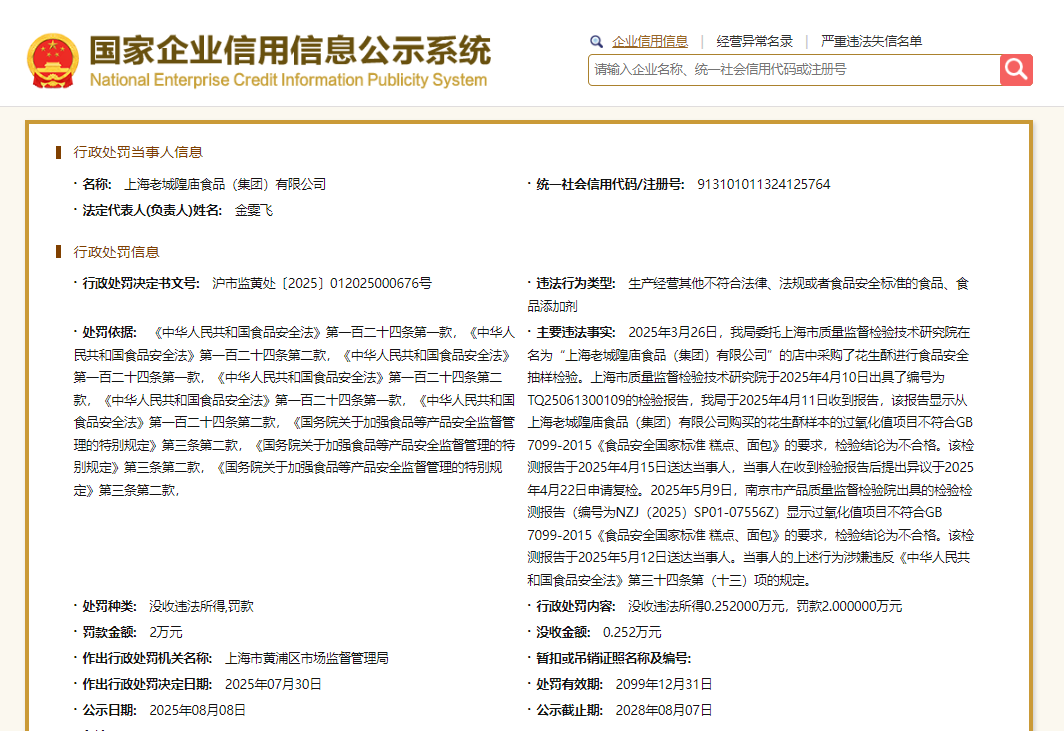
浙江洛神酒业因酒类产品不合格被处罚 罚款1万元并没收违法所得
Qi Lu Wan Bao· 2025-08-28 05:23
Core Viewpoint - Zhejiang Luoshen Wine Industry Co., Ltd. was fined for exceeding health safety standards in its alcoholic products, highlighting regulatory scrutiny in the food and beverage industry [1] Company Summary - Zhejiang Luoshen Wine Industry Co., Ltd. was found to have sold alcoholic products with harmful substances exceeding food safety limits as per the inspection conducted on April 9, 2025 [1] - The company was established on March 23, 2022, with a registered capital of 10 million RMB, and its legal representative is Cai Dongfeng [1] - The company operates in the production of alcoholic beverages and tea products, as well as food sales [1] Regulatory Action - The company was penalized under the Food Safety Law of the People's Republic of China for violating regulations concerning harmful substances in food products [1] - The penalties included an order to rectify the violations, confiscation of illegal gains amounting to 120 RMB, and a fine of 10,000 RMB, with the administrative decision made on August 26, 2025 [1] - The public notice period for the administrative penalty is set until August 26, 2028 [1]
上海市食品安全宣传周启动
Jie Fang Ri Bao· 2025-08-28 01:42
启动仪式上,63名食品安全社会监督员获市食药安办颁发的聘书,全市食品安全社会监督员增至 125名,将围绕食品领域新模式新业态等人民群众关心的热点问题,深入基层一线参与调查研究,积极 向食品安全管理部门建言献策。 2024年,上海食品安全总体有序可控、稳中向好,全市主要食品总体监测合格率为99.4%,市民食 品安全知识知晓度91.6分、总体满意度91.5分,连续3年未报告发生集体性食物中毒事故。 市委常委、副市长陈杰,市政协副主席邵志清出席启动仪式。 记者 陈玺撼 昨天,2025年上海市食品安全宣传周启动。今年宣传周活动以"尚德守法 共享食安"为主题,引 导"尚德守法"食品安全风尚,营造人人关心与维护食品安全的良好社会共治氛围。 ...
立华股份跌2.00%,成交额1.55亿元,主力资金净流出1084.78万元
Xin Lang Zheng Quan· 2025-08-27 05:54
Group 1 - The core viewpoint of the articles indicates that Lihua Co., Ltd. has experienced fluctuations in stock price and trading volume, with a recent decline of 2.00% to 20.09 CNY per share, and a total market capitalization of 16.82 billion CNY [1] - Lihua Co., Ltd. has seen a year-to-date stock price increase of 5.96%, with a 3.82% rise over the last five trading days and a 2.81% increase over the last 20 days [2] - The company primarily engages in the production and sales of yellow feather chickens, pigs, and meat geese, with chicken revenue accounting for 75.84% of total revenue, pig revenue at 23.31%, and goose revenue at 0.86% [2] Group 2 - As of June 30, 2025, Lihua Co., Ltd. reported a revenue of 8.353 billion CNY, reflecting a year-on-year growth of 7.02%, while the net profit attributable to shareholders decreased by 74.10% to 149 million CNY [2] - The company has distributed a total of 1.979 billion CNY in dividends since its A-share listing, with 1.030 billion CNY distributed over the past three years [3] - Institutional holdings show that as of June 30, 2025, the top ten circulating shareholders include E Fund's ChiNext ETF, which increased its holdings by 627,700 shares to 7.6594 million shares [3]

山姆超市被曝!监管部门:已立案调查!
Zhong Guo Ji Jin Bao· 2025-08-27 03:38
Core Viewpoint - A media report highlighted inconsistencies in the packaging and labeling of a product named "Crab Four Treasures Crab Yellow Noodles" sold at a Sam's Club in Jiaxing, Zhejiang, leading to public concern and regulatory investigation [1]. Group 1: Product Details - The product "Crab Four Treasures Crab Yellow Noodles" is priced at 118.9 yuan per item on the Sam's Club app, with over 7000 reviews and a 94.1% positive rating, with many customers claiming it is more delicious and cost-effective than restaurant offerings [2]. - The outer packaging and inner packaging of the product label it as "Handmade Dry Alkali Noodles," while the small inner packaging states "Intangible Cultural Heritage Handmade Sun-Dried Noodles (Raw Dry Noodles)," and the ingredient list does not mention edible alkali [2]. Group 2: Regulatory Response - The Jiaxing Sam's Club's parent company, Walmart, is taking the issue seriously and has contacted the supplier, Jiangsu Huaxiu Food Co., Ltd., for verification. The product's packaging content was reportedly compliant with local regulatory reviews before market release [3]. - The Jiaxing Market Supervision Bureau has opened a case following the consumer complaint and will investigate based on the findings from the supplier's local regulatory authority [3]. Group 3: Legal Standards - According to the Food Safety Law and the National Standard for Prepackaged Food Labeling, food labels must be truthful and accurate, without misleading content [4]. - Specific regulations require that edible alkali components must be clearly listed in the ingredient list, and any alterations to production dates or shelf life must not be added or modified [4].
