
乡村振兴战略

Search documents
小病不出乡:太平人寿打造医联体帮扶新路径
Jing Ji Ri Bao· 2025-09-19 05:14
Core Viewpoint - The collaboration between Taiping Life Insurance and its shareholder, Fuge Insurance, aims to enhance grassroots medical services through innovative medical assistance mechanisms, improving access to quality healthcare for local communities [1][2]. Group 1: Medical Assistance Mechanism - Taiping Life Insurance and Fuge Insurance have developed a medical assistance mechanism that integrates quality medical resources into grassroots healthcare, utilizing various methods such as free clinics, training, and lectures [1]. - The initiative has led to significant improvements in local healthcare facilities, including the donation of essential dental equipment to the Chengguan Health Center in Gansu, allowing residents to receive dental care locally [1]. Group 2: Impact on Healthcare Services - In 2024, the Chengguan Health Center reported over 7,000 outpatient visits and more than 300 inpatient admissions, marking a 45% increase year-on-year [2]. - The dental department of the health center has seen over 700 outpatient visits and 15 inpatient admissions from September 2024 to August 2025, reflecting the growing demand for local healthcare services [2]. Group 3: Future Development and Support - The Chengguan Health Center has been officially recognized as a "first-class" township health center and plans to continue utilizing donated equipment to enhance specialized departments and improve service capabilities [2]. - Taiping Life Insurance is also conducting a series of public medical service activities in Anhui Province, integrating expert resources from various medical institutions to provide diverse medical support to local health centers [2].

第三届全国技能大赛今日在郑开幕 技能英才 中原竞技
He Nan Ri Bao· 2025-09-18 23:37
Core Points - The third National Skills Competition is being held in Zhengzhou, featuring 3,420 participants from 35 delegations across the country, marking it as the largest and most comprehensive national vocational skills event in China [2][3] Group 1: Event Overview - The competition is organized by the Ministry of Human Resources and Social Security and hosted by the Henan Provincial Government, with support from various local and industry bodies [2] - The event includes 106 competition projects, with over 50% focusing on intelligent manufacturing, high-end equipment, digital technology, and new energy, aligning with national innovation strategies [3] Group 2: Participation and Demographics - A total of 3,420 competitors and 3,275 judges are participating, showcasing a diverse range of skills from both young talents and experienced professionals [5] - The average age of participants is 24, with 77% under 30 years old, indicating a strong presence of younger competitors [5] - High-education participants include 13 PhDs, 286 Master's, and 843 Bachelor's degree holders, making up 33% of all competitors, particularly in advanced technology fields [5] Group 3: Competition Structure and Activities - The competition adopts a "competition-exhibition-performance" model over five days, featuring 106 projects across 28 exhibition halls [6] - Special activities include a national achievements exhibition, skills training experiences, and a forum aimed at enhancing skill awareness among the public, especially youth [6]

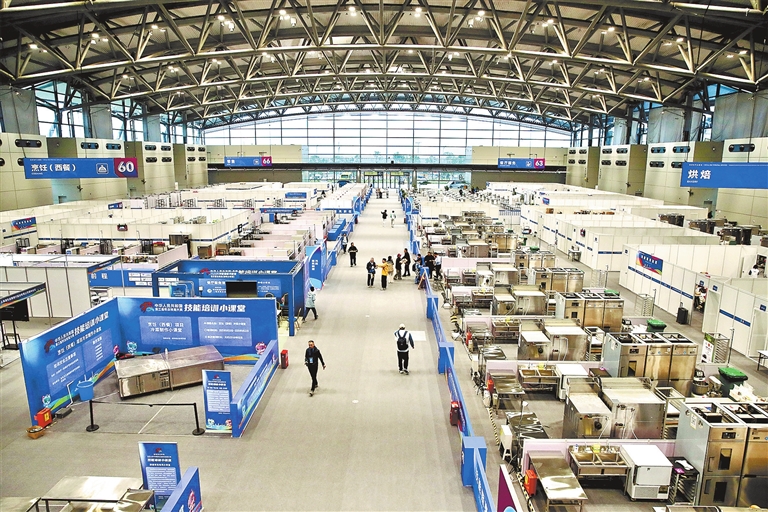
第三届全国职业技能大赛明日开幕
Zheng Quan Ri Bao Wang· 2025-09-18 13:14
Core Points - The third National Vocational Skills Competition will open on September 19 in Zhengzhou, Henan Province, China [1] - The theme of this year's competition is "Skills Illuminate the Future," featuring 106 competition projects with 3,420 participants from 35 delegations nationwide [1] - This event is recognized as the highest specification, largest scale, and most influential national vocational skills competition in China [1] Competition Structure - The competition includes 66 selection projects for the World Skills Competition and 40 selected national competition projects [1] - Over 50% of the competition projects focus on intelligent manufacturing, high-end equipment, digital technology, and new energy, aligning with the national innovation-driven development strategy [1] Special Features - For the first time, a special competition for rural revitalization has been established, directly supporting the national rural revitalization strategy [1] - Four professional technical competition projects are included, showcasing the latest trends in technology and skill integration: artificial intelligence engineering technology, intelligent manufacturing engineering technology, industrial internet engineering technology, and integrated circuit engineering technology [1]
金融教育宣传周系列之“保险为民办实事”: 小病不出乡,家门口就能看! 太平人寿医联体帮扶打造健康帮扶新路径
Zhong Jin Zai Xian· 2025-09-17 01:04
Core Insights - The company is actively integrating health initiatives with rural revitalization strategies, focusing on enhancing grassroots medical services through innovative support mechanisms [1] - The company has successfully implemented a series of public health service activities in Anhui, providing diverse medical support to local health institutions [2] - The donation of dental equipment in Gansu has significantly improved local healthcare access, allowing residents to receive necessary dental treatments without traveling long distances [3][4] Group 1 - The company, in collaboration with its shareholder, is creating a medical alliance support mechanism to enhance the capacity of grassroots healthcare services [1] - The initiative includes various forms of support such as free clinics, training, and lectures to improve local healthcare conditions [1] - The company aims to ensure that more residents can access quality medical resources close to home, thereby increasing health satisfaction [1] Group 2 - The "Duanwu Ankang, Medical Journey Together" series of public health service activities has been successfully conducted in Anhui, marking its fourth phase [2] - Experts from various medical institutions provided on-site consultations, lectures, and training to local healthcare providers, enhancing their diagnostic and treatment capabilities [2] - The company is focusing on multidisciplinary collaboration in treatment and improving early recognition and management of critical conditions among local medical staff [2] Group 3 - The donation of dental equipment to the Chengguan Health Center in Gansu has addressed the issue of accessibility to dental care for local residents [3] - The health center is now equipped with advanced dental facilities, allowing for a range of services that were previously unavailable locally [3] - The increase in patient visits and the health center's recognition as a "first-class township health center" reflect the positive impact of the company's initiatives [4] Group 4 - The company’s support has transitioned from merely providing resources to fostering self-sustaining healthcare capabilities in rural areas [4] - Systematic training, remote consultations, and standardized management have been implemented to enhance the operational efficiency of grassroots medical institutions [4] - This model serves as a replicable and sustainable health support pathway, contributing to health security within the rural revitalization strategy [4]
韶关原创音乐剧《春暖花开》惊艳羊城:一出好戏唱响驻村干部情深
Nan Fang Nong Cun Bao· 2025-09-14 09:36
Core Viewpoint - The original musical "Spring Blossoms" showcases the dedication of village officials in promoting rural revitalization, blending traditional art forms with modern storytelling to resonate with contemporary audiences [4][8][34]. Group 1: Event Overview - "Spring Blossoms" premiered from September 9 to 13 at the Guangdong Cantonese Opera Art Center, marking the first performance of the 2025 provincial stage art boutique tour [5][6]. - The musical received enthusiastic applause from the audience, highlighting both the performers' artistry and the tribute to those working in rural revitalization [3][4]. Group 2: Thematic Elements - The production reflects the "Hundred Counties, Thousand Towns, and Ten Thousand Villages" high-quality development project, focusing on the protagonist Ouyang Song, a village official dedicated to the revitalization of Nanping Village [15][16]. - The narrative intertwines personal stories with broader themes of rural development, showcasing the efforts of local officials and the community's response to these initiatives [22][34]. Group 3: Artistic Innovation - The musical integrates elements of the national intangible cultural heritage of northern Guangdong tea-picking opera with modern musical styles, creating a unique artistic expression [7][56]. - The production features over 20 original compositions that blend traditional tea-picking opera melodies with contemporary harmonies and rhythms, appealing to both older and younger audiences [59][60]. Group 4: Audience Reception - The audience's response was overwhelmingly positive, with many expressing a deep emotional connection to the story, particularly those with experience in grassroots work [12][14]. - The production has successfully toured over 20 performances since its debut, attracting more than 10,000 viewers and receiving acclaim for its authentic portrayal of rural life [99][100].

经济地理丨国家城市群空间战略迎来大变局
Sou Hu Cai Jing· 2025-09-12 06:06
Core Viewpoint - The recent policy document from the Central Committee of the Communist Party of China and the State Council emphasizes the need for orderly integration of urban agglomerations and metropolitan areas, aiming to develop a modern urban system that is well-structured and networked [2][3]. Group 1: Urban Agglomeration Development - Urban agglomerations play a crucial role in guiding population and resource distribution, enhancing industrial division of labor, and promoting coordinated development among cities of different sizes [2]. - The development strategy focuses on creating a modern urban system that is group-style and networked, responding to the challenges posed by technological revolutions and industrial transformations [2][3]. Group 2: Economic Spatial Structure - The differentiation or reconstruction of urban agglomerations is identified as a new trend in China's regional economic development, with a shift from traditional resource allocation to a global resource configuration [3][4]. - The transition from coastal-dominated urban agglomeration directions to a more balanced approach involving inland development and east-west interaction is highlighted [3][4]. Group 3: Governance and Challenges - The governance system of urban agglomerations faces significant challenges but also unprecedented opportunities, particularly in the context of high-quality development and improved business environments [5][6]. - The need for a scientific and forward-looking spatial strategy is emphasized to guide economic and social development effectively [6][7]. Group 4: Digital Economy and Resource Allocation - The digital economy is transforming the flow of resources and factors, enhancing the speed and quality of economic growth, and reshaping urban agglomeration applications [7][8]. - The traditional spatial organization of urban agglomerations is undergoing differentiation and reconstruction due to the influence of digital civilization [7][8]. Group 5: Future Urban Layout - The future urban layout is expected to transition from a regional focus to a global perspective, with a new "T" shaped spatial strategy for urban agglomerations [9][10]. - The new spatial framework includes major corridors and hubs that facilitate connectivity and resource allocation across urban agglomerations [9][10].

海南近400名“三支一扶”人员集中“充电”
Hai Nan Ri Bao· 2025-09-12 01:49
Core Points - The training program for the new recruits of the "Three Supports and One Assistance" initiative took place from September 6 to 10 in Haikou, involving nearly 400 participants from 18 cities and counties in Hainan Province [1] - The training combined specialized lectures and on-site teaching, focusing on topics such as the construction of Hainan Free Trade Port, rural revitalization strategy, grassroots governance practices, and public document writing and media promotion [1] - Participants engaged in practical experiences through visits to various villages, allowing them to directly observe and interact with the initiatives related to Hainan Free Trade Port and grassroots work [1] Summary of Related Aspects - The "Three Supports and One Assistance" program aims to deploy college graduates to rural areas for educational, agricultural, medical, and rural revitalization support, with a service period of two years [2] - The training is designed to equip recruits with the necessary skills and knowledge to effectively contribute to local communities and support the broader goals of Hainan's development initiatives [1][2]
青岛市农房节能改造示范片区建设现场观摩会在莱西召开
Qi Lu Wan Bao Wang· 2025-09-10 11:39
Core Viewpoint - The Qingdao Municipal Housing and Urban-Rural Development Bureau is actively promoting energy-saving renovations for rural housing, aiming to improve living conditions and reduce energy consumption in rural areas [1][5]. Group 1: Meeting and Participation - A work promotion meeting for rural housing energy-saving renovation was held in Laixi City, attended by over 50 leaders and officials from various districts [1]. - The meeting included a site visit to the energy-saving renovation achievements in Qianzhuangfu Village, which has 380 households [3]. Group 2: Renovation Achievements - The energy-saving renovations have improved energy efficiency by over 30% through comprehensive insulation and window upgrades [3]. - The combination of "clean heating + energy-saving renovation" has significantly reduced energy consumption and heating costs, enhancing the livability of rural homes [3]. Group 3: Future Plans and Goals - The meeting outlined the completion of the 2025 rural housing energy-saving renovation demonstration area, emphasizing the importance of improving rural living environments and quality of life [5]. - Key focus areas include creating high-quality projects, completing acceptance inspections on schedule, and planning for the "14th Five-Year Plan" to promote modern, livable green rural housing [5]. - As of now, the Qingdao Municipal Housing and Urban-Rural Development Bureau has exceeded its target by completing energy-saving renovations for 51,000 households [6].

农村中小银行应主动作为 让“绿色红利”惠及更多经营主体
Zheng Quan Ri Bao· 2025-08-30 13:53
Core Viewpoint - The development of green finance in rural small and medium-sized banks is crucial for transforming ecological advantages into economic benefits, aligning with the "Two Mountains" theory [1][2]. Group 1: Advantages of Rural Small and Medium-sized Banks - Rural small and medium-sized banks are well-positioned to connect ecological resources with economic value due to their local presence and understanding of regional ecological resources [1]. - These banks can quickly design personalized financial products and services, facilitating a positive cycle of "ecological protection - industrial development - financial profitability" [1][2]. - The proximity to local governments enhances the efficiency of financial resources and policy resource integration [1]. Group 2: Challenges in Green Finance Development - Current challenges include difficulties in identifying green projects, inadequate risk-sharing mechanisms, and a lack of specialized green finance talent [2]. - There is a need for collaboration with local government and third-party institutions to improve risk-sharing mechanisms and enhance employee training [2]. Group 3: Opportunities for Rural Small and Medium-sized Banks - The national "dual carbon" goals and rural revitalization strategy present significant opportunities for these banks [2]. - Policy incentives, such as the central bank's carbon reduction support tools and local government risk compensation, lower the operational costs of green finance [2]. - The growing market demand for green financing, driven by the "dual carbon" goals and new business models in ecological agriculture and rural tourism, opens up new avenues for green loans and bonds [2]. Group 4: Strategic Recommendations - Rural small and medium-sized banks should accelerate product innovation to create flexible green credit products tailored to local economic characteristics [3]. - Exploring a combination of "green credit + green insurance" can provide additional security for green projects and enhance collaboration with policy banks to improve loan accessibility [3].
规模效益双优 天津滨海农商银行稳健经营护航区域经济
2 1 Shi Ji Jing Ji Bao Dao· 2025-08-29 09:32
Core Viewpoint - Tianjin Binhai Rural Commercial Bank demonstrated robust growth in the first half of 2025, with significant increases in assets, deposits, and profits, reflecting its resilience and strategic focus in a complex economic environment [1][2]. Group 1: Financial Performance - As of June 30, 2025, the bank's total assets reached 305.736 billion, an increase of 18.190 billion or 6.33% from the end of the previous year [2]. - Total deposits amounted to 240.6 billion, up by 11.960 billion or 5.23% year-on-year [2]. - Total loans stood at 176.538 billion, increasing by 5.931 billion or 3.48% compared to the previous year [2]. - The bank achieved a revenue of 2.730 billion, with a pre-provision profit of 2.073 billion and a net profit of 541 million, marking a year-on-year growth of 18.43% [2]. Group 2: Strategic Focus and Initiatives - The bank is actively optimizing its liability structure and enhancing loan precision to meet capital management requirements, achieving synchronized growth in scale and efficiency [2]. - It has established strategic partnerships with local governments and organizations to support high-quality development initiatives in Tianjin [3]. - The bank is focusing on supporting strategic emerging industries, particularly in the technology sector, and has received recognition for its efforts in financing innovative enterprises [3]. Group 3: Support for Agriculture and Small Enterprises - The bank has successfully implemented innovative business models to support agriculture and small enterprises, including the first local interbank certificate of deposit pledge refinancing business [4]. - As of June 30, 2025, the bank's agricultural loan balance reached 12.210 billion, with a year-on-year increase of 5.65% [6]. - The average interest rate for newly issued inclusive small micro loans decreased by 33 basis points, effectively reducing the financial burden on small enterprises [4]. Group 4: Regional Development and Collaboration - The bank is committed to serving the Binhai New Area as a core area for high-quality development, having signed a strategic cooperation agreement with the local government [8]. - It is actively involved in supporting the integration of port, industry, and city development, providing comprehensive financial services to the shipping industry [9]. - The bank plans to continue enhancing its financial services quality while focusing on rural revitalization and regional economic development in the second half of 2025 [9].