数据中心建设

Search documents
XLI: High Quality Growth At A Reasonable Price
Seeking Alpha· 2025-11-29 14:14
What sector combines defense, aerospace, electricity grids, transportation, and heavy machinery, all with clear growth drivers and not dominated by AI or data center build-out? The broader industrial sector, as part of the S&P 500 index (Experience is difficult to learn. After 30 plus years of critically analyzing the nuts and bolts of businesses as diverse as airlines, oil, retail, mining to fintech and ecommerce plus the macro, monetary and political drivers. I continue to immensely enjoy learning and app ...


配网变压器出海专家交流
2025-11-26 14:15
Summary of Conference Call on Power Distribution Transformers Industry Overview - The power distribution transformer market is experiencing rapid growth, primarily driven by the construction of data centers. However, the low technical barriers have led to increased competition as many manufacturers enter the market. Major companies like Siemens are significantly expanding production capacity to alleviate supply pressure, indicating that future market competition will intensify [1][4]. Key Insights and Arguments - **Data Center Demand**: Data centers have specific requirements for power distribution transformers, including high reliability, quick delivery, and customized configurations. For instance, a 1 GW data center can have a total value of $33 million for its power distribution equipment, with box transformers accounting for over half of this value [1]. - **Competitive Landscape**: Chinese companies face competition from Mexico, which has advantages in labor costs, delivery times, and tariffs. Establishing production capacity in Mexico is suggested as a strategy for Chinese firms to meet North American market demands while avoiding high tariffs and transportation costs [1][8][9]. - **Customer Base**: The main customers for power distribution and box transformers are EPC (Engineering, Procurement, and Construction) companies, which have strict requirements for delivery timelines and product quality [1][10]. - **Production Automation**: The primary bottleneck in expanding power distribution transformer production in North America is not technology but labor constraints. The production process is highly automated, allowing for large-scale production with minimal labor oversight [2]. - **Pricing and Profit Margins**: Chinese exports of power distribution equipment are typically 15%-20% lower than overseas market prices. The gross margin for OEM (Original Equipment Manufacturer) work is around 30%-40%, while direct exports can reach 50%-60% [3][21][20]. Additional Important Points - **Delivery Challenges**: Chinese companies can generally control delivery cycles within one year if they produce domestically. In contrast, international giants like Siemens may take two to three years from order to delivery [13]. - **Insurance Issues**: Chinese companies face challenges in the U.S. market due to insurance requirements. U.S. clients often require bonds from recognized American insurance companies, which can be a barrier for new entrants [27]. - **Future Revenue Projections**: The expected overseas sales revenue for 2025 is projected to be between 5 billion to 5.5 billion yuan, with the U.S. market accounting for 40% of this revenue [29]. For 2026, the expected revenue is projected to be between 6 billion to 6.5 billion yuan [31]. - **Long-term Focus**: The company aims to focus on long-cycle, sustainable projects such as the renovation of aging transformers in the U.S. and Europe, rather than solely relying on data center orders [34]. This summary encapsulates the key points discussed in the conference call regarding the power distribution transformer industry, highlighting market dynamics, competitive challenges, and future strategies for growth.
国泰海通|电新:电力设备出海专题——数据中心等带动变压器,开关需求,供给缺口明显
国泰海通证券研究· 2025-11-26 13:12
Group 1 - The global data center market is projected to grow from $242.72 billion in 2024 to $584.86 billion by 2032, with a compound annual growth rate (CAGR) of 11.62% [1] - Approximately half of the power demand for data centers will be met by renewable energy sources, driving the demand for transformers and switches [1] - The current backlog of transformer orders is significant, with delivery cycles expected to remain high until 2025, indicating a supply chain bottleneck [2] Group 2 - The global trade of power transformers has increased by 80% from 2018 to 2023, with China accounting for 25% of the total trade, highlighting its dominance in the market [3] - The U.S. and European markets have seen their transformer trade volumes double since 2018, indicating a reliance on imports from countries like Mexico, Europe, and South Korea [3] - In the context of a global transformer shortage, Chinese transformer manufacturers are positioned to benefit significantly [3]

雄韬股份:目前公司的生产经营正常进行
Zheng Quan Ri Bao Wang· 2025-11-25 11:22
证券日报网讯 雄韬股份(002733)11月25日在互动平台回答投资者提问时表示,目前公司的生产经营 正常进行。一方面,公司全力开拓市场,紧紧抓住数据中心建设的大风口;另一方面,公司抓紧统筹研 发、生产、解决方案、智慧化服务,保质保量如期完成订单交付和运营。 ...

UL Solutions (NYSE:ULS) 2025 Conference Transcript
2025-11-18 20:42
Summary of UL Solutions Conference Call Company Overview - **Company**: UL Solutions (NYSE: ULS) - **Industry**: Testing, Inspection, and Certification (TIC) Key Points Business Segments and Revenue - UL Solutions operates in two main segments: industrial tech and consumer tech, with 33% of revenue being recurring from inspection and certification services [4][8][11] - Industrial tech is identified as the core focus, with historical roots in electrical safety [11][12] - Industrial segment has experienced high single-digit revenue growth, driven by mega trends such as energy transition and the proliferation of devices connected to the electrical grid [14][15] Growth Drivers - The industrial segment has seen double-digit revenue growth in 2023 and 2024, attributed to trends in energy generation and innovative uses of electrical energy [14] - Data centers and renewable energy are significant growth drivers, although specific revenue percentages tied to these sectors have not been disclosed [16][17][38] Margin Expansion - EBITDA margin expansion in the industrial segment is attributed to operational efficiencies and pricing initiatives [23][28] - Consumer segment margins have improved but are inherently lower due to higher labor intensity in testing processes [36][37] Market Position and Competitive Advantage - UL Solutions has a strong reputation in the U.S. market, benefiting from its involvement in crafting safety standards and regulations [38][39] - The company has historically outperformed industry growth rates and expects to continue this trend [39][41] Future Investments and Innovations - Plans for new laboratory facilities, including a Fire Research Center of Excellence, are set to enhance UL's capabilities in fire safety [50][72] - The company is focusing on expanding its software and advisory services, particularly in supply chain traceability and ESG reporting [51][75] Challenges and Adaptations - The consumer product division faced challenges due to tariff uncertainties, but clients have adapted to the new normal [33][34] - The company is continuously looking for ways to optimize its lab utilization and operational efficiency [31][32] Conclusion - UL Solutions is positioned for continued growth in the TIC industry, with a strong focus on industrial tech and a commitment to innovation and operational efficiency. The company is adapting to market changes and investing in future capabilities to maintain its competitive edge.

*ST宇顺(002289.SZ)拟取得爱怀数据6%股权
智通财经网· 2025-11-17 14:39
Group 1 - The company *ST Yushun (002289.SZ) has signed a conditional equity transfer agreement with its controlling shareholder Shanghai Fengwang Industrial Co., Ltd. to purchase 6% equity of Hebei Aihua Data Technology Co., Ltd. for 3 million yuan [1] - The equity corresponds to a capital contribution of 3 million yuan, which has already been fully paid by Shanghai Fengwang [1] - Hebei Aihua Data has not yet commenced operations and plans to build a smart computing center project in Huailai County, Zhangjiakou City, Hebei Province [1] Group 2 - The project has completed the enterprise investment project filing and has obtained the energy-saving review opinion from the Hebei Provincial Development and Reform Commission [1] - According to the filing documents, the total investment for the project is 3 billion yuan, with a total construction area of approximately 122,000 square meters [1] - The project includes six 4-story digital center buildings totaling 100,000 square meters, one 5-story research office building of 12,000 square meters, and two 3-story auxiliary facility buildings of 10,000 square meters, with a production scale of approximately 12,000 cabinets and 180,000 servers [1]

*ST宇顺拟取得爱怀数据6%股权
Zhi Tong Cai Jing· 2025-11-17 14:38
Core Viewpoint - Company *ST Yushun (002289.SZ) has signed a conditional equity transfer agreement with its controlling shareholder Shanghai Fengwang Industrial Co., Ltd. to acquire a 6% stake in Hebei Aihua Data Technology Co., Ltd. for 3 million yuan [1] Group 1: Equity Acquisition - The company plans to use its own or raised funds of 3 million yuan to purchase the 6% equity stake from Shanghai Fengwang, which has already completed the capital contribution [1] - The corresponding capital contribution for the acquired stake is 3 million yuan [1] Group 2: Business Operations - Hebei Aihua Data has not yet commenced actual operations [1] - The company intends to construct an intelligent computing center project in Huailai County, Zhangjiakou City, Hebei Province [1] Group 3: Project Details - The project has completed the enterprise investment project filing and has received energy-saving review opinions from the Hebei Provincial Development and Reform Commission [1] - The total investment for the project is 3 billion yuan, with a total construction area of approximately 122,000 square meters, including six 4-story digital center buildings of 100,000 square meters, one 5-story research office building of 12,000 square meters, and two 3-story auxiliary facility buildings of 10,000 square meters [1] - The production scale is expected to include 12,000 cabinets with a capacity of approximately 8KW each, 180,000 servers, and related auxiliary IT and electromechanical equipment [1]
*ST宇顺:拟购买爱怀数据6%股权参与爱怀数据项目
Ge Long Hui· 2025-11-17 13:19
Core Viewpoint - Company plans to acquire 6% equity in Hebei Aihua Data Technology Co., Ltd. for 3 million yuan to enhance its strategic development goals and strengthen its position in the IDC industry [1][2] Group 1: Investment Details - The acquisition involves purchasing 6% equity from the controlling shareholder Shanghai Fengwang Industrial Co., Ltd. for a total investment of 3 million yuan [1] - Hebei Aihua Data has not yet commenced operations and is in the process of establishing a smart computing center project in Zhangjiakou, Hebei Province [1] - The total investment for the smart computing center project is 3 billion yuan, with a total construction area of approximately 122,000 square meters [1] Group 2: Strategic Implications - This investment will enhance the company's influence and competitiveness in the IDC industry, while also improving its sustainable development capabilities [2] - The investment is strategically driven and aligns with the company's actual business development needs, allowing for a lower-cost entry into a quality project [2] - The project is currently in the planning stage and is progressing as scheduled, which provides the company with an opportunity to secure a proactive position [2]
摩根大通给AI投资算了笔账:每位iPhone用户月均多花250元,才能回本
3 6 Ke· 2025-11-16 23:37
Core Insights - Morgan Stanley's report highlights the significant role of AI infrastructure in the U.S. economy, indicating that data center construction is a key driver of non-residential building investment in 2023 [1][2] - The report emphasizes the challenges in scaling up electricity supply to meet the growing demand from AI data centers, with a projected need for substantial new power generation capacity [3][11] - The financial landscape for tech giants is shifting towards debt financing to support their capital expenditures in AI, with notable increases in bond issuance among major companies [22][25] Group 1: AI Infrastructure and Economic Impact - The construction of data centers is expanding from tech giants to a broader range of companies, significantly contributing to non-residential building investment in the U.S. [2][10] - Although over 300 GW of data center capacity is planned, only 175-200 GW is realistically expected to materialize, with annual additions projected to be five times higher than previous years [2][10] - Data centers are becoming a critical component of the U.S. economy, with their spending accounting for 6% of non-residential construction, despite overall declines in other sectors [7][10] Group 2: Electricity Supply Challenges - The U.S. electricity grid is currently unable to support the simultaneous operation of 300 GW of data centers, making power supply the primary constraint on AI expansion [11][20] - New power generation projects, particularly natural gas, are being prioritized, with a 158% increase in planned capacity to 147 GW [16][20] - The annual electricity consumption of data centers is expected to rise significantly, necessitating the addition of at least 100 GW of new generation capacity [13][14] Group 3: Financial Strategies of Tech Giants - Major tech companies are increasingly turning to debt financing to support their capital expenditures, with Oracle, Meta, and Alphabet leading in bond issuance [22][25] - The total capital expenditure for global data centers has reached $450 billion annually, prompting companies to seek external financing options [22][23] - Oracle faces significant debt pressures, with total debt exceeding $100 billion, while other companies like Microsoft maintain a more stable financial position [25][26] Group 4: Revenue Generation and Investment Returns - To achieve a reasonable investment return of 10%, the AI industry must generate approximately $650 billion in annual revenue, equating to 0.6% of global GDP [3][34] - The potential increase in costs for consumers, such as an additional $35 per month for iPhone users, highlights the need for effective monetization strategies in the AI sector [3][35] - Historical parallels with the telecom industry suggest that the success of AI investments will depend on viable business models rather than just technological advancements [31][32]





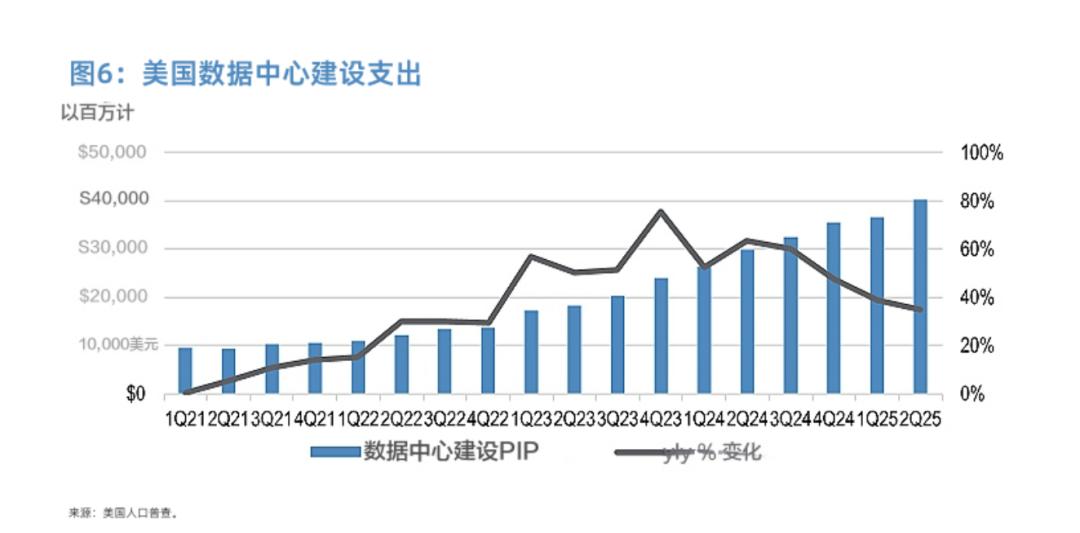
【有色】美国数据中心高速发展,电力供应紧张带来电解铝投资机会——有色金属行业动态点评报告(王招华/方驭涛/马俊)
光大证券研究· 2025-11-16 23:03
Core Viewpoint - The rapid construction of data centers in the United States is raising concerns about electricity supply shortages, which may impact various industries, particularly aluminum production [4]. Group 1: Electricity Supply and Demand - In 2024, the United States is projected to generate approximately 4.3 trillion kWh of electricity, which is about 42.5% of China's expected generation of 10.1 trillion kWh [5]. - The industrial sector accounts for 26% of the total electricity consumption in the U.S., with total electricity consumption expected to reach 4.1 trillion kWh in 2024 [5]. Group 2: Data Center Electricity Consumption - Data centers in the U.S. are expected to consume around 178 TWh of electricity in 2024, representing about 4% of the total electricity consumption, and this is projected to increase to 606 TWh by 2030, accounting for 12% of total consumption [6]. - The increase in electricity consumption by data centers is expected to account for approximately 41% of the total increase in electricity demand in the U.S. from 2024 to 2030 [10]. Group 3: Aluminum Production and Costs - The U.S. is projected to produce 670,000 tons of electrolytic aluminum in 2024, which is about 0.9% of global production and 1.6% of China's production [7]. - The electricity cost for producing electrolytic aluminum in the U.S. is approximately 1.9 times higher than in China, with U.S. industrial electricity prices averaging 9.06 cents/kWh compared to China's average of 0.386 yuan/kWh [8][9]. - The high electricity costs and supply constraints are likely to accelerate the exit of high-cost aluminum production capacity in the U.S. and delay the construction of new capacity [10].