
科技保险

Search documents
北京商业航天保险共保体首个服务项目成功发射 提供近亿元风险保障
Zheng Quan Ri Bao Wang· 2025-05-26 10:53
Core Viewpoint - The establishment of the Beijing Commercial Aerospace Insurance Consortium marks a significant step in providing tailored insurance solutions for the commercial aerospace sector, demonstrating the ability to quickly respond to the insurance needs of technology-driven enterprises [1][3]. Group 1: Consortium Formation and Initial Project - The Beijing Commercial Aerospace Insurance Consortium is the first of its kind in China, formed by 20 insurance institutions in Beijing, including 17 property insurance companies, 2 reinsurance companies, and 1 insurance intermediary [2]. - The consortium's first project involved the successful launch of the Kuaizhou-1A Yaoqi-7 rocket on May 21, 2025, which deployed six satellites for urban planning, environmental monitoring, and meteorological detection [2]. - The consortium provided nearly 100 million yuan in risk coverage for this launch, with a streamlined insurance process that reduced the overall underwriting cycle by 20% compared to previous practices [2][3]. Group 2: Government Support and Policy Framework - Various government departments have introduced policies to support the insurance of technology enterprises, emphasizing the importance of consortiums in managing risks associated with innovative projects [4]. - The "Implementation Plan for High-Quality Development of Technology Finance" released in April 2023 highlights the need for new technology insurance products and risk dispersion mechanisms to support major technological projects [4]. - The recent policies aim to enhance the insurance service system for technology enterprises, ensuring that the insurance industry can effectively provide risk compensation and financial support for significant technological tasks [5]. Group 3: Industry Impact and Future Prospects - The consortium model is expected to enhance the underwriting capacity of the insurance industry, allowing for the coverage of high-value projects such as satellite launches [4]. - The insurance sector has provided approximately 9 trillion yuan in technology insurance coverage and invested over 600 billion yuan in technology enterprises as of the end of 2024 [5]. - Ongoing efforts by regulatory bodies aim to optimize the technology insurance service framework, enhancing the industry's role in risk management and financial leverage for technological innovation [5].
市场成交缩量,上证50走势偏强
Hua Tai Qi Huo· 2025-05-23 05:33
Report Industry Investment Rating - Not provided in the content Core Viewpoints - The tax reform proposal passed by the US House of Representatives to gradually cancel tax incentives in the clean energy sector has put pressure on the entire photovoltaic industry chain, and the three major US stock indexes show a differentiated pattern. China continues to improve the science - technology financial support system and strengthens the financing guarantee for technology - based enterprises through multi - dimensional policy tools. The market is in a shrinking adjustment with structural characteristics, and the trend of the Shanghai Stock Exchange 50 Index is more certain [3] Summary by Directory 1. Market Analysis - **Domestic Policy**: The Financial Regulatory Administration is formulating policies for the high - quality development of science - technology insurance and promoting insurance funds to participate in major national science - technology tasks. The CSRC will support science - technology enterprises that break through key core technologies to use the "green channel". Nearly 100 institutions have issued over 250 billion yuan of science - technology innovation bonds. The CSRC will optimize the domestic listing environment for science - technology enterprises, implement a more flexible and precise new - share issuance counter - cyclical adjustment mechanism, and support high - quality red - chip science - technology enterprises to return to the domestic market [1][2] - **Overseas Policy**: Trump's tax - cut bill passed the House of Representatives and will be submitted to the Senate for review. The bill plans to cut taxes by over 4 trillion US dollars in the next decade, cut at least 1.5 trillion US dollars in spending, and raise the US debt ceiling by 4 trillion US dollars, which is lower than the Senate's expectation of 5 trillion US dollars [1] - **Stock Index Performance**: In the spot market, the three major A - share indexes closed down. The Shanghai Composite Index fell 0.22% to 3380.19 points, and the ChiNext Index fell 0.96%. Only the banking, media, and household appliance sectors closed up, while the beauty care, social services, basic chemicals, and environmental protection sectors led the decline. The trading volume of the Shanghai and Shenzhen stock markets decreased slightly to 1.1 trillion yuan. Overseas, the three major US stock indexes closed mixed, with the Dow Jones Industrial Average remaining flat at 41859.09 points, the S&P 500 Index falling 0.04% to 5842.01 points, and the Nasdaq Composite Index rising 0.28% to 18925.73 points [2] - **Futures Market**: In the futures market, the basis of IF, IC, and IM rebounded. The trading volume and open interest of IH, IC, and IM increased simultaneously [2] 2. Macro - economic Charts - The content mainly includes charts showing the relationship between the US dollar index and A - share trends, US Treasury yields and A - share trends, RMB exchange rates and A - share trends, and US Treasury yields and A - share style trends [6][9][10] 3. Spot Market Tracking Charts - **Stock Index Performance**: The daily performance of major domestic stock indexes on May 22, 2025, shows that the Shanghai Composite Index fell 0.22%, the Shenzhen Component Index fell 0.72%, the ChiNext Index fell 0.96%, the CSI 300 Index fell 0.06%, the Shanghai Stock Exchange 50 Index rose 0.87%, the CSI 500 Index fell 0.95%, and the CSI 1000 Index fell 1.08% [12] - **Other Charts**: Charts of the trading volume of the Shanghai and Shenzhen stock markets and the margin trading balance are also included [12] 4. Stock Index Futures Tracking Charts - **Trading Volume and Open Interest**: The trading volume and open interest data of IF, IH, IC, and IM are presented. For example, the trading volume of IF is 72125 (a decrease of 5644), and the open interest is 233159 (a decrease of 1805) [15][17] - **Basis**: The basis data of different contracts (current month, next month, current quarter, and next quarter) of IF, IH, IC, and IM are provided, along with their changes [37] - **Inter - period Spread**: The inter - period spread data and their changes between different contract months (next month - current month, next quarter - current month, etc.) of stock index futures are given [42][43]
5000亿升至8000亿!央行再放大招→
第一财经· 2025-05-22 15:59
2025.05. 22 本文字数:2155,阅读时长大约4分钟 作者 | 第一财经 杜川 作为实现科技和金融"双向奔赴"的基础性、引领性制度安排,近日,科技部会同中国人民银行、国家 金融监管总局、证监会等七部门联合印发《加快构建科技金融体制有力支撑高水平科技自立自强的若 干政策举措》(下称《政策举措》)。 《政策举措》聚焦创业投资、货币信贷、资本市场、科技保险、债券市场等七个方面,提出了15项 政策举措,既有存量政策的迭代升级,也有增量政策的创新供给。5月22日,在国务院新闻发布会 上,相关部门负责人对科技金融政策进行了详细解读。 创新金融工具 《政策举措》聚焦科技型企业融资痛点,从货币信贷、债券市场等维度创新金融工具,为科技企业打 造便捷、低成本的融资渠道。 科技部副部长邱勇表示,《政策举措》提出,将对科技创新与技术改造再贷款,进一步优化结构、扩 大规模、降低利率,目的就是为科技型企业特别是民营中小企业打造融资贷款的"专属渠道"。 比如,金融资产投资公司股权投资试点范围扩大至全国18个城市及所在省份,签约意向金额突破 3800亿元;保险资金长期投资改革试点稳步推进,前两批试点金额分别为500亿元、1120亿 ...


七部门发布科技金融“15条”!支持大湾区先行先试创新政策
Nan Fang Du Shi Bao· 2025-05-14 10:30
Core Viewpoint - The article discusses the release of a significant policy initiative aimed at accelerating the development of a diversified financial service system that supports the financing needs of technology-based enterprises throughout their lifecycle [2] Group 1: Policy Measures - The policy initiative outlines 15 specific measures to enhance technology finance, focusing on venture capital, monetary credit, capital markets, and technology insurance to support innovation [2] - Establishment of a "National Venture Capital Guidance Fund" to promote the growth of technology-based enterprises, particularly in strategic emerging industries and future sectors [3] - Expansion of the pilot scope for financial asset investment companies (AIC) to 18 provinces, encouraging insurance funds to participate in equity investments [3] Group 2: Financial Support Mechanisms - Introduction of a specialized mechanism for bank credit support for technology innovation, including the establishment of technology-focused branches in resource-rich areas [6] - Encouragement for commercial banks to explore long-term performance evaluation schemes for technology innovation loans, with an increase in the loan-to-value ratio for mergers and acquisitions [6] - Development of a bond market "technology board" to facilitate investment in quality technology enterprises through innovative debt instruments [7] Group 3: Regional and Fiscal Policies - Strengthening fiscal policies to support technology finance, including the use of loan interest subsidies and risk compensation tools [8] - Promotion of an "innovation points system" nationwide to link technology innovation with financial support mechanisms [8] - Focus on supporting international technology innovation centers in regions like Beijing, Shanghai, and the Guangdong-Hong Kong-Macau Greater Bay Area [8] Group 4: Overall Impact - The implementation of these policies is expected to effectively coordinate various financial tools, directing more resources into technology innovation and addressing existing challenges in financial support for the sector [9]
董希淼解析金融增量政策:房地产新模式转向“租购双轨”,险资入市或催生蓝筹红利
Sou Hu Cai Jing· 2025-05-09 11:51
Core Viewpoint - The newly introduced financial policies can be seen as an upgraded version of last year's 924 policy, aimed at stabilizing market confidence and promoting high-quality economic development in the face of increasing global uncertainties [2]. Group 1: Financial Policies and Market Impact - The financial policies include eight incremental measures targeting real estate, stock markets, and technology finance, such as new financing systems for real estate and expanded insurance fund investments [1][2]. - The "white list" loan mechanism for real estate financing has increased to 6.7 trillion yuan, allowing banks to selectively support qualified enterprises while managing risk [3][4]. Group 2: Real Estate Development Model - The new real estate development model shifts from a "single sale" approach to a "rental and purchase" model, necessitating innovative financing systems to support rental housing construction and loans [3]. - The financing system will need to adapt to support both rental housing and general commodity housing loans, reflecting a dual-track system of affordable and commercial housing [3]. Group 3: Insurance Fund Investments - Insurance funds, characterized by their large scale and long duration, are expected to increase their investments in the stock market, with over 4.4 trillion yuan currently allocated to equity assets [6]. - Policies are set to direct 30% of new premiums from large state-owned insurance companies into the A-share market annually, providing a stable influx of capital [6]. Group 4: Support for Technology Enterprises - The establishment of financial asset investment companies aims to enhance support for technology enterprises through a "dual investment and loan" model, allowing banks to provide both credit support and equity investment [9][10]. - The development of specialized technology insurance is anticipated to provide risk coverage for early-stage technology companies, facilitating their access to financing [10][11].
一地开发产品最高补贴50%,科技保险“攻关”靠什么
Bei Jing Shang Bao· 2025-04-24 12:15
Core Viewpoint - The recent policy initiatives in Hebei Province aim to promote technology insurance through premium subsidies and innovative models, addressing the risks associated with technological innovation for enterprises [1][4][5]. Group 1: Policy Initiatives - Hebei Province has introduced a subsidy scheme for technology insurance, offering up to 50% subsidies for certain products classified as A-type, with lower subsidies for B-type and C-type products [4][5]. - Other regions, including Beijing, Shanghai, and Zhejiang, are also implementing premium subsidy programs to encourage technology insurance, with specific examples like Hangzhou providing a 50% subsidy for data intellectual property [5][6]. Group 2: Industry Challenges - Despite the positive developments, the technology insurance sector faces challenges such as insufficient effective supply, lack of specialized talent, and the unique risks associated with insuring technological activities [3][7]. - The complexity of pricing and the high costs associated with research and development activities hinder the development of tailored insurance products, making it difficult for companies to find suitable coverage [7][8]. Group 3: Future Directions - To enhance the technology insurance landscape, there is a need for a multi-departmental policy coordination mechanism and improved collaboration between insurance companies and educational institutions to cultivate specialized talent [3][8]. - The establishment of a technology risk data management system is essential for better risk assessment and pricing, alongside the development of innovative insurance products that align with technological advancements [8].

开业获批高管就位,招兵买马进行时,东吴财险“安心”启程
Bei Jing Shang Bao· 2025-04-14 13:33
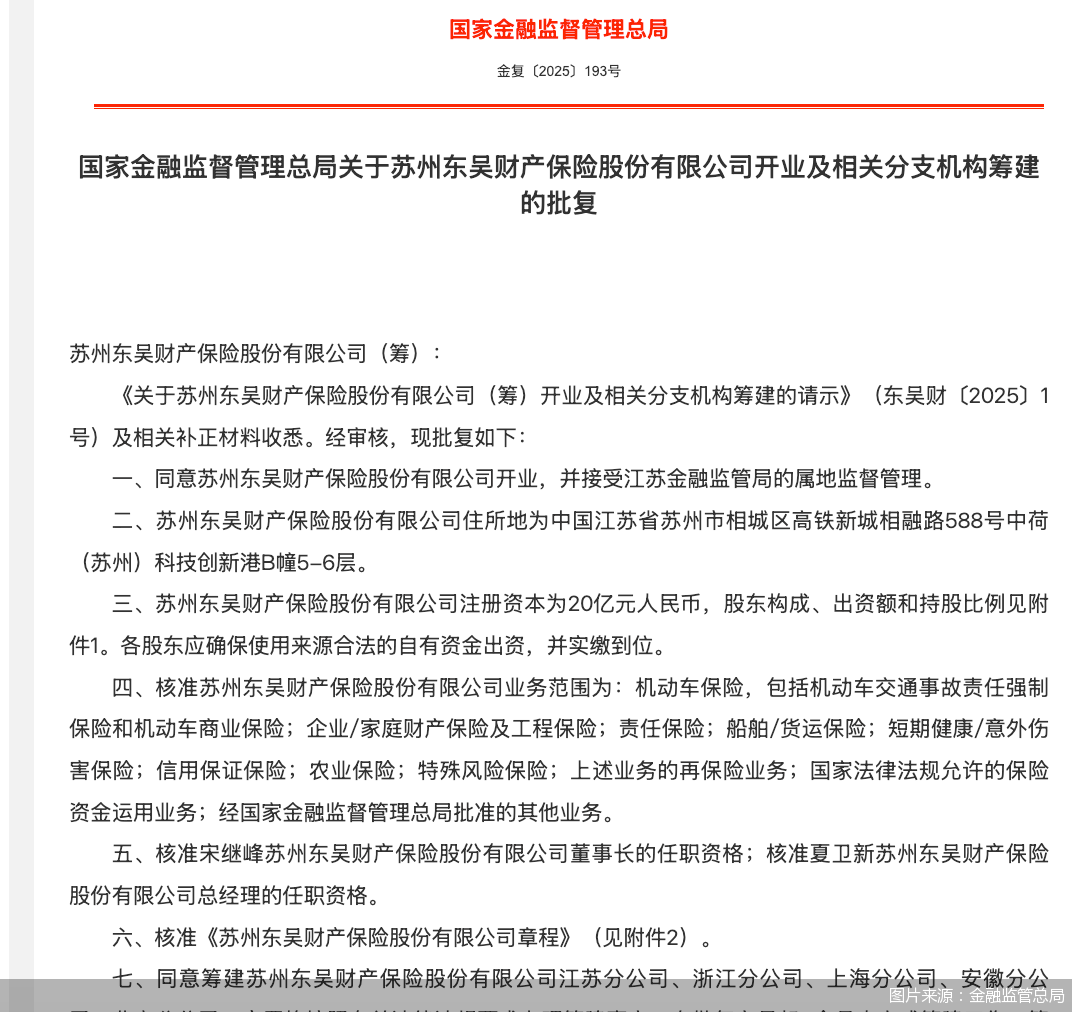
苏州东吴财产保险股份有限公司(以下简称"东吴财险")获批开业,董事长、总经理同步就位。4月14日,金融监管总局发布批复表示,同意东吴财险开 业。此外,除了业务范围获批,宋继峰、夏卫新还分别获批担任东吴财险董事长和总经理。北京商报记者通过近日公布的相关招聘信息了解到,该公司 近百个岗位如火如荼招聘中。 东吴财险获批开业 4月14日,金融监管总局发布关于东吴财险开业及相关分支机构筹建的批复显示,同意东吴财险开业,并接受江苏金融监管局的属地监督管理。该公司注 册资本为20亿元。 金融监管总局还同意筹建东吴财险江苏分公司、浙江分公司、上海分公司、安徽分公司、北京分公司。 东吴财险的业务经营范围也公之于众。金融监管总局表示,核准东吴财险业务范围为:机动车保险,包括机动车交通事故责任强制保险和机动车商业保 险;企业/家庭财产保险及工程保险;责任保险等。 对于此前历经筹建阶段的东吴财险而言,此次获批开业无疑又迈出了关键一步。在业内人士看来,一纸批文的背后,标志着东吴财险正式踏入保险市 场。 据了解,东吴财险由国发集团发起筹建,2024年9月获金融监管总局正式批复,成为苏州唯一国有控股财险法人主体。同年12月,金融监管总局再 ...
科技赋能 向新而行 中国太保服务实体经济再升级
Cai Jing Wang· 2025-04-03 02:36
Core Viewpoint - In 2024, China Pacific Property Insurance (CPIC) focuses on technology insurance as a core strategy to support the high-quality development of technology enterprises, aligning with national financial policies and promoting deep integration of technology and insurance [1][2]. Group 1: Strategic Initiatives - CPIC has established a special working group for technology insurance and formed specialized teams across its branches to systematically advance technology insurance business [2]. - The company leads the Shanghai Technology Insurance Working Group and has set up a service station in the Lingang New Area to enhance service delivery from "window" to "enterprise" [2]. - CPIC participated in formulating industry standards and published the first "Shanghai Technology Insurance Product Catalog" and the "2024 Shanghai Technology Insurance Innovation Development Report" [2]. Group 2: Innovative Products - CPIC launched innovative products tailored to different stages of technology enterprises, including the first domestic "pilot project cost loss insurance" for new materials and a "risk supervision" model to assist in technology transfer [3]. - The company introduced the first "high-tech enterprise certification compensation insurance" and received the "Annual Guaranteed Insurance Product Award" for its "Technology Enterprise Assistance" service case [3]. - CPIC has developed a comprehensive network security insurance service system, recognized by the Ministry of Industry and Information Technology, to support the growth of network security insurance [3]. Group 3: Focus on Key Industries - CPIC provides customized risk solutions for key sectors such as integrated circuits, biomedicine, and low-altitude economy, helping enterprises overcome core technology challenges [5]. - The company has been a leading underwriter for major enterprises in the integrated circuit sector and has introduced new insurance products to support industry stability [5]. - In the biomedicine sector, CPIC offers a full-chain risk solution and has launched various insurance products to support international clinical trials and new technology applications [5]. Group 4: Knowledge Property Insurance - By 2024, CPIC has provided over 4.4 billion yuan in risk protection for more than 8,000 enterprises covering 20,000 patents, trademarks, and other intellectual properties [4]. - The company launched the first "data intellectual property safety insurance" based on a data storage platform, which won the "Annual Guaranteed Insurance Product Award" [4].
