经济不确定性

Search documents
Fastenal Stock Gaps Lower After Q3 Profit Miss
Schaeffers Investment Research· 2025-10-13 14:17
Core Insights - Fastenal Co reported a third-quarter profit miss, while revenue met expectations, attributing the decline to economic uncertainty and changing trade policies affecting demand [1] - The stock is experiencing its third consecutive daily drop and sixth loss in the last seven sessions, currently trading at $43.51, down 5% [1][2] - Despite recent losses, the stock is still up 22% year-to-date [2] Trading Activity - The stock is gapping below the 80-day moving average for the first time since April, indicating a potential bearish trend [2] - Options trading has been notably bullish over the past 10 weeks, with a 50-day call/put volume ratio of 2.06, higher than 80% of annual readings, suggesting a potential unwinding of optimism could further pressure the shares [3] - Current options volume is significantly elevated at 11 times the intraday average, with a notable interest in the October 42.50 put and new positions being opened at the 43.75 put [4]


ING:预估2026年黄金均价为每盎司4150美元
Xin Hua Cai Jing· 2025-10-11 00:52
Core Viewpoint - ING forecasts the average gold price to reach $4,150 per ounce by 2026, with an expected average of $4,000 per ounce in Q4 2025 due to economic uncertainties and efforts to reduce dollar reserves by central banks [1] Group 1 - ING anticipates that central banks will continue to increase their gold reserves [1]
国际金价跳水跌破4000美元整数关口,外媒纷纷表态
Huan Qiu Wang· 2025-10-10 00:53
Group 1 - The core viewpoint of the articles highlights the recent decline in international precious metal futures, with COMEX gold futures dropping 1.95% to $3991.10 per ounce and COMEX silver futures falling 2.73% to $47.66 per ounce, influenced by geopolitical and economic uncertainties [1] - The SPDR Gold ETF has seen an increase of nearly 50% this year, while smaller mining ETFs like MicroSectors Gold Miners 3X Leveraged ETNs have surged over 740%, marking them as the best-performing ETFs tracked by VettaFi [1] - Factors driving the recent rise in gold prices include geopolitical tensions, central bank policies, increased inflows into ETFs, expectations of interest rate cuts, and economic uncertainties stemming from tariff and trade policy changes [1] Group 2 - CBSNEWS suggests that precious metal investments should not completely replace income-generating assets like stocks and bonds in an investment portfolio, but should not be ignored either, especially given the evident economic benefits of silver and gold investments [4] - It is recommended that precious metal investments should not exceed 10% of an investment portfolio, allowing investors to benefit from gold and silver while retaining a portion of their investments in potentially higher-yielding assets [4]
4 forecasters explain why gold's record-shattering rally has further to run — including one call for a 20% surge
Yahoo Finance· 2025-10-08 22:52
Core Viewpoint - The gold market is experiencing a record-breaking surge, with prices surpassing $4,000 an ounce for the first time, marking a year-to-date gain of 52%, potentially leading to its best year since 1979 [1][9]. Group 1: Market Drivers - Economic uncertainty, inflation concerns, and a weaker US dollar are key factors driving the gold rally [2][9]. - Central bank purchases and strong inflows into gold ETFs are expected to continue supporting gold prices [4][5]. Group 2: Price Forecasts - Goldman Sachs has raised its price target for gold to $4,900 per ounce by December 2026, anticipating a 20% increase through the end of next year [3]. - HSBC predicts gold prices could range from $3,600 to $4,400 next year, suggesting an 8% potential increase from current levels [6][7]. Group 3: Future Considerations - Analysts caution that the rally may lose momentum in 2026 due to increased supply and reduced physical demand, alongside potential downward pressure from a strengthening US dollar [8].
华尔街预言家惊世预测:金价2030年前将冲击10000美元
Jin Shi Shu Ju· 2025-10-07 05:58
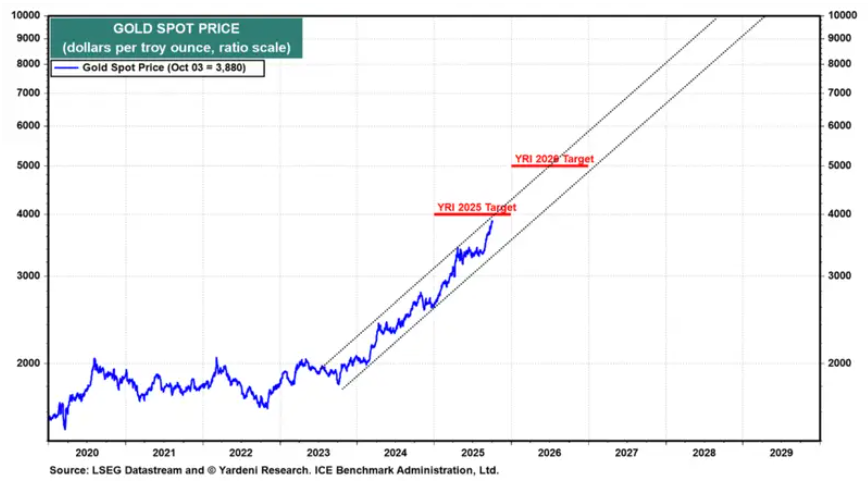
Core Viewpoint - Senior market forecaster Ed Yardeni predicts that the current record-breaking rally in gold prices may continue until 2030, ultimately pushing the price of gold to $10,000 per ounce, representing a 151% increase over the next five years [1][3]. Group 1: Factors Supporting Gold Price Increase - Economic uncertainty is driving investors towards safe-haven assets like gold, influenced by geopolitical tensions and economic disruptions [3]. - Central banks are actively increasing their gold reserves, providing a solid foundation for gold prices. In August, global central banks added a net 15 tons of gold to their reserves, with Kazakhstan, Bulgaria, and El Salvador being the top buyers [3]. - The current momentum in gold prices aligns with Yardeni's analysis, indicating that if the upward trend continues, reaching the $10,000 mark is imminent. As of now, gold has already entered the range of Yardeni's 2025 target price of $4,000 [3]. Group 2: Market Performance and Investor Interest - Gold prices have surged over 50% year-to-date, positioning gold for its best annual performance since the 1970s, driven by both individual and institutional investors seeking its safe-haven attributes amid economic turmoil, a weakening dollar, and rising inflation risks [4].
Why the price of gold could surge 150% by the end of the decade, according to a market vet
Business Insider· 2025-10-07 00:16
Core Viewpoint - Gold is experiencing a significant rally and is projected to continue its upward trend, potentially reaching $10,000 an ounce by 2030, representing a 151% increase over the next five years [1][2]. Economic Factors - Economic and geopolitical uncertainties have driven investors towards safe-haven assets like gold, contributing to its momentum [2]. - Factors such as tariffs imposed by former President Donald Trump, pressure on the Federal Reserve to lower interest rates, and issues in China's housing market have also increased gold demand [3]. Central Bank Activity - Central banks are increasing their gold reserves, which supports the bullish outlook for gold prices. This trend is referred to as the "Gold Put" [3]. - In August, central banks globally added a net 15 metric tons of gold to their reserves, with Kazakhstan, Bulgaria, and El Salvador being the largest buyers [9][10]. Market Performance - Gold has risen 48% year-to-date, positioning it for its best performance since the 1970s, as both individual and institutional investors seek refuge amid economic turmoil and inflation concerns [10]. - Yardeni's analysis indicates that gold is on track to reach a year-end price target of $4,000 an ounce for 2025, suggesting strong ongoing momentum [8].
Trading, TPO Training, Verification Tools; Investor Shutdown News; Fifth Third
Mortgage News Daily· 2025-10-06 15:45
Economic and M&A Trends - The government shutdown is affecting lenders' businesses but not impacting M&A activity, as evidenced by Fifth Third's announcement to acquire Comerica in a $10.9 billion stock deal, which could signal a consolidation trend among regional banks [1] - The acquisition would create the nation's ninth-largest bank, indicating a potential shift in the banking landscape under the current administration's favorable stance towards such deals [1] Technology and Innovation in Lending - FirstClose™ has integrated with Optimal Blue's product, pricing, and eligibility engine, allowing lenders to accelerate home equity closings from 45 days to 10 or fewer, enhancing borrower experience and operational efficiency [2] - Dark Matter Technologies is showcasing how orchestration in mortgage lending can enhance human engagement in automated processes, emphasizing the importance of technology in delivering a better customer experience [3] Government Shutdown Impact on Lending - The USDA has furloughed most staff, halting loan guarantees and conditional commitments, while the FHA continues operations with limited services, suspending HRAP condominium approvals [10][11] - VA lending and Ginnie Mae operations are ongoing but with reduced staffing, while Fannie Mae and Freddie Mac remain unaffected by the shutdown [12] Market Conditions and Economic Indicators - Economic data delays due to the government shutdown are creating uncertainty in the markets, with recent reports indicating layoffs at the fastest pace since 2009 and a contraction in business activity for the first time since 2020 [18] - Despite signs of labor market weakness, consumer spending remains resilient, although this is fragile and influenced by temporary factors such as auto sales spikes [18] Political Risks and Market Sentiment - The potential for the Trump Administration to exploit the shutdown for permanent workforce reductions is adding political volatility to an already shaky economic environment, influencing market sentiment [19] - The ongoing uncertainty and potential restructuring could reinforce investor wariness, particularly affecting lower-income households facing economic strain [19]



Gold price today, Thursday, October 9: Gold opens at $4,061.80 as geopolitical tensions ease
Yahoo Finance· 2025-10-06 11:57
Core Insights - Gold futures opened at $4,061.80 per ounce, reflecting a 0.5% increase from the previous day's close of $4,043.30, with a year-to-date gain of 54.3% [1][2] - Geopolitical conflicts, particularly in the Middle East and Ukraine, have significantly contributed to the rise in gold prices, with a recent ceasefire agreement between Israel and Hamas marking a potential turning point [1] - Economic uncertainty in the U.S., central bank demand for gold, and the possibility of lower interest rates later this year are additional factors supporting high gold values [2] Price Trends - The opening price of gold futures on Thursday is up 5.3% from the opening price of $3,856.20 one week ago [2] - In the past month, gold futures have increased by 11.4% from the opening price of $3,647.10 on September 9 [2] - Over the past year, gold prices have risen by 56% from the opening price of $2,603 on October 9, 2024 [2] Industry Monitoring - Investors can track gold prices continuously through platforms like Yahoo Finance, which offers 24/7 monitoring [3] - There are opportunities to explore top-performing companies in the gold industry using screening tools available on financial platforms [3] Investment Opportunities - Establishing a gold IRA can provide tax benefits while diversifying retirement wealth through the holding of gold and other precious metals [4] - A gold IRA is a specialized self-directed IRA designed specifically for precious metals, allowing for potential tax perks [4]
深夜!特朗普重大宣布,史上规模最大
Zheng Quan Shi Bao· 2025-10-04 14:49
Core Points - President Trump announced a major celebration for the U.S. Navy's 250th anniversary on October 5 in Norfolk, Virginia, despite the ongoing government shutdown [1][2] - The government shutdown, which began on October 1, has led to significant disruptions in various federal services, including consular services and data reporting by the Bureau of Labor Statistics [4][5] - The economic impact of the shutdown is estimated to reduce GDP growth by 0.1 to 0.2 percentage points for each week it continues, according to S&P Global Ratings [7] Group 1: Government Shutdown Impact - The U.S. government shutdown has resulted in the suspension of consular services and limited updates on the State Department's website [4] - The Bureau of Labor Statistics has halted the release of key employment data, affecting the assessment of economic conditions [5] - The Federal Communications Commission (FCC) placed 81% of its employees on leave, halting most of its operations, including consumer complaint handling [6] Group 2: Economic Outlook - The ongoing government shutdown is expected to create rising economic uncertainty, with potential implications for market sentiment [7] - The shutdown has already led to the closure of numerous national parks and iconic sites in Washington, D.C., due to staffing shortages and funding issues [6]
Gold Isn't the Only Metal That's Shining—Silver and Platinum Prices Are Surging Too
Investopedia· 2025-10-03 19:45
Group 1 - The price of gold is on track to achieve its highest yearly return in nearly 50 years, with a significant surge this year, while silver and platinum have also seen substantial gains, with silver reaching its highest historical value and platinum outperforming gold [1][5][8] - The gains in precious metals reflect a global financial market characterized by policy uncertainty, inflation concerns, and a looming U.S. government shutdown, leading investors to seek safe-haven assets [2][4][8] - The Federal Reserve's potential interest rate cuts may further support demand for precious metals by reducing competition from income-generating assets [3][4] Group 2 - Gold has increased by 48% year-to-date, trading near $3,900 per troy ounce, while silver has gained approximately 65% and is trading near $48 per troy ounce, surpassing its 2011 peak [5][6] - Platinum has shown remarkable performance with a nearly 80% year-to-date return, trading around $1,600 per troy ounce, indicating strong demand across all three precious metals [6][8] - Mining companies have benefited from rising prices, with the Van Eck Gold Miners ETF (GDX) and Global X Silver Miners ETF (SIL) each gaining about 125% [6] Group 3 - Investment demand is a primary driver of the price increases in precious metals, but central banks have also increasingly turned to gold for reserve storage, with 90% of demand coming from investors, central banks, and jewelry [7][9] - Silver and platinum have industrial applications that support their demand, with silver used in electronics and platinum in catalytic converters for automobiles [9] - Current economic conditions suggest a potential stagflationary environment, which may further bolster the appeal of precious metals as a hedge against inflation and economic uncertainty [10]