
国企改革

Search documents
重庆港跌0.54%,成交额4119.73万元,后市是否有机会?
Xin Lang Cai Jing· 2025-08-29 07:19
Core Viewpoint - The company, Chongqing Port, is engaged in port transshipment and comprehensive logistics services, with a strong position in the southwestern region of China, benefiting from major national strategies like the Belt and Road Initiative and the Yangtze River Economic Belt [2][7]. Company Overview - Chongqing Port Co., Ltd. was established on January 8, 1999, and listed on July 31, 2000. Its main business includes port terminal loading, storage, and multimodal transport logistics [7]. - The company's revenue composition includes 54.28% from commodity trading, 31.90% from loading and freight agency services, 13.13% from comprehensive logistics, and 0.04% from blasting construction services [7]. - As of June 30, 2025, the company reported a revenue of 2.255 billion yuan, a year-on-year increase of 3.57%, while net profit attributable to shareholders was 5.6853 million yuan, a significant decrease of 88.36% [7]. Business Segments - The company operates through its subsidiary, Chongqing Yuwu Civil Explosives Co., Ltd., which specializes in civil explosive materials such as explosives, detonators, and fuses [2]. - The port has developed specialized terminals for containers, general cargo, vehicles, and chemicals, leading to a strong cargo throughput capacity [2]. Market Position - Chongqing Port is strategically located at a key junction for major national strategies, facilitating connections between eastern and western China, as well as north and south [2]. - The company is a state-owned enterprise, ultimately controlled by the Chongqing State-owned Assets Supervision and Administration Commission [3]. Financial Analysis - The stock's average trading cost is 5.91 yuan, with a current price near the support level of 5.54 yuan, indicating potential for a rebound if it holds above this level [6]. - Recent trading data shows a net outflow of 3.4357 million yuan, with the stock's main trading volume being low, indicating a lack of strong control by major investors [5]. Shareholder Information - As of June 30, 2025, the number of shareholders increased to 44,100, with an average of 26,916 shares held per person, reflecting a decrease of 15.84% from the previous period [7]. - The company has distributed a total of 799 million yuan in dividends since its A-share listing, with 148 million yuan distributed over the past three years [8].

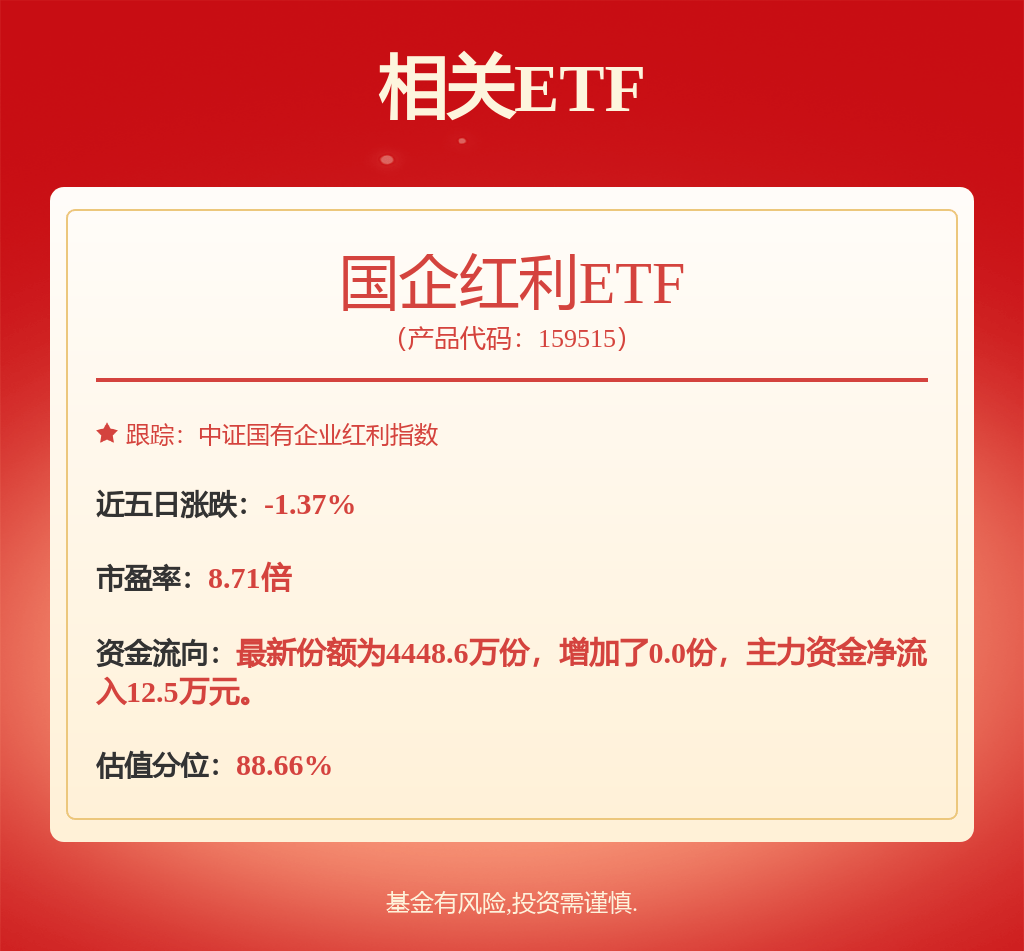
红利板块近期被相对忽视,国企红利ETF涨0.78%
Zheng Quan Zhi Xing· 2025-08-29 03:19
Group 1 - The core viewpoint of the articles highlights the recent performance of the A-share market, which has successfully surpassed the 3800-point mark, reaching a ten-year high [1] - The National Enterprise Dividend Index (code 000824) has seen a decline of 1.2% this week, underperforming the CSI 300 Index by approximately 2 percentage points [1] - Analysts suggest that the recent market sentiment has led to a relative neglect of dividend assets, despite their potential for long-term investment [1] Group 2 - The National Enterprise Dividend Index combines the themes of state-owned enterprises and dividend strategies, enhancing the effectiveness of both strategies [2] - The index is expected to benefit from further deepening of state-owned enterprise reforms, which may improve profitability and operational efficiency [2] - The National Enterprise Dividend ETF (159515) is recommended for active attention due to its focus on high-quality state-owned enterprises with strong profitability and low valuations [2]


红利板块近期被相对忽视,国企红利ETF(159515)涨0.78%
Sou Hu Cai Jing· 2025-08-29 03:04
Group 1 - The core viewpoint of the articles highlights the recent performance of the A-share market, with the major indices showing slight gains and the national enterprise dividend sector experiencing a minor increase [1] - As of August 29, the National Enterprise Dividend ETF (159515) rose by 0.78%, with notable individual stocks such as Lu'an Environmental Energy increasing by 1.99% and Jizhong Energy by 1.01% [1] - The National Enterprise Dividend Index (code 000824) has seen a decline of 1.2% this week, underperforming the CSI 300 Index by approximately 2 percentage points [1] Group 2 - The National Enterprise Dividend Index combines the themes of state-owned enterprises and dividend strategies, enhancing the effectiveness of the investment strategy [2] - The index is expected to benefit from further reforms in state-owned enterprises, which may improve profitability and operational efficiency [2] - The National Enterprise Dividend ETF is recommended for active attention due to its focus on high-quality state-owned enterprises with strong profitability and low valuations [2]
航发控制(000738):1H25营收完成年度目标52%,国际合作业务保持增长
Minsheng Securities· 2025-08-28 08:26
Investment Rating - The report maintains a "Recommended" rating for the company, indicating a positive outlook based on its market position and growth potential [4][6]. Core Views - The company achieved 52% of its annual revenue target in the first half of 2025, with total revenue of 2.74 billion yuan, reflecting a year-over-year decrease of 2.5%. The net profit attributable to shareholders was 310 million yuan, down 34.3% year-over-year, primarily due to the impact of VAT reform on product pricing [1][4]. - The company is positioned as a leader in the control systems for aviation engines and gas turbines, and despite facing challenges during the transition between old and new models in 2025, it is expected to benefit from the stable growth of new model production and the aftermarket [4]. Summary by Sections Financial Performance - In 2Q25, the company reported revenue of 1.39 billion yuan, a slight decrease of 0.3% year-over-year, with a net profit of 160 million yuan, down 22.8% year-over-year. The gross margin for 1H25 decreased by 3.6 percentage points to 27.5%, while the net margin fell by 5.4 percentage points to 11.4% [1][2]. - The company’s revenue from aviation engine and gas turbine control systems was 2.44 billion yuan, down 3.1% year-over-year, accounting for 89% of total revenue. International cooperation revenue grew by 11.8% to 200 million yuan, representing 7% of total revenue [2]. Cost and Cash Flow - The company’s operating cash flow improved significantly, reaching 1.01 billion yuan in 1H25 compared to 180 million yuan in the same period last year. The period expense ratio increased by 1.3 percentage points to 11.2% [3]. - As of the end of 2Q25, accounts receivable decreased by 3.9% to 5.3 billion yuan, while inventory decreased by 1.0% to 1.52 billion yuan [3]. Future Projections - The company is projected to achieve net profits of 755 million yuan, 838 million yuan, and 938 million yuan for the years 2025, 2026, and 2027, respectively, with corresponding price-to-earnings ratios of 36x, 32x, and 29x [4][5].

弘业期货跌0.24%,成交额3.17亿元,后市是否有机会?
Xin Lang Cai Jing· 2025-08-28 08:00
Core Viewpoint - 弘业期货 is a significant player in the futures market, being the first A+H share listed company in the industry, with a focus on various financial services including futures brokerage and asset management [2][7]. Company Overview - 弘业期货主要从事商品期货经纪、金融期货经纪、期货投资咨询、资产管理、基金销售和金融资产投资业务 [7]. - The company is controlled by the Jiangsu Provincial Government's State-owned Assets Supervision and Administration Commission, indicating its status as a state-owned enterprise [3]. - As of April 20, the company had 43,600 shareholders, an increase of 0.69% from the previous period [7]. Financial Performance - For the period from January to March 2025, 弘业期货 reported an operating income of 0.00 yuan, while the net profit attributable to the parent company was 1.2032 million yuan, reflecting a year-on-year growth of 109.07% [7]. - The company has distributed a total of 44.3422 million yuan in dividends since its A-share listing [8]. Market Activity - On August 28, 弘业期货's stock price decreased by 0.24%, with a trading volume of 317 million yuan and a turnover rate of 3.38%, leading to a total market capitalization of 12.597 billion yuan [1]. - The stock has experienced a net outflow of 34.6782 million yuan from main funds, ranking 22 out of 27 in its industry, indicating a trend of reduced investment from major players [4][5]. Shareholder Composition - As of March 31, 2025, the top ten circulating shareholders included 南方金融主题灵活配置混合A, which increased its holdings by 597,100 shares, while 香港中央结算有限公司 reduced its holdings by 348,360 shares [8].

交易型指数基金资金流向周报-20250828
Great Wall Securities· 2025-08-28 03:37
Report Information - Report Title: Weekly Report on Capital Flows of Exchange-Traded Index Funds [1] - Data Date: August 18 - 22, 2025 [1] - Analyst: Jin Ling [1] - Report Date: August 28, 2025 [1] Core Findings Domestic Passive Equity Funds - Different index funds showed varying performance in terms of fund size, weekly returns, and net weekly capital inflows. For example, the Shanghai - Shenzhen 300 index fund had a size of 983.449 billion yuan, a weekly return of 4.27%, and a net weekly capital outflow of 34.74 billion yuan; while the ChiNext Index fund had a size of 126.448 billion yuan, a weekly return of 5.81%, and a net weekly capital inflow of 22.61 billion yuan [4]. Overseas Index Funds - International index funds also had diverse performance. The Nasdaq 100 index fund had a size of 78.421 billion yuan, a weekly return of -3.08%, and a net weekly capital inflow of 7.78 billion yuan; the S&P 500 index fund had a size of 20.837 billion yuan, a weekly return of -1.63%, and a net weekly capital outflow of 1.44 billion yuan [5]. Bond Funds - Bond funds had different performance based on factors such as maturity and credit rating. The 30 - year bond fund had a size of 8.969 billion yuan, a weekly return of -1.25%, and a net weekly capital inflow of 59.60 billion yuan; the short - term financing bond fund had a size of 29.341 billion yuan, a weekly return of 0.01%, and a net weekly capital outflow of 28.50 billion yuan [6]. Commodity Funds - Commodity funds, including gold, soybean meal, and others, also had distinct performance. The gold fund had a size of 70.887 billion yuan, a weekly return of -0.29%, and a net weekly capital outflow of 0.94 billion yuan; the energy and chemical fund had a size of 2.93 billion yuan, a weekly return of 0.76%, and a net weekly capital inflow of 0.88 billion yuan [6]. Index - Enhanced Funds - Index - enhanced funds based on different indices had different performance. The CSI 500 index - enhanced fund had a size of 1.978 billion yuan, a weekly return of 3.76%, and a net weekly capital inflow of 0.12 billion yuan; the ChiNext Index - enhanced fund had a size of 0.469 billion yuan, a weekly return of 5.46%, and a net weekly capital outflow of 0.04 billion yuan [6].
国建集团减债融资课题深化国企改革 决胜“十四五”迎接“十五五”
Cai Fu Zai Xian· 2025-08-28 02:08
Group 1 - The core viewpoint emphasizes the importance of deepening state-owned enterprise (SOE) reform and promoting high-quality development as key measures to implement the "14th Five-Year Plan" and prepare for the "15th Five-Year Plan" [1][4] - State-owned enterprises are identified as the leading force in the national economy, and their reform and innovation are crucial for achieving long-term national development goals [1][4] - The National Investment Group is actively implementing the "New Era SOE Debt Reduction Financing (DRF) Collaborative Development with Private Enterprises" initiative, providing systematic solutions through debt and equity investments to support SOE reform [1][2] Group 2 - The DRF initiative allows enterprises to use part of the funds to address immediate financial difficulties while another portion can be invested in an industry equity fund established by the National Investment Group [2] - The National Investment Group acts as a fund guide, assessing industry development and advantages to determine different levels of industry, with funding ratios ranging from 1:1 to 1:9 based on industry strength [2] - This funding mechanism aims to enhance the linkage effects of advantageous industries and supports the concentrated development of key industries outlined in the "14th Five-Year Plan" [2] Group 3 - The DRF initiative embodies a development model that promotes production through financing and enhances financing through production, facilitating the collaborative development of the industrial chain [3] - The operation of the industry equity fund not only provides financial support but also fosters collaboration across the supply chain, aiding SOEs in structural adjustments and upgrades [3] - By combining equity and debt, SOEs can better grasp industry trends, improve resource allocation efficiency, and enhance sustainable development capabilities [3] Group 4 - The current period is critical for concluding the "14th Five-Year Plan" and planning the "15th Five-Year Plan," making SOE reform and the enhancement of new development momentum particularly significant [4] - The DRF initiative serves both the immediate goals of the "14th Five-Year Plan" and the long-term development needs of the "15th Five-Year Plan" [4] - The National Investment Group aims to deepen the integration of industrial, innovation, and financial chains, exploring new investment and financing models that align with high-quality development requirements [4]
华强科技: 湖北华强科技股份有限公司2025年度“提质增效重回报”专项行动方案的进展报告
Zheng Quan Zhi Xing· 2025-08-27 10:06
Core Viewpoint - The company is actively implementing the "Quality Improvement and Efficiency Enhancement" initiative, focusing on enhancing core capabilities, expanding market presence, and improving product quality while maintaining a commitment to shareholder interests and social responsibility [1][2][3]. Group 1: Strengthening Core Capabilities - The company has focused on the special protection field, achieving significant order fulfillment exceeding annual budget in the first half of 2025 [1]. - The company participated in four bidding processes for special products and successfully secured contracts, ensuring timely delivery [1]. - A new quality management system is being established, with training and process design completed [1]. Group 2: Civil Product Development - New product sales, such as pen-type injector components, have significantly increased, leading to a 3.48 percentage point rise in gross margin for civil products [2]. - The company has signed strategic cooperation agreements with new clients and expanded foreign trade channels, resulting in a 5% year-on-year increase in exports [2]. - The company successfully activated the registration number for a new insulin pen component, achieving important regulatory approval [2]. Group 3: Technological Innovation - Research and development investment reached 16.3% of revenue, a 4.65 percentage point increase year-on-year [2]. - The company has applied for 20 patents, including 15 invention patents, and achieved a 91.94% completion rate for research project milestones [2]. - An innovation platform is being established, centered around a national-level enterprise technology center [2]. Group 4: Quality and Efficiency Improvement - The company has implemented 86 specific measures to enhance quality and efficiency, focusing on cost reduction and revenue increase [3]. - A total of 6,715 million yuan was generated in additional revenue through various initiatives in the first half of 2025 [3]. - The company achieved a comprehensive cost reduction of 15.27 million yuan [3]. Group 5: Reform and Development - The company has completed 93% of its planned 100 reform tasks, receiving high marks in reform assessments [4]. - The brand strength increased by 7% to 892, maintaining its position on the Chinese brand value evaluation list [4]. - Digital transformation initiatives are underway, including the intelligent transformation of production facilities [4]. Group 6: Corporate Governance - The company has established a modern corporate governance system, implementing new management and compliance policies [6]. - A total of 68 announcements were made in the first half of 2025, including annual and quarterly reports [7]. - The company’s ESG rating improved from "BB" to "A," reflecting excellence in environmental, social, and governance practices [7]. Group 7: Investor Relations - The company has enhanced communication with investors, holding performance briefings and engaging in various outreach activities [8]. - A cash dividend of 0.434 yuan per share was distributed, representing 90.07% of the net profit attributable to shareholders [8]. - The company has established a value management system to comply with regulatory requirements and improve market performance [9]. Group 8: Management Responsibility - The company emphasizes the responsibility of key personnel, enhancing their awareness of compliance and operational standards [10]. - Training sessions for management and key personnel have been conducted to improve their capabilities [10]. Group 9: Future Outlook - The company will continue to evaluate the implementation of the "Quality Improvement and Efficiency Enhancement" initiative and maintain transparency in its operations [11].

华强科技: 湖北华强科技股份有限公司2025年半年度报告
Zheng Quan Zhi Xing· 2025-08-27 09:59
Core Viewpoint - Hubei Huaqiang Technology Co., Ltd. reported a significant decline in revenue and profit for the first half of 2025, primarily due to reduced demand in its main business segments, particularly in special protective equipment and pharmaceutical packaging [3][5][7]. Financial Performance - The company achieved operating revenue of 177.73 million yuan, a decrease of 25.98% compared to the same period last year [3]. - Total profit amounted to 2.88 million yuan, down 88.98% year-on-year [3]. - Net profit attributable to shareholders was 4.13 million yuan, representing an 84.49% decline [3]. - The net cash flow from operating activities was a negative 23.44 million yuan, although this was an improvement of 80.04% year-on-year [3]. Business Segments - The special protective equipment segment saw a revenue decline of 28.63%, attributed to the timing of military orders, with most deliveries expected in the fourth quarter [3][8]. - The pharmaceutical packaging and medical device segment experienced a 25.67% revenue decrease, mainly due to reduced demand for butyl rubber stoppers in the antibiotic and chemical drug sectors [3][5]. Industry Context - The defense budget for 2025 is projected at 178.47 billion yuan, reflecting a 7.2% increase, which may enhance demand for military equipment [5][8]. - The pharmaceutical packaging industry is expected to grow, with a market size of 143.96 billion yuan in 2024, showing a 14.4% year-on-year increase [5][6]. Innovation and Development - The company has established itself as a leader in the domestic butyl rubber stopper market, achieving significant milestones in smart manufacturing and product development [6][14]. - The company has a strong focus on R&D, with 135 technical personnel, accounting for 20.55% of the total workforce, and has filed 20 patent applications during the reporting period [12][18]. Strategic Initiatives - The company is actively pursuing international market expansion and has signed strategic cooperation agreements with over 40 new clients [8][9]. - It has implemented a "strong foundation and new expansion" strategy to enhance core competitiveness and adapt to market changes [9][10].
弘业期货跌4.79%,成交额4.02亿元,后市是否有机会?
Xin Lang Cai Jing· 2025-08-27 09:45
Core Viewpoint - 弘业期货 experienced a decline of 4.79% on August 27, with a trading volume of 402 million yuan and a market capitalization of 12.627 billion yuan [1] Company Overview - 弘业期货股份有限公司 primarily engages in commodity futures brokerage, financial futures brokerage, futures investment consulting, asset management, fund sales, and financial asset investment [2][7] - The company is the first A+H share listed company in the futures industry [2] - 弘业期货 is a state-owned enterprise, ultimately controlled by the Jiangsu Provincial Government State-owned Assets Supervision and Administration Commission [3] Financial Performance - As of April 20, 弘业期货 reported a revenue of 0.00 yuan for the first quarter of 2025, with a net profit attributable to shareholders of 1.2032 million yuan, representing a year-on-year increase of 109.07% [7] - Cumulative cash distribution since A-share listing amounts to 44.3422 million yuan [8] Shareholder Structure - As of March 31, 2025, the top ten circulating shareholders include 南方金融主题灵活配置混合A (004702) with 3.526 million shares, an increase of 597,100 shares from the previous period [8] - 香港中央结算有限公司 holds 2.1274 million shares, a decrease of 348,360 shares from the previous period [8] Market Activity - The main net inflow of funds today was -58.7575 million yuan, with a market ranking of 20 out of 27 in the industry [4] - The average trading cost of the stock is 13.03 yuan, with the current price near a support level of 12.39 yuan [6]