
硬科技

Search documents
科技板块领涨港股 硬科技品种最为吸金
Mei Ri Jing Ji Xin Wen· 2025-11-25 05:31
Core Viewpoint - The Hong Kong stock market is experiencing a strong inflow of funds into the technology sector, particularly in AI and semiconductor-related ETFs, following a significant correction in the sector since October, which has made valuations more attractive [1][2]. Group 1: Market Performance - On November 25, the Hong Kong stock market opened higher, with technology and semiconductor sectors showing strong performance, leading to active trading in related ETFs [1]. - The Hang Seng Technology Index has corrected over 14% from its year-to-date high since October, highlighting the increased attractiveness of valuations in the technology sector [1]. - On November 24, the overall market ETFs saw a net inflow of 14.4 billion yuan, with technology ETFs in Hong Kong being the primary focus for fund accumulation [1]. Group 2: ETF Specifics - The Hong Kong Stock Connect Technology ETF (159262) is the largest product tracking the Hang Seng Stock Connect Technology Index, focusing on hard technology sectors like AI and semiconductors, while excluding automotive, pharmaceutical, and home appliance sectors [2]. - As of November 24, the index has gained 45% over the past year, with an annualized Sharpe ratio of 1.37, both of which are among the best in the Hong Kong technology and internet thematic indices [2]. - The Hong Kong Stock Connect Technology ETF (159262) received a net inflow of 270 million yuan on November 24, making it the top-performing ETF in its category, with a total size nearing 6 billion yuan [1][2]. Group 3: Investment Outlook - Analysts believe that the current valuation of the hard technology sector in Hong Kong offers good value for money, especially as the external environment remains in a rate-cutting cycle, providing a favorable opportunity for reverse positioning [2]. - The Hong Kong Stock Connect Technology ETF (159262) is seen as a key investment tool for capturing recovery opportunities in the Hong Kong technology sector [2]. - Tianfeng Securities highlights that the ETF's index covers a broad range of technology fields, including internet, software, and hardware, making it a more precise investment choice compared to other ETFs that focus on narrower segments [3].
美国启动AI“创世纪计划”引发市场热议,科创创业人工智能ETF易方达(159140)深度布局“硬科技”发展机遇
Xin Lang Cai Jing· 2025-11-25 05:21
Group 1 - The U.S. government has launched a new national initiative called the "Genesis Project" aimed at transforming scientific research through artificial intelligence (AI) [1] - The initiative will involve the Department of Energy creating an AI experimental platform that integrates U.S. supercomputers and unique data assets to support scientific foundational models and robotic laboratories [1] - The project will be coordinated by the Assistant to the President for Science and Technology (APST) and will collaborate with academia and private sector innovators [1] Group 2 - E Fund is set to launch a new ETF focused on AI, named the E Fund CSI Innovation and Entrepreneurship AI ETF, starting from November 28 [2] - This ETF will track the CSI Innovation and Entrepreneurship AI Index, which selects 50 companies from the STAR Market and ChiNext that are involved in AI foundational resources, technology support, and cutting-edge applications [2] - The ETF provides investors with a cost-effective and transparent way to invest in leading companies within the AI sector, capitalizing on the growth opportunities presented by technological innovation [2] Group 3 - The focus on "hard technology" positions the ETF to benefit directly from the upward cycle of global and domestic AI capital expenditures and technological upgrades [3]

科技板块领涨港股,硬科技品种最为吸金
Mei Ri Jing Ji Xin Wen· 2025-11-25 04:04
Core Viewpoint - The Hong Kong stock market is experiencing a strong inflow of funds into the technology sector, particularly in AI and semiconductor-related ETFs, following a significant correction in the sector since October, which has made valuations more attractive [1][2]. Group 1: Market Performance - On November 25, the Hong Kong stock market opened higher, with technology and semiconductor sectors showing strong performance, leading to active trading in related ETFs [1]. - The Hang Seng Technology Index has corrected over 14% from its year-to-date high since October, highlighting the increased attractiveness of valuations in the technology sector [1]. - On November 24, the overall market ETFs saw a net inflow of 14.4 billion yuan, with technology ETFs in Hong Kong being the primary focus for fund accumulation [1]. Group 2: ETF Specifics - The Hong Kong Stock Connect Technology ETF (159262) is the largest product tracking the Hang Seng Stock Connect Technology Index, focusing on hard technology sectors like AI and semiconductors [2]. - The ETF's top ten holdings include major companies such as Alibaba, Tencent, Xiaomi, Meituan, and SMIC, accounting for nearly 80% of the index, indicating a high concentration in the technology sector [2]. - As of November 24, the index has achieved a 45% increase over the past year, with an annualized Sharpe ratio of 1.37, both of which are among the best in the Hong Kong technology and internet thematic indices [2]. Group 3: Investment Sentiment - Industry experts believe that the current valuation of the hard technology sector in Hong Kong offers good value for money, especially as the external environment remains in a rate-cutting cycle, providing a favorable opportunity for reverse positioning [2]. - The Hong Kong Stock Connect Technology ETF (159262) is seen as a key investment tool for capturing recovery opportunities in the Hong Kong technology sector [2]. - Brokerage firms express optimism about the long-term investment value of the ETF, noting its comprehensive coverage of the technology sector, including internet, software, and hardware, which allows for a more precise focus on core technology areas [3].
上海LP火力全开
3 6 Ke· 2025-11-25 03:33
Core Insights - The primary focus of the article is the recovery and growth of the primary market driven by policy incentives and technological advancements, leading to increased investment activity among Limited Partners (LPs) [1][9]. Group 1: Investment Trends - By the end of the third quarter of 2025, institutional LPs have committed approximately 1.24 trillion RMB, marking a 9% year-on-year increase, with 3,434 new funds registered, up 15.18% [1]. - Investment sentiment in the primary market has significantly improved, particularly in first-tier regions like Jiangsu, Zhejiang, and Shanghai, with LPs showing a strong willingness to invest [3][5]. - The Shanghai government has accelerated its investment pace, with major funds like the Shanghai Future Industry Fund actively selecting sub-funds and making investment decisions [3]. Group 2: Government and Institutional Involvement - Local governments and state-owned platforms have become the most active LPs in the primary market, with a shift towards more market-oriented and professional investment strategies [6]. - The Shanghai State Investment Company and Shanghai Science and Technology Innovation Group have seen rapid growth in their fund management, with projected new investment decisions reaching 55 billion RMB in 2025, three times the amount from 2024 [4]. - Various districts in Shanghai are establishing differentiated fund systems to enhance investment capabilities, such as the "Tropical Rainforest Fund Matrix" in Minhang District [4]. Group 3: Changes in Investment Strategy - The average return investment ratio for newly established or revised guiding funds has decreased to 1.15 times, with some regions eliminating return requirements altogether, allowing for more market-aligned operations [7]. - LPs are increasingly favoring industry-focused General Partners (GPs), with a notable decline in interest for traditional blue-chip and financial GPs [8]. - Investment strategies are becoming more specialized and refined, with a focus on sectors like AI, robotics, and hard technology, reflecting a shift towards long-term value creation [8][9].
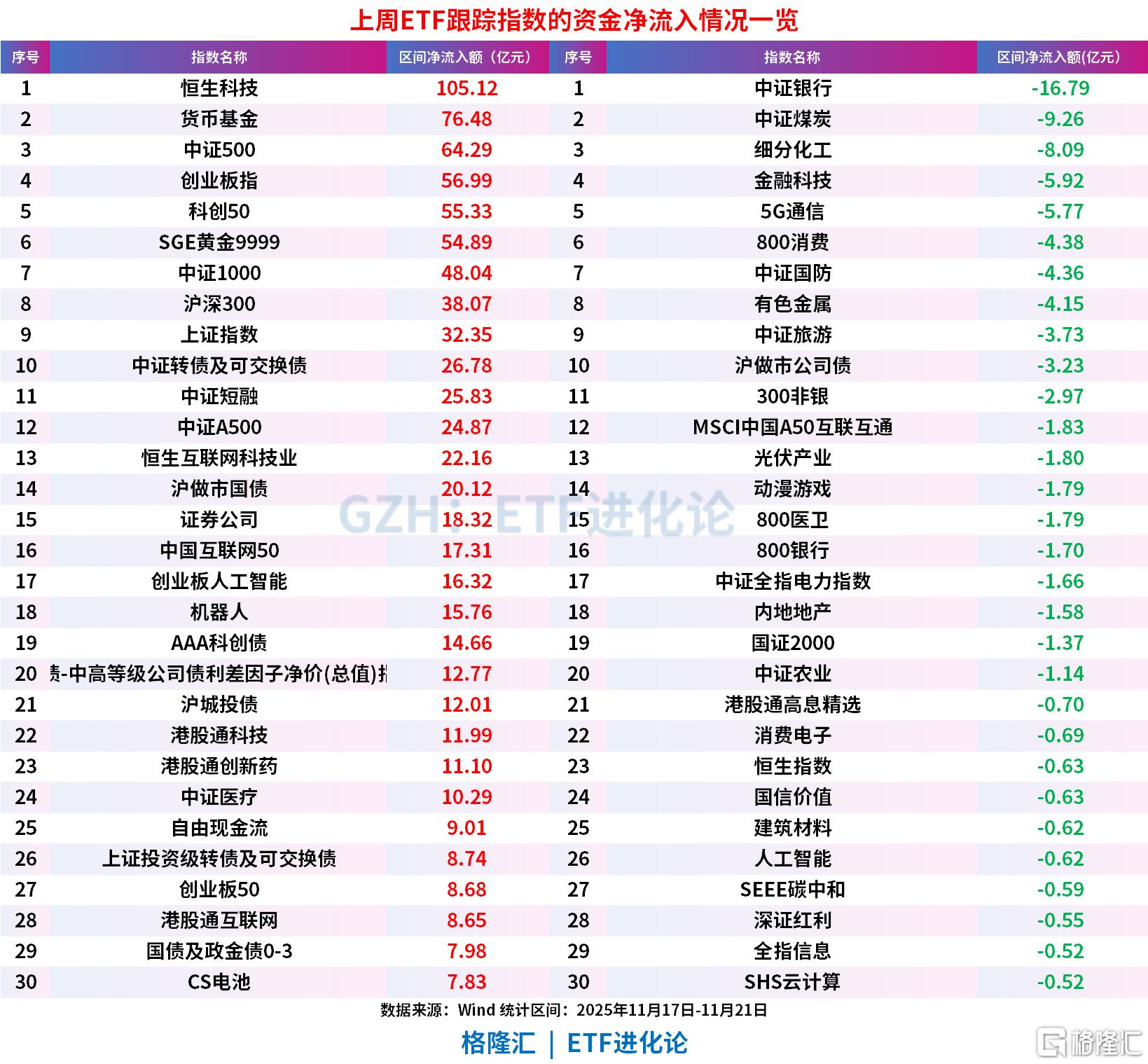
上周超500亿资金抄底股票ETF,恒生科技、中证500、创业板指、科创50“吸金”居前
Ge Long Hui· 2025-11-25 00:40
Market Performance - The A-share market saw a decline across major indices last week, with the CSI 300, Shanghai Composite Index, and SME Index showing returns of -3.77%, -3.90%, and -5.10% respectively. The ChiNext Index, CSI 1000, and CSI 500 had lower returns of -6.15%, -5.80%, and -5.78% respectively [1] - In terms of industry performance, banks, food and beverage, and media sectors had relatively better returns of -0.87%, -1.36%, and -1.39% respectively, while sectors like comprehensive, electric equipment and new energy, and basic chemicals lagged with returns of -9.47%, -9.41%, and -8.24% respectively [1] Fund Flows - The ETF market experienced a net inflow of 98 billion, with stock ETFs contributing 54.577 billion, QDII stock ETFs 15.544 billion, commodity ETFs 6.495 billion, bond ETFs 13.8 billion, and money market fund ETFs 7.648 billion. Notably, on November 21, there was a significant inflow of 50 billion aimed at "bottom-fishing" through ETFs [2] - Specific indices such as Hang Seng Technology, money market funds, CSI 500, ChiNext Index, and others saw net inflows ranging from 10.512 billion to 0.3235 billion, while sectors like CSI Bank, CSI Coal, and others experienced net outflows [2][4] ETF Performance - The top-performing ETFs included the S&P Biotechnology ETF and Emerging Asia ETF, with weekly gains of 1.35% and 0.67% respectively. Conversely, several new energy and photovoltaic ETFs saw significant declines, with losses ranging from -11.70% to -13.44% [12][14] - A total of 41 new funds were launched last week, with a combined issuance scale of 35.635 billion, marking an increase from the previous week. This included 14.022 billion in equity funds, 8.056 billion in mixed funds, and 13.557 billion in bond funds [15] Regulatory Changes - The Shanghai and Shenzhen stock exchanges announced new regulations requiring the 5.7 trillion ETF market to standardize fund names. The revised guidelines mandate that fund names must include core investment elements and the fund manager's abbreviation, with a deadline for compliance set for March 31, 2026 [15] - Sixteen hard technology-themed funds were approved on November 21, including the first seven AI ETFs, three chip ETFs, and four chip design theme ETFs, involving multiple fund management companies [16]


今日视点:并购市场迈向价值创造新征程
Zheng Quan Ri Bao· 2025-11-24 22:16
Core Viewpoint - The merger and acquisition (M&A) market in China is evolving from simple scale expansion to deeper strategic integration and value creation, reflecting the pursuit of high-quality development and the ongoing transformation of the Chinese economy [1] Group 1: Industry Logic Dominates - The recent M&A market has shifted from a "scale-oriented" approach to one dominated by "industry logic," entering a new phase of "optimizing and strengthening" [2] - A notable example is China International Capital Corporation (CICC) planning to merge with Dongxing Securities and Xinda Securities, which will leverage their complementary advantages to enhance overall financial service capabilities [2] - The State-owned Assets Supervision and Administration Commission (SASAC) emphasizes the need for central enterprises to utilize capital markets effectively for strategic integration, aligning with future industry and technology trends [2] Group 2: Innovation-Driven M&A - "Hard technology" has emerged as the most active sector for M&A, driven by technological breakthroughs and industrial upgrade demands [3] - Mergers are increasingly led by "chain master" enterprises aiming to secure key technologies and scarce capacities, enhancing the resilience and security of the entire industrial chain [3] - Policies such as the "Science and Technology Innovation Board" and "M&A Guidelines" are directing capital towards the "hard technology" sector [3] Group 3: Focus on Integration Effectiveness - The success of M&A is shifting from execution capability to integration effectiveness, with value creation becoming the key measure of success [4] - Regulatory bodies are focusing on the effectiveness of integration post-merger, assessing the ability to implement effective integration and the sustainability of the acquired companies [4] - The strategic transformation in the M&A market reflects an upgrade in the capital market's ability to serve the real economy, emphasizing industry logic, technological innovation, and effective integration [4]

A股午评:今天大跌在3821,若无意外,午后或将重演历史行情
Sou Hu Cai Jing· 2025-11-24 20:41
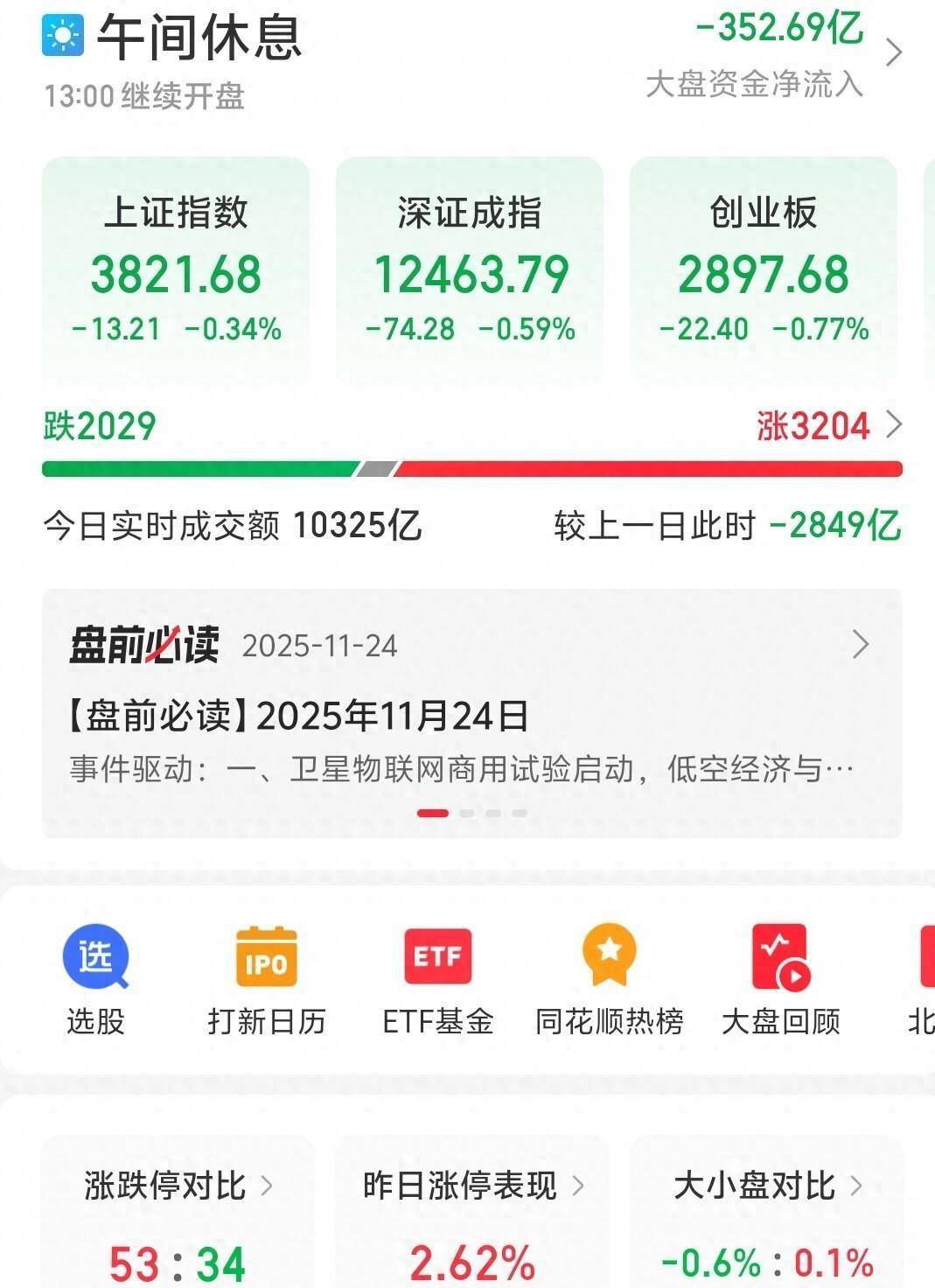
Market Overview - The Shanghai Composite Index closed at 3821.68 points, down 0.34%, while over 3200 stocks rose, indicating a divergence between the index and individual stock performance [1][2]. - The total trading volume was 1.03 trillion yuan, a decrease of nearly 300 billion yuan compared to the previous day, suggesting that funds are waiting for direction [5]. Sector Performance - Defensive sectors such as military and wind power showed strength, with multiple stocks hitting the daily limit, while technology stocks experienced significant internal divergence [5][6]. - Semiconductor and AI sectors saw a narrowing of losses, with some leading stocks showing signs of accumulation, indicating potential recovery [6]. Capital Flow - The market is witnessing a classic scenario where defensive sectors attract capital, while technology stocks face mixed performance [6][8]. - Northbound capital saw a net outflow of 7.5 billion yuan, which could trigger follow-up selling if the trend continues [8]. Historical Context - The current market behavior resembles previous instances in late August and mid-September, where significant index movements followed periods of low trading volume at key support levels [5][6]. - Historical data suggests that sudden movements in brokerage stocks without accompanying volume can lead to false signals, as seen on September 18 [8].
科创债风险分担工具运用稳步拓展
Zhong Guo Zheng Quan Bao· 2025-11-24 20:13
Core Viewpoint - The issuance of the second batch of technology innovation bonds supported by risk-sharing tools is set to take place from November 26 to 28, aimed at expanding long-term capital sources for private equity investment institutions and supporting the development of hard technology enterprises [1] Group 1: Issuance and Support - Four private equity investment institutions plan to issue a total of 930 million yuan in technology innovation bonds, indicating a broader application of risk-sharing tools in the bond market [1] - The China Interbank Market Dealers Association will continue to leverage risk-sharing tools to develop the "technology board" in the bond market, promoting the growth of patient and long-term capital [1] Group 2: Fund Utilization and Impact - Since June, five private equity investment institutions have raised 1.35 billion yuan through technology innovation bonds, with nearly 50% of the funds already utilized, effectively leveraging over 10 billion yuan in total funding for key sectors such as integrated circuits, artificial intelligence, and biomedicine [2] - The issuance of technology innovation bonds has significantly accelerated the establishment and funding pace of venture capital funds, ensuring that capital is quickly matched to specific technology enterprises [2] Group 3: Market Activity and Participation - As of November 21, the association has supported 276 enterprises in issuing over 530 billion yuan in technology innovation bonds, with a notable increase in participation from private enterprises [3] - The bond issuance structure is primarily medium to long-term, aligning with the research and investment cycles, with over 60% of the issuance being five years or longer, effectively supporting the cultivation of patient capital for long-term investments in hard technology [3]
并购市场迈向价值创造新征程
Zheng Quan Ri Bao· 2025-11-24 16:22
Group 1 - The core viewpoint of the article highlights the significant transformation in the M&A market, moving from simple scale expansion to deeper strategic integration and value creation, reflecting the pulse of China's economic transformation and upgrade [1] Group 2 - The M&A market has shifted from a "scale-oriented" approach to one dominated by "industrial logic," emphasizing the need for companies to enhance their strengths and optimize their operations [2] - A notable example is the proposed merger of CICC with Dongxing Securities and Xinda Securities, which aims to leverage their complementary advantages and create a powerful synergy in the financial sector [2] - The State-owned Assets Supervision and Administration Commission (SASAC) is promoting the professional integration of central enterprises, emphasizing the importance of aligning M&A activities with future industry and technology trends [2] Group 3 - "Hard technology" has emerged as the most active sector for M&A, driven by the need for technological breakthroughs and industrial upgrades, with companies seeking to acquire cutting-edge technologies and core talent through acquisitions [3] - The integration of upstream and downstream in the industrial chain has become a mainstream model, with leading companies aiming to secure key technologies and enhance the resilience of the entire industry chain [3] - Policies such as the "Science and Technology Innovation Board Eight Articles" and "M&A Six Articles" are guiding capital towards the "hard technology" sector, providing clear direction and strong momentum for this M&A wave [3] Group 4 - The focus of successful M&A has shifted from transaction execution to integration effectiveness, with value creation becoming the key measure of success [4] - Regulatory bodies are emphasizing the importance of effective integration post-acquisition, assessing the sustainability of the target company's operations and the reasonableness of the acquisition price [4] - The strategic transformation in the M&A market represents an upgrade in the ability of the capital market to serve the real economy, with a continued focus on industrial logic, technological innovation, and integration effectiveness [4]


超60家沪市公司集体释放积极信号 合同订单、研发利好不断
Shang Hai Zheng Quan Bao· 2025-11-24 13:38
Group 1 - Over 20 positive announcements were released by companies listed on the Shanghai Stock Exchange, indicating a trend of share buybacks and operational improvements [1] - China Petroleum & Chemical Corporation (Sinopec) completed its share buyback plan, repurchasing 89.35 million shares for approximately 5 billion yuan, with a repurchase average price of 5.60 yuan per share [2] - Spring Airlines initiated a share buyback plan of 300 million to 500 million yuan, with a total of 7.18 million shares repurchased so far, amounting to nearly 4 million yuan [2] Group 2 - At least 14 companies on the STAR Market announced share buyback progress and contract orders, with notable buyback amounts indicating strong commitment [3] - JinkoSolar announced the mass production of its Tiger Neo 3.0 solar module, achieving a production efficiency of over 24.8% and a power output of up to 670W [3] - Mountain Stone Network Technology reported progress in its ASIC security chip development, entering the mass production phase with successful internal testing [4]