
创新药

Search documents
14亿控股绿谷医药,复星医药“豪赌”阿尔茨海默症“神药”?
Xin Lang Cai Jing· 2025-12-16 12:40
Core Viewpoint - Fosun Pharma announced plans to invest approximately 1.412 billion yuan to acquire Green Valley Pharmaceutical, aiming to integrate the latter's Alzheimer's treatment drug, Manluo Sodium Capsule, into its innovative drug pipeline. This move reflects Fosun Pharma's strategy to accelerate its transition from generic to innovative drugs and seek a revaluation in the capital market [1][15]. Acquisition Details - Fosun Pharma's subsidiary, Fosun Pharma Industry, will invest a total of 1.412 billion yuan to acquire control of Green Valley Pharmaceutical, which will become a subsidiary of Fosun Pharma. The transaction includes a capital transfer of 143 million yuan for 15.15 million yuan of registered capital and an additional 1.27 billion yuan for 2.009 billion yuan of new registered capital [2][16]. - After the acquisition, Fosun Pharma will hold 53% of Green Valley's shares, with plans to reduce this to 51% after further share transfers. Green Valley focuses on developing, producing, and selling drugs for neurodegenerative diseases, with its core product, Manluo Sodium Capsule, conditionally approved for Alzheimer's treatment in November 2019 [3][16]. Controversies Surrounding the Drug - Manluo Sodium Capsule has faced significant controversy since its launch, with questions regarding its mechanism of action and clinical efficacy. The drug's registration has expired, and it will not resume commercial production until it completes ongoing post-marketing confirmatory clinical trials and receives approval from regulatory authorities [4][17]. - Due to the halt in sales of its core product, Green Valley's financial performance has been adversely affected, reporting revenues of 572 million yuan in 2024 and a net profit of 70.77 million yuan, followed by a loss of 67.61 million yuan in the first nine months of 2025 [5][17]. Market Reaction - Following the acquisition announcement, Fosun Pharma's stock fell significantly, with a drop of over 9% at one point in Hong Kong, closing down 5.81% at 21.06 HKD per share, and a decline of 4.22% in A-shares, closing at 26.75 yuan per share [5][18]. Strategic Moves in Innovative Drugs - Fosun Pharma has been actively expanding its innovative drug portfolio through various strategies, including partnerships and licensing agreements. For instance, in July, it signed a licensing agreement with Newco for the development of AR1001, another drug targeting Alzheimer's disease [6][19]. - The company has also made significant investments in its cell therapy platform, acquiring full ownership of Fosun Kite and planning further capital injections to enhance its capabilities in oncology [6][20]. Financial Performance and Challenges - Fosun Pharma's financial performance has shown mixed results, with revenues of 439.52 billion yuan in 2022, declining to 410.67 billion yuan in 2024. The company reported a net profit of 25.23 billion yuan in the first three quarters of 2024, reflecting a year-on-year decline of 4.91% in revenue [10][22]. - The company has faced scrutiny regarding its financial health, with short-term borrowings reaching 16.447 billion yuan and cash reserves insufficient to cover these debts, indicating potential liquidity pressures [11][24]. Future Prospects - The success of the acquisition and the potential re-approval of Manluo Sodium Capsule remain uncertain, raising questions about its contribution to Fosun Pharma's future performance [13][24].


长春高新:13.65亿美元BD落地加速全球化,TSHR药物有望突破临床痛点
Zheng Quan Shi Bao Wang· 2025-12-16 11:25
Core Viewpoint - The future of innovative drugs is seen as the main driving force behind China's independent innovation, with a focus on benefiting both domestic and global populations [1] Group 1: Company Strategy and Developments - Changchun High-tech has shifted from a "single product" strategy focused on growth hormone to a comprehensive pharmaceutical company driven by innovation [1] - The company’s subsidiary, Jinsai Pharmaceutical, is set to launch China's first self-developed IL-1β inhibitor, Fuxin Qibai monoclonal antibody, by June 30, 2025, marking a significant milestone in its innovation transformation [1] - In September, Changchun High-tech submitted a listing application to the Hong Kong Stock Exchange, emphasizing its "innovation-driven + globalization" strategy and vision to become a leading innovative global pharmaceutical company [1] Group 2: Business Development and Financial Aspects - On December 15, Changchun High-tech announced a significant business development (BD) project worth up to $1.365 billion, reinforcing its commitment to innovation and globalization [2] - The agreement involves a licensing deal for the GenSci098 injection project with Yarrow Bioscience, which includes an upfront payment of $70 million and potential milestone payments totaling $1.365 billion [2] - GenSci098 is a first-class new drug developed by Jinsai Pharmaceutical, targeting thyroid-related diseases and aiming to address clinical pain points associated with existing treatments [2][3] Group 3: Market Potential and Competitive Landscape - The market for thyroid eye disease (TED) treatment is substantial, with the current leading drug, Tepezza, generating $1.9 billion in sales despite high recurrence rates and adverse effects [3] - GenSci098 aims to resolve issues related to high recurrence rates and safety concerns in existing therapies, potentially filling a significant market gap [3] - The drug also targets Graves' disease (GD), which shares a high comorbidity with TED, indicating a promising market opportunity for GenSci098 [3][4] Group 4: Research and Development Focus - The successful BD of GenSci098 is seen as a first milestone in the company's broader strategy of innovation and globalization [4] - In the past three months, Changchun High-tech has reported multiple pipeline developments across various therapeutic areas, including oncology and immunology, reflecting its commitment to innovation [4] - The company emphasizes the importance of a strong scientific team and high R&D investment as key factors driving its success in the innovative drug sector [4]

市场再度大幅调整,创指跌超2%,主力资金抢筹零售板块 | 华宝3A日报(2025.12.16)
Xin Lang Cai Jing· 2025-12-16 11:11
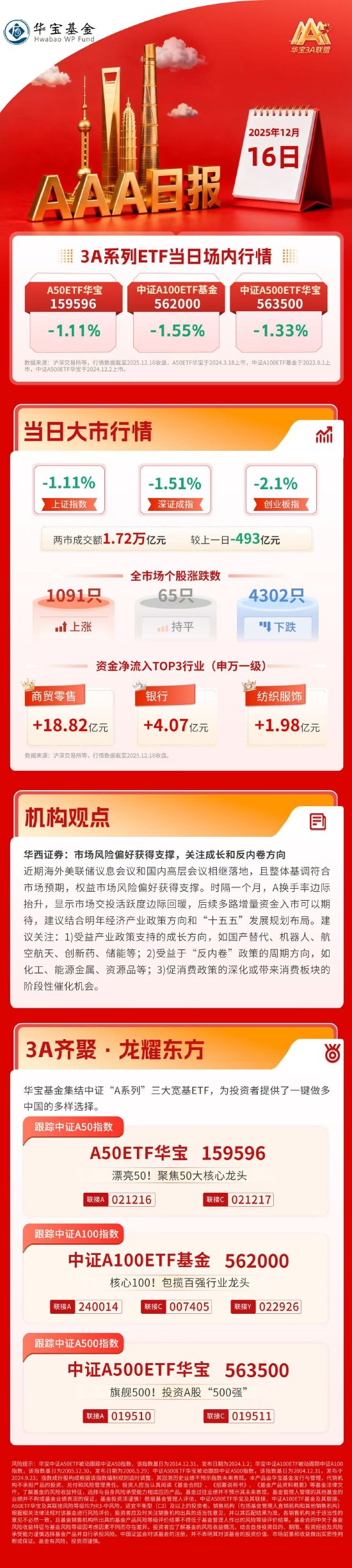
Group 1 - The market risk appetite has been supported by recent meetings of the Federal Reserve and domestic high-level conferences, aligning with market expectations [3][9] - The turnover rate has marginally increased, indicating a slight recovery in market trading activity, with expectations for multiple new capital inflows [3][9] - Suggested investment focus includes growth sectors benefiting from industrial policy support, such as domestic substitution, robotics, aerospace, innovative pharmaceuticals, and energy storage [3][9] Group 2 - The "A Series" ETFs from Huabao Fund provide investors with diverse options to invest in China, tracking major indices like the A50, A100, and A500 [4] - The A50 ETF focuses on 50 leading companies, while the A100 ETF encompasses the top 100 industry leaders, and the A500 ETF covers a broader range of 500 companies [4] - The total market turnover reached 1.72 trillion yuan, with a decrease of 493 billion yuan compared to the previous day, reflecting overall market dynamics [8]
港股医药板块午后回暖,恒生创新药ETF(159316)全天净申购约2000万份
Mei Ri Jing Ji Xin Wen· 2025-12-16 10:28
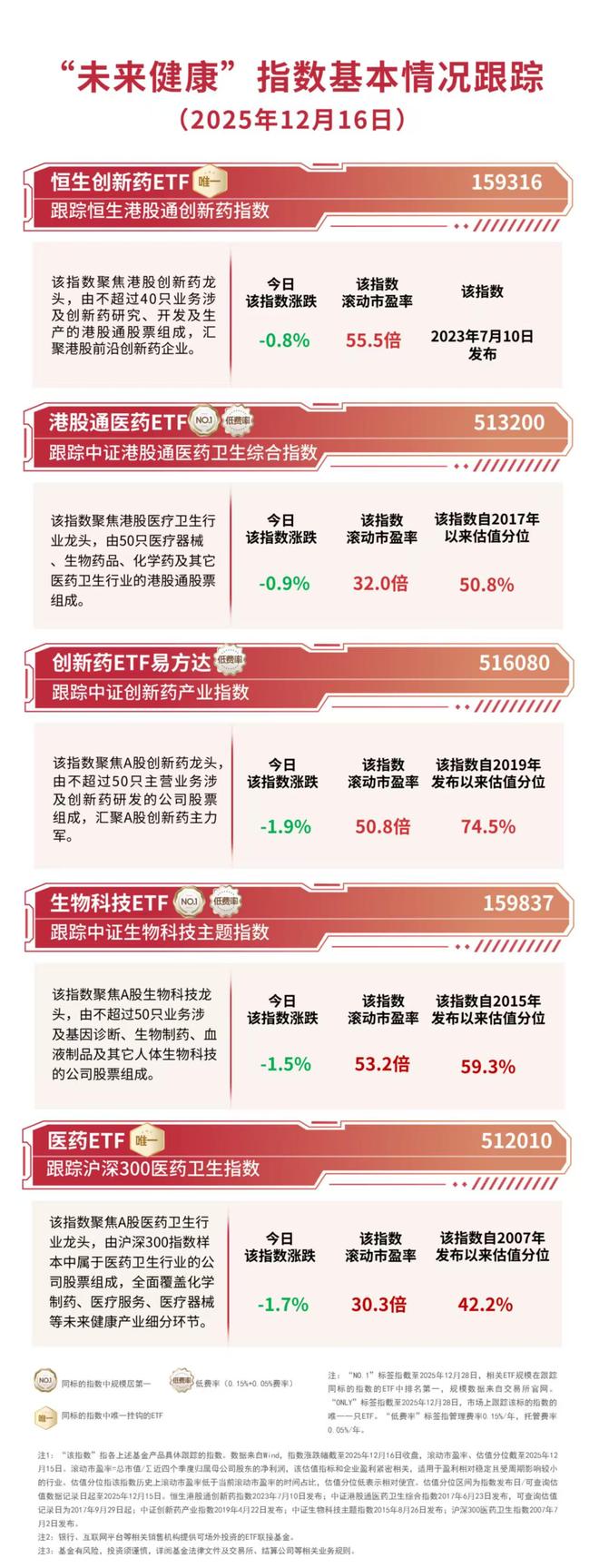
Market Overview - The A-share pharmaceutical sector opened lower and continued to decline, while the Hong Kong pharmaceutical sector showed signs of recovery in the afternoon, with a significant narrowing of losses [1] - The Hang Seng Hong Kong Stock Connect Innovative Drug Index fell by 0.8%, the China Securities Hong Kong Stock Connect Pharmaceutical and Health Comprehensive Index decreased by 0.9%, the China Securities Biotechnology Theme Index dropped by 1.5%, the CSI 300 Pharmaceutical and Health Index declined by 1.7%, and the China Securities Innovative Drug Industry Index fell by 1.9% [1] Fund Activity - Despite the market downturn, there was a counter-trend investment with the Hang Seng Innovative Drug ETF (159316) seeing a net subscription of approximately 20 million units throughout the day [1]
界面新闻2025年度医疗健康行业CEO榜单发布:药明康德李革、百利天恒朱义、迈瑞医疗吴昊列前三
Xin Lang Cai Jing· 2025-12-16 08:08
Core Insights - The article highlights the launch of the Super CEO series by Zhito Finance for the ninth consecutive year, featuring various sub-lists that reflect the diverse driving forces behind China's economic growth, particularly in the healthcare sector [1] Industry Overview - The Chinese pharmaceutical manufacturing industry is experiencing a decline, with revenue of 1,227.52 billion yuan in the first half of 2025, down 1.2% year-on-year, and total profit of 176.69 billion yuan, down 2.8% year-on-year, indicating ongoing industry pressure and deepening segmentation [1] - Since 2025, numerous policies have been introduced to support high-quality development in innovative pharmaceuticals, including measures to enhance the clinical trial approval process and the introduction of a commercial insurance directory for innovative drugs [2] - The medical device export sector continues to grow, with a total import and export value of 41.09 billion USD in the first half of 2025, a 1.1% increase year-on-year, while imports decreased by 3.9%, indicating a shift towards domestic alternatives in high-end equipment [3] Investment Trends - The overseas business development (BD) orders for innovative pharmaceuticals have reached a record high, surpassing 60 billion USD, with significant transactions indicating a shift in China's role from a follower to a contributor in the global pharmaceutical landscape [4] - Capital preferences are improving, with the healthcare industry in China seeing a recovery in financing activities, particularly in medical devices and innovative pharmaceuticals, with significant investments in areas like cancer screening and AI healthcare [5] Future Outlook - The 15th Five-Year Plan emphasizes the importance of health in economic development, aiming to enhance public health and support the growth of innovative drugs and medical devices, which will shape the future of the healthcare industry in China [6] - The aging population, active policy support, and the internationalization of medical devices are driving demand and supply upgrades in the healthcare sector, presenting both opportunities and challenges for industry leaders [6] CEO Insights - The Super CEO list features 25 leaders whose companies have shown median revenue growth of 6.11% and net profit growth of 16.08%, with an average market capitalization of 86.1 billion yuan [9] - The list includes a notable representation of women leaders, with three female CEOs demonstrating strong strategic vision in high-barrier industries [10] - The majority of CEOs on the list have advanced degrees, reflecting the industry's demand for leaders with deep scientific understanding and business acumen [10] Company Highlights - Li Ge, CEO of WuXi AppTec, leads the list, showcasing strong performance with a revenue of 32.857 billion yuan in the first three quarters of 2025, a year-on-year increase of 18.61% [17] - Zhu Yi, CEO of BaiLi TianHeng, achieved significant revenue growth through strategic partnerships, emphasizing the importance of building a robust product pipeline [18] - Wu Hao, CEO of Mindray, reported a revenue of 36.726 billion yuan in 2024, with a focus on R&D and international expansion [19] - Zhong Huijuan, CEO of Hansoh Pharmaceutical, became the richest woman in China with a revenue of 12.261 billion yuan in 2024, driven by innovative drug sales [19] - Shi Yifeng, CEO of Aimeike, led the company to a revenue of 3.026 billion yuan in 2024, emphasizing shareholder value through high dividend payouts [20]




A股收评:三大指数集体下挫!贵金属领跌,零售股逆市走高
Ge Long Hui· 2025-12-16 07:41
Market Overview - The A-share market experienced a collective decline, with the Shanghai Composite Index falling by 1.11% to 3824 points, the Shenzhen Component Index down by 1.51%, and the ChiNext Index dropping by 2.1% [1][2] - The total market turnover was 1.75 trillion yuan, a decrease of 463 billion yuan compared to the previous trading day, with over 4300 stocks declining [1] Sector Performance - The precious metals sector saw significant declines, with notable drops in stocks such as Xiaocheng Technology and Western Gold, which fell over 8% and 7% respectively [4][5] - The Hainan sector faced pressure, with New Dazhou A dropping over 9% and other stocks like Hainan Highway and Hainan Ruize also declining [10] - The controllable nuclear fusion sector experienced a sharp drop, with Guoji Heavy Industry and Jingda Co. hitting the daily limit down [8][9] - The retail sector saw gains, with stocks like Yonghui Supermarket and Cuilan Co. hitting the daily limit up, supported by government policies aimed at boosting consumption [12][16] Notable Stocks - Xiaocheng Technology closed at 29.46 yuan, down 8.51%, while Western Gold ended at 26.10 yuan, down 7.61% [5] - Yonghui Supermarket reached a closing price of 5.56 yuan, up 10.10%, following announcements from the central government regarding economic policies [12][16] - The film industry faced declines, with Bona Film Group hitting the limit down and other companies like China Film and Ciweng Media dropping over 9% [6][7] Policy Impact - The central government emphasized expanding domestic demand as a key task for the upcoming year, which is expected to influence market sentiment positively [11][16] - The Hainan Free Trade Port is set to officially start operations on December 18, 2025, which may impact local businesses and investment opportunities [13]


君实生物跌2.19%,成交额1.97亿元,近5日主力净流入-421.42万
Xin Lang Cai Jing· 2025-12-16 07:41
Core Viewpoint - The company, Junshi Biosciences, is focused on becoming a leading innovative pharmaceutical company with a complete industry chain capability, from drug discovery to commercialization, and is actively developing vaccines and monoclonal antibodies for various diseases, including monkeypox [2][3]. Company Overview - Junshi Biosciences was established on December 27, 2012, and went public on July 15, 2020. The company is headquartered in Shanghai and specializes in the research and commercialization of monoclonal antibodies and other therapeutic protein drugs [7]. - The main revenue sources for the company include drug sales (90.67%), technology licensing and royalties (8.74%), and technical services (0.59%) [7]. Financial Performance - For the period from January to September 2025, Junshi Biosciences reported a revenue of 1.806 billion yuan, representing a year-on-year growth of 42.06%. However, the net profit attributable to the parent company was -596 million yuan, which is a 35.72% increase compared to the previous year [8]. Product Development - The company has developed a comprehensive pipeline of innovative drugs, including the first domestically approved PD-1 monoclonal antibody, Toripalimab, which has received approval for 11 indications in mainland China and is also approved in multiple countries including the US and EU [2]. - Junshi Biosciences is also developing Tifcemalimab, the world's first anti-BTLA monoclonal antibody, which is currently in Phase III clinical trials [2]. Collaborations and Research - On October 27, 2023, Junshi Biosciences announced collaborations with several research institutions and universities to develop a recombinant protein vaccine for monkeypox, with related products currently in preclinical development [3].

中国银河证券:首次覆盖复宏汉霖(02696)予“推荐”评级 国内外业务稳步推进
智通财经网· 2025-12-16 07:37
Core Viewpoint - Fuhong Hanlin (复宏汉霖) is positioned as a leading player in the biosimilar drug market in China, focusing on hematological malignancies, solid tumors, and autoimmune diseases, with a strong emphasis on international collaboration and product commercialization [1][2] Group 1: Business Performance - In 2023, the company achieved profitability with projected revenue of 5.724 billion yuan in 2024, representing a 6% year-on-year growth, and a net profit of 815 million yuan, reflecting a 50% increase compared to the previous year [2] - The company is expected to enter a high-growth phase in overseas business by 2025, with overseas product profits projected to grow over 200% in the first half of 2025 [2] Group 2: Product Pipeline and R&D - HLX43, a potential BICPD-L1ADC, is under clinical development for multiple indications including lung cancer and gastric cancer, showing significant efficacy in clinical trials with an overall response rate (ORR) of 33.3% for squamous NSCLC and 48.6% for non-squamous NSCLC [3] - HLX22, in combination with trastuzumab, has shown improved efficacy and safety in treating HER2-positive gastric/gastroesophageal junction cancer, with ongoing global Phase III trials [3] - The company is also advancing the development of Surulitinib, which aims to replace postoperative chemotherapy in gastric cancer with immunotherapy, having met primary clinical endpoints [3] Group 3: Market Strategy and Valuation - The company has established a global presence with its biosimilar products, which are key drivers of revenue growth, and is considering implementing full circulation of H-shares to enhance liquidity [4] - The projected net profits for 2025-2027 are estimated at 823 million, 744 million, and 1.129 billion yuan respectively, with corresponding price-to-earnings ratios of 39, 43, and 28, suggesting a total market valuation between 52.1 billion and 67.9 billion yuan [4]

A股收评 | 沪指收跌1.11% 智能驾驶逆势拉升 资金抱团零售、食品饮料等消费主线
智通财经网· 2025-12-16 07:18
Market Overview - The market experienced a significant adjustment, with the Shanghai Composite Index falling over 1% and the ChiNext Index dropping over 2% [1] - Total market turnover reached 1.7 trillion yuan, with over 4,300 stocks declining [1] Reasons for Market Adjustment - The market is avoiding "gray rhino" risks, particularly in anticipation of the Bank of Japan's monetary policy meeting on December 18-19, where a 25 basis point rate hike to 0.75% is expected [1] - Recent declines in U.S. stocks, particularly Oracle and Broadcom, have reignited market disagreements regarding AI narratives [1] - A significant drop in the A-share commercial aerospace sector has negatively impacted market sentiment, affecting the defense and military industry [1] Sector Performance - Retail, food and beverage, and consumer sectors saw active trading, with stocks like Baida Group achieving four consecutive trading limits [1] - The smart driving concept saw gains, with stocks like Zhejiang Shibao and Suoling shares hitting the daily limit [1] - The digital currency sector strengthened, with stocks like Cuiwei Co. and Aerospace Information reaching the daily limit [1] - The real estate sector rebounded in the afternoon, with stocks like Shilianhang hitting the daily limit [1] - Declines were noted in sectors such as precious metals, film and television, and Hainan [1] Capital Movement - Main funds focused on retail, passenger vehicles, and education sectors, with notable net inflows into stocks like Yonghui Supermarket and Beiqi Blue Valley [3] Policy and Economic Outlook - The National Development and Reform Commission emphasized the importance of expanding domestic demand to strengthen the domestic economic cycle [6] - Shenzhen is promoting a series of actions to enhance its capital market, including support for the ChiNext reform and venture capital initiatives [7] Future Market Predictions - According to Everbright Securities, a new round of policy deployment is expected to support the A-share market's year-end performance, with a focus on TMT and advanced manufacturing sectors [9] - Huaxi Securities suggests that recent meetings have supported market risk appetite, with expectations for increased market activity and investment in growth and anti-involution sectors [10] - Dongfang Securities indicates that the market will continue to experience structural fluctuations, with a focus on core technology sectors [11]
A股收评:沪指跌1.11%、创业板指跌2.1%,影视院线、贵金属、光伏板块集体走低,全市场超4300只个股飘绿
Jin Rong Jie· 2025-12-16 07:13
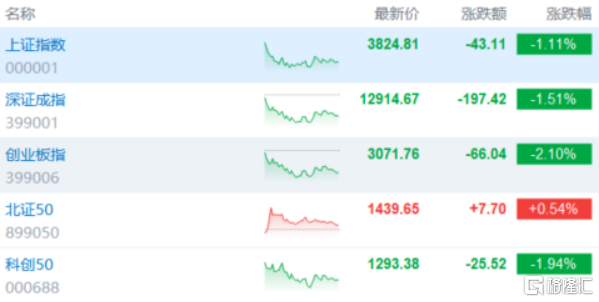
Core Viewpoint - The A-share market experienced a decline, with major indices falling, while certain sectors like retail and digital currency showed strength due to supportive government policies aimed at boosting consumption [1][2][4]. Group 1: Market Performance - The Shanghai Composite Index fell by 1.11% to 3824.81 points, the Shenzhen Component dropped by 1.51% to 12914.67 points, and the ChiNext Index decreased by 2.1% to 3071.76 points [1]. - The total trading volume in the Shanghai and Shenzhen markets reached 1.72 trillion yuan, with over 4300 stocks declining [1]. Group 2: Sector Highlights - The retail sector was notably active, with Baida Group achieving a four-day consecutive rise, and Hongqi Chain and Guangbai Shares both rising for two consecutive days [2]. - The dairy industry saw a resurgence, with Huangshi Group hitting a daily limit up and other companies like Huanlejia and Sunshine Dairy also performing well [3]. - Digital currency-related stocks strengthened, with companies like Aerospace Information and Cuilong Shares hitting daily limits [4]. Group 3: Institutional Insights - Everbright Securities anticipates a favorable cross-year market for A-shares, supported by ongoing domestic economic policies and historical trends indicating strong market performance at the beginning of new five-year plans [5]. - Huaxi Securities highlights that recent meetings have bolstered market risk appetite, suggesting a focus on growth sectors and industries benefiting from anti-involution policies [6]. - Dongfang Securities emphasizes the importance of core technology sectors, noting that the market may continue to experience structural fluctuations as it approaches year-end [7].
