
多边主义

Search documents
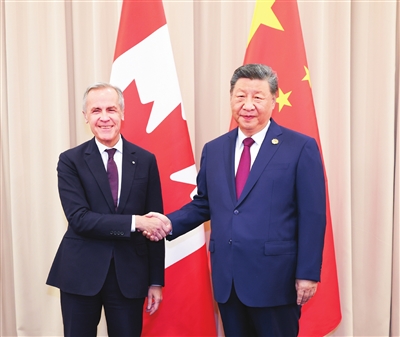
习近平分别会见加拿大总理、泰国总理、日本首相
Xin Hua She· 2025-11-01 01:03
Group 1: China-Canada Relations - President Xi Jinping emphasized the importance of restoring and improving China-Canada relations, marking the 55th anniversary of diplomatic ties and the 20th anniversary of the strategic partnership [3][4] - Both sides agreed to enhance cooperation in agriculture, energy, and climate change, aiming for mutual benefits and increased welfare for their peoples [4] - The two countries will work together to address specific economic issues and strengthen their strategic partnership [4] Group 2: China-Thailand Relations - Xi Jinping expressed condolences for the passing of Thailand's Queen Mother and highlighted the strong ties between China and Thailand, celebrating the 50th anniversary of diplomatic relations [6][7] - Both nations aim to deepen cooperation in various fields, including trade, technology, and tourism, to elevate their relationship to new heights [7] - China is willing to share its development experiences and enhance collaboration on infrastructure projects like the China-Thailand railway [7] Group 3: China-Japan Relations - Xi Jinping noted the significance of maintaining a healthy and stable relationship between China and Japan, emphasizing mutual cooperation and understanding [8][9] - The Chinese side urged Japan to adhere to historical agreements and principles to ensure a solid foundation for bilateral relations [9] - Japan expressed its commitment to maintaining high-level exchanges and enhancing cooperation in various sectors, including regional stability [10]

习言道 | “拆墙”与“拉手”,习近平诠释APEC初心
Zhong Guo Xin Wen Wang· 2025-11-01 00:51
Core Points - The article emphasizes the importance of APEC's founding principles and the need for resilient cooperation in the Asia-Pacific region to contribute significantly to the world [3][5]. - Xi Jinping's speech at the APEC Business Leaders' Summit highlights the challenges posed by unilateralism and protectionism, advocating for multilateralism and open cooperation [5][10]. Group 1: APEC's Founding Principles - APEC was established over 30 years ago to promote trade and investment liberalization and support economic growth and prosperity [4]. - Today, the Asia-Pacific region accounts for over 60% of the global economy, nearly half of global trade, and contributes 70% to global economic growth [5]. Group 2: Current Challenges and Responses - Xi Jinping poses critical questions regarding the future direction of international cooperation, contrasting unity and cooperation with hegemonism and the jungle law [5]. - The speech reiterates the need for "breaking walls" to maintain stable global supply chains and industry chains, reflecting China's commitment to high-level opening-up [7]. Group 3: Metaphors of Cooperation - Xi Jinping uses the metaphor of "holding hands" to emphasize the importance of connectivity and collaboration among APEC members, advocating for mutual support rather than disengagement [8][9]. - The concept of "holding hands" also symbolizes the need for inclusivity and cooperation in the diverse development paths of APEC members [9].

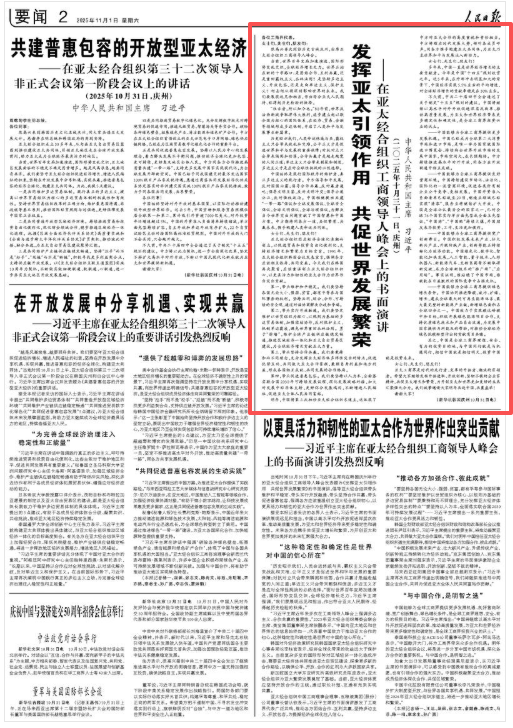
在亚太经合组织工商领导人峰会上的书面演讲:发挥亚太引领作用 共促世界发展繁荣
Ren Min Ri Bao· 2025-10-31 23:30
Core Points - The speech emphasizes the importance of unity and cooperation in addressing global challenges, advocating for multilateralism over unilateralism and protectionism [2][3] - China positions itself as a key contributor to global economic growth, with an average growth rate of approximately 5.5% over the past five years, contributing around 30% to global economic growth [6] - The country aims to provide a favorable business environment, with a significant reduction in foreign investment restrictions and a commitment to high-level opening up [7] Group 1: Global Economic Context - The current global economic landscape is characterized by instability and a lack of growth, necessitating a choice between cooperation and conflict [2][3] - Historical context is provided, highlighting the establishment of a multilateral system post-World War II, which is essential for peace and development [3] Group 2: China's Role and Contributions - China has proposed several initiatives, including the Belt and Road Initiative and global governance proposals, to address pressing global issues [3] - The country is recognized as the second-largest consumer and import market globally, presenting significant opportunities for international businesses [6][7] Group 3: Business Environment and Opportunities - China is committed to creating a market-oriented, law-based, and international business environment, enhancing fair competition among various ownership enterprises [7] - The nation is advancing in future industries and green technologies, positioning itself as a leader in innovation and sustainable development [8]
韩国专家:亚太各方应携手共建可持续未来
Zhong Guo Xin Wen Wang· 2025-10-31 22:52
Core Viewpoint - The APEC meeting in Gyeongju, South Korea, is significant for promoting cooperation in the Asia-Pacific region, emphasizing the need for multilateral collaboration and sustainable development [1][2]. Group 1: APEC Meeting Significance - The APEC meeting is described as a historic multilateral diplomatic platform with multi-layered and comprehensive significance [1]. - It serves as an important opportunity for rebuilding trust and consensus in the Asia-Pacific region amid complex international circumstances [1]. Group 2: Economic Cooperation and Trade - The meeting advocates for multilateral cooperation and free trade while opposing unilateralism and protectionism, reflecting a common desire among member countries [1]. - China's role in promoting free trade and multilateralism is highlighted, with expectations for its leadership as the APEC host in 2026 [2]. Group 3: Themes and Goals - The theme of the meeting is "Building a Sustainable Tomorrow," focusing on cooperation to address global economic and social transformation challenges [1]. - Key concepts introduced include "connectivity, innovation, and prosperity," aiming to foster tighter global connections and explore new growth paths through digital innovation [1].
“越是风高浪急,越要同舟共济”
Xin Hua She· 2025-10-31 22:44
Core Points - The APEC meeting in Gyeongju, South Korea, on October 31, 2023, highlighted the need for cooperation in the face of global economic challenges, with Chinese President Xi Jinping emphasizing the importance of a collective approach to development [1][2][3] - Xi proposed five key suggestions for fostering an open and inclusive economic environment in the Asia-Pacific region, including maintaining a stable multilateral trade system and promoting digital and green trade [2][3] Group 1 - The APEC meeting serves as a platform for discussing the challenges of instability and uncertainty in the Asia-Pacific region, with Xi calling for unity among member economies [2] - Xi's emphasis on "共同维护多边贸易体制" (jointly maintaining the multilateral trade system) reflects a commitment to international cooperation and economic globalization [2] - The international media has recognized Xi's role as a proponent of economic globalization and multilateralism during the APEC summit [2] Group 2 - The recent Chinese Communist Party meeting outlined a five-year development plan, which Xi indicated would be leveraged to deepen reforms and expand high-level openness [3] - Xi's vision for the future includes collaboration with Asia-Pacific nations to create shared prosperity and development opportunities [3]
在开放发展中分享机遇、实现共赢
Ren Min Ri Bao· 2025-10-31 22:32
Core Points - The speech by President Xi Jinping emphasizes the importance of multilateralism and regional economic cooperation in the Asia-Pacific region, proposing five key suggestions for future development [1][2][3]. Group 1: Economic Cooperation and Multilateralism - Xi Jinping's five suggestions include maintaining a multilateral trade system, creating an open regional economic environment, ensuring stable supply chains, promoting digital and green trade, and fostering inclusive development [1][2]. - Strengthening regional economic cooperation and maintaining stable supply chains can help reduce conflict risks and enhance the ability of member economies to respond to economic fluctuations [2][3]. - The establishment of the APEC Free Trade Area and the commitment to the Bogor Goals reflect APEC's long-term dedication to maintaining a multilateral trade system [2][3]. Group 2: China's Role and Contributions - China's approach to global challenges through cooperation and dialogue is highlighted, with a focus on opposing unilateralism and protectionism [3]. - The promotion of artificial intelligence and economic policy coordination in the Asia-Pacific region is seen as a way to bridge the digital divide and ensure that technological advancements benefit more countries [4]. - China's advancements in clean energy and green technology, such as solar and wind energy, are setting a benchmark for global green transformation [5].
以更具活力和韧性的亚太合作为世界作出突出贡献
Ren Min Ri Bao· 2025-10-31 22:32
Group 1 - Xi Jinping's speech at the APEC Business Leaders Summit emphasizes the importance of maintaining peace, stability, and cooperation in the Asia-Pacific region, advocating for open and inclusive development [1][2][4] - The speech reflects China's commitment to high-level opening-up and deep reforms, aiming to provide more stability and certainty for the Asia-Pacific and global economies [1][2][6] - Various stakeholders express that China's consistent message of promoting cooperation in the Asia-Pacific is crucial for regional economic integration and shared benefits [2][3][4] Group 2 - Xi Jinping's proposals include equal participation of all countries in international affairs, maintaining a multilateral trade system centered around the WTO, and promoting sustainable development [4][6] - The business community resonates with Xi's call for collaboration and mutual benefit, viewing it as a way to boost confidence in economic globalization [3][4] - China is seen as an ideal investment destination, offering numerous opportunities and a conducive business environment, which is expected to be highlighted in the upcoming APEC meetings [5][6]
共促繁荣 共赢未来(和音)
Ren Min Wang· 2025-10-31 22:29
Group 1 - The core message emphasizes China's commitment to high-quality development and expanding high-level openness, aiming to create new opportunities and drive global economic growth through its new development model [1][3][4] - The Asia-Pacific Economic Cooperation (APEC) was established to promote trade and investment liberalization, and has played a significant role in maintaining strong economic growth in the Asia-Pacific region over the past 30 years [1][2] - Current global challenges necessitate a collective response that emphasizes multilateralism, openness, and cooperation among APEC members to meet the expectations of the Asia-Pacific people [1][2] Group 2 - President Xi Jinping outlined four key proposals for APEC cooperation: maintaining peace and stability, promoting open connectivity, adhering to win-win cooperation, and fostering inclusive development [2][3] - China has been a major contributor to global economic growth, achieving an average growth rate of approximately 5.5% during the 14th Five-Year Plan period, contributing around 30% to global economic growth [3] - China is recognized as a safe and promising investment destination, with the consensus that "working with China means working with opportunities" [3][4] Group 3 - China will host APEC for the third time, reflecting its commitment to regional cooperation and responsibility [4] - The country has actively proposed and implemented various global initiatives, showcasing its role as a defender of the current international order and a practitioner of true multilateralism [4] - China aims to deepen cooperation and achieve development through openness and inclusivity, contributing to global peace and development [4]
习近平会见日本首相高市早苗
证监会发布· 2025-10-31 14:31
Core Viewpoint - The meeting between Chinese President Xi Jinping and Japanese Prime Minister Suga Yoshihide emphasizes the importance of maintaining a stable and constructive Sino-Japanese relationship, aligning with the expectations of both nations and the international community [2][3]. Group 1: Opportunities and Challenges in Sino-Japanese Relations - Xi Jinping highlighted that Sino-Japanese relations currently face both opportunities and challenges, urging the new Japanese cabinet to adopt a correct understanding of China and to value the efforts of past leaders in developing bilateral relations [3]. - The importance of adhering to key political consensus, such as "comprehensively promoting strategic mutual benefit" and "learning from history while looking to the future," was stressed to ensure the foundation of Sino-Japanese relations remains intact [3]. Group 2: Areas for Cooperation - There is significant potential for cooperation in various sectors, including high-end manufacturing, digital economy, green development, finance, healthcare, and third-party markets, as outlined in China's 14th Five-Year Plan [3]. - Both countries are encouraged to work together to maintain a stable multilateral trade system and ensure the smooth operation of industrial and supply chains [3]. Group 3: Enhancing Communication and Understanding - Continuous communication between governments, political parties, and legislative bodies is essential to deepen cultural and local exchanges, thereby improving public sentiment between the two nations [3]. - The promotion of multilateral cooperation based on principles of neighborly friendship, equality, mutual benefit, and non-interference in internal affairs is vital for building an Asia-Pacific community [3]. Group 4: Managing Differences - It is crucial to focus on the bigger picture, seek common ground while reserving differences, and avoid allowing conflicts to define the bilateral relationship [3].

世贸组织副总干事张向晨:全球化方向并未改变
Xin Hua Cai Jing· 2025-10-31 14:26
Core Insights - Despite challenges to globalization, the direction remains unchanged, with future international cooperation still possible [1][2] - Non-commercial factors, such as security concerns, have gained importance in policy decisions, leading to skepticism about the effectiveness of multilateralism [1] - A significant majority of international trade, 72%, continues to operate under the World Trade Organization's Most-Favored-Nation principle [1] Summary by Sections Global Trade Environment - The global economic and trade environment has undergone profound changes in recent years, with non-commercial factors influencing policy decisions [1] - Unilateral measures have had a noticeable impact on trade, yet the overall direction of globalization remains intact [1] Future Cooperation - There is still room for international cooperation despite unfavorable short-term conditions [1] - Countries supporting multilateralism and trade liberalization should adhere to WTO rules and adopt a constructive approach to problem-solving [1] Opportunities for Development - Digitalization, green development, and cutting-edge technology present new opportunities and tools for addressing global challenges [2] - The WTO aims to build multilateral cooperation mechanisms to enhance the stability and predictability of rules, thereby ensuring global economic resilience [2]