AI医疗

Search documents
8亿+战略合作落地!港仔机器人:重塑人类健康管理,开启
Zhi Tong Cai Jing· 2025-09-17 08:28
Core Insights - The collaboration between 港仔机器人集团 and 美年健康 marks a significant shift in the global health industry, introducing AI-driven health services through a strategic partnership valued at over 800 million yuan [1][5]. Group 1: Partnership Overview - The partnership aims to deploy 20,000 "smart health robot examination centers" over the next three years, transforming health services by making them more accessible and convenient for the public [2][4]. - This initiative will create a vast "human-machine collaborative health service network," allowing individuals to receive health assessments in their workplaces, communities, and factories [2][4]. Group 2: Technological Integration - 港仔机器人的 advanced humanoid robots will integrate over 30 instant detection functions, providing comprehensive health data collection, while 美年健康 will leverage its expertise to analyze this data and offer personalized health plans [3][4]. - The "海睿OS" cloud-based medical brain will enable real-time data processing for millions of users, addressing healthcare disparities by providing high-quality health guidance even in remote areas [3][5]. Group 3: Market Impact - The collaboration combines 美年健康's extensive network of over 500 clinics and a large customer base with 港仔机器人的 cutting-edge technology, creating a differentiated service system in health management [4]. - This partnership is expected to reach 300,000 corporate users and millions of individual users, establishing a new standard for AI in healthcare and showcasing China's capabilities in the global medical AI landscape [5].


迈瑞香港上市提速,年度最大医械融资背后的信号
思宇MedTech· 2025-09-17 03:59
Core Viewpoint - Mindray Medical is accelerating its secondary listing in Hong Kong, aiming to raise at least $1 billion, which would be one of the largest medical device secondary listings in Hong Kong this year [3][4]. Group 1: Business Structure and Financial Performance - Mindray Medical's business is divided into three main pillars: Life Information and Support, In Vitro Diagnostics, and Medical Imaging, which together form a robust revenue base [4]. - In 2024, the company expects total revenue of 36.73 billion RMB, with a net profit of approximately 11.7 billion RMB and R&D investment exceeding 4 billion RMB, maintaining a high ratio of about 11% of revenue [4]. - The company's international business revenue reached 16.4 billion RMB in 2024, a year-on-year increase of 21.3%, accounting for nearly 45% of total revenue [16]. Group 2: Technological Advancements - Mindray launched the "Qiyuan" critical care AI model in 2024, achieving over 95% accuracy in clinical applications, marking a significant step for domestic medical AI products [13]. - The company has integrated automation in laboratory systems to enhance efficiency and standardization, showcasing its capability in system integration [7][10]. Group 3: Globalization Strategy - Mindray's international strategy has evolved from exporting to localizing operations, with significant investments in local production and service teams in key markets like India and Brazil [16][14]. - The company has established localized production projects in 13 countries, transitioning from an "exporter" to a "multinational medical solution provider" [16]. Group 4: New Growth Areas - Mindray is actively expanding into minimally invasive surgery and high-value consumables, acquiring a 24.61% stake in Huatai Medical for 6.65 billion RMB to enter the cardiovascular intervention market [17]. - The minimally invasive surgery segment has seen over 90% growth, with significant breakthroughs in ultrasound knives and energy platforms [18]. Group 5: Market Challenges - The medical device industry faces challenges from centralized procurement policies, which have significantly reduced prices, impacting profit margins [21]. - Domestic competitors are rapidly emerging, necessitating Mindray to leverage R&D and system integration to maintain a competitive edge [21]. Group 6: Rationale for Hong Kong Listing - The timing of the Hong Kong secondary listing is driven by the need for capital to support significant investments in new headquarters and AI medical centers [22]. - Listing in Hong Kong will enhance Mindray's international brand recognition and attract global institutional investors [22][23]. Group 7: Conclusion - The secondary listing in Hong Kong represents a pivotal moment in Mindray's global strategy, emphasizing its capabilities in digital ecosystems, AI applications, and international market localization [24].



德适生物宋宁:千亿医学影像市场有望迎来智能化
Xin Jing Bao· 2025-09-17 01:41
Core Insights - The medical imaging field faces a significant contradiction between high demand for services and a shortage of qualified professionals, with only 1.43 radiologists per 100,000 people in China [1] - AI is identified as a key tool to address the challenges in medical imaging, particularly in enhancing diagnostic accuracy and efficiency [1][2] - The AI-driven medical imaging market in China is projected to reach a scale of 2.4 billion yuan by 2024, with an expected annual growth rate of 60.2% until 2030 [1] Group 1 - The demand for medical imaging services in China reaches hundreds of millions of instances annually, while the disparity in diagnostic interpretations among different doctors can be as high as 20% under heavy workloads [1] - The integration of AI in medical imaging is one of the fastest-growing sectors in AI healthcare development, aiming to alleviate the burden on radiologists and improve diagnostic consistency [1] - The company, 德适生物, is developing a generalized foundational model for medical imaging that supports basic diagnostic capabilities for thousands of diseases [1] Group 2 - The implementation of AI is expected to allow doctors more time to learn advanced medical knowledge and to train specialized AI imaging models for rare and emerging cases, ultimately leading to more precise and standardized medical care [2] - This advancement is anticipated to help bridge the gap in healthcare quality between urban and rural areas [2]
九安医疗(002432) - 002432九安医疗投资者关系管理信息20250916
2025-09-16 14:28
Group 1: Company Valuation and Financial Performance - The company uses a valuation model based on PB (Price to Book) and PE (Price to Earnings) ratios, with a focus on net financial assets and segment profits [3] - As of mid-2025, the asset allocation includes 59.2% fixed income, 26.2% public equity, 12.6% private equity, and 2.0% hedge funds [3] - The company aims for a long-term return of 6%-10% per year from its diversified asset management strategy [3] Group 2: Business Growth and Market Opportunities - The iHealth product line's revenue in H1 2025 exceeded that of H1 2024, with improved gross margins following the launch of new products [4] - The CGM (Continuous Glucose Monitoring) market in China is projected to reach over 5 billion RMB by 2025, while in the U.S., it could exceed 6 billion USD [4] - The company is expanding its diabetes care model, currently serving approximately 366,000 patients across 424 hospitals in China [6] Group 3: Shareholder Returns and Market Management - The company has committed to a shareholder return plan, ensuring cash dividends (including share buybacks) will not be less than 30% of cumulative net profits from 2025 to 2027 [11] - Since 2021, the company has executed five share buyback programs, spending a total of approximately 2.88 billion RMB and repurchasing 94,921,428 shares [7] - Cumulative cash dividends since 2020 amount to approximately 1.74 billion RMB [7] Group 4: Talent Management and Incentives - The company employs a "cash + equity" compensation model to attract and retain talent, linking employee performance to company value [8] - The management emphasizes the importance of aligning employee interests with shareholder value through stock options and equity participation [8] Group 5: Investment and Strategic Focus - The company is focused on expanding its core business areas, particularly in IVD (In Vitro Diagnostics), home medical devices, and internet healthcare [10] - The company is cautious about pursuing acquisitions outside its main business areas due to the high risks and costs associated with entering unfamiliar markets [10] - The company has initiated investments in venture capital, with some projects entering the IPO preparation stage [9] Group 6: AI and Technological Advancements - The company is developing an "AIoT Diabetes Home Assistant" project to enhance chronic disease management through AI technology [13] - The project aims to improve care efficiency and patient experience by integrating AI with IoT devices [14]

医药行业2025年中报总结:持续看好创新药、AI医疗、脑机接口等方向
Southwest Securities· 2025-09-16 11:34
Investment Rating - The report maintains a positive outlook on innovative drugs, AI healthcare, and brain-computer interfaces [1]. Core Insights - The report analyzes 362 pharmaceutical listed companies, including those on the Sci-Tech Innovation Board, reporting a total revenue of 1,084.5 billion yuan in H1 2025, a decrease of 2.1% year-on-year. The net profit attributable to shareholders was 103.64 billion yuan, down 1.1%, while the net profit excluding non-recurring items was 88.905 billion yuan, down 9.4% [3][17]. - In H1 2025, 165 companies achieved revenue growth, accounting for 46% of the total, while 165 companies also reported positive net profit growth, also 46% [17]. Summary by Relevant Sections Overall Industry Performance - The pharmaceutical industry faced pressure from policies and macroeconomic conditions, leading to a decline in performance in H1 2025 [19]. - The overall revenue for the industry decreased by 2.1%, with a net profit decline of 1.1% [46]. Subsector Analysis - **Innovative Drugs and Formulations**: Revenue was 194.6 billion yuan (-2.0%), with net profit at 25.8 billion yuan (+1.2%) [5]. - **Medical Devices**: Revenue decreased to 96.8 billion yuan (-5%), with net profit down 16.9% [5]. - **CXO Services**: Revenue increased by 13.8% to 44.85 billion yuan, with net profit rising 64.6% [5]. - **Active Pharmaceutical Ingredients**: Revenue remained stable at 52.88 billion yuan, with net profit increasing by 19.1% [5]. - **Life Sciences**: Revenue was 3.9 billion yuan (-1.8%), with net profit down 3.6% [7]. - **Medical Services**: Revenue grew by 0.9% to 28.3 billion yuan, but net profit fell by 10.2% [7]. - **Blood Products**: Revenue was approximately 11.7 billion yuan (-0.3%), with net profit down 14.4% [7]. - **Retail Pharmacies**: Revenue was 57.8 billion yuan (+0.1%), with net profit up 0.9% [9]. - **Pharmaceutical Distribution**: Revenue increased by 0.9% to 404.57 billion yuan, with net profit rising 12.4% [9]. - **Traditional Chinese Medicine**: Revenue decreased by 4.8% to 173 billion yuan, with net profit slightly up by 0.6% [9]. - **Vaccine Sector**: Revenue plummeted by 58.0% to 10.5 billion yuan, with a net loss of 0.5 billion yuan [11]. Financial Metrics - The overall gross margin for the industry was 32.4%, with a decline in the four expense ratios [46][49]. - The report highlights that the CXO sector showed the highest growth in both revenue and net profit, indicating a strong recovery trajectory [34][37].
从AI排床位到AI写病例,透过14个案例,看懂AI医疗落地正确姿势
3 6 Ke· 2025-09-15 23:20
Core Insights - The emergence of generative AI has positioned healthcare as a critical application area, attracting significant capital investment, with companies like OpenEvidence raising $210 million, Qventus $105 million, and Chai Discovery $70 million in funding rounds [1] - AI's role in healthcare is evolving from a supportive tool to a core workflow component, directly influencing clinical decisions and operational processes [2] - The healthcare AI industry is transitioning from single-point solutions to multi-modal models that enhance entire workflows, focusing on both clinical and operational efficiency [3] Investment Trends - Major investments in healthcare AI include Redpoint's backing of six companies, emphasizing areas such as clinical decision support and drug development [1] - Companies are leveraging AI to create structured data from patient interactions, exemplified by Abridge, which transforms doctor-patient conversations into actionable data streams [1] Business Models - AI healthcare companies primarily generate revenue through two models: enhancing existing processes for clear ROI and developing new market segments with longer cycles and higher potential returns [3][7] - Companies like Qventus and Outcomes4Me align their pricing models with client benefits, charging based on savings or successful patient enrollments [23] Case Studies - Qventus utilizes predictive analytics to reduce average hospital stays by 0.6 days, translating to increased profitability for hospitals [4][26] - OpenEvidence provides rapid, evidence-based answers to clinical queries, achieving a monthly consultation volume exceeding 8.5 million [16] - Truveta aggregates de-identified electronic health records and genomic data for pharmaceutical and insurance companies, charging for data access [18] Diagnostic Innovations - Companies like Quibim and Viz.ai focus on specific disease areas, offering advanced imaging analysis and real-time alerts for critical conditions [10][11] - AI-driven diagnostic tools are increasingly integrated into clinical workflows, enhancing efficiency and accuracy [10] Early Detection and Screening - Platforms like Tempus and Freenome are pioneering multi-omics approaches for early cancer detection, combining genomic data with clinical insights [29][30] - These companies employ complex business models involving milestone payments and data licensing, indicating a longer return cycle but larger market potential [28] Operational Efficiency - AI is systematically penetrating labor-intensive areas of healthcare, addressing issues like appointment scheduling and resource allocation [23] - Companies are demonstrating quantifiable ROI through metrics such as reduced hospital stays and improved trial enrollment rates [23]
调研速递|康泰医学接受投资者调研,聚焦产品研发与市场布局要点
Xin Lang Cai Jing· 2025-09-15 10:55
Core Viewpoint - 康泰医学 held an investor relations meeting on September 15, 2025, to discuss product development and market strategies, revealing significant insights into their operations and future plans [1] Group 1: Product Development - The "Embodied Motion Rehabilitation Intelligent Equipment" project, led by Hebei University of Technology in collaboration with Fudan University and Yanshan University, won the first prize in the 2024 Hebei Provincial Science and Technology Progress Award, indicating successful technology transfer into business applications [1] - The company is focusing on the development of mid-to-high-end products and medical devices to address product homogenization and meet changing market demands [1] - The company is actively working on the development of exoskeleton robot products and will disclose relevant information as per regulatory requirements [1] Group 2: Market Strategy - 康泰医学 is enhancing its domestic market presence through deep collaborations with leading e-commerce platforms to boost brand awareness and influence [1] - The company plans to expand its global market coverage by leveraging research and product advantages, targeting regions such as Southeast Asia, Africa, and South America, driven by the increasing demand for cost-effective medical devices due to global aging and home healthcare trends [1] Group 3: Financial Performance - The company's second-quarter profits were impacted by market conditions, seasonal sales, and increased R&D investments, prompting a focus on market promotion, product structure optimization, and cost control to enhance profitability [1] - Shareholder reductions were attributed to personal funding needs, with the company adhering to regulations and commitments while maintaining normal operations [1] Group 4: AI and Innovation - 康泰医学 is investing in AI technology, exploring its integration with medical devices, and focusing on innovations in patient monitoring through algorithm development, aiming to advance smart healthcare [1]
康泰医学(300869) - 300869康泰医学投资者关系管理信息20250915
2025-09-15 09:36
Group 1: Product Development and Innovation - The company has developed key technologies in "embodied motion rehabilitation intelligent equipment," which won the 2024 Hebei Provincial Science and Technology Progress Award [2] - Ongoing projects include medical endoscopes, in vitro diagnostic products, and dental consumables to meet changing market demands [3] - The company focuses on high-end products and has optimized existing products in ECG, blood pressure, and blood oxygen categories while actively developing new products [2] Group 2: Market Strategy and Expansion - The company is enhancing its domestic market presence through deep cooperation with leading e-commerce platforms to increase brand awareness [4] - Plans to expand into Southeast Asia, Africa, and South America are underway, targeting the growing demand for cost-effective medical devices in these regions [6] - The company aims to improve global market coverage and penetration through localized construction and cross-border e-commerce initiatives [6] Group 3: Financial Performance and Governance - The company's performance in the second quarter was not profitable, with profits primarily from the first quarter; management remains confident in future growth [7] - Shareholder reductions in holdings are attributed to personal financial needs and comply with legal regulations [7] - Recent changes in the supervisory board were part of normal governance optimization and did not involve any collective board incidents [4] Group 4: Technological Advancements - The company is actively investing in AI technology, focusing on integrating AI with medical devices and developing algorithms for patient monitoring [7] - Innovations include multi-mode temperature detection and pulse wave-based respiratory rate calculations, contributing to the advancement of smart healthcare [7]
2025中国细胞与基因治疗大会在京举办
Zhong Guo Jing Ji Wang· 2025-09-15 08:31
Core Insights - The China Cell and Gene Therapy Conference (CSGCT) was held in Beijing, focusing on regulatory frameworks and global collaboration in the CGT sector [1] - The establishment of the CSGCT alliance aims to create an international platform for scientific research and collaboration in cell and gene therapy [1] - The conference highlighted the importance of building a global incubation platform for future pharmaceutical and health industries, particularly in Beijing [1] Group 1: Conference Overview - The conference attracted nearly 2,000 participants, including over 10 international leaders in CGT, scientists, clinicians, entrepreneurs, and investors [1] - The event featured one main forum, 15 sub-forums, and two project roadshows, covering various aspects of cell and gene therapy [1][2] - The release of the "Blue Book on the Development and Regulatory Policy Interpretation of China's Cell and Gene Therapy Industry" provided a significant resource for industry dialogue [1] Group 2: Expert Discussions - International experts discussed global opportunities and challenges in CGT, with a focus on international collaboration [2] - Key topics included advancements in gene editing and the historical impact of the HEK 293 cell line [2] - A roundtable discussion on "China's CGT Ecological Practices and Global Competitiveness" involved prominent figures from various sectors, aiming to strategize for China's CGT global development [2] Group 3: Sub-Forums and Project Roadshows - The gene therapy sub-forum focused on CNS diseases, ophthalmology, and cardiovascular metabolic diseases, while the immune cell therapy forum addressed major directions in oncology and autoimmune diseases [3] - The project roadshows facilitated connections between innovative companies and international capital, with participation from well-known investment firms [3] - CSGCT is recognized as one of the most influential international conferences in China's CGT field, promoting collaboration across the entire value chain from research to global cooperation [3]
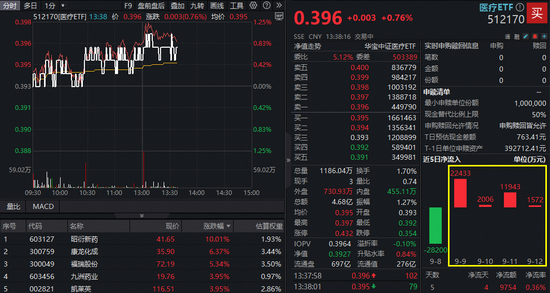
CXO龙头集体走强,昭衍新药涨停!A股最大医疗ETF(512170)盘中涨逾1%,近4日大举吸金3.8亿元
Xin Lang Ji Jin· 2025-09-15 06:03
Core Viewpoint - The medical sector is experiencing significant growth, with the largest medical ETF in A-shares (512170) showing a notable increase and attracting substantial investment recently [1][3]. Group 1: ETF Performance - The medical ETF (512170) rose over 1% on September 15, with a trading volume exceeding 460 million yuan [1]. - The ETF has attracted a total of 380 million yuan over four consecutive days leading up to September 12, bringing its total size to 27.584 billion yuan, ranking first among similar ETFs [1]. Group 2: Stock Performance - CXO stocks performed well, with notable gains from companies such as Zhaoyan New Drug, which hit the daily limit, and Kanglong Chemical and Jiuzhou Pharmaceutical, with increases of 6.37% and 3.95% respectively [3]. - Conversely, companies like BGI Genomics, Weining Health, and BGI Intelligent Manufacturing saw declines of 2.91%, 2.38%, and 1.93% respectively [3]. Group 3: Industry Outlook - According to Wanlian Securities, the overall revenue of the medical R&D outsourcing CXO sector is expected to grow by 13.77% year-on-year in the first half of 2025, with net profit attributable to shareholders increasing by 63.82% [3]. - The period from September 1 to 15, 2025, saw over 400 new Class I drugs in clinical trials and more than 1,800 Class II and III medical devices approved for market [3]. - Xinda Securities highlighted that the recovery of in-hospital procurement in the high-end medical device sector is driving growth, alongside a gradual recovery in consumer medical demand and increased penetration of high-end consumables [3]. Group 4: ETF Composition - The ETF (512170) and its off-market linked fund (012323) passively track the CSI Medical Index, with the top ten weighted stocks including WuXi AppTec, Mindray Medical, and United Imaging Healthcare [4][5].