
人工智能教育

Search documents
微软承诺支持人工智能教育 将为美国大学生免费提供Copilot AI
Ge Long Hui A P P· 2025-09-05 02:43
Core Viewpoint - Microsoft announced a series of new commitments to support artificial intelligence education in response to an executive order during a meeting of the White House AI Education Task Force [1] Group 1: Commitments to Education - Microsoft will provide free access to Microsoft 365 Personal for 12 months to every college student in the U.S. [1] - The company will offer broader access to Microsoft 365 Copilot [1] - Microsoft is allocating $1.25 million for teacher training [1] - Free LinkedIn Learning AI courses will be provided for students, teachers, and job seekers [1]

微软承诺支持人工智能教育 将为美国大学生免费提供Copilot AI-美股-金融界
Jin Rong Jie· 2025-09-05 02:08
Core Points - Microsoft announced a series of new commitments to support an executive order related to artificial intelligence education during a meeting of the White House AI Education Task Force [1] Group 1: Commitments to Education - Microsoft will provide free access to Microsoft 365 Personal for 12 months to every college student in the U.S. [1] - The company will offer broader access to Microsoft 365 Copilot [1] - Microsoft is allocating $1.25 million for teacher training [1] - Free LinkedIn Learning AI courses will be provided to students, teachers, and job seekers [1]
一年学费 6.5 万美元,这所「无教师」AI 私立学校长什么样?
3 6 Ke· 2025-09-03 03:01
Core Viewpoint - Alpha School proposes an innovative educational model where students spend only two hours a day on academic learning, utilizing adaptive applications and personalized curricula, while the rest of the time is dedicated to life skills such as cycling and financial literacy [1][2]. Group 1: Educational Model - The school charges $65,000 annually and aims to enroll up to 25 K-3 students in its new Virginia campus [1]. - Alpha School operates at the intersection of alternative education and the rapid growth of online learning platforms, promoting personalized teaching that adapts to individual student needs [2]. - The school has already established three campuses across the U.S. and is seen as a case study for integrating more AI learning into education [2]. Group 2: Support and Funding - Co-founder MacKenzie Price has garnered support from tech billionaires and political figures, contributing over $2 million to Republican candidates and political action committees advocating for alternatives to traditional public schooling [3][4]. - Price has met with White House officials to showcase Alpha School, aligning with the Trump administration's push for AI integration in K-12 education [3]. Group 3: Expansion and Challenges - Alpha School plans to expand its model to six states by 2024, but has faced challenges in gaining approval, with only Arizona currently allowing it [4][12]. - Critics question the applicability of Alpha's model to a broader student population, noting that it often attracts families with higher economic means and educational backgrounds [3][4]. Group 4: Learning Environment - Students at Alpha School use platforms like IXL for personalized learning, with the school claiming that students learn twice as much as those in traditional classrooms [11]. - The school employs AI to monitor student engagement and focus, ensuring that students are actively participating in their learning [11]. Group 5: Parental Interest and Community Response - Parents are drawn to Alpha School's flexible model, which allows for additional enriching experiences outside of traditional academic settings [15][16]. - The school's "shadow day" events have attracted interest from families, with initial responses indicating a strong desire to enroll their children [15][16].
海南印发实施意见构建“1248”体系架构 加快建设新时代教育强省
Hai Nan Ri Bao· 2025-09-02 01:13
Core Viewpoint - The implementation opinions aim to accelerate the construction of a strong education province in Hainan, aligning with the needs of the Hainan Free Trade Port and proposing a "1248" system framework for high-quality education development [1][2]. Group 1: Education Development Framework - The "1248" system framework includes two platforms: "International Education Innovation Island" and "Smart Education Island," focusing on creating a new high ground for educational openness, a new benchmark for digital education, and a new engine for comprehensive educational reform [1][2]. - The goal is to establish a high-quality education system that supports and leads the development of the Hainan Free Trade Port by 2035, with major educational indicators ranking among the top in the country [1]. Group 2: Specific Measures and Goals - The implementation opinions outline comprehensive plans for basic education, higher education, and vocational education, proposing 40 specific measures across 10 areas to enhance educational reform and innovation [2]. - Key initiatives include establishing a monitoring system for school-age population changes, optimizing higher education structures to meet the needs of the Free Trade Port, and strengthening vocational education to align with key industries [2]. - The plan emphasizes the integration of artificial intelligence in education and aims to attract world-class educational resources, including top overseas universities to establish campuses in Hainan [2]. Group 3: Governance and Accountability - Local party committees and governments are tasked with the primary responsibility for educational development, ensuring that policies and objectives for building a strong education province are effectively implemented [3]. - A regular tracking and evaluation mechanism will be established to promote collective efforts across society in advancing the education province initiative [3].
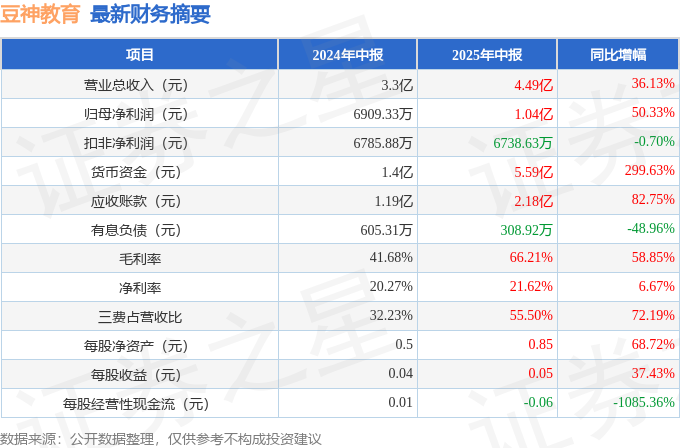
豆神教育2025年中报简析:营收净利润同比双双增长,三费占比上升明显
Zheng Quan Zhi Xing· 2025-08-29 22:41
Core Viewpoint - Dou Shen Education reported strong financial performance for the first half of 2025, with significant increases in revenue and net profit, indicating a positive growth trajectory for the company. Financial Performance - Total revenue for the first half of 2025 reached 449 million yuan, a year-on-year increase of 36.13% [1] - Net profit attributable to shareholders was 104 million yuan, up 50.33% year-on-year [1] - In Q2 2025, total revenue was 260 million yuan, reflecting an 86.54% increase compared to the same quarter last year [1] - Q2 net profit attributable to shareholders was 66.5 million yuan, a 41.93% increase year-on-year [1] - Gross margin improved to 66.21%, up 58.85% year-on-year, while net margin was 21.62%, an increase of 6.67% [1] - Total expenses (selling, administrative, and financial) amounted to 249 million yuan, accounting for 55.5% of total revenue, a significant increase of 72.19% year-on-year [1] Key Financial Ratios - Earnings per share (EPS) increased to 0.05 yuan, a rise of 37.43% year-on-year [1] - Book value per share rose to 0.85 yuan, up 68.72% year-on-year [1] - Operating cash flow per share was -0.06 yuan, a drastic decrease of 1085.36% year-on-year [1] - The company's return on invested capital (ROIC) was 8.9%, indicating average capital returns [2] Business Model and Strategy - The company's performance is primarily driven by marketing efforts, necessitating a closer examination of the underlying factors [2] - Dou Shen Education has introduced a new AI-driven educational product matrix, which includes various innovative learning services aimed at enhancing educational quality and accessibility [4][5] - The product offerings include "Dual Teacher" models, interactive training environments, and companion robots designed to support children's learning and development [4][5] Fund Holdings - The largest fund holding Dou Shen Education shares is the Huashang New Trend Flexible Allocation Mixed Fund, with a total of 12.68 million shares [3] - Other notable funds increasing their positions include E Fund New Normal Flexible Allocation Mixed Fund and E Fund Innovation Driven Flexible Allocation Mixed Fund [3]


中公教育: 2025年半年度报告
Zheng Quan Zhi Xing· 2025-08-29 17:47
Core Viewpoint - The report highlights a significant decline in the company's financial performance for the first half of 2025, with a 20.21% decrease in revenue and a 46.69% drop in net profit compared to the same period last year, indicating challenges in the employment training sector amid increasing competition and changing market dynamics [2][16]. Company Overview and Financial Indicators - Company Name: Offcn Education Technology Co., Ltd. - Stock Code: 002607 - Total Assets: 6,130.19 million RMB, down 5.84% from the previous year [2][16]. - Net Profit Attributable to Shareholders: 61.78 million RMB, down 46.69% year-on-year [2][16]. - Basic Earnings Per Share: 0.01 RMB, a 50% decrease from the previous year [2][16]. Business Operations - The company focuses on providing employment and re-employment services, targeting university students and professionals seeking career advancement [2][3]. - The main business segments include public service recruitment training, educational advancement, and vocational qualification training, with over 100 types of employment training services offered [2][3]. - The company aims to leverage AI technology to enhance traditional education services and provide personalized employment solutions [3][4]. Industry Environment - The employment service industry is experiencing a policy-driven growth phase, with the government emphasizing job creation and quality employment as key priorities [3][6]. - The number of university graduates is expected to reach a record high of 1.22 million in 2025, increasing demand for employment services [3][7]. - The market for employment training is characterized by low concentration in various segments, presenting opportunities for leading firms to expand their service offerings [3][4]. Financial Performance Analysis - Revenue for the reporting period was 1,155.24 million RMB, a decrease of 20.21% compared to 1,447.88 million RMB in the previous year [2][16]. - The company has implemented cost control measures, resulting in a 23.42% reduction in operating costs [16]. - The gross profit margin improved to 59.61%, up nearly 3 percentage points from the previous year, indicating effective management strategies [11][16]. Strategic Initiatives - The company is focusing on digital transformation and AI integration in its services, launching the "Offcn AI Employment" sub-brand to enhance its offerings [11][12]. - New teaching service centers have been established to improve market penetration and service delivery [10][12]. - The management team is undergoing a transformation to enhance youth engagement and professional development within the organization [11][12]. Competitive Landscape - The employment training market is becoming increasingly competitive, with smaller institutions adopting low-price strategies, leading to market polarization [3][4]. - The company is positioned to leverage its research and development capabilities to maintain a competitive edge against smaller players [4][5]. - The rise of digital media and AI technology is reshaping the competitive dynamics, with a focus on content creation and delivery becoming crucial for success [5][6].

院士带队“智囊团”,北京首届中小学人工智能教育专委会成立
Xin Jing Bao· 2025-08-28 11:56
Group 1 - The Beijing municipal government has officially launched an artificial intelligence general education course for primary and secondary schools starting this autumn semester [1] - The first Beijing Primary and Secondary School Artificial Intelligence Education Expert Committee has been established, consisting of 55 members, with the chairperson being Zheng Zhiming, an academician from the Chinese Academy of Sciences and a professor at Beihang University [1] - The committee will provide consultation, research, training, evaluation, and guidance for AI education in schools, focusing on developing curriculum, teaching systems, and support frameworks [1][2] Group 2 - The committee is composed of experts from prestigious universities such as Peking University, Tsinghua University, and Renmin University, as well as principals and teachers from various Beijing primary and secondary schools [2] - It also includes specialists from companies like Beijing Zhipu Huazhang Technology Co., Ltd., and iFLYTEK Co., Ltd., indicating a collaboration between academia and industry [2]
开学第一课换成了 AI,通识课今秋正式走进课堂
3 6 Ke· 2025-08-27 06:43
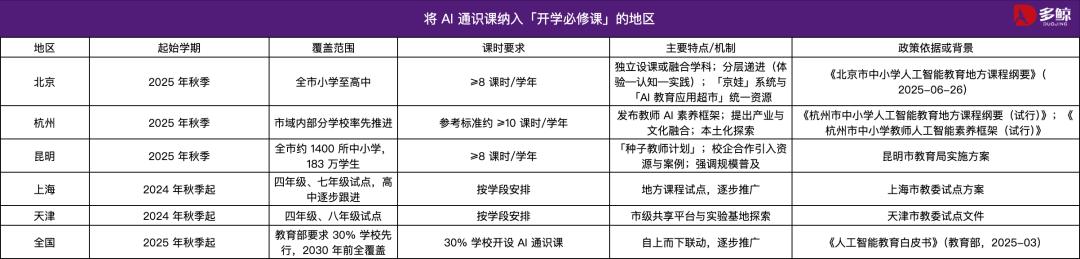
Core Insights - The introduction of artificial intelligence (AI) education in primary and secondary schools in Hangzhou marks a significant shift in China's educational landscape, with AI courses becoming a formal part of the curriculum starting from the 2025 autumn semester [1][5] - Major cities like Beijing, Hangzhou, and Kunming are leading the way in implementing AI education, with specific guidelines and requirements for course hours and content [2][3][4] Group 1: Implementation Details - Hangzhou will require at least ten class hours of AI education per academic year, starting from September 2023, as part of its local curriculum framework [1][3] - Beijing mandates a minimum of eight class hours for AI education across all grades, with a focus on integrating AI into existing subjects [3][6] - Kunming plans to implement AI courses in approximately 1,400 schools, covering over 180 million students, with a minimum of eight class hours per student [4][5] Group 2: Educational Frameworks - The AI education framework in Beijing includes a "京娃" intelligent system and an "AI education application supermarket" to provide standardized resources [3][7] - Hangzhou emphasizes local industry and culture integration into the AI curriculum, aiming to connect students with the digital economy [3][8] - Kunming's approach includes a "seed teacher program" to train key educators and enhance the practical applicability of AI courses [4][7] Group 3: Trends and Challenges - A common trend across regions is the establishment of clear course hour requirements, ensuring AI education has a defined presence in the curriculum [6][8] - The integration of ethical education into AI courses is becoming a standard, with various regions incorporating social responsibility into their curricula [8][9] - Challenges remain in teacher training and course quality, as many educators lack the necessary background in AI, which could hinder effective implementation [9][10] Group 4: Future Outlook - The Ministry of Education has set a target for 30% of schools to offer AI courses by 2025, with full coverage expected by 2030, indicating a critical period for the establishment of AI education [11] - The success of AI education will depend on continuous efforts in teacher training, curriculum development, and resource allocation to ensure it becomes a fundamental part of the educational system [11]
盛通股份(002599.SZ):与宇树科技持续达成战略合作,开启人工智能教育协同共创新范式
Xin Lang Cai Jing· 2025-08-21 02:20
Core Insights - The collaboration between Shengtong Education Group and Yushu Technology aims to enhance artificial intelligence education in primary and secondary schools, aligning with national policies to popularize AI education by 2030 [1][5][9] Group 1: Strategic Collaboration - Shengtong Education Group and Yushu Technology have reached a strategic consensus to leverage their strengths in AI education, focusing on innovative talent cultivation, course development, and practical activities [1][4] - The partnership will introduce Yushu's quadruped robots into schools, filling a gap in AI education infrastructure and providing students with hands-on experience [4][6] Group 2: Market Demand and Policy Support - The demand for AI education is growing as the government emphasizes its importance in enhancing national competitiveness and nurturing innovative talent [5][6] - Major educational regions like Beijing and Shandong are leading the way in implementing AI general courses, which cover fundamental concepts and applications of AI [5][6] Group 3: Educational Ecosystem Development - The collaboration aims to create a comprehensive AI education service system that includes customized course development, teaching platform construction, and teacher training, potentially reaching millions of students [5][8] - The initiative will standardize AI education across various school types, making it accessible to both urban and rural students [6][7] Group 4: Future Prospects and Innovations - The partnership seeks to define and standardize a new educational paradigm for the AI era, integrating laboratory solutions, curriculum systems, and talent incubation [9] - Shengtong Education plans to explore various AI education applications and develop new models to contribute to the growth of AI education in China [9]

盛通股份子公司与宇树科技达成战略合作 发力人工智能教育
Zheng Quan Shi Bao Wang· 2025-08-21 01:45
Group 1 - The core viewpoint of the articles is the strategic collaboration between Shengtong Education Group and Yushu Technology to enhance artificial intelligence education through various initiatives [1][2] - The partnership aims to leverage each other's strengths in AI education, including innovative talent cultivation, curriculum development, practical activities, and the establishment of innovation laboratories in schools [1] - Shengtong Education Group is recognized as a leading education technology company in China, with significant expertise in AI curriculum development and teaching platform construction [1] Group 2 - Yushu Technology is a global leader in "embodied intelligence" technology, known for its advanced four-legged robots, which will be integrated into the educational framework [1][2] - The collaboration will introduce four-legged robots into schools, allowing students to interact with programming and transform abstract AI knowledge into engaging practical experiences [1] - The partnership will create a comprehensive AI education service system, including customized course development, teaching platform construction, and teacher training, targeting K12 education with a potential audience of millions of students nationwide [1][2] Group 3 - The strategic cooperation agreement aims to seize the historical opportunity in AI education by providing a complete solution that includes hardware, software, content, and services [2] - Yushu Technology will offer a stable and impressive four-legged robot platform, with open API interfaces for deep secondary development by Shengtong Education Group, ensuring the exclusivity and flexibility of teaching content [2] - The collaboration emphasizes not just product sales but also the definition and standardization of a new educational paradigm in the AI era, aiming to build a complete educational ecosystem that includes laboratory solutions, curriculum systems, competition outlets, and talent incubation [2]