公募基金费率改革

Search documents
每日市场观察-20250930
Caida Securities· 2025-09-30 02:24
Market Performance - On September 29, the market showed strong performance with the Shanghai Composite Index rising by 0.90%, the Shenzhen Component increasing by 2.05%, and the ChiNext Index up by 2.74%[3] - The total trading volume reached 2.18 trillion yuan, a slight increase of approximately 10 billion yuan compared to the previous trading day[1] Sector Analysis - Non-bank, non-ferrous metals, and electric equipment sectors led the gains, while coal, banking, social services, and oil sectors experienced slight declines[1] - The semiconductor equipment sector maintained strength, showing limited decline with significant gains near the market close, indicating strong stability in investor sentiment[2] Capital Flow - On September 29, net inflows into the Shanghai Stock Exchange were 35.651 billion yuan, while the Shenzhen Stock Exchange saw net inflows of 46.963 billion yuan[4] - The top three sectors for capital inflow were securities, batteries, and consumer electronics, while the sectors with the highest outflows were chemical pharmaceuticals, coal mining, and white goods[4] Economic Indicators - From January to August, state-owned enterprises reported total profits of 27,937.2 billion yuan, with total operating revenue of 539,620.1 billion yuan, reflecting a year-on-year growth of 0.2%[8] - The asset-liability ratio for state-owned enterprises was 65.2% at the end of August, an increase of 0.3 percentage points year-on-year[8] Industry Developments - China has built the world's largest and most comprehensive water conservancy infrastructure system, with 95,000 reservoirs and over 200 major water diversion projects completed by the end of 2024[5][9] - The automotive sector saw an import and export total of 25.81 billion USD in August, with a month-on-month increase of 3.3% but a year-on-year decrease of 0.3%[10]
银行基金代销无证上岗遭处罚 费改机遇期需先补合规课
Zhong Guo Zheng Quan Bao· 2025-09-26 23:03
Core Viewpoint - The bank fund distribution business is experiencing a surge in popularity due to multiple market and policy factors, but compliance issues, particularly unqualified personnel, have led to penalties for some banks [1][3][4]. Group 1: Market Trends - There has been a noticeable increase in customer inquiries and purchases of funds in the past six months, with some banks reporting that popular fund products have already been sold out [2]. - The China Securities Regulatory Commission (CSRC) has solicited opinions on the draft regulations for managing sales fees of publicly offered securities investment funds, which may enhance banks' willingness to sell equity funds [2]. Group 2: Compliance Issues - Several banks have faced penalties for violations in fund distribution, including unqualified sales personnel and inadequate internal assessment mechanisms [3][4]. - Specific cases include Hainan Bank and Huaxia Bank's Haikou branch, which were penalized for failing to ensure that sales staff had the necessary qualifications and for not incorporating long-term investor returns into performance evaluation metrics [3]. Group 3: Recommendations for Improvement - Banks are advised to strengthen their internal control systems, ensure that sales personnel are well-qualified, and enhance risk management practices [4][5]. - It is essential for banks to conduct thorough due diligence and product reviews before sales, adhere to sales regulations, and improve investor suitability management throughout the sales process [4][5].
费改机遇期需先补合规课
Zhong Guo Zheng Quan Bao· 2025-09-26 20:48
Group 1 - The core viewpoint is that the popularity of bank fund distribution is increasing, but there are significant compliance issues that need to be addressed, particularly regarding unqualified sales personnel and inadequate internal controls [1][2][3] - The China Securities Regulatory Commission (CSRC) has solicited opinions on the management of sales fees for publicly raised securities investment funds, which may enhance banks' willingness to sell equity funds [2][4] - Major banks like China Merchants Bank, ICBC, and others are leading in fund distribution, as indicated by the latest data from the Asset Management Association of China [2] Group 2 - Several banks have faced penalties for violations in fund distribution, including unqualified sales personnel and inadequate internal assessment mechanisms [2][3] - Specific cases include Hainan Bank and Huaxia Bank, which were penalized for failing to ensure that sales personnel had the necessary qualifications and for not incorporating long-term investor returns into their evaluation systems [3][4] - The need for comprehensive sales process standardization is emphasized, with a focus on improving internal controls, enhancing the qualifications of sales personnel, and ensuring compliance with investor suitability management [4]
首批新型浮动费率基金收益向好
Shen Zhen Shang Bao· 2025-09-25 23:17
Group 1 - The first batch of new floating rate funds has been launched, with most funds showing positive net value growth and a significant performance divergence among them [1][2] - The average return of the first batch of floating rate funds is close to 13%, with a performance gap of nearly 45 percentage points between the best and worst performers [1] - The introduction of floating rate mechanisms is expected to shift fund managers' focus from scale to performance, potentially expanding to bond funds and fixed income+ products in the future [1][4] Group 2 - The China Securities Regulatory Commission issued a plan in May to promote high-quality development in public funds, establishing a fee structure linked to fund performance [2] - The new floating rate funds are seen as a significant step in the fee reform of the public fund industry, aiming to align the interests of fund managers and investors [2][3] - The operational model of floating rate funds is shifting towards open-ended structures, allowing for emergency redemptions while encouraging long-term holding through fee rules [3] Group 3 - The high operational thresholds and research requirements of floating rate funds present challenges for fund companies, with larger firms likely to have an advantage due to their resource reserves [3] - The weighted management fee rates of various fund types have significantly decreased compared to the end of 2022, indicating effective fee reduction efforts in the public fund industry [4] - There is still potential for further fee reductions in China's fund industry compared to overseas markets, suggesting ongoing opportunities for fee reform and product innovation [4]
余额宝加入降费“大军”
Sou Hu Cai Jing· 2025-09-25 23:14
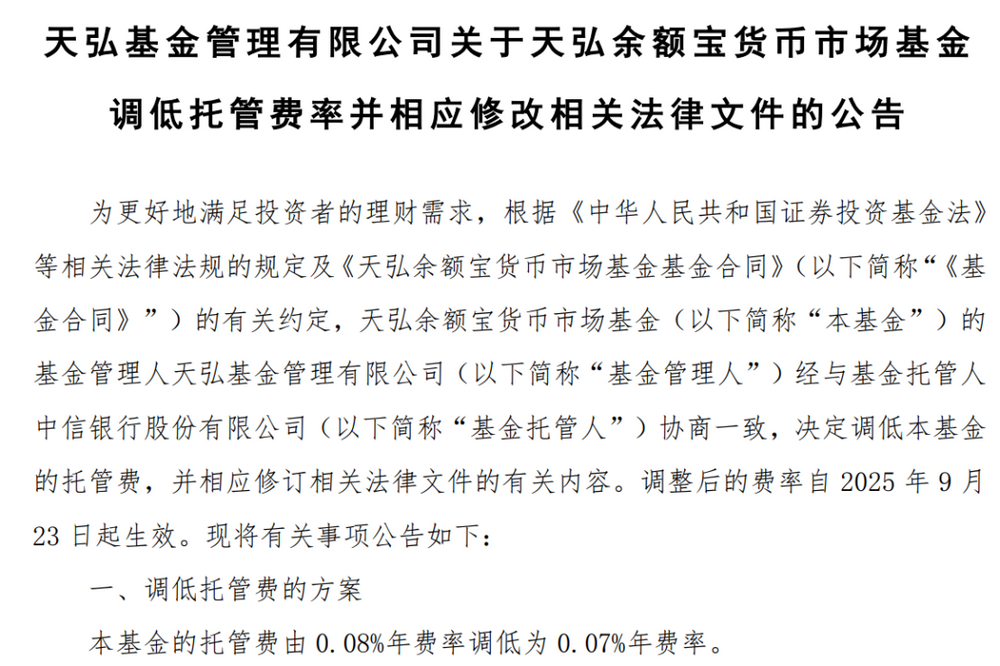
Group 1 - The core viewpoint of the articles is that the public fund industry, particularly money market funds, is undergoing a fee reduction trend, with major funds like Yu'ebao and E Fund leading the charge [1][2][3] - The China Securities Regulatory Commission (CSRC) reports that the three phases of public fund fee reforms have saved investors approximately 51 billion yuan annually, significantly lowering investment costs [1] - Tianhong Fund announced a reduction in the custody fee for Yu'ebao from 0.08% to 0.07%, marking the first fee cut since its inception [1] Group 2 - Other money market funds, such as E Fund and Guoxin Guozheng, have also announced fee reductions, with E Fund lowering its management fee from 0.2% to 0.15% and custody fee from 0.08% to 0.05% [2] - Industry experts believe that the leading products in the money market fund sector initiating fee cuts may create a demonstration effect, potentially sparking a broader trend of fee reductions across the industry [3] - The current fee rates for money market funds still have room for downward adjustment, with expectations of a "stair-step decline" in fees based on fund size and operational standards [3]
基金降费再扩容 货币基金也发“红包”
Xin Jing Bao· 2025-09-25 07:13
Core Points - Tianhong Yu'ebao, the largest money market fund in the market, announced a fee reduction for the first time since its establishment in 2013, lowering its custody fee from 0.08% to 0.07% [1][2] - Other money market funds, including Guoxin Guozheng Cash Increase and E Fund Margin, also announced fee reductions on the same day, indicating a broader trend in the industry [3] - The average management fee for money market funds is currently 0.24%, while the average custody fee is 0.06%, suggesting that Tianhong Yu'ebao's fees remain above industry averages [3][4] Fund Performance - As of September 23, 2023, the average 7-day annualized yield for over 900 money market funds is 1.24%, with some funds yielding below 0.5% [4] - Only one fund, Taiping Daily Gold A, exceeded a 7-day annualized yield of 2%, indicating overall poor performance in the sector [4] Industry Trends - The fee reduction trend in the public fund industry has been ongoing for the past two to three years, with over a thousand public funds announcing fee cuts in 2023 [7] - The China Securities Regulatory Commission (CSRC) has initiated a three-phase fee reform plan aimed at reducing costs for investors, with an estimated annual savings of approximately 510 billion yuan [8] - Fund companies are facing challenges due to declining management fees, prompting them to optimize business structures and diversify income sources to maintain profitability [9]
基金降费再扩容,货币基金也发“红包”
Xin Jing Bao· 2025-09-25 07:11
Core Viewpoint - The largest money market fund, Tianhong Yu'ebao, announced a fee reduction for the first time since its establishment in 2013, lowering its custody fee from 0.08% to 0.07% annually, reflecting a broader trend of fee reductions in the money market fund sector due to declining market interest rates and regulatory guidance [1][2][7]. Group 1: Fee Reductions - Tianhong Yu'ebao's custody fee is reduced from 0.08% to 0.07%, while its management fee remains at 0.30% and sales service fee at 0.25% [2][3]. - Other funds, such as Guoxin Guozheng Cash Increase and E Fund Margin, also announced fee reductions, with Guoxin reducing its management fee from 0.30% to 0.20% and custody fee from 0.10% to 0.07%, and E Fund reducing its management fee from 0.20% to 0.15% and custody fee from 0.08% to 0.05% [3]. - The average management fee for money market funds is currently 0.24%, and the average custody fee is 0.06%, indicating that Tianhong Yu'ebao's fees are still above the industry average [3]. Group 2: Market Context - The overall trend of fee reductions in the public fund industry has been driven by a combination of declining market interest rates and regulatory encouragement for public funds to lower fees for investors [3][7]. - As of September 23, 2023, the average 7-day annualized yield for over 900 money market funds is 1.24%, with some funds yielding below 0.5%, highlighting the need for fee reductions to enhance investor returns [4][5]. Group 3: Regulatory Environment - The China Securities Regulatory Commission (CSRC) has initiated a three-phase fee reform plan for public funds, with the first phase focusing on reducing management and custody fees for actively managed equity funds [7]. - The third phase of the reform aims to reduce sales-related fees, potentially saving investors approximately 30 billion yuan annually, with an overall expected reduction of 51 billion yuan across all phases [7][8]. Group 4: Industry Challenges - The fee reduction trend poses challenges for fund companies, as their management fees are decreasing while the total scale of public funds continues to grow [8]. - To adapt, fund companies are encouraged to optimize their business structures, diversify income sources, and enhance operational efficiency through digital transformation [8].
公募基金改革浪潮下,基金费率何去何从?——新发浮动费率产品及使用基准的观察
Morningstar晨星· 2025-09-25 03:48
Core Viewpoint - The reform of public fund fee rates represents a shift from scale-driven to value-driven approaches, enhancing investor experience, with floating fee rates as a key tool for aligning the interests of fund managers and investors [1] Group 1: Background and Initial Developments - The public fund industry previously operated on a fixed management fee plus custody fee model, leading to a growing contradiction where fund companies profited while funds underperformed [1] - In 2023, eight floating fee rate funds linked to performance were approved, but their design was still rudimentary, lacking comprehensive mechanisms for performance benchmarks and imposing liquidity constraints due to a three-year lock-up period [1] Group 2: Policy and Market Response - By 2025, the "Action Plan for Promoting High-Quality Development of Public Funds" mandates that over 60% of new actively managed equity funds from leading companies must adopt floating fee rates, guiding the industry towards standardized designs [2] - As of now, 30 floating fee rate funds established this year have raised a total of 33 billion yuan, accounting for 24% of the total raised in actively managed equity funds, indicating strong investor demand for performance-linked products [2] Group 3: Operational Challenges and Requirements - The new floating fee rate funds require advanced backend systems to dynamically match investor shares with holding periods and returns, creating a high operational threshold for fund companies [3] - Fund companies must outperform benchmarks to earn higher management fees, which raises the bar for their research and investment capabilities [3] Group 4: Mechanism and Product Innovations - The 2025 floating fee rate funds have introduced a mechanism where excess returns relative to benchmarks play a decisive role in fee structures, enhancing accountability for fund managers [6] - Unlike the previous closed-end model, the new funds operate on an open-ended basis, allowing for emergency redemptions while encouraging long-term holding through fee structures [6] Group 5: Product Diversity and Investor Benefits - The new floating fee rate funds include thematic and style funds, addressing gaps in the market and catering to investor preferences for specific sectors [7] - These funds allow investors to participate in thematic investments while reducing costs associated with underperformance, promoting a shared risk and reward structure [8] Group 6: Importance of Benchmark Selection - The performance benchmarks for the new funds utilize price indices rather than total return indices, which may lead to easier outperformance but could misrepresent actual returns [8] - The choice of benchmarks is critical as it directly impacts investor costs and fund performance assessments [8] Group 7: Overall Significance - The issuance of the new floating fee rate funds is significant for investors, providing diverse options that align with their investment needs while lowering costs through flexible fee mechanisms [9] - This shift encourages fund managers to focus on long-term investment capabilities, steering the public fund industry towards high-quality development and better wealth management services for residents [9]


“引长钱促长投”改革效果加快显现 各类中长期资金合计持有市值逾20万亿元
Jin Rong Shi Bao· 2025-09-24 03:32
Core Insights - The Chinese Securities Regulatory Commission (CSRC) is accelerating investment reforms to establish a "long money long investment" policy framework, with significant achievements in promoting long-term capital into the market as of August 2023 [1][4] Group 1: Investment Reforms - The CSRC has implemented a comprehensive fee reduction reform in the public fund industry, achieving a significant breakthrough with a three-phase fee reduction plan that has been fully rolled out [2] - The third phase of the fee reduction reform is expected to save investors approximately 30 billion yuan annually, with an overall reduction of about 34% in sales fees [2] - Cumulatively, the three phases of the public fund fee reform are projected to save investors around 51 billion yuan each year, exceeding the initial reduction targets [2] Group 2: Public Fund Industry Growth - The public fund industry in China has reached a record high, surpassing 35 trillion yuan by the end of August 2023, indicating its growing importance in the capital market [3] - The successful implementation of the fee reduction reform marks a new phase of high-quality development for the public fund industry [3] Group 3: Long-term Capital Investment - Long-term capital plays a crucial role in stabilizing the market and mitigating short-term volatility, with a reported increase of 6.4 trillion yuan in the A-share market's circulating value held by various long-term funds, representing a year-on-year growth of 42.7% [4] - As of August 2023, various long-term funds collectively held approximately 21.4 trillion yuan in A-share circulating market value [4] Group 4: ETF Development - The CSRC has proposed establishing a fast-track approval process for ETF index funds to enhance the scale and proportion of equity funds, with ETF assets exceeding 5 trillion yuan by August 2023 [5] - The development of innovative ETF products has catered to diverse investment needs, contributing to the high-quality growth of the industry [5] - Central Huijin has significantly increased its holdings in ETFs, with a total value of 1.28 trillion yuan by mid-2025, accounting for nearly 30% of the total ETF market [5]
余额宝12年来首次降费!此次调降并非个案
Qi Lu Wan Bao· 2025-09-24 03:29
Core Viewpoint - The recent fee reductions in money market funds, including Tianhong's Yu'ebao, are aimed at better meeting investor needs and are part of a broader trend in the industry to lower costs for investors [2][3][4]. Group 1: Fee Adjustments - Tianhong Yu'ebao has reduced its custody fee rate for the first time in 12 years, from 0.08% to a new comprehensive operational fee rate of 0.62%, while management and sales service fees remain unchanged [2]. - Other funds, such as E Fund and Guoxin Guozheng, have also announced fee reductions, with management fees decreasing from 0.20% to 0.15% and custody fees from 0.08% to 0.05% [3]. - The fee adjustments are expected to save significant costs for investors, especially those with larger holdings [2][3]. Group 2: Industry Trends - The trend of lowering fees in money market funds is seen as a response to regulatory encouragement and is likely to reshape the competitive landscape of the market [4]. - The reduction in fees is expected to benefit ordinary investors and may lead to increased competition among fund companies, particularly as larger firms leverage scale to offset the impact of lower fees [4].