
社会消费品零售总额

Search documents
国家统计局:中国1-11月社会消费品零售总额同比增长4.6%
Guo Jia Tong Ji Ju· 2025-12-15 02:04
Group 1 - In November, the total retail sales of consumer goods reached 43,898 billion yuan, with a year-on-year growth of 1.3% [5] - From January to November, the total retail sales of consumer goods amounted to 456,067 billion yuan, growing by 4.0% year-on-year [5] - Urban retail sales in November were 37,684 billion yuan, increasing by 1.0% year-on-year, while rural retail sales were 6,214 billion yuan, growing by 2.8% [5][6] Group 2 - For the first eleven months, retail sales of goods reached 403,822 billion yuan, with a year-on-year increase of 4.1%, while catering revenue was 52,245 billion yuan, growing by 3.3% [5] - Online retail sales for the first eleven months totaled 144,582 billion yuan, reflecting a year-on-year growth of 9.1%, with physical goods online retail sales at 118,193 billion yuan, increasing by 5.7% [4][5] - The proportion of physical goods online retail sales accounted for 25.9% of the total retail sales of consumer goods [4] Group 3 - Among retail formats, convenience stores, supermarkets, department stores, specialty stores, and brand stores saw year-on-year sales growth of 6.0%, 4.7%, 0.7%, 3.4%, and 0.1% respectively from January to November [4] - The retail sales of food and oil products in November were 2,060 billion yuan, with a growth of 6.1%, while clothing, shoes, and textile products saw a growth of 3.5% [6] - The sales of household appliances and audio-visual equipment experienced a significant decline of 19.4% in November, totaling 1,000 billion yuan [6]

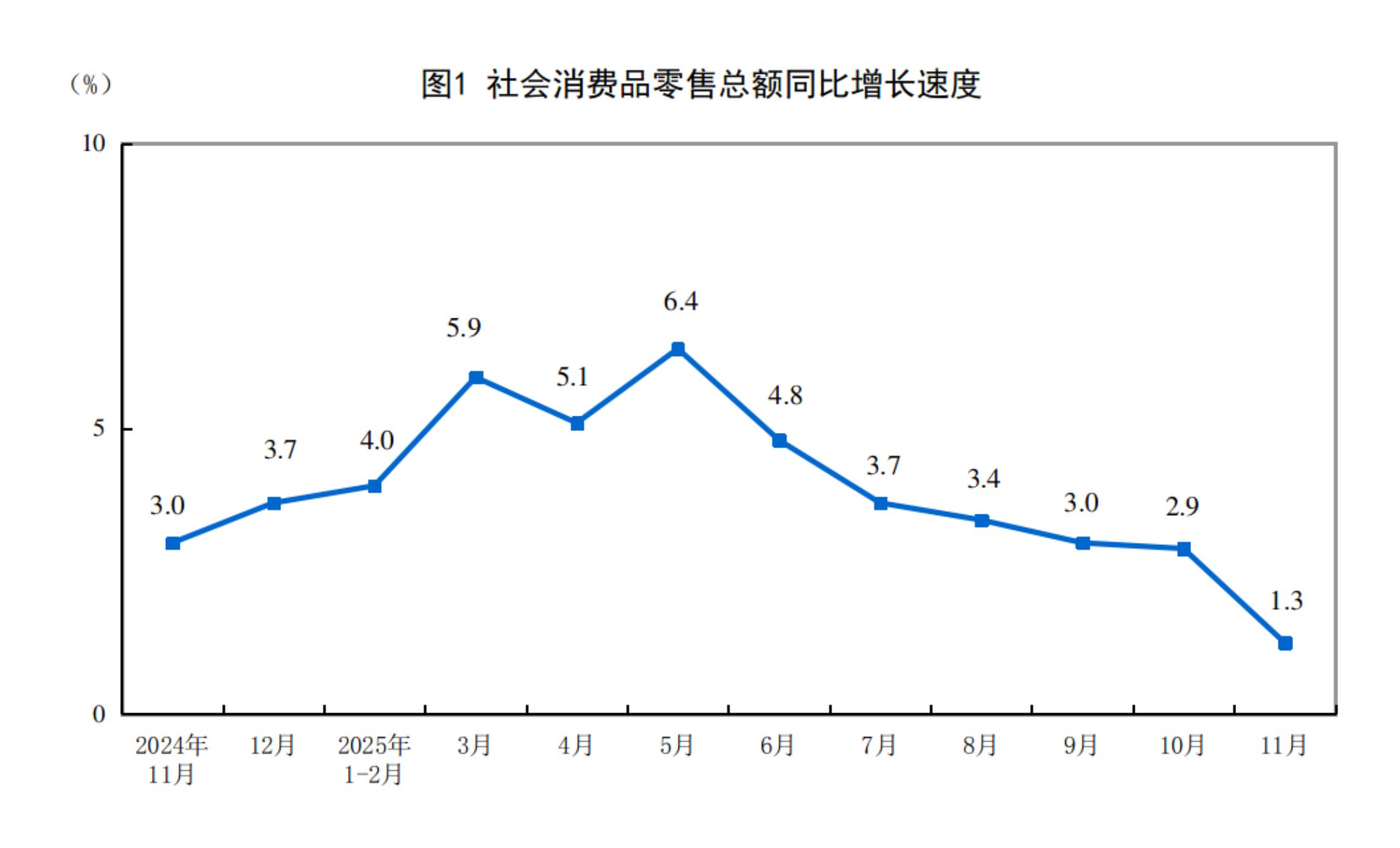
中国11月社会消费品零售总额同比 1.3%,前值 2.9%
Hua Er Jie Jian Wen· 2025-12-15 02:02
市场有风险,投资需谨慎。本文不构成个人投资建议,也未考虑到个别用户特殊的投资目标、财务状况或需要。用户应考虑本文中的任何 意见、观点或结论是否符合其特定状况。据此投资,责任自负。 风险提示及免责条款 中国1至11月社会消费品零售总额同比 4%,前值 4.3%。 ...
X @外汇交易员
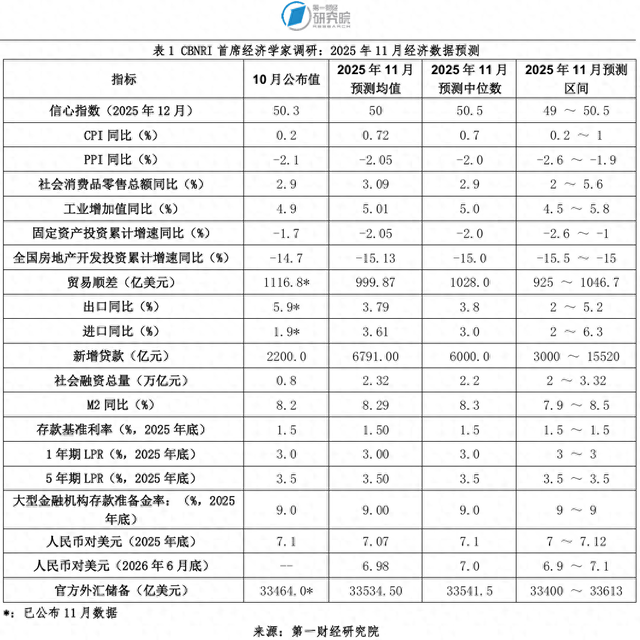
外汇交易员· 2025-12-15 02:02
Economic Indicators - China's November industrial added value above designated size increased by 4.8% year-on-year, below the expected 5.0% [1] - China's November total retail sales of consumer goods increased by 1.3% year-on-year, below the expected 2.8% [1] - China's November surveyed urban unemployment rate was 5.1%, in line with the expected 5.1% [1] - China's fixed asset investment in urban areas from January to November decreased by 2.6% year-on-year, below the expected -2.3% [1]
2025年11月份社会消费品零售总额增长1.3%
Guo Jia Tong Ji Ju· 2025-12-15 02:00
Group 1 - In November, the total retail sales of consumer goods reached 43,898 billion yuan, with a year-on-year growth of 1.3% [5] - From January to November, the total retail sales of consumer goods amounted to 456,067 billion yuan, growing by 4.0% year-on-year [5] - The retail sales of goods (excluding automobiles) in November were 39,444 billion yuan, with a year-on-year increase of 2.5% [5] Group 2 - In November, urban retail sales were 37,684 billion yuan, growing by 1.0% year-on-year, while rural retail sales were 6,214 billion yuan, increasing by 2.8% [2] - From January to November, urban retail sales totaled 394,544 billion yuan, with a growth of 3.9%, and rural retail sales reached 61,523 billion yuan, growing by 4.4% [2] Group 3 - Online retail sales from January to November reached 144,582 billion yuan, with a year-on-year growth of 9.1% [4] - Among online retail, the sales of physical goods were 118,193 billion yuan, increasing by 5.7%, accounting for 25.9% of total retail sales [4] - The growth rates for food, clothing, and daily necessities in online retail were 14.9%, 3.5%, and 4.4% respectively [4] Group 4 - The retail sales of dining services in November were 6,057 billion yuan, with a year-on-year increase of 3.2% [5] - From January to November, dining service revenue reached 52,245 billion yuan, growing by 3.3% year-on-year [5] Group 5 - The retail sales of convenience stores, supermarkets, department stores, specialty stores, and brand stores grew by 6.0%, 4.7%, 0.7%, 3.4%, and 0.1% respectively from January to November [4]
重磅经济数据即将发布,11月工业生产、消费有望企稳
Di Yi Cai Jing· 2025-12-09 13:00
Economic Overview - China's economy is experiencing fluctuations in macroeconomic indicators due to weak domestic demand and increased external uncertainties, but there is optimism for stabilization in November with coordinated policies [1][2] - Premier Li Qiang expressed confidence in achieving economic and social development goals, highlighting industrial upgrades and large-scale market demand as key growth drivers [1] Industrial Production - The forecast for November's industrial value-added growth is 5.0%, slightly up from 4.9% in October, indicating a potential recovery in industrial production [3][4] - The manufacturing PMI improved to 49.2 in November, reflecting a slight increase in market confidence, although it remains below the growth threshold [3][4] Consumer Spending - The predicted year-on-year growth for retail sales in November is 3.09%, an increase from 2.9% in October, supported by policies encouraging consumption upgrades [5][6] - The "Double 11" shopping festival contributed to a 17.6% increase in online sales compared to last year, indicating a positive impact on consumer spending [6] Fixed Asset Investment - The forecast for fixed asset investment growth in November is -2.1%, a decline from -1.7% in October, reflecting ongoing challenges in infrastructure and manufacturing investments [8][9] - New policy financial tools have been introduced to support investments in key sectors, including digital economy and infrastructure, with a total of 500 billion yuan allocated to over 2,300 projects [9][10] Policy Measures - The government is implementing various policies to stabilize investment, including the expansion of infrastructure REITs, which aim to attract private investment into public projects [10] - Recent meetings have emphasized the importance of strategic planning and collaboration across departments to enhance investment in critical areas [10]
张瑜:京沪社零为何背离?
Xin Lang Cai Jing· 2025-12-09 01:56
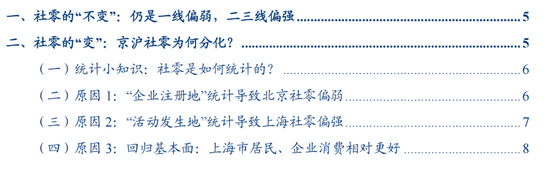
炒股就看金麒麟分析师研报,权威,专业,及时,全面,助您挖掘潜力主题机会! 来源:一瑜中的 文:华创证券研究所副所长 、首席宏观分析师 张瑜(执业证号:S0360518090001) 核心观点 本文聚焦各能级城市的社零表现。整体看仍是一线偏弱,二三线偏强。但一线内部,北京上海社零增速 明显背离,今年前10个月,北京社零同比仍为-3.2%,上海则升至4.8%。二者背离或与统计因素有关: 社零按"企业注册地"统计,若企业迁移,则对应社零也会跟随迁移。据北京统计局,近期北京企业设立 跨区域经营主体明显增加,此前计入北京的社零迁移至外地,进而拖累北京社零。但上海或在推动社零 制度改革,即从此前的"企业注册地"统计切换至"活动发生地",在这一制度下,企业设立异地经营主体 对上海社零影响不大,这或是北京、上海社零分化的重要原因之一。当然,抛开统计因素回归基本面来 看,上海市的居民消费、企业消费确实在改善,社零读数回升有基本面支撑。 报告摘要 "不变":仍是一线偏弱,二三线偏强 2024年,我们曾分析为何一线社零偏弱、三四线社零偏强,参见报告《一线城市消费为何走弱?》、 《三四线城市消费为何偏强?》,目前来看,这一趋势仍在延 ...
张瑜:京沪社零为何背离?
一瑜中的· 2025-12-08 16:04
文 : 华创证券研究所副所长 、首席宏观分析师 张瑜(执业证号:S0360518090001) 联系人: 陆银波(15210860866) 韩港(微信 HGK1366) 核心观点 本文聚焦各能级城市的社零表现。整体看仍是一线偏弱,二三线偏强。但一线内部,北京上海社零增速明 显背离,今年前 10 个月,北京社零同比仍为 -3.2% ,上海则升至 4.8% 。二者背离或与统计因素有关: 社零按"企业注册地"统计,若企业迁移,则对应社零也会跟随迁移。据北京统计局,近期北京企业设立跨区 域经营主体明显增加,此前计入北京的社零迁移至外地,进而拖累北京社零。但上海或在推动社零制度改 革,即从此前的"企业注册地"统计切换至"活动发生地",在这一制度下,企业设立异地经营主体对上海社零 影响不大,这或是北京、上海社零分化的重要原因之一。当然,抛开统计因素回归基本面来看,上海市的 居民消费、企业消费确实在改善,社零读数回升有基本面支撑。 报告摘要 "不变":仍是一线偏弱,二三线偏强 2024 年,我们曾分析为何一线社零偏弱、三四线社零偏强,参见报告《一线城市消费为何走弱?》、《三 四线城市消费为何偏强?》,目前来看,这一趋势仍在 ...

2026年经济政策有望维持宽松基调,更加强调质效并重丨第一财经首席经济学家调研
Di Yi Cai Jing· 2025-12-08 09:08
Economic Confidence Index - The "Economic Confidence Index" for December 2025 is reported at 50, slightly lower than the previous month, indicating a weak recovery in the economy [6][8]. Inflation Predictions - Economists predict the Consumer Price Index (CPI) for November 2025 to be 0.72%, up from 0.2% in the previous month, while the Producer Price Index (PPI) is expected to be -2.05% [9][10]. Retail Sales Growth - The forecast for the year-on-year growth of social retail sales in November is 3.09%, slightly higher than the previous month's 2.9%, driven by the "Double 11" shopping festival and a recovery in the dining sector [10][11]. Industrial Value Added - The predicted year-on-year growth rate for industrial value added in November is 5.0%, an increase from the previous month's 4.9% [11]. Fixed Asset Investment - The forecast for the year-on-year growth rate of fixed asset investment in November is -2.1%, lower than the previous month's -1.7%, indicating continued pressure from the real estate market [12][14]. Real Estate Investment - The predicted year-on-year growth rate for real estate development investment in November is -15.1%, reflecting ongoing challenges in the sector [14]. Trade Surplus - China's trade surplus for November is reported at $111.68 billion, with exports growing by 5.9% and imports by 1.9%, aligning with economists' expectations [15]. New Loans - Economists forecast new loans for November to rebound to 679.1 billion yuan, significantly higher than the previous month's 220 billion yuan [16]. Total Social Financing - The predicted total social financing for November is 2.32 trillion yuan, an increase from the previous month's 0.81 trillion yuan [17]. M2 Growth Rate - The forecast for the year-on-year growth rate of M2 in November is 8.29%, slightly above the previous month's 8.2% [18]. Monetary Policy Outlook - Economists expect the possibility of adjustments to the Loan Prime Rate (LPR) and reserve requirement ratios to be low in the near term, with a continued focus on maintaining liquidity in the market [20]. Exchange Rate Predictions - The predicted exchange rate for the Chinese yuan against the US dollar at the end of 2025 is 7.07, with expectations of a potential adjustment to 6.98 by mid-2026 [21]. Foreign Exchange Reserves - As of the end of November, China's foreign exchange reserves are reported at $33,464 billion, reflecting a slight increase from the previous month [22][23].
京沪社零为何背离?
Huachuang Securities· 2025-12-03 06:41
京沪社零为何背离? ❖ 核心观点 本文聚焦各能级城市的社零表现。一线偏弱,二三线偏强的格局未变。但一线 内部,北京上海社零增速明显背离,今年前 10 个月,北京社零同比仍为-3.2%, 上海则升至 4.8%。原因或与统计因素有关,社零按"企业注册地"统计,若企 业迁移,则对应社零也会跟随迁移。据北京统计局,近期北京企业设立跨区域 经营主体明显增加,此前计入北京的社零迁移至外地,进而拖累北京社零。但 上海或在推动社零制度改革,即从此前的"企业注册地"切换至"活动发生地", 在这一制度下,企业设立异地经营主体对上海社零影响不大,这一统计因素或 是北京、上海社零分化的重要原因之一。当然,抛开统计因素回归基本面来看, 上海市的居民消费、企业消费确实在改善,社零读数回升有基本面支撑。 ❖ "不变":仍是一线偏弱,二三线偏强 2024 年,我们曾分析为何一线社零偏弱、三四线社零偏强,参见报告《一线城 市消费为何走弱?》、《三四线城市消费为何偏强?》,目前来看,这一趋势仍 在延续,今年前三季度,全国社零同比增长 4.5%,一线增速为 1.5%,而二线 (19 城)、三线(轧差得来)增速均在 5%左右,2024 年为-1.6 ...
青岛:“十四五”以来,地区生产总值连续跨越五个千亿级台阶
Zheng Quan Shi Bao Wang· 2025-12-02 06:25
Core Insights - Qingdao's GDP is expected to exceed 1.7 trillion yuan in 2023, with an average annual growth rate of 5.9%, ranking among the top in similar cities [1] - Labor productivity is projected to reach 311,000 yuan per person in 2024, with an average annual growth of 6.4%, significantly higher than GDP growth [1] - Per capita GDP is set to increase from 127,000 yuan in 2020 to 161,000 yuan in 2024, a cumulative growth of 21.3%, equivalent to approximately 23,000 USD [1] - Total retail sales of consumer goods are expected to grow at an average annual rate of 6.4%, surpassing 650 billion yuan, second only to Beijing among northern cities [1] - Total import and export volume is projected to grow at an average annual rate of 9.1%, exceeding 900 billion yuan, accounting for over 2% of the national total [1]