
设备更新

Search documents
专家解读“两新政策”:仪器设备更新注重优化提质
仪器信息网· 2026-01-14 09:02
Core Viewpoint - The article discusses the 2026 "Two New" policy, emphasizing quality improvement and efficiency enhancement through lowering the investment threshold for small and medium enterprises (SMEs) and optimizing the timing of fund allocation while strictly combating fraudulent subsidy claims [1][2]. Group 1: Policy Implementation - The 2026 equipment update will focus on optimizing quality and efficiency, particularly highlighting the upgrade of inspection and testing equipment as a key component in building a quality-oriented nation and enhancing the overall quality infrastructure [2]. - The policy will lower the investment threshold for applying for equipment update projects, which will expand the policy's reach and strengthen effective investment momentum [2][3]. Group 2: Fund Allocation - In terms of fund usage, the policy will adopt a more precise approach to implementation, emphasizing the principles of "timeliness" and "balance," aligning policy effects with market demand and macroeconomic cycles [3]. - The central government will allocate funds for consumer goods replacement on a quarterly basis, while local governments will develop balanced funding usage plans by sector to ensure smooth implementation of the replacement policy [3]. Group 3: Compliance and Regulation - The article highlights that illegal activities such as "first raise, then subsidize" and fraudulent claims will be strictly targeted in 2026 [3].

“抢不到”,“突然没有了”,广东以旧换新国补上线即告罄
Sou Hu Cai Jing· 2026-01-14 04:49
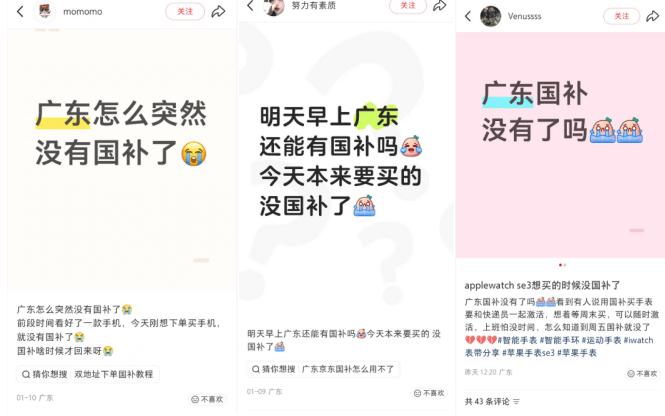
Group 1 - The core viewpoint of the article highlights the launch of the 2026 consumer goods trade-in subsidy in Guangdong, which has sparked significant consumer interest and demand for new products [1][3] - The subsidy program covers various categories including home appliances and 3C digital products, with consumers eligible for up to 1,500 yuan for larger items and 500 yuan for smaller electronics [3] - Despite the program's launch, there is a high demand for subsidy qualifications, leading to many consumers struggling to secure them, indicating a strong market potential in Guangdong [5] Group 2 - The article mentions that many consumers are actively trying to obtain subsidy qualifications but are facing challenges due to limited availability, with some expressing frustration on social media [1][3] - The government has set clear guidelines for the subsidy program, which aims to promote consumption and facilitate the upgrade of consumer goods [3] - The immediate exhaustion of subsidy qualifications reflects the urgent demand for equipment updates and quality improvements among consumers in Guangdong [5]
2026年首批625亿元资金已下达 新一轮“国补”落地多地积极部署
Zhong Guo Chan Ye Jing Ji Xin Xi Wang· 2026-01-14 01:08
Core Viewpoint - The 2026 national subsidy program aims to stimulate domestic consumption through a series of financial incentives for consumers purchasing new products, particularly in the electronics and automotive sectors, with a total of 62.5 billion yuan allocated for the first batch of subsidies [1][8]. Subsidy Details - Consumers purchasing eligible digital products such as smartphones, tablets, smartwatches, and smart glasses priced under 6,000 yuan will receive a subsidy of 15% of the product price, capped at 500 yuan per item [2]. - For major home appliances like refrigerators, washing machines, and air conditioners, a similar subsidy of 15% applies, with a maximum of 1,500 yuan per item [2]. - In the automotive sector, scrapping eligible old vehicles for new energy cars will yield a subsidy of 12% of the new car price, up to 20,000 yuan, while scrapping fuel vehicles for smaller fuel cars will provide a 10% subsidy, capped at 15,000 yuan [2]. Regional Implementation - All 21 cities in Guangdong Province launched the 2026 subsidy program on January 1, with the first transactions occurring in Guangzhou, indicating strong local engagement [3]. - Other provinces, such as Yunnan and Zhejiang, have also initiated their own automotive subsidy programs, leading to increased consumer interest and foot traffic in dealerships [3][4]. Process Optimization - Various regions have streamlined the subsidy application process, allowing consumers to apply for automotive subsidies through national systems or mobile apps, while home appliance subsidies are facilitated through major e-commerce platforms [4]. - Cities like Beijing and Shanghai have adopted innovative methods for subsidy distribution, enhancing consumer participation and interest [4]. Market Impact - The expanded subsidy program is expected to create new opportunities in the digital and smart product markets, with significant sales increases observed in smart glasses and AI-enabled home appliances during the New Year holiday [5][7]. - The policy is designed to support small and medium enterprises by lowering investment thresholds for equipment upgrades, thereby enhancing public service and commercial facilities [5]. Economic Outlook - The 2026 subsidy program is viewed as a critical measure for boosting domestic demand and stabilizing economic growth, with long-term benefits anticipated in industrial structure optimization and consumer ecosystem enhancement [8].
聚焦“工贸联动” 浙江出台《实施意见》
Mei Ri Shang Bao· 2026-01-12 22:16
Core Viewpoint - Zhejiang Province has introduced implementation opinions to strengthen the linkage between industry and trade, focusing on expanding quality product supply, exploring effective demand potential, enhancing supply-demand connection effectiveness, and reinforcing policy collaboration in industry and trade, effective from January 8 [1][2]. Group 1: Key Measures - The implementation opinions emphasize the integration of technological and industrial innovation, accelerating the research and development of new technologies, processes, and products, with an annual selection of 100 Zhejiang manufacturing excellence products and 100 provincial-level outstanding industrial new products eligible for related policies [1]. - There is encouragement for local governments to support provincial industrial new product projects that address key industry application scenarios and are successfully implemented, along with increased policy support for first sets of equipment and patent-intensive products [1]. - Zhejiang will promote the "Thousand Groups and Ten Thousand Enterprises" initiative to expand market reach and increase orders, supporting manufacturing enterprises in overseas exhibitions and providing policy support for qualifying exhibitors and exhibition agencies [1]. Group 2: Equipment Update and Industry Chain Coordination - The province will leverage equipment update policies, enhance project guidance services, and strengthen supply-demand matching for equipment update projects in various sectors, including industrial, energy, transportation, environment, and healthcare, while assisting eligible enterprises in securing national ultra-long-term special bond support [2]. - A more vigorous approach will be taken in the "Ten Chains and Hundred Events for Ten Thousand Enterprises" initiative, focusing on the cultivation of advanced manufacturing clusters and supporting upstream and downstream enterprises in various forms of cooperation, with over 100 matching events organized annually [2]. - Leading enterprises and state-owned enterprises will be encouraged to participate in matching activities, publish demand lists, and optimize procurement product structures, while local governments will be supported in organizing enterprises to meet the material, product, and equipment needs of major projects [2].
汽车家电数码全涵盖!2026郑州以旧换新补贴来了
Xin Lang Cai Jing· 2026-01-12 07:42
Core Viewpoint - Zhengzhou Municipal Bureau of Commerce announced the launch of a subsidy program for the replacement of consumer goods, including automobiles, home appliances, and digital smart products, as part of the 2026 old-for-new policy [1]. Group 1: Automotive Sector - The subsidy for scrapping and updating automobiles will follow the guidelines set by the Ministry of Commerce and other departments, with applications submitted through the national automotive circulation information management system or the "Old-for-New Car" mini-program [1]. - Consumers can retain relevant proof materials for vehicle replacement subsidies until the application system for Henan Province is launched [1]. Group 2: Home Appliances and Digital Smart Products Home Appliances - Consumers purchasing specific home appliances such as refrigerators, washing machines, televisions, air conditioners, computers, and water heaters will receive a subsidy of 15% of the final sales price for energy-efficient products, with a maximum subsidy of 1,500 yuan per item [2]. - Each consumer is eligible for one subsidy per product category [2]. Digital Smart Products - For digital smart products like smartphones, tablets, smartwatches, and smart glasses, consumers will receive a subsidy of 15% of the final sales price, capped at 500 yuan per item, provided the single item price does not exceed 6,000 yuan [3]. - Each consumer can claim one subsidy per product category [3]. Group 3: Participation Method - Consumers can access the subsidy program through the Cloud Flash Payment APP by searching for the "Henan Province Consumer Goods Old-for-New Service Platform" mini-program and completing personal information and real-name authentication [4]. - Subsidy vouchers are valid for the day of issuance and can be reissued if not used [4]. - Necessary information such as delivery address, product serial numbers, and activation evidence must be provided to the merchants [4].
2026年“国补”来了
Xin Lang Cai Jing· 2026-01-11 18:13
Core Insights - The notification regarding the implementation of large-scale equipment updates and consumer goods trade-in policies in 2026 was released on December 30, 2025, outlining the support scope, subsidy standards, and work requirements for the "Two New" policies. Group 1: Equipment Updates - The support scope for equipment updates has been expanded to include the installation of elevators in old residential communities and equipment updates in elderly care institutions, as well as updates for fire rescue and inspection equipment in the safety sector [1]. - The subsidy for updating old residential elevators will be adjusted from a fixed amount to a tiered subsidy based on the number of elevator floors [3]. - Priority will be given to supporting the replacement of old operational trucks with electric trucks in the subsidy program [4]. Group 2: Consumer Goods Trade-in - The focus will be on enhancing the coverage and impact of key consumer goods by improving the "subsidy rate" [2]. - For automobile trade-ins, the subsidy will be adjusted from a fixed amount to a percentage of the vehicle price, maintaining the upper limit for subsidies [5]. - For scrapping eligible old vehicles and purchasing new energy passenger cars, a subsidy of 12% of the new car sales price (up to 20,000 yuan) will be provided [5]. - For scrapping eligible fuel passenger cars and purchasing fuel passenger cars with an engine size of 2.0 liters or less, a subsidy of 10% (up to 15,000 yuan) will be provided [5]. - For purchasing eligible new energy passenger cars, a subsidy of 8% (up to 15,000 yuan) will be provided [6]. - For purchasing eligible fuel passenger cars, a subsidy of 6% (up to 13,000 yuan) will be provided [6]. - The subsidy for home appliances trade-in will be adjusted to 15% of the selling price for products meeting the 1st-level energy efficiency or water efficiency standards, with a maximum subsidy of 1,500 yuan per item [7][10]. - The subsidy standards for digital and smart products will remain unchanged, with a subsidy of 15% for items priced under 6,000 yuan, capped at 500 yuan per item [11][12]. Group 3: Implementation Mechanism - The project application mechanism and review process for equipment updates will be optimized to lower the investment threshold for applications, increasing support for small and medium-sized enterprises [12]. - The funding allocation method will be improved, and detailed implementation rules will be established to combat fraudulent claims and illegal practices such as "price hikes before subsidies" [12].
民生举措精准发力 惠及百姓生活
Yang Shi Wang· 2026-01-11 12:16
Group 1 - A series of new livelihood measures have been implemented at the beginning of the year, bringing tangible convenience and benefits to the public [1] - The 2026 "old for new" consumption activity has been launched nationwide, including subsidies for green home appliances and smart products [3] - The government has allocated long-term special bond funds to support the renovation of old residential areas and facilities in elderly care institutions, enhancing living conditions [5] Group 2 - A total of 114 new drugs have been added to the national medical insurance drug list, improving access to healthcare for the public [7] - Adjustments have been made to reduce transaction costs for second-hand housing and lower the interest rates on existing housing provident fund loans to meet housing needs [7] - New childcare subsidies for children under three years old have been introduced, allowing families to claim 3,600 yuan per child per year [7]
各地抢抓政策红利 持续激活消费市场
Yang Shi Wang· 2026-01-10 23:00
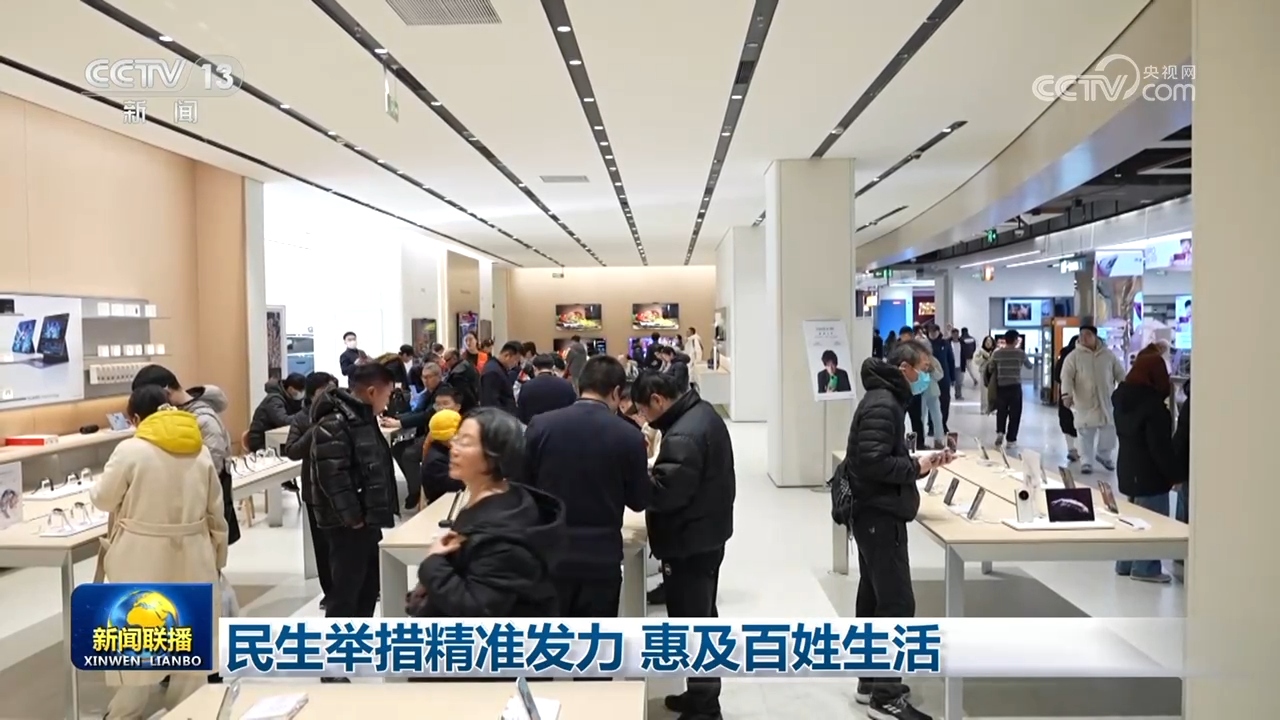
Group 1 - The core viewpoint of the article is that a large-scale equipment update and trade-in policy for consumer goods will be implemented in 2026, covering various sectors such as automobiles, home appliances, and digital smart products [1] - Since the New Year, local areas have been actively seizing the benefits of the new policy, continuously stimulating the consumer market [1] - New product categories like smartwatches and smart glasses have been included in the subsidy scope for the first time, leading to a sustained increase in consumer enthusiasm [1]
2026版“国补”,三类人最省钱
Xin Lang Cai Jing· 2026-01-08 23:24
Core Viewpoint - The newly revised national subsidy policy for 2026 aims to enhance consumer safety and promote green transformation in the home appliance industry, with a total of 625 billion yuan allocated for subsidies to encourage the replacement of old products with new ones [3][5]. Group 1: Subsidy Implementation and Scope - The 2026 subsidy program includes support for various sectors such as automobiles, home appliances, digital products, and smart devices, with specific categories like refrigerators, washing machines, televisions, air conditioners, computers, and water heaters eligible for subsidies [7][8]. - Consumers purchasing energy-efficient home appliances will receive a subsidy of 15% of the product price, capped at 1,500 yuan per item, with a limit of one item per category per consumer [7][8]. - The subsidy for digital and smart products, including smartphones, tablets, smartwatches, and smart glasses, is also set at 15% of the product price, with a maximum subsidy of 500 yuan per item for products priced under 6,000 yuan [7][8]. Group 2: Market Impact and Consumer Behavior - The launch of the subsidy policy has invigorated the consumer market, with significant sales recorded during the New Year holiday, including 26.86 million yuan in home appliance sales and nearly 10 million yuan in communication equipment sales in Henan province [5][6]. - Despite the increase in vehicle purchase tax for new energy vehicles, the overall market did not experience a decline in consumer interest due to the offsetting effect of the subsidy program [5][6]. - The new policy is expected to benefit specific consumer groups, particularly those in rural areas, families seeking home modifications, and individuals planning to purchase new appliances or vehicles [10]. Group 3: Changes and Optimizations in the Subsidy Policy - The 2026 subsidy policy has optimized its scope, standards, and implementation mechanisms, focusing on high-efficiency products and including new categories like smart glasses [8][9]. - The policy emphasizes a unified implementation mechanism while allowing local adaptations, ensuring that the subsidy distribution is fair and effective across different regions [9]. - The subsidy program is designed to be more targeted, benefiting consumers who truly need assistance rather than promoting impulsive buying behaviors [10].
钢铁ETF(515210)近10日净流入超6亿元,行业政策预期支撑行情
Sou Hu Cai Jing· 2026-01-08 02:09
Group 1 - The steel ETF (515210) has seen a net inflow of over 600 million yuan in the past 10 days, supported by industry policy expectations [1] - Bohai Securities indicates that as the stable growth policies for the steel industry are gradually implemented, the competitive landscape is expected to improve, potentially enhancing future industry profitability [1] - Demand in sectors such as shipbuilding steel and construction steel is anticipated to increase, with "equipment upgrades" and "low-carbon transformation" expected to become development hotspots for the industry [1] Group 2 - The China Federation of Logistics and Purchasing's survey indicates that the PMI index for the steel industry is projected to be 46.3% by December 2025, reflecting a month-on-month decrease of 1.7 percentage points, suggesting continued tightening in industry operations [1] - The steel ETF (515210) tracks the CSI Steel Index (930606), which selects listed companies in the steel industry from the Shanghai and Shenzhen markets to reflect the overall performance of these securities [1] - The index constituents cover various sub-sectors, including ordinary steel and special steel, exhibiting significant cyclical characteristics [1]