无人驾驶

Search documents
虹软科技跌2.09%,成交额9325.73万元,主力资金净流出636.77万元
Xin Lang Cai Jing· 2025-10-16 03:00
Core Points - The stock price of Hongsoft Technology has increased by 33.92% year-to-date but has seen a decline of 18.34% in the last five trading days and 14.76% in the last twenty days [2] - The company specializes in visual artificial intelligence technology, providing solutions for smart devices including smartphones, smart cars, and IoT [2] - As of June 30, 2025, Hongsoft Technology reported a revenue of 410 million yuan, a year-on-year increase of 7.73%, and a net profit of 88.54 million yuan, up 44.06% year-on-year [2] Financial Performance - The company has a total market capitalization of 20.464 billion yuan, with a stock price of 51.01 yuan per share as of October 16 [1] - The company has distributed a total of 613 million yuan in dividends since its A-share listing, with 387 million yuan distributed in the last three years [3] - The number of shareholders decreased by 8.42% to 20,100 as of June 30, 2025, while the average circulating shares per person increased by 9.20% to 19,938 shares [2] Shareholder Information - The seventh largest circulating shareholder is Taixin Small and Medium Cap Selected Mixed Fund, holding 3.83 million shares, an increase of 170,000 shares from the previous period [3] - The tenth largest circulating shareholder is Golden Eagle Technology Innovation Stock A, which is a new entrant holding 2.77 million shares [3] - Hong Kong Central Clearing Limited has exited the list of the top ten circulating shareholders [3]

长城汽车涨2.03%,成交额2.18亿元,主力资金净流入661.18万元
Xin Lang Cai Jing· 2025-10-16 02:43
Core Viewpoint - Great Wall Motors' stock price has experienced fluctuations, with a year-to-date decline of 6.84% and a recent increase in trading activity, indicating potential investor interest amidst mixed performance metrics [1][2]. Financial Performance - For the first half of 2025, Great Wall Motors reported a revenue of 923.35 billion yuan, reflecting a year-on-year growth of 0.99%. However, the net profit attributable to shareholders decreased by 10.48% to 63.37 billion yuan [2]. - Cumulatively, since its A-share listing, the company has distributed a total of 346.96 billion yuan in dividends, with 89.50 billion yuan distributed over the past three years [3]. Stock Market Activity - As of October 16, Great Wall Motors' stock price was 24.11 yuan per share, with a trading volume of 2.18 billion yuan and a market capitalization of 206.33 billion yuan [1]. - The stock has seen a net inflow of 661.18 million yuan from major funds, with significant buying activity from large orders [1]. Shareholder Structure - As of June 30, 2025, Great Wall Motors had 178,500 shareholders, an increase of 18.73% from the previous period. The average circulating shares per person remained at zero [2]. - Among the top ten circulating shareholders, China Securities Finance Corporation holds 197 million shares, while Hong Kong Central Clearing Limited has reduced its holdings by 1.94 million shares [3].

瑞玛精密涨4.38%,成交额2271.88万元,主力资金净流入68.44万元
Xin Lang Cai Jing· 2025-10-16 02:16
Core Viewpoint - 瑞玛精密's stock price has shown a positive trend this year, with a notable increase in both revenue and net profit, indicating strong business performance and investor interest [2][3]. Financial Performance - As of June 30, 2025, 瑞玛精密 achieved a revenue of 935 million yuan, representing a year-on-year growth of 23.22% [3]. - The net profit attributable to shareholders reached 18.40 million yuan, marking a significant increase of 164.57% year-on-year [3]. Stock Market Activity - 瑞玛精密's stock price increased by 16.60% year-to-date, with a 4.38% rise on October 16, 2025, reaching 25.50 yuan per share [1][2]. - The stock has seen a net inflow of 684,400 yuan from main funds, with large orders accounting for 11.16% of total buying and 8.14% of total selling [1]. Shareholder Information - The number of shareholders increased to 22,800, up by 57.59% compared to the previous period, while the average circulating shares per person decreased by 36.54% to 2,865 shares [3]. - The company has distributed a total of 78.10 million yuan in dividends since its A-share listing, with 18.10 million yuan distributed over the past three years [4]. Business Overview - 瑞玛精密 specializes in the manufacturing of precision structural components and related precision mold manufacturing, with applications in automotive, new energy vehicles, mobile communications, power batteries, and energy storage batteries [2]. - The revenue composition includes 58.04% from precision metal structural components, 31.75% from automotive electronics, 6.65% from communication equipment, 2.18% from other sources, and 1.38% from molds [2].
动力新科涨2.73%,成交额1720.64万元,主力资金净流出4.46万元
Xin Lang Zheng Quan· 2025-10-16 02:14
Core Viewpoint - The stock of Power New Technology has shown fluctuations in trading activity, with a year-to-date increase of 26.04% but a recent decline in the last few trading days, indicating potential volatility in investor sentiment [1][2]. Group 1: Stock Performance - As of October 16, Power New Technology's stock price increased by 2.73% to 6.39 CNY per share, with a total market capitalization of 8.868 billion CNY [1]. - The stock has experienced a year-to-date increase of 26.04%, but has seen a decline of 0.47% over the last five trading days, 0.93% over the last twenty days, and 7.66% over the last sixty days [1]. Group 2: Financial Performance - For the first half of 2025, Power New Technology reported a revenue of 2.829 billion CNY, a year-on-year decrease of 23.80%, while the net profit attributable to shareholders was -301 million CNY, showing a year-on-year increase of 56.35% [2]. - The company has cumulatively distributed 1.268 billion CNY in dividends since its A-share listing, with no dividends distributed in the last three years [3]. Group 3: Shareholder Information - As of June 30, 2025, the number of shareholders for Power New Technology was 59,500, a decrease of 13.11% from the previous period [2]. - The top ten circulating shareholders include Hong Kong Central Clearing Limited, which holds 4.8294 million shares, a decrease of 748,000 shares compared to the previous period [3]. Group 4: Business Overview - Power New Technology, established on December 27, 1993, and listed on March 11, 1994, is primarily engaged in the production and sale of heavy trucks and diesel engines, with engine sales contributing 85.20% to its revenue [1]. - The company operates within the automotive industry, specifically in the automotive parts sector, focusing on chassis and engine systems, and is associated with various concepts including generator concepts and autonomous driving [1].

汽车早餐 | 斯堪尼亚在华生产基地开业;众泰汽车暂变为无控股股东;日产因燃油泵问题在美国召回超17.33万辆汽车
Zhong Guo Qi Che Bao Wang· 2025-10-16 02:04
Domestic News - China has implemented new export restrictions on rare earths, prompting EU officials to call for stronger measures against China. The Chinese Foreign Ministry stated that the export control policy aims to maintain world peace and regional stability, fulfilling international obligations [2] - In response to India's electric vehicle and battery subsidy measures, China has requested consultations at the WTO, claiming these measures violate multiple obligations and provide unfair competitive advantages to Indian industries, harming Chinese interests [2] - In September, China's industrial producer prices decreased by 2.3% year-on-year, with the decline narrowing by 0.6 percentage points from the previous month. The average industrial producer prices from January to September fell by 2.8% compared to the same period last year [3] - In the first eight months of the year, China's manufacturing sector benefited from tax reductions and refunds totaling approximately 1.3 trillion yuan, with manufacturing sales revenue increasing by 4.7% year-on-year [4] International News - Nissan is recalling over 173,000 vehicles in the U.S. due to a fuel pump issue that could lead to engine stalling [5] - General Motors announced a $1.6 billion charge due to adjustments in electric vehicle production, anticipating a slowdown in EV adoption following recent U.S. policy changes [6] - Waymo plans to launch a driverless ride-hailing service in London next year, collaborating with Moove and engaging with local regulators for necessary approvals [7] - Stellantis Group announced a $13 billion investment in the U.S. over the next four years, marking the largest single investment in the U.S. market since the company began operations there [9] Corporate News - Scania has opened a new production base in China with a planned annual capacity of 50,000 vehicles and a total investment of 20 billion euros (approximately 166 billion yuan), expected to create over 3,000 jobs [10] - NIO's brand, Ladao, has officially rolled out its 100,000th production vehicle, marking a significant milestone in its delivery journey [11] - SenseTime and Cambricon have signed a strategic cooperation agreement to enhance software and hardware product compatibility, focusing on the computing power market [12] - FAW has established a new energy technology company in Changchun with a registered capital of 200 million yuan, focusing on emerging energy technology research and development [13] - Zotye Auto announced a change in its controlling shareholder status, with its previous major shareholder's stock being auctioned, resulting in no single shareholder holding more than 30% of the company [14] - Dong'an Power has secured five new market agreements with an expected lifecycle of 5-10 years and total sales projected at 1 million units, positively impacting future revenue [15] - CATL has established a new energy technology company in Jinzhou with a registered capital of 5 million yuan, focusing on emerging energy technology and battery swap facilities [16]





伯特利涨2.03%,成交额1.08亿元,主力资金净流出776.05万元
Xin Lang Cai Jing· 2025-10-16 02:01
Core Insights - Bertli's stock price increased by 2.03% on October 16, reaching 49.72 CNY per share, with a total market capitalization of 30.156 billion CNY [1] - The company has seen a year-to-date stock price increase of 12.38%, but a recent decline of 4.57% over the last five trading days [1][2] - Bertli's main business involves the research, development, production, and sales of automotive brake system-related products, with a revenue composition of 45.59% from intelligent electronic control products and 44.77% from mechanical brake products [1] Financial Performance - For the first half of 2025, Bertli reported a revenue of 5.164 billion CNY, representing a year-on-year growth of 30.04%, and a net profit of 522 million CNY, up 14.19% year-on-year [2] - Cumulative cash dividends since the company's A-share listing amount to 664 million CNY, with 499 million CNY distributed over the last three years [3] Shareholder Structure - As of September 10, 2025, the number of Bertli's shareholders increased to 40,000, a rise of 65.24%, while the average circulating shares per person decreased by 39.46% to 15,162 shares [2] - The top ten circulating shareholders include Hong Kong Central Clearing Limited as the third-largest shareholder, holding 38.4732 million shares, a decrease of 2.7464 million shares from the previous period [3]

百度世界2025启幕:聚焦AI核心议题,智能体数字人引领应用创新浪潮
Sou Hu Cai Jing· 2025-10-15 15:22
Core Insights - The "Baidu World 2025" conference is set to take place on November 13 in Beijing, focusing on AI advancements and their impact on human productivity and lifestyle [1] - Baidu founder Robin Li will announce significant technological breakthroughs during the event, covering six core areas including intelligent agent development and AI computing architecture [3] - The commercialization of digital human technology is highlighted, with a recent live-streaming event generating over 55 million yuan in GMV, showcasing the commercial value of virtual hosts in e-commerce [3] Technology and Innovation - The Wenxin large model has been upgraded to version X1.1, surpassing international mainstream models in key metrics such as logical reasoning and multimodal understanding [3] - The search service has undergone its largest overhaul in a decade, with daily active users of products like Wenku and Wangpan continuing to grow, maintaining a leading position in the domestic AI application market [3] - The no-code development platform "Miaoda" has enabled users to create 200,000 applications, while the Qianfan enterprise service platform has served 460,000 companies, demonstrating Baidu's capability in industrializing AI technology [3] Autonomous Driving Developments - The autonomous driving business has made significant progress, with partnerships established with international ride-hailing platforms like Uber and Lyft, covering 16 major cities and completing over 14 million autonomous rides [4] - Baidu's autonomous driving technology has been recognized in Fortune magazine's "Change the World" list, indicating its commercial viability in Asia, Europe, and the Middle East [4] - The conference will feature immersive exhibits showcasing AI applications in smart cities, intelligent manufacturing, and life sciences, reflecting Baidu's commitment to advancing AI technology from the lab to industry [4]



亿航VT35将按飞行距离计价
Di Yi Cai Jing· 2025-10-15 09:15
Core Insights - EHang's EH216-S is the only eVTOL model globally that has obtained three airworthiness certificates and is set to commence commercial operations [1] - The newly launched VT35 model has a starting price of 6.5 million yuan and offers a longer range, enabling intercity travel [1][2] - EHang is collaborating with Jianghuai Automobile and Hefei Guoxian Holdings to establish a joint venture for low-altitude aircraft manufacturing in Hefei [2] Group 1 - EHang's EH216-S successfully ascended to 50 meters during a test flight, showcasing its operational capabilities [1] - The VT35 model is designed for mid to long-range travel, with a maximum range exceeding 200 kilometers, allowing potential routes from Shanghai to nearby cities like Hangzhou and Wuxi [2] - The pricing model for the VT35 will be based on flight distance, similar to taxi fare structures [2] Group 2 - EHang is the only certified operator in the eVTOL industry, which positions it as a key player in setting operational standards and regulations [1] - The interior suppliers for the VT35 share similarities with those of the luxury car brand ZunJie, indicating a focus on high-quality design [2] - The Civil Aviation Administration of China is closely monitoring EHang's operations, which could lead to accelerated industry development once a successful operational model is established [1]

万马科技:公司于近期参加亚洲数据中心展览会以及GITEX Global科技展会
Zheng Quan Ri Bao Wang· 2025-10-15 09:12
Core Viewpoint - Wanma Technology (300698) is actively engaging in partnerships within the RoboX field and emphasizes its commitment to value management and long-term investor interests [1] Group 1: Company Activities - The company recently participated in the Asia Data Center Exhibition and GITEX Global Technology Exhibition, but has no plans to attend the World Intelligent Connected Vehicles Conference [1] - In the first half of the year, the company signed a business cooperation agreement with a domestic autonomous driving company and has since established partnerships with several firms including Zhixingzhe, Hello, and Caocao Travel [1] Group 2: Market Positioning - The company's stock price is influenced by multiple factors including industry cycles and market sentiment [1] - Wanma Technology is focused on systematic value management, maintaining a balance between intrinsic value and market value, and is committed to protecting the long-term interests of all shareholders [1]

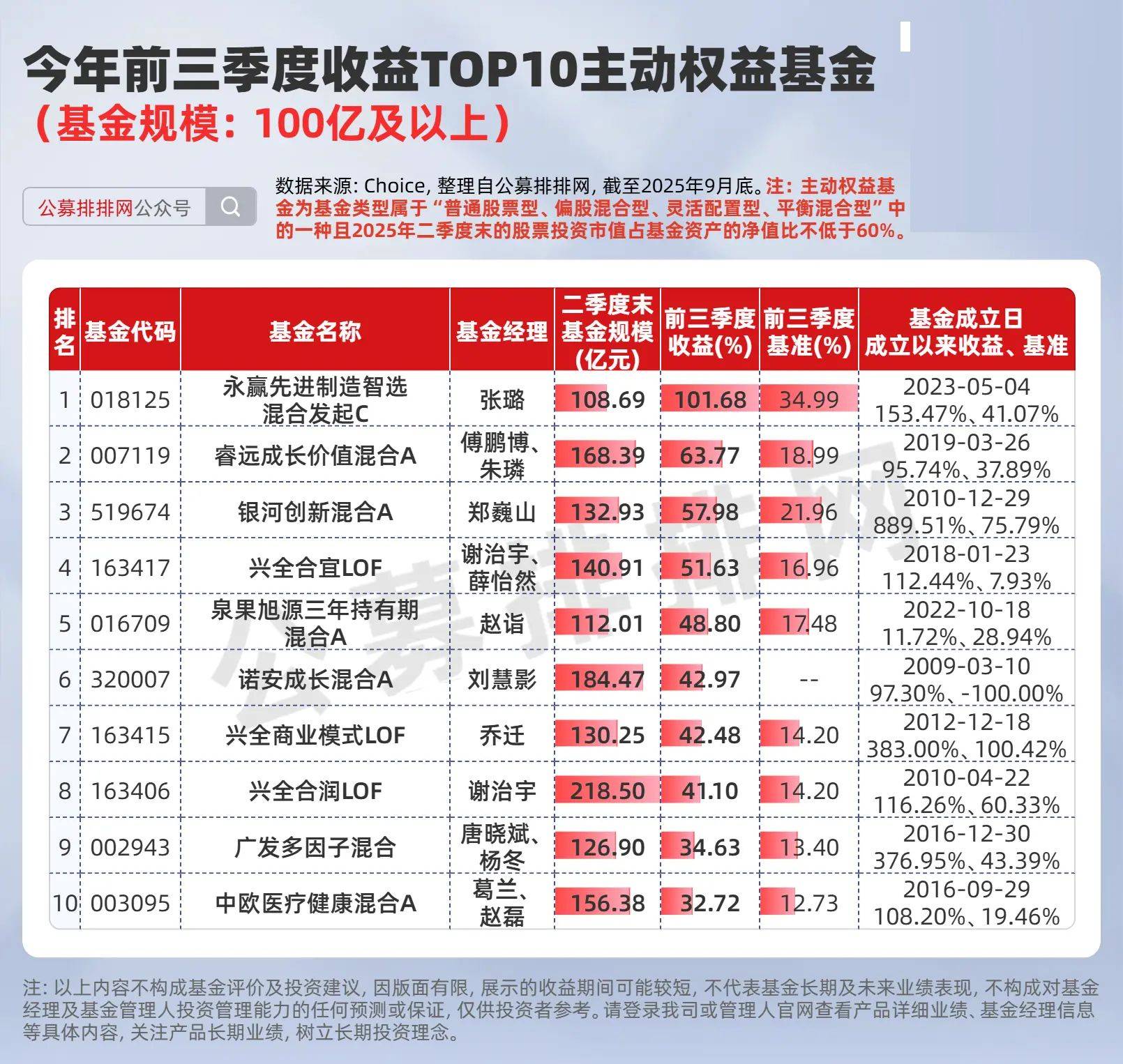
前三季度收益TOP10基金揭晓!谢治宇、葛兰等旗下基金上榜!
Sou Hu Cai Jing· 2025-10-15 08:43
Core Insights - The A-share market has shown remarkable performance in 2025, with total trading volume reaching 301.92 trillion yuan in the first three quarters, surpassing the total for 2021 [1] - The Shanghai Composite Index increased by approximately 15.84%, while the Shenzhen Component Index rose by about 29.88%, and the ChiNext Index surged over 51% [1] - Active equity funds have significantly improved performance, with an average return of 35.13% for existing funds, and 21.33% of funds achieving returns of 50% or more [1] Fund Performance by Size 100 Billion and Above - The top-performing fund is "Yongying Advanced Manufacturing Smart Selection Mixed Initiation C" managed by Zhang Lu, with a return of 101.68% [4] - The average return for active equity funds in this category is 34.37%, with the top 10 funds having a minimum return of 32.72% [2] 50-100 Billion - "Penghua Carbon Neutral Theme Mixed C" managed by Yan Siqian leads this category with a return of 110.85% [9] - The average return for funds in this size category is 35.55%, with the top 10 funds requiring a minimum return of 48.53% [7] 20-50 Billion - "Yongying Medical Innovation Smart Selection Mixed Initiation C" managed by Shan Lin tops this group with a return of 114.01% [13] - The average return for this category is 40.07%, with the top 10 funds needing a minimum return of 91.06% [11] 10-20 Billion - "Yongying Technology Smart Selection Mixed Initiation C" managed by Ren Jie achieved a return of 193.09%, ranking second among all active equity funds [17] - The average return for funds in this category is 38.14%, with the top 10 requiring a minimum return of 91.35% [15] 5-10 Billion - "Zhonghang Opportunity Navigation Mixed Initiation C" managed by Han Hao leads with a return of 126.16% [21] - The average return for this size group is 36.73%, with the top 10 funds needing a minimum return of 98.86% [19] 1-5 Billion - "Yongying Technology Smart Selection Mixed Initiation A" managed by Ren Jie tops this category with a return of 194.49% [24] - The average return for funds in this category is 36.94%, with the top 10 requiring a minimum return of 113.50% [23]