AI大模型

Search documents
百度李彦宏:AI产业正从不健康向健康的结构进行转变
Sou Hu Cai Jing· 2025-11-13 02:32
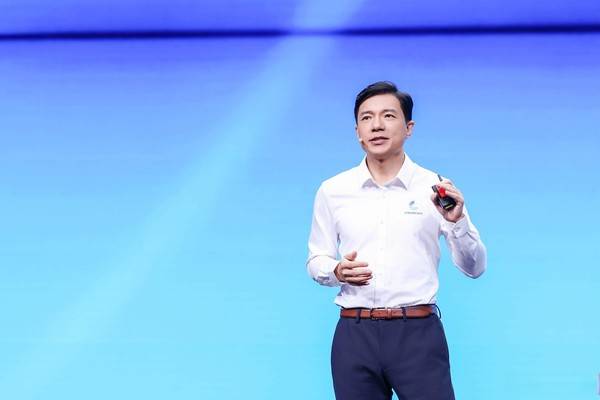
Core Insights - The AI industry is transitioning from an unhealthy "pyramid" structure to a healthier "inverted pyramid" structure, emphasizing the importance of applications over chips and models [1][3]. Group 1: Industry Structure - The previous "pyramid" structure allocated most value to the chip layer, with model manufacturing receiving only 1/10 of that value, and application value being an order of magnitude smaller [3]. - A healthy industry structure should allow chip manufacturers to earn 10 times their value from models, and applications developed from those models to create 100 times the value [5]. Group 2: Market Environment - The AI large model development is nearing a critical point, with expectations of numerous valuable applications emerging soon, indicating an exciting market environment [5]. - Currently, 65% of content on Baidu's search platform incorporates generative content, primarily presented in formats like galleries, videos, or live broadcasts, marking a significant transformation in search engine capabilities [5].


Arm、AMD相继官宣收购 AI芯片大厂开启密集整合
2 1 Shi Ji Jing Ji Bao Dao· 2025-11-12 22:28
Core Insights - The article discusses the recent acquisition activities among major international chip manufacturers, driven by the rapid evolution of AI large model technology, highlighting their efforts to enhance ecosystem capabilities [1][2]. Group 1: Acquisition Activities - Arm and AMD have announced acquisition plans, with Arm set to acquire DreamBig Semiconductor for approximately $265 million, aimed at enhancing data transmission capabilities in data centers [3][5]. - AMD completed the acquisition of MK1, which specializes in high-speed AI inference, marking a significant milestone in AMD's strategy to improve AI performance and efficiency [2][3]. - Qualcomm is also pursuing acquisitions, including a deal with Alphawave IP Group valued at around $2.4 billion, to bolster its data center capabilities and enhance data transmission efficiency [5][6]. Group 2: Market Opportunities - The current AI market presents diverse opportunities, spanning from cloud data centers to edge AI inference, necessitating improvements in data transmission and development efficiency [2][4]. - The acquisitions reflect a strategic shift for companies traditionally focused on mobile or PC markets, as they aim to expand into broader AI-related markets [1][2]. Group 3: Ecosystem Development - Companies are not only focusing on enhancing AI chip capabilities but are also aiming to build comprehensive ecosystem capabilities, integrating hardware, software, and cloud services [6][7]. - Qualcomm's acquisitions in various sectors, including automotive and IoT, indicate its transition from a mobile-centric focus to a broader strategy encompassing data centers and intelligent devices [6][7]. - The competitive landscape is evolving from individual chip performance to a holistic approach that includes system-level integration and ecosystem development [7].



生物人、数字人、机器人 未来头条得看谁?
Shang Hai Zheng Quan Bao· 2025-11-12 15:35
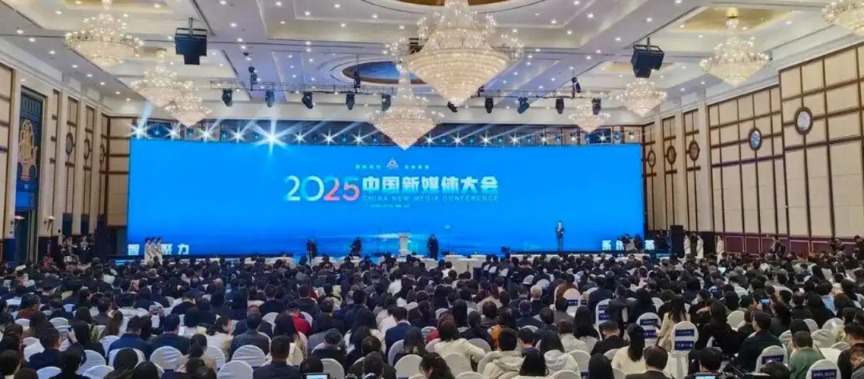
Core Insights - The 2025 China New Media Conference opened in Changsha, focusing on the theme of "Intelligent Synergy, Systemic Transformation" with various forums and exhibitions [1] - The conference serves as a national authoritative platform for promoting deep integration and systemic transformation in media, having been held annually since 2018 [1] Group 1: Technological Innovations - A discussion on "Biological Humans, Digital Humans, Robots: Who Will Headline the Future?" sparked significant interest, featuring representatives from various media and technology companies [3] - A robot from Yushu Technology demonstrated its ability to perform editing tasks through voice interaction, showcasing the potential for AI in media production [3] Group 2: AI Applications in Media - Tencent Cloud launched the "AI Audio Superpower" - MuseLM and Lingyin models, aimed at enhancing music editing capabilities for media professionals [5] - The MuseLM model addresses challenges such as lack of copyright, low production efficiency, and limited interaction in audio creation, enabling high-quality audio program generation [6] Group 3: Virtual Production Techniques - SenseTime showcased its self-developed "Seko" model for generating digital humans and creating films from a single sentence, demonstrating rapid content creation capabilities [8] - iQIYI presented its virtual production AI video technology, which utilizes a 2500 square meter indoor virtual production scene to enhance filming processes and improve visual realism [8][10] - The virtual production technology has been applied in multiple film and television projects, with plans to establish a digital asset library to foster a new "Cultural + Technology" ecosystem [10]

Arm、AMD相继官宣收购,AI芯片大厂开启密集整合
2 1 Shi Ji Jing Ji Bao Dao· 2025-11-12 13:20
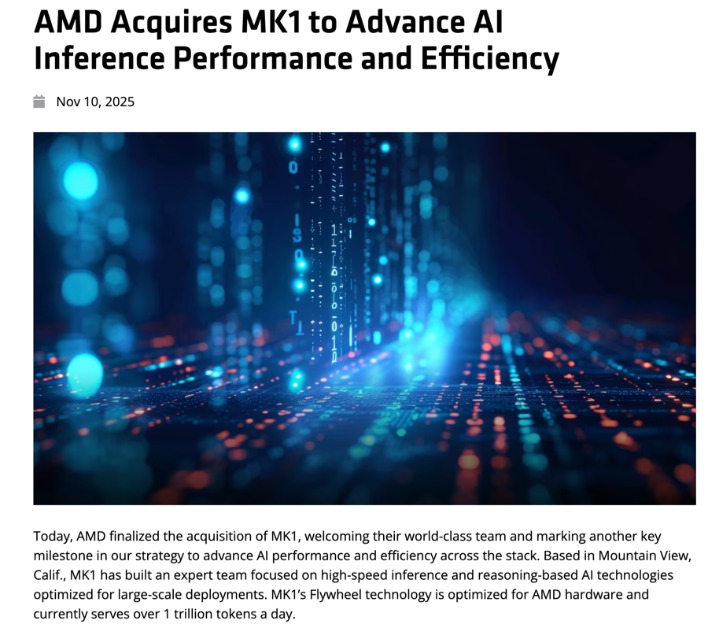
Core Insights - The article discusses the recent acquisition activities among major international chip manufacturers, driven by the rapid evolution of AI large model technology, highlighting their efforts to enhance ecosystem capabilities [1][4]. Group 1: Acquisition Activities - AMD announced the completion of its acquisition of MK1, which specializes in high-speed AI inference, marking a significant milestone in enhancing AI performance and efficiency [3][4]. - Arm plans to acquire DreamBig Semiconductor for approximately $265 million, aiming to improve data transmission capabilities within data centers [4][5]. - Qualcomm is set to acquire Alphawave IP Group for an implied enterprise value of about $2.4 billion, focusing on enhancing data transmission efficiency for AI training and inference [5][6]. Group 2: Strategic Focus - The acquisitions reflect a broader strategy among AI chip manufacturers to strengthen their capabilities in various dimensions, including data transmission efficiency and AI inference [1][4]. - Companies are not only enhancing their chip capabilities but are also expanding their ecosystem to include software and system-level integration, moving from selling individual chips to offering comprehensive solutions [9]. Group 3: Market Trends - The competitive landscape is shifting towards a race to build integrated systems that encompass computing, transmission, memory, and inference capabilities, indicating a transition from discrete technology to a cohesive ecosystem [9]. - The article emphasizes the importance of improving data transmission efficiency, which is critical for AI chip manufacturers as they navigate the complexities of the AI market [5][6].
“雷军千万年薪招揽”?罗福莉宣布加入小米
Sou Hu Cai Jing· 2025-11-12 13:10
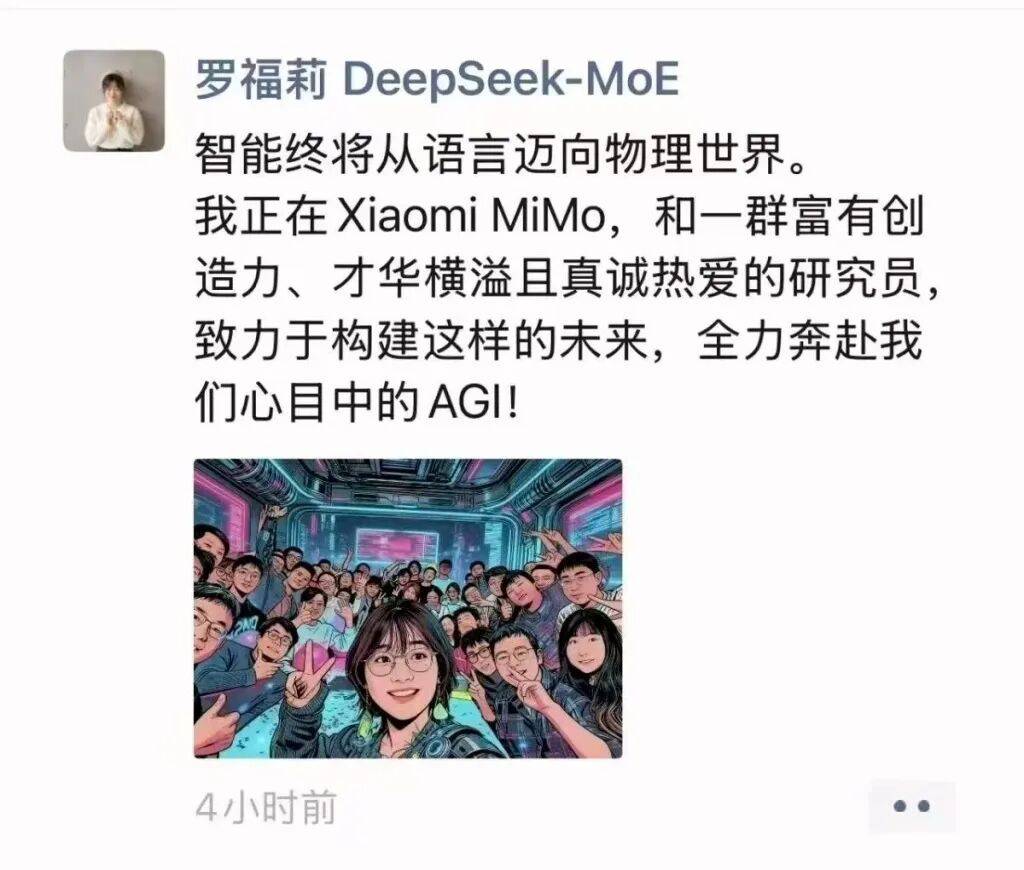
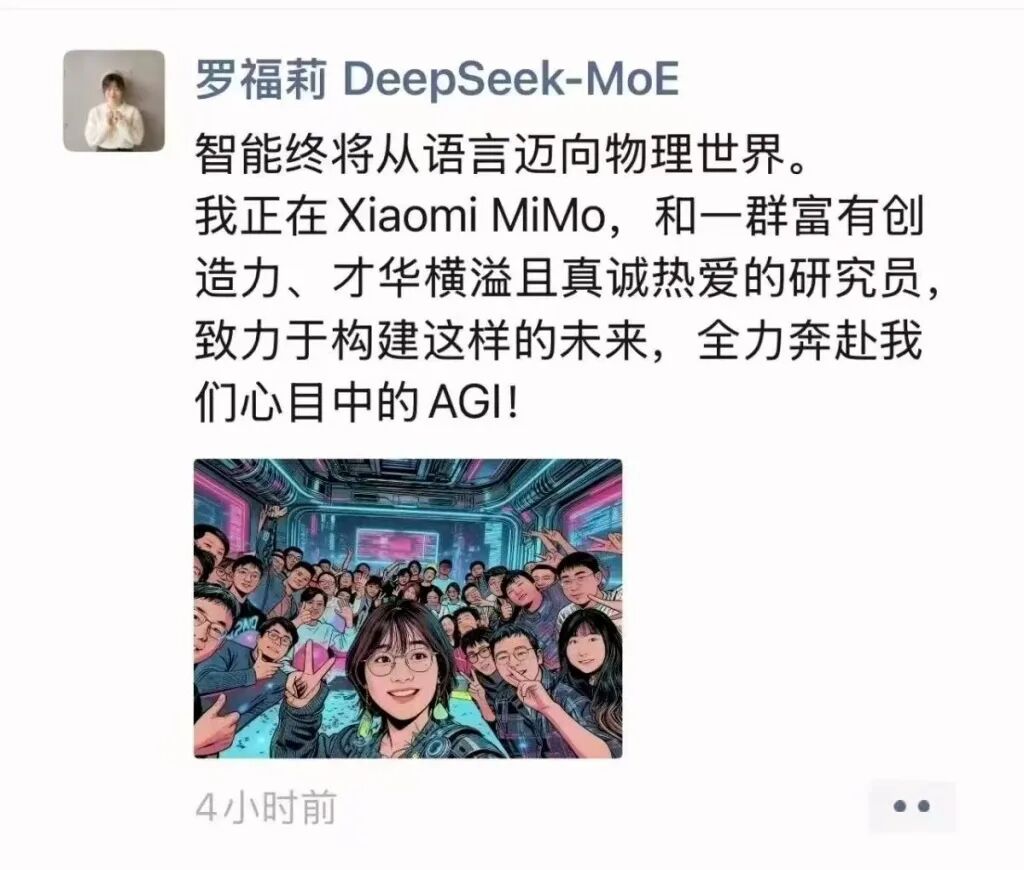
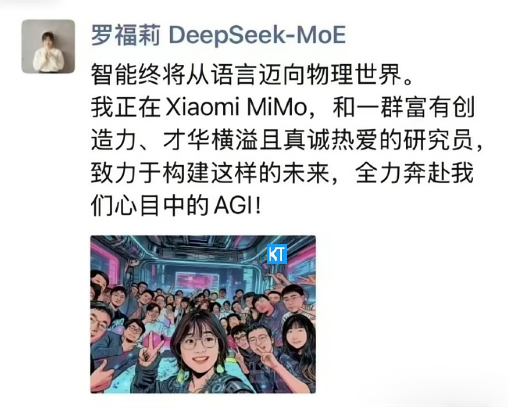
12日,"AI才女"、前DeepSeek研究员罗福莉宣布加入小米公司。她在朋友圈发文:"智能终将从语言迈向物理世界。我正在Xiaomi MiMo,和一群 富有创造力、才华横溢且真诚热爱的研究员,致力于构建这样的未来,全力奔赴我们心目中的AGI。" 据悉,Xiaomi MiMo是小米首个推理大模型。罗福莉正式宣布加入小米亦是对此前传言的回应。 去年年末,雷军在直播时说,希望用千万年薪挖角罗福莉,请她到小米带领团队从事AI大模型研究。 当时有消息称,小米公司正在积极搭建自己的GPU万卡集群,以加大对AI大模型的投入力度。小米大模型团队在成立之初就已拥有6500张GPU资 源,而此次搭建GPU万卡集群,将进一步提升小米在AI大模型领域的研发实力。据知情人士透露,该计划已经实施数月之久,雷军在其中扮演了 重要的领导角色。他对于AI硬件的重视程度极高,认为手机是AI硬件领域的核心,小米必须全力以赴。 不过,当时小米并未给出回应,罗福莉本人也未直接回应此事。 监制:王薇薇 审核:杜秀萍 编辑:陈婧琳 校对:李璐亚 在今年10月举行的2025智能网联汽车大会上,小米集团创始人、董事长雷军表示,AI大模型是智能网联汽车的未来 ...

罗福莉宣布加入小米
Xin Jing Bao· 2025-11-12 13:05
Core Insights - The announcement of AI expert Luo Fuli joining Xiaomi marks a significant step in the company's ambition to develop advanced AI models, particularly the Xiaomi MiMo, which is its first reasoning large model [1][8] - Xiaomi's founder Lei Jun previously expressed a strong interest in recruiting Luo Fuli, indicating the company's commitment to enhancing its AI capabilities and infrastructure [5] - The establishment of a GPU cluster with 10,000 units is part of Xiaomi's strategy to bolster its research and development in AI large models, with an initial resource of 6,500 GPUs already in place [5] Company Strategy - Xiaomi's core strategy revolves around integrating AI into its ecosystem, particularly in smart connected vehicles, which are seen as a crucial node in the company's "people, vehicles, and home" ecosystem [6] - The AI model for smart vehicles is designed to operate without internet connectivity, utilizing various sensors for features like emotion recognition and multimodal interaction, ensuring data privacy through local computing [6] - The collaboration between Xiaomi's AI team and Peking University on research related to MoE and reinforcement learning highlights the company's focus on cutting-edge AI research [7] Team Development - Luo Fuli's background includes significant experience in AI research, having worked at Alibaba's DAMO Academy and DeepSeek, where she contributed to various AI models [7][8] - Xiaomi's AI laboratory established a large model team in April 2023, with Luan Jian as the team leader, indicating a structured approach to AI development [8] - The Xiaomi MiMo model was open-sourced in April 2023, representing an initial effort from the newly formed core team dedicated to large models [8]
热搜第一!“AI才女”官宣
Zhong Guo Ji Jin Bao· 2025-11-12 10:46
Core Insights - The article highlights the significant move of AI expert Luo Fuli joining Xiaomi, indicating the company's commitment to advancing artificial general intelligence (AGI) and physical world intelligence [1][4]. Company Overview - Luo Fuli, a prominent figure in AI, has a strong academic background with a Bachelor's degree in Computer Science from Beijing Normal University and a Master's in Computational Linguistics from Peking University [3]. - She previously worked at Alibaba's DAMO Academy, where she led the development of the VECO multilingual pre-training model and contributed to the open-source efforts of AliceMind [3]. Recent Developments - Luo Fuli's transition to Xiaomi is seen as a strategic enhancement of the company's AI capabilities, particularly in AGI research [4]. - Xiaomi is reportedly building a large GPU cluster to bolster its investment in AI large models, with founder Lei Jun playing a crucial leadership role in this initiative [4]. - In October, Xiaomi's AI team collaborated with Peking University to publish a paper focusing on MoE and reinforcement learning, marking Luo Fuli's first public research output since joining Xiaomi [4][7]. Technological Innovations - Xiaomi has established an AI laboratory large model team, which released its first inference large model, Xiaomi MiMo, in April 2023 [7]. - The company announced the open-sourcing of its first native end-to-end voice large model, Xiaomi-MiMo-Audio, in September 2023, representing a significant breakthrough in voice technology [7].
AI“天才少女”加入!小米系统已显示罗福莉信息,曾传雷军千万年薪挖角
Bei Jing Shang Bao· 2025-11-12 10:39
Core Insights - The article discusses the announcement of Luo Fuli, a prominent AI researcher, joining Xiaomi to lead the company's AI model team, specifically focusing on the Xiaomi MiMo model [3][6]. Group 1: Company Developments - Luo Fuli officially announced her joining Xiaomi on November 12, stating her commitment to building a future in artificial general intelligence (AGI) with a talented team [3][6]. - Xiaomi is actively building a GPU cluster to enhance its capabilities in AI model development, with an initial resource of 6,500 GPUs [6]. - The recruitment of Luo Fuli was part of Xiaomi's strategy to strengthen its AI research team, with reports indicating a significant annual salary offer to attract her [6]. Group 2: Background of Luo Fuli - Luo Fuli has a strong academic background, having graduated from Beijing Normal University and pursued further studies at Peking University, where she specialized in computational linguistics [9]. - Prior to joining Xiaomi, she worked at Alibaba's Damo Academy and later at DeepSeek, contributing to the development of advanced AI models [9]. - Her rise to prominence in the AI field has earned her the nickname "AI talent girl," reflecting her achievements and recognition in the industry [9].

热搜第一!“AI才女”官宣
中国基金报· 2025-11-12 10:39
Core Insights - The article highlights the significant recruitment of AI expert Luo Fuli by Xiaomi, indicating a strategic move towards enhancing the company's capabilities in artificial general intelligence (AGI) and physical world applications [1][4]. Group 1: Luo Fuli's Background and Achievements - Luo Fuli, born in the 1990s in Sichuan, China, has an impressive academic background with a Bachelor's degree in Computer Science from Beijing Normal University and a Master's in Computational Linguistics from Peking University [3]. - She has published eight papers at the prestigious ACL conference in 2019, with two as the first author, showcasing her expertise in the field [3]. - Her career includes significant roles at Alibaba's DAMO Academy, where she developed the multilingual pre-training model VECO, and at DeepSeek, where she contributed to the development of the MoE large model DeepSeek-V2 [3]. Group 2: Xiaomi's AI Strategy - Xiaomi is actively building its GPU cluster to enhance its investment in AI large models, with founder Lei Jun playing a crucial leadership role in this initiative [4]. - The company has established an AI laboratory large model team in April 2023, with the first large model, Xiaomi MiMo, being open-sourced shortly after [8]. - In September 2023, Xiaomi announced the open-sourcing of its first native end-to-end voice large model, Xiaomi-MiMo-Audio, marking a significant breakthrough in voice technology [8]. Group 3: Implications of Luo Fuli's Recruitment - Luo Fuli's joining Xiaomi is seen as a pivotal step towards advancing the company's research and investment in AGI, particularly in the context of physical world intelligence [4]. - Her involvement is expected to shift the research focus towards engineering implementation and system stability, as evidenced by her name appearing in a recent collaborative paper with Peking University [4][8]. - The recruitment is also indicative of Xiaomi's commitment to enhancing its AI capabilities and competitiveness in the rapidly evolving tech landscape [4].

智能汽车“下半场”的破局者:德赛西威的全栈融合之路
半导体芯闻· 2025-11-12 10:19
Core Viewpoint - The global smart automotive industry is undergoing unprecedented transformation, driven by software-defined vehicles and AI advancements, leading to a shift in competitive logic within the industry [2][14]. Group 1: Industry Transformation - The transition from distributed architecture to centralized computing platforms signifies a comprehensive change in the automotive sector, with a focus on system integration and cross-domain collaboration [2][3]. - Chinese companies, particularly Desay SV, are showcasing remarkable innovation and are evolving from traditional component suppliers to system solution providers [2][14]. Group 2: Full-Stack Integration - Full-stack integration involves a systematic transformation across multiple technical layers, including hardware-software decoupling, faster OTA upgrades, and enhanced safety and stability requirements [3][4]. - Desay SV is actively implementing full-stack integration in smart cockpits, intelligent driving, and connected services, exemplified by their integrated product ICP S01E [3][9]. Group 3: Growth Strategy - The company's growth strategy is encapsulated in the "growth flywheel" concept, emphasizing comprehensive product solutions, open communication with OEMs, rapid market introduction of new products, and leveraging experience for future innovations [5][6][14]. - Desay SV's R&D investment has seen a compound annual growth rate of 34% over the past five years, focusing on building a complete technology chain from perception to interaction [7][10]. Group 4: Key Technological Focus - The key areas of focus include artificial intelligence and machine learning, intelligent computing platforms, multi-sensor fusion technology, and 5G V2X technology, which together form a complete technology chain for smart vehicles [7][10]. Group 5: Global and Local Integration - Desay SV is expanding its vision from vehicle-centric products to include infrastructure, addressing the limitations of single-vehicle intelligence through vehicle-road collaboration [11][12]. - The company emphasizes the importance of localizing its innovations to fit different markets, advocating for a collaborative approach to global integration [12][14].