
人民币汇率

Search documents
每日机构分析:10月23日
Sou Hu Cai Jing· 2025-10-23 09:57
Core Insights - The direction of inflation changes in the U.S. may cause concern for the Federal Reserve [1] - A decline in U.S. Treasury yields signals a potential interest rate cut by the Federal Reserve [2] - U.S. inflation rate in September is expected to reach a 17-month high [3] Inflation Analysis - The U.S. September CPI data is likely to show a growth rate similar to August, with energy prices rising by 0.7% in August and expected to show rapid growth in September [1] - The overall and core CPI year-on-year rates for September are anticipated to be close to 3.0%, exceeding the Federal Reserve's target by one percentage point [1][3] - The increase in inflation is attributed to the impact of tariffs, with the overall price index expected to rise by 3.1% year-on-year [3] Monetary Policy Outlook - U.S. investors predict that the Federal Reserve will cut interest rates in meetings on October 29 and December 10, with a nearly 97% probability for a 25 basis point cut in October [2] - The European Central Bank is expected to reiterate its September stance in the upcoming October meeting, indicating stability in its policy [4] - The Bank of Korea appears less dovish, with expectations of a potential rate cut in November [5] Currency and Exchange Rate Projections - CITIC Securities forecasts a moderate appreciation of the RMB in 2026, influenced by the Federal Reserve's rate cuts and the impact of tariffs on the U.S. economy [3] - The Indonesian central bank is expected to cut rates by 25 basis points in the fourth quarter, maintaining a cautious stance amid global uncertainties [5]
9月金融机构代客净卖出518亿美元外汇创近三年新高
Sou Hu Cai Jing· 2025-10-23 07:30
根据周三晚间发布的官方数据,9月份贷款机构代客户 净卖出518亿美元外汇,创下2020年12月以来的 最大月度净卖出额。客户包括出口商、进口商和一些海外金融资产投资者。 来源:豆豆君的纸飞机 数据显示,人民币汇率上月触及11月以来的最高点后,市场对人民币的看涨情绪有所升温。国内出口商 增加外汇兑换,或将支撑人民币在中美贸易紧张局势再度升温的背景下走强。 澳新银行集团亚洲研究主管Khoon Goh表示:"外汇结算净顺差表明流入中国的资金正在增加,这有助 于支撑人民币,同时出口商的转换也在加速。" 这些数据凸显了9月份出口强劲增长背景下货物贸易货币兑换的激增。这有助于抵消证券投资的资金外 流,因为央行的另一份数据显示,上个月外国机构继续削减境内债券持有量。#热点观点##海外新鲜事# ...


升值36基点!人民币中间价报7.0918
Sou Hu Cai Jing· 2025-10-23 02:21
北京商报讯(记者 岳品瑜 董晗萱)10月23日,中国人民银行授权中国外汇交易中心公布,当日银行间 外汇市场人民币汇率中间价为1美元对人民币7.0918元,相较前一交易日中间价7.0954元,调升36个基 点。 国家外汇管理局统计数据显示,2025年1—9月,银行累计结汇132747亿元人民币,累计售汇128261亿元 人民币。前三季度我国涉外收支总规模创下11.6万亿美元历史新高,这一规模扩张对人民币汇率也将形 成坚实支撑。 截至最新发稿时间9时40分,在岸人民币对美元报7.1226,日内升值0.02%;离岸人民币对美元报 7.1267。 ...
在岸人民币对美元开盘上涨 报7.1230
Sou Hu Cai Jing· 2025-10-23 01:57
华泰期货研报认为,预计年内人民币仍以稳中偏强为主。若美联储降息节奏符合市场预期、美元趋势性 走弱,叠加国内政策持续托底、经济修复延续,人民币有望逐步靠近7.0-6.9区间。需关注后续美国通胀 与就业数据集中公布后的方向性修正风险。 上证报中国证券网讯(记者 陈佳怡)10月23日,Wind数据显示,在岸人民币对美元开盘上涨,报 7.1230,前一交易日16时30分收盘报7.1245。截至9时30分,离岸人民币对美元报7.1262。 与此同时,截至9时30分,美元指数报99.0217。 同日,人民币对美元中间价报7.0918,上调36点。 ...
人民币对美元中间价报7.0918 上调36个基点
Zhong Guo Jing Ji Wang· 2025-10-23 01:45
(责任编辑:马欣) 中国人民银行授权中国外汇交易中心公布,2025年10月23日银行间外汇市场人民币汇率中间价为:1美 元对人民币7.0918元,1欧元对人民币8.2434元,100日元对人民币4.6766元,1港元对人民币0.91251元, 1英镑对人民币9.4851元,1澳大利亚元对人民币4.6098元,1新西兰元对人民币4.0781元,1新加坡元对 人民币5.4749元,1瑞士法郎对人民币8.9202元,1加拿大元对人民币5.0778元,人民币1元对1.1293澳门 元,人民币1元对0.59514马来西亚林吉特,人民币1元对11.4379俄罗斯卢布,人民币1元对2.4530南非兰 特,人民币1元对201.32韩元,人民币1元对0.51691阿联酋迪拉姆,人民币1元对0.52787沙特里亚尔,人 民币1元对47.1823匈牙利福林,人民币1元对0.51347波兰兹罗提,人民币1元对0.9062丹麦克朗,人民币 1元对1.3249瑞典克朗,人民币1元对1.4108挪威克朗,人民币1元对5.90675土耳其里拉,人民币1元对 2.5967墨西哥比索,人民币1元对4.6116泰铢。 中国经济网北京10月23日讯 ...
前三季度涉外收支破11.6万亿美元
Sou Hu Cai Jing· 2025-10-22 15:37
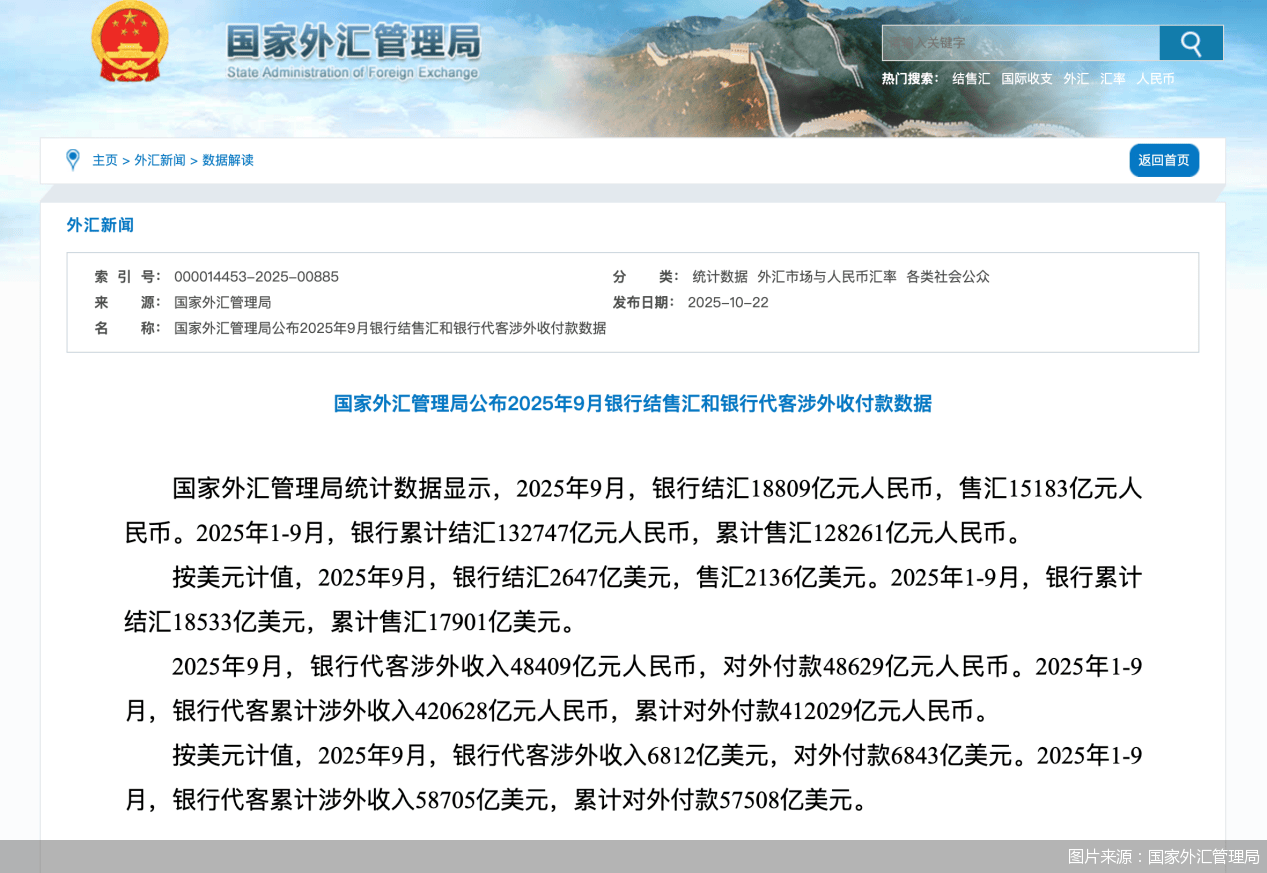
按美元计值,2025年9月,银行代客涉外收入6812亿美元,对外付款6843亿美元。2025年1—9月,银行 代客累计涉外收入58705亿美元,累计对外付款57508亿美元。 整体来看,9月数据延续了今年以来的良好态势。苏商银行特约研究员武泽伟指出,今年前三季度我国 涉外收支总规模创下11.6万亿美元历史新高:首先源于货物贸易的持续韧性,在全球经济波动背景下出 口竞争力稳固,带来稳定外汇流入;其次,国内经济温和复苏与资本市场吸引力增强,促使外资配置人 民币资产,资本项下收支同步增长;此外,高水平对外开放政策深化,如金融市场互联互通机制优化, 也为跨境资金流动提供了制度保障。 据国家外汇管理局10月22日消息,日前,国家外汇管理局公布了2025年9月银行结售汇和银行代客涉外 收付款数据。9月,我国银行结售汇延续顺差态势,银行代客涉外收付款基本平衡,外汇市场运行平稳 有序。 在分析人士看来,今年前三季度我国涉外收支总规模创下11.6万亿美元历史新高,这一规模扩张对人民 币汇率也将形成坚实支撑,后续,重点看好人民币升值趋势。 9月数据延续良好态势 数据显示,2025年9月,银行结汇18809亿元人民币,售汇1518 ...
前三季度涉外收支破11.6万亿美元,外汇韧性凸显人民币稳中有进
Sou Hu Cai Jing· 2025-10-22 14:25
Core Insights - The State Administration of Foreign Exchange reported a continued surplus in China's bank foreign exchange settlement and sales in September 2025, with a stable foreign exchange market [1][4] - Analysts highlight that the total scale of foreign-related income and expenditure in the first three quarters of 2025 reached a historical high of $11.6 trillion, supporting the trend of RMB appreciation [1][8] Summary by Category Foreign Exchange Settlement and Sales - In September 2025, banks settled 18,809 billion RMB and sold 15,183 billion RMB, with cumulative settlements of 132,747 billion RMB and sales of 128,261 billion RMB from January to September [3] - In USD terms, banks settled 2,647 billion USD and sold 2,136 billion USD in September, with cumulative settlements of 18,533 billion USD and sales of 17,901 billion USD for the first three quarters [3] Cross-Border Payments - In September 2025, banks recorded foreign-related income of 48,409 billion RMB and payments of 48,629 billion RMB, with cumulative income of 420,628 billion RMB and payments of 412,029 billion RMB from January to September [3] - In USD, foreign-related income was 6,812 billion USD and payments were 6,843 billion USD in September, with cumulative income of 58,705 billion USD and payments of 57,508 billion USD for the first three quarters [3] Market Trends and Analysis - The foreign exchange market showed active and balanced cross-border capital flows, with a total of 1.37 trillion USD in cross-border income and expenditure in September, reflecting a 7% month-on-month increase [4] - The surplus in bank foreign exchange settlement was 51 billion USD in September, indicating a balanced supply and demand in the foreign exchange market [5][7] RMB Appreciation Outlook - Analysts expect a trend of RMB appreciation due to the expansion of foreign-related income and expenditure, which alleviates depreciation pressure and enhances the currency's resilience [8][10] - The People's Bank of China is advancing the internationalization of the RMB, with its status in the Special Drawing Rights (SDR) basket being raised, indicating a significant milestone in RMB internationalization [9]
在岸人民币兑美元16:30收盘 较上一交易日跌74点
Di Yi Cai Jing· 2025-10-22 08:43
Core Viewpoint - The onshore Chinese yuan (CNY) against the US dollar (USD) closed at 7.1245 at 16:30 Beijing time, marking a decline of 74 points from the previous trading day's official closing price [1] Currency Exchange Summary - The official closing rate of the onshore CNY against the USD indicates a depreciation trend [1] - The specific decline of 74 points highlights the currency's volatility in the current market environment [1]
中国经济向好,人民币挑战7.085
EBSCN· 2025-10-22 07:55
Economic Indicators - In September, the Consumer Price Index (CPI) in mainland China decreased by 0.3% year-on-year, marking two consecutive months of decline[2] - The core CPI, excluding food and energy, increased by 1% year-on-year, with the growth rate expanding for the fifth consecutive month[2] - The GDP for the third quarter grew by 4.8% year-on-year and 1.1% quarter-on-quarter, both exceeding market expectations[2] - For the first three quarters, the economic growth rate was 5.2%[2] Currency Trends - The offshore RMB initially targeted a level of approximately 7.12 against the USD, reaching a high of about 7.0851 on September 17[1] - Following a slight rise in the USD, the offshore RMB fluctuated around 7.12, with a temporary rise to 7.1535 but failing to break the 50-day moving average[1] - The RMB is expected to test the high of approximately 7.085 again in the fourth quarter, despite uncertainties from U.S. trade policies[1][3] - The People's Bank of China has signaled moderate easing, which may support the RMB as the economy continues to stabilize[3]
人民币汇率升至年内新高后小幅回调
Jin Rong Shi Bao· 2025-10-22 02:38
Core Insights - The interbank foreign exchange market in China showed a mixed performance in September, with the US employment data falling short of expectations and the Federal Reserve lowering interest rates by 25 basis points, leading to a rebound in the US dollar index [1][6] - The Chinese yuan reached a new high for the year in September, but experienced slight fluctuations towards the end of the month [2][3] - The offshore yuan weakened against the onshore yuan, resulting in a shift from a positive to a negative exchange rate differential [3] Exchange Rate Performance - The yuan appreciated to a high of 7.1019 against the US dollar in early September, driven by a weaker dollar index and positive sentiment from US-China trade talks [2] - By the end of September, the yuan was trading at 7.1186, reflecting a monthly appreciation of 0.17% [2] - The CFETS index for the yuan against a basket of currencies rose by 0.21% to 96.77 [2] Exchange Rate Differential - The exchange rate differential between onshore and offshore yuan shifted from positive to negative, with the average differential for the month being -4 basis points [3] - The maximum differential recorded was -97 basis points on September 26 [3] Foreign Exchange Options Market - The trading volume for yuan foreign exchange options was stable, with an average daily transaction of 63.18 billion USD, up 8.37% month-on-month [4] - Implied volatility for yuan options continued to decline, with the 1-month ATM implied volatility dropping to 2.3%, the lowest since August 2024 [4] Swap Market Activity - The yuan foreign exchange swap market saw active trading, with an average daily volume of 931.95 billion USD, an increase of 8.90% month-on-month [5] - Short to medium-term transactions dominated, accounting for nearly 70% of the trading volume [5] Interest Rate Differentials - The interest rate differential between Chinese and US bonds fluctuated, with the 10-year US Treasury yield dropping to a year-low of 4.01% before rebounding to around 4.2% [6] - The 10-year US-China bond yield spread ended the month at -230 basis points, an increase of 9 basis points from the previous month [6] - The 1-year swap points rose significantly, reaching -1322 basis points, the highest in nearly two and a half years [6]