欧洲央行政策

Search documents
瑞达期货沪镍产业日报-20260326
Rui Da Qi Huo· 2026-03-26 09:17
1. Report Industry Investment Rating - Not provided in the given content 2. Core Viewpoints of the Report - The report predicts that Shanghai nickel will experience short - term shock adjustments, and investors should focus on the competition around the MA60 line [4] - On the macro - front, the situation between the US and Iran is complex. Iran has rejected the US cease - fire proposal, while the White House claims the negotiation is ongoing and productive. The information exchange is not considered a negotiation by Iran, and the Strait of Hormuz is open to non - belligerent countries [3] - On the fundamental side, the nickel ore imports have declined as the Philippines enters the rainy season. The approval progress of Indonesia's nickel ore RKAB production is faster than expected, alleviating supply concerns. The domestic refined nickel production is expected to rise again, and the demand from stainless steel plants and new - energy vehicles is increasing [3] - Technically, the position volume has decreased, the price has corrected, and the bullish sentiment is cautious [4] 3. Summary by Relevant Catalogs 3.1 Futures Market - The closing price of the main futures contract of Shanghai nickel is 135,860 yuan/ton, down 270 yuan; the 05 - 06 contract spread of Shanghai nickel is - 230 yuan/ton, down 40 yuan [3] - The LME 3 - month nickel price is 17,345 US dollars/ton, up 365 US dollars; the main contract position volume of Shanghai nickel is 179,895 hands, down 8,924 hands [3] - The net long position of the top 20 futures positions of Shanghai nickel is - 49,024 hands, up 4,278 hands; the LME nickel inventory is 282,456 tons, down 432 tons [3] - The Shanghai Futures Exchange nickel inventory is 63,661 tons (weekly), down 20 tons; the LME nickel cancelled warrants total 18,492 tons, down 408 tons [3] - The warehouse receipt quantity of Shanghai nickel is 57,593 tons, down 12 tons [3] 3.2 Spot Market - The SMM 1 nickel spot price is 139,350 yuan/ton, up 1,550 yuan; the spot average price of 1 nickel plate in Yangtze River Non - ferrous Metals is 139,250 yuan/ton, up 1,350 yuan [3] - The CIF (bill of lading) price of Shanghai electrolytic nickel is 210 US dollars/ton, unchanged; the bonded warehouse (warehouse receipt) price of Shanghai electrolytic nickel is 210 US dollars/ton, unchanged [3] - The average price of battery - grade nickel sulfate is 31,650 yuan/ton, unchanged; the basis of the NI main contract is 3,490 yuan/ton, up 1,820 yuan [3] - The LME nickel (spot/three - month) premium is - 195.11 US dollars/ton, up 0.78 US dollars [3] 3.3 Upstream Situation - The monthly import volume of nickel ore is 122.39 million tons, down 16.03 million tons; the total port inventory of nickel ore is 792.66 million tons (weekly), down 65.68 million tons [3] - The average monthly import unit price of nickel ore is 96.59 US dollars/ton, down 28.97 US dollars/ton; the tax - included price of Indonesian laterite nickel ore with 1.8% Ni is 41.71 US dollars/wet ton, unchanged [3] 3.4 Industry Situation - The monthly electrolytic nickel output is 29,430 tons, up 1,120 tons; the total monthly nickel - iron output is 2.14 million metal tons, unchanged [3] - The monthly import volume of refined nickel and alloys is 17,308.15 tons, down 5,231.79 tons; the monthly import volume of nickel - iron is 83.17 million tons, down 7.82 million tons [3] 3.5 Downstream Situation - The monthly output of 300 - series stainless steel is 131.94 million tons, down 53.87 million tons; the total weekly inventory of 300 - series stainless steel is 62.42 million tons, down 1.28 million tons [3] 3.6 Industry News - The negotiation between the US and Iran is unclear. Iran has rejected the US cease - fire proposal, while the White House claims the negotiation is ongoing and productive. Iran is prepared for further escalation of the situation [3] - Non - belligerent ships can pass through the Strait of Hormuz after coordination. COSCO Shipping Lines has resumed new booking business (ordinary containers) to some Middle - East countries but will not pass through the Strait of Hormuz for now [3] - As of the end of February, the total installed power generation capacity in China is 3.95 billion kilowatts, a year - on - year increase of 15.9%. The installed capacity of solar power generation is 1.23 billion kilowatts, a year - on - year increase of 33.2%; the installed capacity of wind power is 0.65 billion kilowatts, a year - on - year increase of 22.8% [3] - A Fed governor believes that the current Fed policy is dragging down the economy and should gradually cut interest rates to the neutral level this year. The overall inflation forecast for this year is raised to 2.7% due to the oil price shock [3] - The ECB President says that the ECB will take decisive action if inflation is triggered by the soaring energy cost, and is currently assessing the impact of the Middle - East situation [3]

拉加德:预计欧元区通胀将在中期内稳定在2%的目标水平
Xin Hua Cai Jing· 2026-02-26 14:53
Core Viewpoint - The European Central Bank (ECB) President Christine Lagarde stated that inflation in the Eurozone is expected to stabilize at the target level of 2% in the medium term, while monitoring exchange rate fluctuations without setting specific targets [1] Group 1: Inflation and Economic Outlook - Lagarde emphasized that the ECB has successfully controlled consumer prices, but policymakers must closely monitor public perceptions of high inflation [1] - Despite a decrease in inflation, surveys indicate that many citizens perceive prices to be rising faster than official data suggests, which could negatively impact private consumption and lead to higher wage demands [1] - The ECB officials indicated that the next interest rate adjustment will be "fully flexible," with no immediate intention to change policies [1] Group 2: Economic Support Factors - Lagarde expects Eurozone economic activity to be supported by a resilient labor market, growing labor income, and infrastructure investment [1] Group 3: Leadership Speculation - Recent market speculation suggested that Lagarde might resign this year, to which she responded that her basic expectation is to serve until the end of her term in October next year [1]
欧元区国债收益率开盘走高 德国制造业订单意外激增叠加债券供应在即
Xin Lang Cai Jing· 2026-02-05 08:06
Core Viewpoint - Eurozone government bond yields have slightly increased in early trading, influenced by an unexpected rise in German manufacturing orders and upcoming large bond issuances in Spain and France [1] Group 1: Economic Indicators - German manufacturing orders unexpectedly surged in December, contributing to the rise in bond yields [1] - The European Central Bank's policy announcement is a key focus, with the market widely expecting interest rates to remain unchanged [1] - Economic data indicates relative resilience in the Eurozone economy, which supports the maintenance of the deposit rate at 2.0% [1] Group 2: Bond Yield Changes - The 10-year German government bond yield rose by 0.5 basis points to 2.867% [1] - The 10-year Spanish government bond yield increased by 1.1 basis points to 3.242% [1] - The 10-year French government bond yield went up by 1 basis point to 3.458% [1]
欧元连续上涨 市场聚焦政策信号
Jin Tou Wang· 2026-01-21 11:50
Group 1: Euro/USD Dynamics - The Euro/USD has been rising for several consecutive trading days, driven primarily by a weaker dollar due to escalating tensions between the U.S. and Greenland, which has undermined market confidence in the dollar [1] - The Euro's recent performance has shown strength, distancing itself from previous long-term moving average levels, indicating enhanced bullish momentum [1] - The rise of the Euro is largely attributed to the dollar's weakness rather than significant improvements in the Euro's own fundamentals [1] Group 2: U.S. Economic Policy - The Federal Reserve recently implemented a widely anticipated interest rate cut, but conveyed a cautious signal regarding future policy adjustments [2] - Decision-makers emphasized that inflation remains at elevated levels and that clear signs of a cooling labor market are needed before further policy changes can be considered [2] - The overall outlook suggests that the easing cycle is not automatic, and future policy direction will depend on economic data performance [2] Group 3: European Economic Outlook - The European Central Bank maintained interest rates at a steady level in its recent policy meeting, with a slightly improved assessment of economic growth and inflation prospects, reducing expectations for short-term rate cuts [1] - Recent economic data has stabilized market sentiment, with the Eurozone economy performing better than expected, supported by strong domestic demand and exporters' adaptability to external pressures [1] - Inflation trends remain within the European Central Bank's target range, with stable service sector inflation expected to continue [1]
德国通胀率大幅放缓至2% 支持欧洲央行维持利率不变
Xin Lang Cai Jing· 2026-01-06 13:28
Core Viewpoint - Germany's inflation rate at the end of last year decreased more than expected, supporting the European Central Bank's (ECB) policy direction [1][2] Group 1: Inflation Data - The consumer price index in December rose by 2%, down from 2.6% in the previous month, while the Bloomberg median forecast was 2.2% [1] - Reports from France and Spain also indicated a reduction in price pressures, with Eurozone data expected to show an inflation rate reaching the 2% target [1] Group 2: Policy Implications - Policymakers express confidence in inflation returning to a controllable range, despite ECB's latest forecasts indicating that price increases this year and next will be below target, with only a small deviation [2] - ECB President Christine Lagarde highlighted unexpectedly strong wage growth and emphasized the need for officials to maintain a "humble" approach in analyzing data [2]
市场的分歧在哪里?大摩回应客户对其“2026年展望”的质疑
美股IPO· 2025-12-08 04:35
Core Viewpoint - Morgan Stanley reaffirms that AI-driven investment demand will continue to grow, leading to an expansion in the credit market, with total investment-grade bond issuance expected to surge to $2.25 trillion, while credit spreads will only widen modestly [1][3]. Group 1: AI Investment and Credit Market Outlook - Morgan Stanley predicts that U.S. investment-grade bond issuance will reach $2.25 trillion in 2026, a 25% year-over-year increase, with net issuance expected to hit $1 trillion, reflecting a 60% year-over-year growth [7]. - The firm believes that credit markets will be the primary funding channel for the next wave of AI investments, which are expected to be relatively insensitive to macroeconomic conditions such as interest rates and economic growth [4]. - There is a divergence in client feedback regarding the growth expectations from AI capital expenditures, with some questioning why higher growth is not anticipated [5]. Group 2: Factors Stabilizing Credit Spreads - Morgan Stanley argues that several factors will help stabilize credit spreads despite the anticipated surge in bond issuance, including a majority of AI-related issuances coming from high-quality issuers (AA-AAA rated) [8]. - Continued policy easing, with expectations of three more rate cuts from the Federal Reserve, is also seen as a stabilizing factor [9]. - The firm anticipates a mild economic re-acceleration and ongoing demand from yield-seeking investors will further anchor credit spreads [9]. Group 3: Central Bank Policy Divergence - The Federal Reserve's policy path remains a focal point of market debate, with Morgan Stanley expecting a rate cut in December, despite mixed signals from the labor market [10]. - The firm also predicts that the European Central Bank will implement two additional rate cuts by 2026, contradicting the ECB's president's assertion that the anti-inflation process has ended [10]. Group 4: Yield Curve Dynamics - Morgan Stanley defines 2026 as a "transition year" for global interest rates, moving from synchronized tightening to asynchronous normalization, with a consensus on the yield curve maintaining a range-bound pattern [11]. - There is ongoing debate regarding the nature of the yield curve steepening, whether it will be driven by falling rates (bull steepening) or rising long-term rates (bear steepening) [11].



欧洲央行官员Kazimir敦促对持续存在的通胀风险保持警惕
Sou Hu Cai Jing· 2025-11-03 10:34
Core Viewpoint - The European Central Bank (ECB) must remain vigilant against inflationary risks and resist the temptation to make minor adjustments to its policies [1] Group 1: Inflation Risks - Peter Kazimir, a member of the ECB Governing Council, highlighted the need to be cautious about upward inflation risks due to uncertainties in supply chains, energy costs, and unexpectedly strong potential price pressures [1] - Kazimir emphasized that these factors indicate a persistent risk that officials must acknowledge, warning against complacency at this stage [1] Group 2: Policy Stance - Despite the inflation concerns, Kazimir reaffirmed the ECB's position that its policies are well-positioned to address the challenges posed by the current turbulent environment [1] - He advised the central bank to avoid being overly aggressive, even if short-term forecasts suggest that price pressures may not meet the ECB's targets [1]
【UNforex财经事件】美联储鹰派预期升温 美元站稳高位 黄金震荡整理
Sou Hu Cai Jing· 2025-10-31 10:33
Group 1 - Recent US economic data remains robust, leading to a decrease in market expectations for interest rate cuts by the Federal Reserve, with the probability of a December rate cut dropping from 90% to below 70% [1] - The strong performance of the US dollar is supported by high interest rates and signs of economic expansion, with the dollar index maintaining above 99.50 [1] - The European Central Bank decided to keep its main interest rates unchanged, aligning with market expectations, while the Eurozone inflation has decreased to 2.1%, indicating weak growth momentum [1] Group 2 - The strong US dollar is hindering the rebound of gold prices, which saw a temporary increase of over 2% but remains under pressure due to the Fed's tight policy and declining rate cut expectations [2] - Gold is experiencing limited upward movement due to reduced safe-haven demand and the strengthening dollar, resulting in a short-term inability to break through resistance levels [2] - Market focus is expected to shift back to central bank policy signals as key inflation and employment data are released in the coming weeks, highlighting the need for vigilance regarding monetary policy and global economic changes [2]
每日机构分析:10月23日
Sou Hu Cai Jing· 2025-10-23 09:57
Core Insights - The direction of inflation changes in the U.S. may cause concern for the Federal Reserve [1] - A decline in U.S. Treasury yields signals a potential interest rate cut by the Federal Reserve [2] - U.S. inflation rate in September is expected to reach a 17-month high [3] Inflation Analysis - The U.S. September CPI data is likely to show a growth rate similar to August, with energy prices rising by 0.7% in August and expected to show rapid growth in September [1] - The overall and core CPI year-on-year rates for September are anticipated to be close to 3.0%, exceeding the Federal Reserve's target by one percentage point [1][3] - The increase in inflation is attributed to the impact of tariffs, with the overall price index expected to rise by 3.1% year-on-year [3] Monetary Policy Outlook - U.S. investors predict that the Federal Reserve will cut interest rates in meetings on October 29 and December 10, with a nearly 97% probability for a 25 basis point cut in October [2] - The European Central Bank is expected to reiterate its September stance in the upcoming October meeting, indicating stability in its policy [4] - The Bank of Korea appears less dovish, with expectations of a potential rate cut in November [5] Currency and Exchange Rate Projections - CITIC Securities forecasts a moderate appreciation of the RMB in 2026, influenced by the Federal Reserve's rate cuts and the impact of tariffs on the U.S. economy [3] - The Indonesian central bank is expected to cut rates by 25 basis points in the fourth quarter, maintaining a cautious stance amid global uncertainties [5]
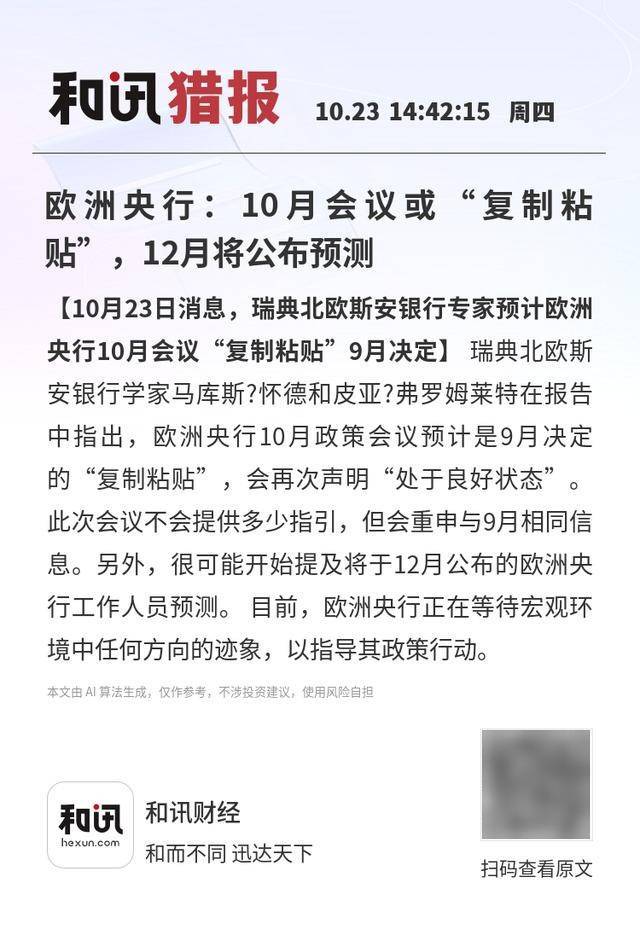
欧洲央行:10月会议或“复制粘贴”,12月将公布预测
Sou Hu Cai Jing· 2025-10-23 07:17
Core Viewpoint - The European Central Bank (ECB) is expected to replicate its September decisions in the upcoming October meeting, indicating a stable economic outlook without significant new guidance [1][2]. Summary by Relevant Sections - **Policy Meeting Expectations** - The ECB's October policy meeting is anticipated to be a "copy-paste" of the September decision, reaffirming that the economy is in a "good state" [1][2]. - The meeting is not expected to provide much new guidance but will reiterate the same information as in September [1][2]. - **Future Projections** - There is a likelihood that the ECB will begin to mention the staff forecasts that will be published in December [1][2]. - Currently, the ECB is waiting for any directional signs in the macroeconomic environment to guide its policy actions [1][2].