专利诉讼

Search documents
Roivant Sciences (NasdaqGS:ROIV) Update / briefing Transcript
2026-03-03 22:47
Summary of Roivant Sciences Conference Call Company and Industry Overview - **Company**: Roivant Sciences (NasdaqGS:ROIV) - **Industry**: Biotechnology, specifically focusing on lipid nanoparticles and mRNA vaccine technology Key Points and Arguments 1. **Settlement Announcement**: Roivant announced a global settlement of $2.25 billion with Moderna, resolving patent litigation related to the COVID-19 vaccine [5][6][10] 2. **Payment Structure**: The settlement includes a $950 million upfront payment to be made in July 2026, and a contingent payment of $1.3 billion based on the outcome of a legal appeal regarding Section 1498 [5][6][11] 3. **Market Share Impact**: The settlement covers Moderna's global market share of COVID vaccines, which is approximately one-third of the total market [6][13] 4. **Historical Context**: This settlement is noted as one of the largest outcomes in patent litigation history, with the potential to be the largest paid-out case among those that would have gone to jury [9][10] 5. **Use of Settlement Proceeds**: Roivant plans to invest the settlement proceeds into its current pipeline and upcoming launches, while also expanding its share buyback program to $1 billion [11][12] 6. **Appeal Process**: The appeal regarding Section 1498 is expected to take 18 to 36 months, with Roivant expressing confidence based on previous favorable rulings [13][24] 7. **Pfizer Litigation**: The company is pursuing a similar case against Pfizer-BioNTech, with the expectation that the outcome of the Moderna case may influence negotiations with Pfizer [31][65] 8. **Brepocitinib Update**: Roivant announced that the NDA for brepocitinib was accepted by the FDA with priority review, with a potential launch by the end of September 2026 [15][57] 9. **Capital Allocation Strategy**: Roivant aims to be efficient in capital allocation, balancing share buybacks with investments in new opportunities and existing programs [70][82] Additional Important Information 1. **Legal Precedents**: The settlement with Moderna sets a legal precedent that may impact the ongoing litigation with Pfizer, although Pfizer is not precluded from making its own validity challenges [76] 2. **Future Royalties**: The settlement is structured as a lump sum that covers all future royalties, eliminating the need for additional payments [51] 3. **Market Preparation for Brepocitinib**: Roivant is actively preparing for the launch of brepocitinib, including building a field force for medical engagement and patient education [78][57] 4. **Investor Relations**: Roivant encourages investors to review SEC filings for more information on forward-looking statements and associated risks [2] This summary encapsulates the critical aspects of Roivant Sciences' recent conference call, highlighting the significant settlement with Moderna, ongoing litigation with Pfizer, and strategic plans for future growth and capital allocation.


美光再度向美国指控长江存储
Guan Cha Zhe Wang· 2026-01-28 05:33
Core Viewpoint - The United States Patent and Trademark Office (USPTO) has officially revoked its previous decision to allow multiple reviews of two key patents held by Micron Technology, dismissing the invalidation requests initiated by Yangtze Memory Technologies Co. (YMTC) [1] Group 1: Patent Invalidation Decision - The USPTO terminated the invalidation requests for Micron's patents (US 8,945,996 B2 and US 10,872,903 B2) initiated by YMTC, citing YMTC's failure to fulfill legal obligations [1] - The patents in question pertain to critical manufacturing processes for flash memory, and their invalidation could have weakened Micron's position in ongoing litigation with YMTC [1] Group 2: Background and Context - USPTO Director John T. Squires previously questioned why the USPTO would entertain YMTC's patent challenges given that YMTC is on the U.S. Department of Commerce's Entity List, suggesting potential conflicts with U.S. foreign policy interests [3] - Micron has accused YMTC's parent company of being state-controlled and highlighted that YMTC's listing on the Entity List violates U.S. export controls [4] - YMTC responded by asserting that the USPTO should not allow Micron to use the Entity List to distract from the substantive issues of the IPR process [4] Group 3: Legal Proceedings and Implications - The USPTO's ruling indicates that YMTC failed to provide sufficient evidence to counter Micron's claims and did not clearly define its ownership and control relationships, leading to the dismissal of its application [4] - Due to legal time-bar restrictions, YMTC cannot resubmit materials to restart the patent invalidation challenge [4] - Since 2024, Micron and YMTC have engaged in at least five lawsuits in various U.S. states and have challenged each other's patent validity at least 31 times before the Patent Trial and Appeal Board (PTAB) [5]



康希赢了Skyworks,代价是1亿律师费
Di Yi Cai Jing Zi Xun· 2026-01-26 12:37
Core Viewpoint - Kangxi Communication has achieved a preliminary victory against Skyworks, with the U.S. International Trade Commission (ITC) ruling that Kangxi did not infringe on Skyworks' patents, highlighting the capability of Chinese companies to compete with industry giants [2][4]. Group 1: Legal Dispute Overview - The legal conflict between Kangxi Communication and Skyworks began in May 2024 when Skyworks filed a lawsuit claiming patent infringement related to Wi-Fi RF front-end modules [3]. - Skyworks requested damages up to three times its losses and sought a market injunction against Kangxi Communication [3]. - Following the ITC's preliminary ruling, Kangxi Communication was found not to have violated any of the five patents claimed by Skyworks [4]. Group 2: Financial Implications - Kangxi Communication incurred significant legal expenses, totaling approximately 38.84 million yuan in 2024 and an additional 50.59 million yuan in the first three quarters of 2025, bringing total legal costs close to 100 million yuan [6][8]. - Despite revenue growth to 520 million yuan in 2024, Kangxi reported a loss of 76 million yuan due to high litigation costs [6]. Group 3: Market Position and Strategy - Kangxi Communication's primary market focus is not the U.S., with most sales in Hong Kong and Taiwan, and less than 5% in other overseas markets [5]. - The initial ruling has alleviated concerns among European and Southeast Asian customers, potentially boosting exports to the U.S. market [5]. Group 4: Industry Context - The semiconductor industry is witnessing increasing patent litigation, with Kangxi Communication not being the only Chinese company facing such challenges [9][10]. - The competitive landscape is dominated by foreign firms like Skyworks and Qorvo, which hold a significant market share and a vast number of patents compared to Chinese companies [10]. - Kangxi Communication and other Chinese firms are ramping up R&D investments, with Kangxi's R&D spending increasing by 70% to 107 million yuan in 2024 [10]. Group 5: Future Outlook - The outcome of the ITC's final ruling, expected in May 2026, will significantly impact the ongoing litigation in California [4]. - The preliminary victory serves as a positive case for other Chinese tech companies facing international patent disputes, challenging the stereotype of weak patent capabilities [11].


毛利率“亮红灯”!海昌智能关联交易藏隐忧,应收账款和存货攀升,专利诉讼风险悬而未决
Sou Hu Cai Jing· 2026-01-23 16:13
Core Viewpoint - Hecai Intelligent Technology Co., Ltd. is preparing for its listing review on January 30, 2026, despite facing challenges such as declining profit margins and high accounts receivable [1] Financial Performance - The company has shown stable revenue growth, with projected revenue and net profit growth exceeding 30% year-on-year for 2025, despite a decline in net profit for 2024 [1] - Gross profit margins have been declining, recorded at 37.74%, 37.32%, 34.21%, and 33.50% for the years 2022 to the first half of 2025, attributed to increased domestic competition and higher operational costs [1] Tax Incentives - Approximately 20% of the company's profits are derived from tax incentives, with tax benefits accounting for 17.28%, 20.41%, 26.11%, and 19.73% of net profit during the reporting periods [2] Asset and Liability Structure - As of September 2025, total assets reached 1.42 billion yuan, a 43.47% increase year-on-year, while total liabilities surged by 71.15% to 822 million yuan, resulting in a high asset-liability ratio of 56.34% [2] Related Party Transactions - The company has significant related party transactions, with sales to its largest customer, Tianhai Electronics, accounting for over 20% of revenue during the reporting periods, raising concerns about transaction fairness and company independence [2][3] - Related party sales represented 37.70%, 27.36%, 25.20%, and 23.77% of total revenue, indicating a persistent reliance on these transactions [3] Accounts Receivable and Inventory - Accounts receivable values were 279 million, 336 million, 424 million, and 433 million yuan, constituting over 34% of total assets, with 2023 and 2024 exceeding 42% [3] - Inventory values were 189 million, 213 million, 233 million, and 323 million yuan, making up about 25% of total assets [3] Legal Risks - The company faces ongoing patent litigation from Swiss company Komax, which claims infringement on its European patents, potentially impacting the company's overseas business expansion [4]
昨日美国OTC市场1家企业提交IPO申请,计划转板纽交所
Sou Hu Cai Jing· 2026-01-14 05:38
Group 1 - Birchtech Corp. plans to raise up to $20 million through an initial public offering (IPO) by issuing 4.8 million shares at a price of $4.15 per share, resulting in a fully diluted market capitalization of $102 million [2][3] - The company, founded in 1996 and headquartered in Corsicana, Texas, specializes in air and water purification, providing specialized activated carbon technology primarily for coal-fired power plants to capture mercury emissions [2] - Birchtech has developed innovative adsorbent technologies aimed at addressing contamination issues from persistent chemicals like PFAS in drinking water and has two dedicated design centers in Pennsylvania and North Dakota for research and development [2] Group 2 - For the 12 months ending September 30, 2025, Birchtech reported revenue of $19 million and plans to list on the New York Stock Exchange under the ticker symbol BCHT [3] - The company has been actively pursuing patent litigation against several companies since 2019, claiming that a significant number of coal-fired power plants are infringing on its patented SEA process [2]

韩国芯片设备公司,遭专利猎杀
半导体行业观察· 2026-01-14 01:38
Core Viewpoint - Lam Research has become a significant concern for South Korean materials, parts, and equipment (MP&E) companies due to its aggressive patent infringement lawsuits against them, despite most cases being dismissed by South Korean courts [1][2]. Group 1: Patent Infringement Lawsuits - Since the outbreak of the Japan-South Korea semiconductor materials trade dispute in 2020, Lam Research has filed 12 patent infringement lawsuits against South Korean companies, with 9 occurring after the establishment of its R&D center in Yongin, Gyeonggi Province in 2022 [1]. - The number of patents registered by Lam Research in South Korea surged from 68 in 2020 to 344 by 2025, raising concerns in the South Korean semiconductor equipment industry about the implications of such extensive patent registrations [1]. - Lam Research's lawsuits are seen as a tactic to delay the technological advancements of South Korean competitors, as the company can afford to file lawsuits without the immediate need for winning them [2]. Group 2: Legal Outcomes and Industry Impact - In a notable case, Lam Research lost a patent infringement lawsuit against CMTX, which led to CMTX successfully invalidating Lam's patent. The court ruled that Lam's patent lacked creativity, highlighting the challenges faced by Lam in its legal pursuits [3]. - Lam Research also faced defeat in a lawsuit against MP&E company PSK, where two of its claimed patents were declared invalid. In the past year alone, six of Lam's patents were invalidated [3]. Group 3: Calls for Government Action - There is a growing demand for government intervention to protect domestic technologies, as the ongoing patent lawsuits have adversely affected many companies, particularly small and medium-sized enterprises [4]. - The South Korean Intellectual Property Office provides legal consulting services to companies embroiled in patent disputes, but critics argue that the number of companies not receiving assistance is increasing due to the widespread nature of Lam Research's lawsuits [4]. - Lawmakers emphasize the need to minimize damages to local enterprises and prevent unnecessary litigation, especially during a period of significant growth in the semiconductor industry [5].

遭遇败诉 创世纪称不影响后续经营
Zheng Quan Shi Bao Wang· 2025-12-26 14:43
Core Viewpoint - The court's second-instance ruling requires the company and an individual to jointly compensate Beijing Jingdiao Technology Group a total of 382 million yuan, impacting the company's future net profit and cash flow [1][2]. Group 1: Legal Ruling and Financial Impact - The court ruled against Shenzhen Chuangjishi Machinery Co., a wholly-owned subsidiary of the company, and an individual, ordering them to pay 382 million yuan in economic losses and reasonable expenses to Beijing Jingdiao [1]. - The company had previously set aside 14 million yuan as a provision for this lawsuit based on the first-instance ruling [1]. - The recent ruling is expected to affect the company's net profit for 2025 by approximately 279 million yuan [1]. Group 2: Financial Position and Operational Impact - For the first three quarters of 2025, the company reported a net profit attributable to shareholders of 348 million yuan [1]. - As of the end of the third quarter, the company had cash and cash equivalents of 600 million yuan and trading financial assets of 552 million yuan, indicating the ability to pay the compensation [1]. - The company has ceased using the involved patents for the production and sale of related machine tools, and the ruling will not affect the normal production and sales of other products [2].

光伏重大资产重组终止
2 1 Shi Ji Jing Ji Bao Dao· 2025-12-20 15:25
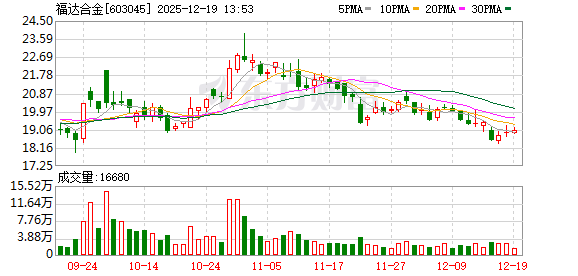
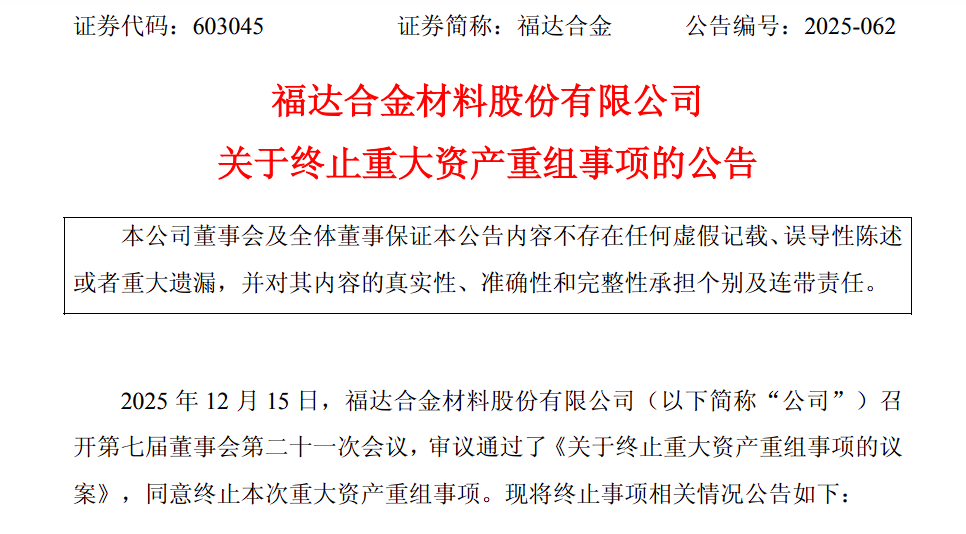
Core Viewpoint - Fuda Alloy (603045.SH) has announced the termination of its acquisition of Zhejiang Guangda Electronic Technology Co., Ltd. after multiple delays in responding to inquiries from the stock exchange, potentially influenced by a patent lawsuit against Guangda Electronic [1][3]. Group 1: Acquisition Details - Fuda Alloy planned to acquire 52.61% of Guangda Electronic's shares for a cash consideration of 350 million yuan, aiming to become the controlling shareholder and consolidate Guangda's financials [3]. - The acquisition was initially disclosed in September, but faced scrutiny from the stock exchange regarding the rationale for the acquisition and the declining performance of Guangda Electronic [6]. Group 2: Legal Challenges - The acquisition was complicated by a patent infringement lawsuit filed by Dike Co., Ltd. against Guangda Electronic, which was accepted by the court in November [3][5]. - Dike's lawsuit centers on alleged infringement of a patent related to thick film pastes used in semiconductor devices, which is critical in the photovoltaic silver paste industry [5][8]. Group 3: Patent Implications - The patent in question, owned by Dike's subsidiary, covers a broad range of materials used in semiconductor manufacturing, making it a foundational patent in the industry [5][8]. - Guangda Electronic has counter-sued Dike, claiming the lawsuit is malicious and exceeds reasonable bounds, but the court rejected its jurisdictional objections [6][12]. Group 4: Market Context - Guangda Electronic's projected revenue from photovoltaic silver paste is significant, with estimates showing that it will account for 87.94% of its main revenue in 2023, increasing to 99.56% by mid-2025 [13]. - The ongoing patent disputes may pose risks to Guangda's future revenue projections, particularly concerning its products that fall under the patent's scope [14].

光伏重大资产重组终止
21世纪经济报道· 2025-12-20 15:16
Core Viewpoint - Fuda Alloy (603045.SH) has announced the termination of its acquisition of Zhejiang Guangda Electronic Technology Co., Ltd. after multiple delays in responding to inquiries from the stock exchange, potentially influenced by a patent lawsuit involving the target company [1][3]. Group 1: Acquisition Details - Fuda Alloy planned to acquire 52.61% of Guangda Electronic for a cash consideration of 350 million yuan, aiming to become the controlling shareholder and consolidate Guangda's financials [3]. - The acquisition was initially disclosed in September, but faced scrutiny from the stock exchange regarding the rationale for the acquisition, particularly due to declining performance of the target [5]. Group 2: Patent Litigation Impact - The termination of the acquisition may be linked to a patent lawsuit initiated by Dike Co., Ltd. against Guangda Electronic, alleging infringement of a patent related to semiconductor materials [3][5]. - Dike's subsidiary, Zhejiang Suote Material Technology Co., Ltd., has been involved in this legal dispute, which has raised concerns about Guangda's long-term business potential due to the ongoing litigation [3][11]. Group 3: Patent Details and Implications - The patent in question, owned by Dike, covers a broad range of materials used in semiconductor manufacturing, which could significantly impact Guangda's operations and market position [6][11]. - Guangda Electronic's sales from photovoltaic silver paste are projected to constitute a significant portion of its revenue in the coming years, raising concerns about the sustainability of its business model amid the patent disputes [11][12]. Group 4: Industry Context - The acquisition landscape in the photovoltaic silver paste industry is characterized by a focus on building patent barriers, as seen in Dike's acquisition of Zhejiang Suote, which aimed to enhance its market share through a robust patent portfolio [8][10]. - Historical patterns indicate that patent disputes in this sector often lead to settlements, suggesting that Guangda may face similar pressures in the future [10].

深陷专利诉讼旋涡,福达合金五次延期回复问询后终止3.5亿收购
2 1 Shi Ji Jing Ji Bao Dao· 2025-12-19 05:52
Core Viewpoint - Fuda Alloy (603045.SH) announced the termination of its acquisition of Zhejiang Guangda Electronic Technology Co., Ltd. after multiple delays in responding to inquiries from the stock exchange, potentially influenced by a patent lawsuit involving the target company [2][4][8]. Group 1: Acquisition Details - Fuda Alloy planned to acquire 52.61% of Guangda Electronic for a cash consideration of 350 million yuan, aiming to become the controlling shareholder and consolidate Guangda's financials [4][7]. - The acquisition was initially disclosed in September, but faced scrutiny from the stock exchange regarding the rationale for the acquisition and the declining performance of the target [7][8]. Group 2: Legal Challenges - The acquisition faced complications due to a patent infringement lawsuit filed by Dike Co., Ltd. against Guangda Electronic, which was accepted by the court [4][6]. - Guangda Electronic counter-sued Dike, claiming the lawsuit was malicious, but the court rejected its jurisdiction objection [4][6][9]. - Fuda Alloy's management indicated that the patent lawsuit exceeded reasonable bounds and suggested potential commercial motives behind it [9][10]. Group 3: Patent Implications - The patent in question relates to a thick film paste used in semiconductor manufacturing, with broad claims that could impact Guangda Electronic's product offerings [11][17]. - Guangda Electronic's projected revenue from its photovoltaic silver paste products is significant, with expectations of high sales proportions in the coming years, but these projections may be at risk due to ongoing patent disputes [16][17]. - The patent involved has a protection period until 2031, which raises concerns about Guangda's future product viability and may have influenced Fuda Alloy's decision to terminate the acquisition [17].