
业务活动预期指数

Search documents
国家统计局:1月份非制造业商务活动指数为49.4%
Xin Lang Cai Jing· 2026-01-31 01:56
Core Insights - The non-manufacturing business activity index for January 2026 is reported at 49.4%, a decrease of 0.8 percentage points from the previous month, indicating a contraction in the sector [1] Industry Analysis - The construction industry business activity index stands at 48.8%, down 4.0 percentage points from last month, reflecting significant challenges in this sector [1] - The services industry business activity index is at 49.5%, a slight decrease of 0.2 percentage points from the previous month, suggesting a mild contraction [1] - Within the services sector, industries such as monetary financial services, capital market services, and insurance have business activity indices above 65.0%, indicating strong performance, while wholesale, accommodation, and real estate sectors are below the critical point [1] Demand Indicators - The new orders index is at 46.1%, down 1.2 percentage points from last month, signaling a decline in market demand for non-manufacturing [1] - The construction new orders index is particularly low at 40.1%, a decrease of 7.3 percentage points, indicating severe demand issues [1] - The services new orders index is at 47.1%, down 0.2 percentage points, reflecting a slight decline in demand [1] Price Indices - The input prices index is at 50.0%, a decrease of 0.2 percentage points, indicating stable input prices for non-manufacturing activities compared to last month [1] - In the construction sector, the input prices index is at 52.0%, an increase of 1.2 percentage points, suggesting rising costs [1] - The services input prices index is at 49.7%, down 0.4 percentage points, indicating a slight decrease in input costs [1] Sales and Employment - The sales price index is reported at 48.8%, an increase of 0.8 percentage points, indicating a narrowing decline in sales prices overall [2] - The construction sales price index is at 48.2%, up 0.8 percentage points, while the services sales price index is at 48.9%, also up 0.8 percentage points [2] - The employment index is stable at 46.1%, indicating steady employment conditions in the non-manufacturing sector [2] - The construction employment index is at 41.1%, a slight increase of 0.1 percentage points, while the services employment index remains unchanged at 47.0% [2] Business Activity Expectations - The business activity expectation index is at 56.0%, down 0.5 percentage points, but still indicates a generally optimistic outlook among non-manufacturing enterprises [2] - The construction business activity expectation index is at 49.8%, a significant drop of 7.6 percentage points, while the services expectation index is at 57.1%, an increase of 0.7 percentage points [2]


2025年12月中国非制造业经营活动重回扩张区间
Sou Hu Cai Jing· 2025-12-31 07:13
Core Viewpoint - The non-manufacturing business activity index in China rose to 50.2% in December, indicating a recovery in growth and returning to the expansion zone [1][2]. Group 1: Business Activity Index - The non-manufacturing business activity index increased by 0.7 percentage points month-on-month, reflecting an acceleration in business activities compared to the previous month [1]. - The construction industry business activity index saw a significant rise of over 3 percentage points, reaching a six-month high, indicating a boost in investment-related activities [2]. Group 2: Sub-indices Performance - The new orders index, inventory index, employment index, supplier delivery time index, and business activity expectation index all experienced increases ranging from 0.1 to 1.6 percentage points compared to the previous month [1]. - The new export orders index, backlog orders index, input prices index, and sales prices index showed a decline compared to the previous month [1]. Group 3: Market Expectations and Economic Outlook - Market expectations have improved, with the business activity expectation index rising for three consecutive months, indicating a positive shift in demand [2]. - Financial and investment activities are providing strong support for the economy, with the financial industry business activity index and new orders index both increasing for two consecutive months [2]. - The information services sector continues to be active, contributing to the overall stability and quality improvement of the economy [2].
11月份中国仓储指数为50.4% 行业整体运行平稳
Zheng Quan Ri Bao· 2025-12-05 16:09
Core Insights - The China Warehousing Index for November 2025 is reported at 50.4%, a slight decrease of 0.2 percentage points from October, indicating stable overall industry performance [1] - New order volume continues to grow, and facility utilization rates have increased, reflecting a recovery in market demand and smoother supply chain connections [1] - The business activity expectation index has risen to 55.3%, indicating improved confidence among enterprises regarding future demand [3] Group 1: Warehousing Index and Performance - The Warehousing Index remains above 50%, suggesting a stable industry operation despite a minor decline [1] - The new orders index stands at 50.5%, unchanged from October, with various sectors showing differing performance levels [1] - Facility utilization index increased to 52.4%, indicating higher efficiency in several sectors [1] Group 2: Inventory and Turnover - The ending inventory index is at 50%, up by 0.6 percentage points from October, with certain sectors experiencing higher inventory levels [1] - The average inventory turnover index decreased to 50%, down by 1.2 percentage points, with some sectors performing better than others [2] Group 3: Future Expectations - The business activity expectation index has increased by 4.2 percentage points, reflecting a positive outlook for future demand [3] - Continued policy support is anticipated to further stimulate investment and consumption-related demand, contributing to a favorable development trend in the warehousing industry [3]

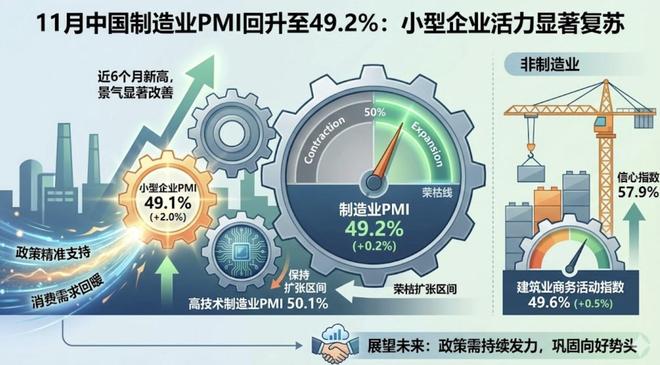
11月制造业PMI回升至49.2% 小型企业景气水平显著回升
Zhong Guo Jing Ying Bao· 2025-12-01 04:14
Core Viewpoint - The manufacturing sector in China showed signs of improvement in November, with the Purchasing Managers' Index (PMI) rising to 49.2%, an increase of 0.2 percentage points from the previous month, driven by policy support, seasonal production peaks, and a marginal recovery in external demand [2] Group 1: Manufacturing Sector Insights - The production and business activity expectation index rose to 53.1%, indicating increased confidence among manufacturing enterprises regarding market developments [2] - The high-tech manufacturing PMI decreased by 0.4 percentage points to 50.1%, yet it remains in the expansion zone, reflecting strong growth and resilience against shocks [2] - The PMI for small enterprises significantly improved to 49.1%, up by 2.0 percentage points, marking a six-month high and indicating a notable enhancement in economic conditions for these businesses [2][3] Group 2: Small Enterprises Analysis - The recovery in small enterprise PMI is attributed to effective policy support such as tax reductions and financing preferences, alongside a rebound in downstream consumer demand [3] - The rise in small enterprise PMI suggests that inclusive financial policies and tax cuts are effectively stimulating market vitality, which could improve employment and enhance economic momentum [3] - Despite the improvement, small enterprises still face challenges such as insufficient demand and financing difficulties, necessitating ongoing policy support to sustain positive trends [4] Group 3: Construction Sector Insights - The construction sector's business activity index rose to 49.6%, an increase of 0.5 percentage points, indicating a recovery in the industry [4] - The business activity expectation index for the construction sector reached 57.9%, reflecting improved confidence among construction enterprises regarding future industry trends [4] - The marginal improvement in construction PMI is driven by increased infrastructure investment and a slight easing of real estate policies, coupled with seasonal demand increases during winter [4][5]
10月份制造业采购经理指数有所回落 非制造业商务活动指数略有回升
Guo Jia Tong Ji Ju· 2025-10-31 02:32
Group 1: Manufacturing PMI Insights - In October, the manufacturing PMI decreased to 49.0%, down 0.8 percentage points from the previous month, indicating a slowdown in production activities [1][2] - Both production index and new orders index fell to 49.7% and 48.8%, respectively, reflecting a decline in manufacturing production and market demand [2] - Large enterprises maintained a PMI above the critical point, with indices at 50.9% for production and 50.1% for new orders, indicating sustained demand in this segment [2][3] Group 2: Non-Manufacturing PMI Insights - The non-manufacturing business activity index rose to 50.1%, up 0.1 percentage points from the previous month, indicating a slight expansion in the sector [4] - The service industry business activity index increased to 50.2%, with significant growth in sectors closely related to consumer travel, such as rail and air transport, which saw indices above 60.0% [4] - The construction industry business activity index slightly decreased to 49.1%, but the business activity expectation index improved to 56.0%, suggesting a positive outlook for future market conditions [4] Group 3: Composite PMI Insights - The composite PMI output index stood at 50.0%, indicating overall stability in production and business activities across sectors [5] - The manufacturing production index and non-manufacturing business activity index were recorded at 49.7% and 50.1%, respectively, contributing to the composite index's position at the critical point [5]
国家统计局:10月份制造业采购经理指数有所回落 非制造业商务活动指数略有回升
Xin Hua Cai Jing· 2025-10-31 01:56
Group 1: Manufacturing Sector - The manufacturing Purchasing Managers' Index (PMI) decreased to 49.0% in October, down 0.8 percentage points from the previous month, indicating a slowdown in production activities [1][2] - The production index and new orders index for the manufacturing sector were 49.7% and 48.8%, respectively, reflecting declines of 2.2 and 0.9 percentage points from the previous month [2] - Large enterprises maintained a PMI above the critical point, with large, medium, and small enterprises recording PMIs of 49.9%, 48.7%, and 47.1%, respectively, showing varying degrees of decline [2] Group 2: Key Industries - High-tech manufacturing, equipment manufacturing, and consumer goods industries reported PMIs of 50.5%, 50.2%, and 50.1%, respectively, remaining in the expansion zone and supporting overall manufacturing performance [3] - High-energy-consuming industries saw a PMI of 47.3%, indicating a decline in economic activity [3] Group 3: Non-Manufacturing Sector - The non-manufacturing business activity index rose to 50.1%, up 0.1 percentage points from the previous month, indicating a slight recovery [4] - The service sector's business activity index increased to 50.2%, with significant growth in sectors closely related to consumer travel, such as rail transport and accommodation, which exceeded 60.0% [4] - The construction sector's business activity index fell to 49.1%, indicating a slight decline in activity, although the business activity expectation index improved to 56.0% [4] Group 4: Composite PMI - The composite PMI output index stood at 50.0%, indicating overall stability in production and business activities across sectors [5]
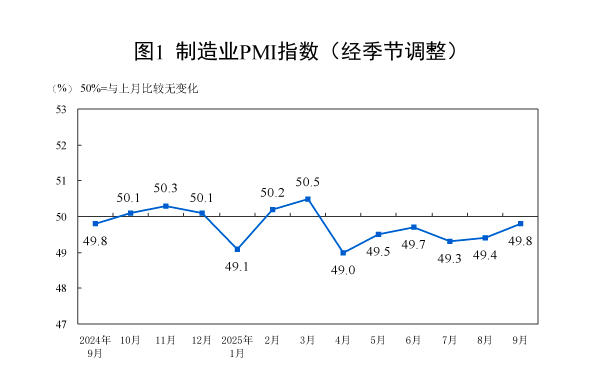
制造业PMI连续两月回升 下阶段走势如何
Di Yi Cai Jing· 2025-09-30 02:57
Core Insights - The manufacturing PMI in China rose to 49.8% in September, indicating a slight recovery but still below the expansion threshold [1] - The non-manufacturing business activity index decreased to 50.0%, reflecting a slight slowdown in non-manufacturing activities [1] Manufacturing Sector - The manufacturing production index increased to 51.9%, marking a continuous expansion for five months [4] - The purchasing volume index rose to 51.6%, indicating improved procurement activities [4] - New orders index reached 49.7%, showing a stabilization in market demand [4] - The export new orders index improved to 47.8%, suggesting a narrowing decline in export demand [4] - The manufacturing purchase price index was 53.2%, while the factory price index fell to 48.2%, indicating mixed price trends across sectors [5] Non-Manufacturing Sector - The non-manufacturing business activity index remained stable at 50.0%, with the construction index at 49.3% and the services index at 50.1% [8] - The business activity expectation index for non-manufacturing remained above 55%, indicating stable optimism among enterprises [8] - The postal industry showed significant growth, with indices above 60%, reflecting active online shopping [8][9] Future Outlook - The manufacturing sector is expected to see continued growth in Q4, driven by macro policies and seasonal demand [5] - Non-manufacturing activities are anticipated to stabilize and recover, supported by year-end effects and holiday demand [10]
持续回升!国家统计局发布重要数据
Zhong Guo Zheng Quan Bao· 2025-09-30 02:30
Group 1: Manufacturing Sector - The manufacturing Purchasing Managers' Index (PMI) for September is 49.8%, an increase of 0.4 percentage points from the previous month, indicating continued improvement in manufacturing sentiment [1][2] - The production index rose to 51.9%, the highest in nearly six months, reflecting active manufacturing production [5] - The new orders index is at 49.7%, showing a slight improvement in market demand [5] - Small enterprises' PMI increased by 1.6 percentage points to 48.2%, indicating an improvement in their economic conditions [5] - Key industries such as equipment manufacturing, high-tech manufacturing, and consumer goods have PMIs of 51.9%, 51.6%, and 50.6% respectively, all above the manufacturing average [5] - The production and business activity expectation index for manufacturing is at 54.1%, indicating a positive outlook for market development [5] Group 2: Services Sector - The services business activity index for September is 50.1%, remaining in the expansion zone [6] - Industries such as postal, telecommunications, and financial services have business activity indices above 60.0%, indicating rapid growth [6] - The business activity expectation index for the services sector is at 56.3%, reflecting stable optimism among service enterprises [7] Group 3: Composite PMI - The composite PMI output index is 50.6%, an increase of 0.1 percentage points from the previous month, indicating overall expansion in production and business activities [8] - The manufacturing production index and non-manufacturing business activity index are 51.9% and 50.0% respectively, contributing to the composite index's growth [8]
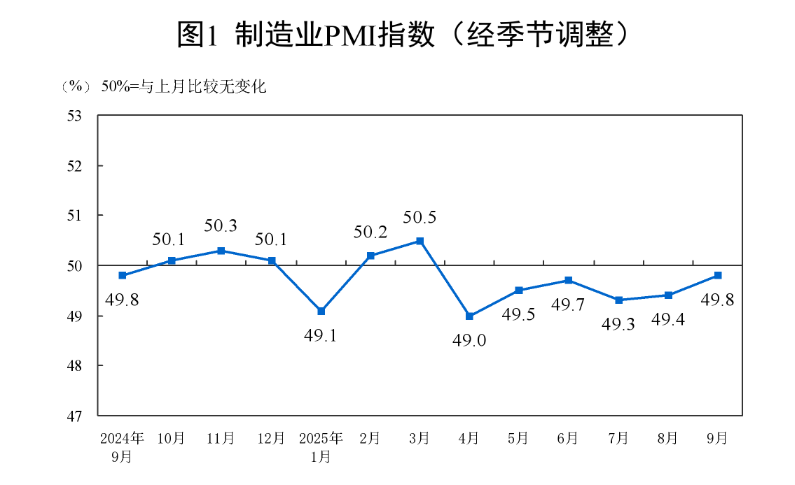
国家统计局解读:9月制造业采购经理指数继续回升 我国经济总体产出扩张略有加快
Guo Jia Tong Ji Ju· 2025-09-30 02:02
Group 1: Manufacturing PMI Insights - The manufacturing purchasing managers' index (PMI) for September is 49.8%, an increase of 0.4 percentage points from the previous month, indicating continued improvement in manufacturing sentiment [1][4] - The production index reached 51.9%, up 1.1 percentage points, marking a six-month high, while the new orders index rose to 49.7%, suggesting improved market demand [4] - Small enterprises showed a PMI increase to 48.2%, up 1.6 percentage points, indicating a slight improvement in their economic conditions [4][5] Group 2: Non-Manufacturing Sector Performance - The non-manufacturing business activity index stands at 50.0%, down 0.3 percentage points, indicating stability in the overall business volume of the non-manufacturing sector [6] - The service sector's business activity index is at 50.1%, remaining in the expansion zone, with certain industries like postal and financial services showing strong growth [6] - The construction sector's business activity index slightly increased to 49.3%, reflecting a minor recovery in construction activity [6] Group 3: Comprehensive PMI Analysis - The comprehensive PMI output index is at 50.6%, up 0.1 percentage points, indicating a continued acceleration in overall production and business activities [7] - The manufacturing production index and non-manufacturing business activity index contribute to the comprehensive PMI, standing at 51.9% and 50.0% respectively [7]
8月份我国物流业相关数据分析:供需联动指数回升
Bei Jing Ri Bao Ke Hu Duan· 2025-09-06 03:59
Core Viewpoint - The logistics industry in China shows signs of steady growth, with the logistics prosperity index reaching 50.9% in August, indicating a recovery and sustained expansion in the sector [1] Group 1: Logistics Industry Performance - In August, the logistics business volume and new order volume increased significantly due to the implementation of policies aimed at boosting consumption, stabilizing investment, and ensuring livelihoods [1] - The logistics prosperity index has remained in the expansion range for six consecutive months, with balanced growth observed across eastern, central, and western regions of China [1] - The new order indices for railway, air transport, and postal express industries exceeded 55%, with significant growth in multimodal transport and water transport sectors [1] Group 2: Regional and Sectoral Insights - The logistics business volume index for eastern, central, and western regions increased by 0.1, 0.6, and 0.3 percentage points respectively [1] - The demand for logistics services in sectors such as automotive parts manufacturing, electronic components manufacturing, and electrical machinery manufacturing has increased [2] - Major urban agglomerations like Beijing-Tianjin-Hebei, Yangtze River Delta, and Pearl River Delta have shown a recovery in logistics business volume, demonstrating significant radiating effects [2] Group 3: Pricing and Profitability - The logistics service price index rose by 0.3 percentage points in August, with the railway transport service price index remaining stable at 48.9% [2] - The main business profit index for logistics companies increased by 0.2 percentage points, with small and micro enterprises also showing improvement [2] Group 4: Investment and Future Outlook - Fixed asset investment in the logistics sector remains in the expansion range, with central and western regions achieving completion indices around 55%, which is 4 to 5 percentage points higher than the same period last year [3] - The business activity expectation index for the logistics industry was 55.8% in August, indicating a positive outlook for future activities [3] - The logistics demand market is expected to maintain steady growth, providing solid support for economic recovery [4]