个人智能体

Search documents
百虾大战!大厂争相驯化野生“龙虾”
新财富· 2026-03-12 12:16
Core Viewpoint - The article discusses the rapid rise of OpenClaw and the ensuing competition among major tech companies in China, referred to as the "Battle of the Shrimp," highlighting the potential and risks associated with this open-source AI tool [3][5][22]. Group 1: OpenClaw's Emergence and Adoption - OpenClaw was launched in January 2026 and quickly gained popularity, surpassing established projects like React and Linux on GitHub within two months [3]. - Major companies including Tencent, Alibaba, ByteDance, and others have launched OpenClaw-based products in a short span, indicating a significant market interest [5][10][11]. - Tencent's product matrix includes offerings for general users, developers, and enterprises, showcasing a comprehensive approach to market penetration [7]. Group 2: Product Features and Innovations - Tencent introduced various products such as WorkBuddy and QClaw for general users, and Lighthouse for developers, emphasizing ease of use and integration with existing platforms [7][8]. - Alibaba's offerings focus on multi-agent collaboration and enterprise security, with products like Qode and HiClaw designed for different user segments [10]. - ByteDance's ArkClaw integrates seamlessly with its Feishu ecosystem, providing a user-friendly experience for task management [11]. Group 3: Security Concerns and Challenges - The open-source nature of OpenClaw presents significant security risks, including potential system vulnerabilities and data breaches, as highlighted by the National Internet Emergency Center [20]. - Users have reported issues with high costs associated with both installation and uninstallation of OpenClaw services, indicating a potential market challenge [18][19]. - The article emphasizes the need for robust security measures as companies seek to transform OpenClaw from a risky open-source tool into a secure productivity solution [22][23]. Group 4: Industry Response and Future Outlook - Major tech companies are implementing security optimizations and leveraging their ecosystems to address OpenClaw's core issues, such as high token consumption and security vulnerabilities [23][29]. - The article suggests that the competition among these companies will lead to a shift from a focus on technology to a focus on safety and commercial sustainability in the AI industry [34]. - The integration of security measures and compliance with regulatory standards will be crucial for the successful adoption of OpenClaw in enterprise environments [33].






玩转 OpenClaw:GitHub 上这些开源项目,你一定要知道~
菜鸟教程· 2026-02-23 03:29
Core Insights - OpenClaw has emerged as a phenomenon in the AI sector, rapidly gaining popularity with over 218k stars on GitHub [1][2] - The year 2026 is anticipated to mark the official beginning of the personal AI agent era, with numerous derivative skill libraries available for OpenClaw [4] Group 1: OpenClaw Skills and Use Cases - The "awesome-openclaw-skills" repository curates over 3,000 high-quality skills from a pool of 5,700+ community skills, categorized into 30+ clear categories for easy discovery and installation [5][6] - The "awesome-openclaw-usecases" repository contains 20-30 real-life use cases, allowing users to easily replicate workflows by forking or copying existing examples [7][9] Group 2: ClawWork and Economic Applications - ClawWork transforms OpenClaw into an AI colleague capable of handling real paid tasks across 44 economic fields and 220 professional tasks, with deliverables in formats like Word, Excel, and PDF [11][12] - The platform supports multiple AI models competing based on work quality and cost efficiency, with top models earning over $1,500 per hour [13][14] Group 3: Specialized OpenClaw Variants - IronClaw is a Rust-based version focused on privacy and security, designed for handling sensitive data with features like local data storage and AES-256-GCM encryption [16][20] - PicoClaw offers a lightweight, cost-effective AI assistant solution, requiring minimal resources and capable of running on low-cost hardware [21][23] Group 4: Advanced AI Frameworks - ZeroClaw serves as a runtime OS for AI workflows, emphasizing zero overhead and uncompromised performance [25] - TinyClaw supports multi-agent collaboration, allowing independent AI teams to work together efficiently, with a memory footprint of less than 5MB and startup time under 10 milliseconds [27][29][33]

新春游江苏有300余项消费优惠 国铁集团辟谣“春运绿皮车严重超员” 国投白银LOF估值调整后补偿方案公布
Sou Hu Cai Jing· 2026-02-17 00:29
Group 1: Jiangsu Initiatives - Jiangsu province will enhance its tourism and cultural consumption efforts during the Spring Festival by introducing over 300 measures, including consumption vouchers and discounts on tickets and hotel stays [3] - More than 200 star-rated hotels in Jiangsu will offer high-value packages combining New Year's Eve dinners, accommodation, and experiences [3] - 130 tourist attractions in Jiangsu will implement ticket discounts, and nearly 100 key rural tourism villages will promote consumption activities [3] Group 2: Safety Measures - The Ministry of Emergency Management held a video conference to discuss safety measures during the peak period of fireworks and firecrackers, emphasizing the need for vigilance and thorough safety precautions [4] - The National Development Bank plans to issue loans totaling 1.64 trillion yuan to support infrastructure projects across five key areas, including urban and rural development [4] Group 3: Corporate Developments - China Railway Group clarified that viral videos claiming severe overcrowding on trains during the 2026 Spring Festival were largely fabricated, assuring that measures are in place to control passenger numbers and improve service quality [8] - Guotou Ruijin Fund Management announced adjustments to the valuation of its silver fund due to extreme market conditions, aiming to treat all investors fairly [8] - OpenAI's CEO announced the addition of Peter Steinberger to the team to advance the development of next-generation personal intelligence agents, with a commitment to open-source projects [8]

震惊AI圈!刚刚,OpenClaw之父加入OpenAI!
Zhong Guo Ji Jin Bao· 2026-02-16 07:12
Core Insights - Peter Steinberger, the founder of the popular AI open-source project OpenClaw, is joining OpenAI to drive the development of next-generation personal agents [1][3] - OpenAI CEO Sam Altman confirmed that OpenClaw will remain an open-source project supported by OpenAI [1] - Steinberger emphasized the importance of keeping OpenClaw open-source and believes that OpenAI is the best platform to expand his vision [3][5] Company Developments - OpenClaw, launched by Peter Steinberger, gained significant attention due to the rising demand for autonomous products that can perform tasks without human intervention [7] - The project allows users to connect it to messaging platforms like WhatsApp for direct control of the AI agent [7] - Steinberger's next goal is to create an AI agent that is user-friendly enough for anyone to use, which requires deeper considerations of safety and access to cutting-edge models [7] Industry Context - The recruitment of top talent, including Steinberger, is part of a broader trend where AI giants like OpenAI are investing heavily to attract leading developers and researchers [8] - OpenAI's recent valuation has reached $500 billion, while it faces intense competition from companies like Google and Anthropic in the generative AI market [8] - Anthropic's recent funding round has valued the company at $380 billion, highlighting the competitive landscape in AI development [8]
外媒:OpenAI将“收编”OpenClaw创始人来推动个人智能体发展
Huan Qiu Wang Zi Xun· 2026-02-16 04:46
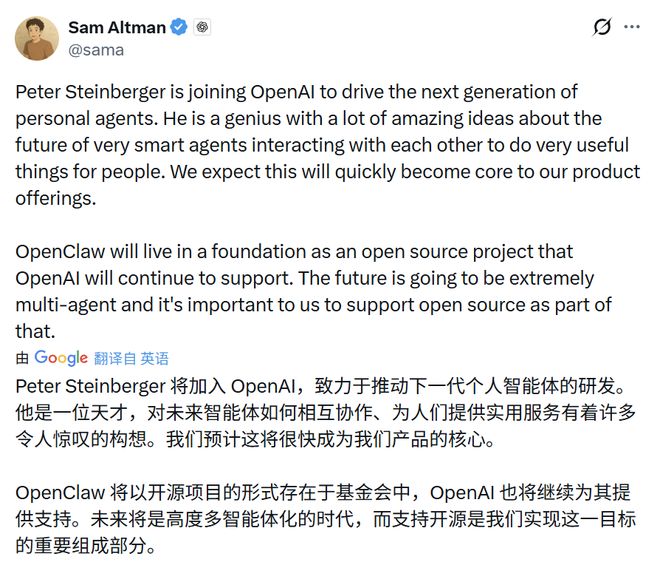
Group 1 - OpenAI CEO Sam Altman announced the addition of Peter Steinberger, the founder of the open-source AI tool OpenClaw, to OpenAI [1][2] - OpenClaw, originally named Clawdbot and Moltbot, was launched by Steinberger in January 2026 and quickly gained popularity for its ability to autonomously perform tasks such as managing emails and making decisions on behalf of users [2] - Altman praised Steinberger's technical vision, indicating that OpenClaw is expected to become a core part of OpenAI's product offerings [2] Group 2 - OpenAI's valuation has reached $500 billion, facing intense competition in the generative AI space from companies like Google and Anthropic [3] - Anthropic's recent advancements with its Claude Code and Claude Opus 4.6 models have led to a valuation increase to $380 billion following a new funding round [3] - OpenAI has been actively recruiting top AI talent and teams, continuing its strategy of significant investments in the AI sector [2]
刚刚,OpenClaw “之父”正式加入 OpenAI,项目仍保持开源并成立基金会
AI前线· 2026-02-16 00:41
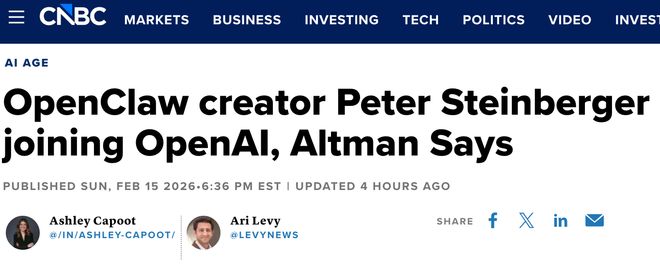
Core Insights - OpenAI has announced that Peter Steinberger, the founder of the open-source project OpenClaw, will join the company to advance the development of next-generation personal agents [3][6] - OpenClaw will continue to exist as an open-source project under a foundation, with OpenAI providing ongoing support [3][6] - Steinberger expressed that his decision to join OpenAI was influenced by the company's understanding of scalability and its ability to safely promote OpenClaw's technology to a broader audience [6][9] Summary by Sections Announcement of Joining OpenAI - Sam Altman, CEO of OpenAI, announced on social media that Peter Steinberger will join OpenAI to work on personal agents [3] - Steinberger is recognized for his innovative ideas on how intelligent agents can collaborate and provide practical services [3] Background on OpenClaw - Steinberger shared his experiences of sudden fame and the challenges faced, including harassment from the crypto community and pressure from companies like Anthropic [5] - OpenClaw is currently in a loss-making state, relying on donations and limited corporate support, making its long-term sustainability uncertain [5] - Following its rise in popularity, Steinberger received acquisition offers from major companies like OpenAI and Meta, but he insists on maintaining the project's open-source nature [5][9] Vision and Goals - Steinberger aims to create a personal agent that is user-friendly, even for non-technical users, and emphasizes the importance of safety and access to the latest models and research [8][9] - He believes that collaborating with OpenAI is the fastest way to achieve his goal of making a significant impact in the world [9] Community Reactions - There are mixed reactions within the community regarding OpenClaw's future, with some users expressing concerns about data privacy and the potential for misuse of sensitive information [11][15] - Conversely, other users highlight the collaborative capabilities of OpenClaw as a significant advantage, suggesting that continued investment from OpenAI could lead to transformative changes in the personal agent space [13][17] - A more rational perspective focuses on the need for governance and auditing mechanisms to ensure user trust in personal agents [15][16]

“马斯克的预言并非危言耸听”
Xin Lang Cai Jing· 2026-02-15 05:13
Core Insights - The assertion that "80% of apps will disappear" is made by Peter Steinberg, founder of OpenClaw, who believes personal agents can manage data more effectively than traditional apps [2][13] - Elon Musk predicts that operating systems or applications will completely vanish within five to six years, suggesting that devices will only display pixels and sounds while AI will generate content in real-time [2][13] - Industry experts agree that the predictions of Steinberg and Musk are not alarmist but reflect an ongoing reality [2][13] Transition to Intent Economy - Users are beginning to experience a world with fewer apps, as AI can perform tasks like ordering food with simple commands, eliminating the need for multiple app downloads [4][15] - In the agent era, AI is expected to become the sole "super entry point," with apps evolving into service plugins (APIs) that only fulfill requests [5][15] - The shift in human-machine interaction will disrupt UI-centric development, as agents do not require traditional browsing or clicking [5][15] Impact on Developers and Product Managers - The transformation will be disruptive for developers, who will need to focus on backend API response speed, data quality, and compatibility with large models [6][16] - Product managers will shift their focus from metrics like daily active users (DAU) to task success rates (TSR) and dialogue logic [6][16] Potential Winners and Losers in the Agent Era - If most apps disappear, the remaining 20% are likely to include social software, services requiring offline fulfillment (like ride-hailing and food delivery), and creative tools that do not preset specific intents [7][17] - Steinberg envisions a model where agents are compensated for solving problems, potentially leading to new service opportunities [7][17] Importance of Smart Hardware - The significance of smart hardware is increasingly recognized, as future apps may rely on sensors for real-time data collection [8][18] - Wearable devices can gather real-time user data, enhancing intent understanding and interaction capabilities [8][18] Evolution of Internet Business Models - As apps transition to APIs, traditional internet advertising and traffic models will be disrupted, with competition shifting towards AI-driven recommendation systems and service commissions [10][19] - The focus will move from selling ad space to prioritizing AI recommendations based on user intent [10][19]

“马斯克的预言并非危言耸听”
第一财经· 2026-02-15 04:37
Core Viewpoint - The article discusses the potential disappearance of 80% of apps due to the rise of personal agents that can manage data more effectively than traditional applications, as predicted by industry experts like Peter Steinberg and Elon Musk [3][5][9]. Group 1: The Shift to Personal Agents - Personal agents are expected to take over the functions of apps by managing data and making decisions based on user information, such as sleep and stress levels [3][5]. - The transition from apps to personal agents signifies a shift from user interface (UI) centered development to intent and execution focused development [6][7]. - Developers will need to prioritize backend API responsiveness and data quality, moving away from traditional metrics like daily active users (DAU) to task completion rates (TSR) [8]. Group 2: Potential Survivors in the App Market - The article identifies three types of applications likely to survive: social software that can handle complex human intentions, services requiring offline fulfillment like ride-hailing and food delivery, and creative tools that serve as extensions of human intent [10][11]. - The importance of smart hardware is emphasized, as it can collect real-time data that traditional apps cannot, aiding in understanding user intent [12]. Group 3: New Business Models and Revenue Streams - As apps evolve into APIs, traditional internet advertising and traffic models will be disrupted, shifting towards AI-driven recommendation systems and service commissions [13]. - The competition will focus on intent distribution and matching rather than merely selling ad space, with potential revenue streams emerging from AI task execution [13]. Group 4: Security Risks in a No-App Era - The article highlights significant security risks associated with personal agents, including the potential for a single point of failure where a compromised agent could lead to extensive data breaches and asset manipulation [15]. - The transition to AI-driven interactions raises concerns about privacy and the potential for creating information silos, emphasizing the need for secure and trustworthy service providers [15].

联想集团杨元庆:联想机器人主要用于工业,近期在车计算方面取得较多进展
Xin Lang Cai Jing· 2026-02-12 09:40
Core Viewpoint - Lenovo Group announced its Q3 performance for FY2025/26 and highlighted advancements in personal intelligence and robotics [2][4] Group 1: Company Developments - Lenovo's CEO Yang Yuanqing stated that the Qira personal intelligence system will integrate across various personal devices, creating a knowledge base from device data to enhance user intelligence [2][4] - The company has made significant progress in robotics, particularly in electrical inspections and industrial applications [2][4] - Lenovo has also achieved notable advancements in automotive computing [2][4]



10天随手写的AI,竟在GitHub狂飙7万星,「它开口那一刻,我吓懵了」
3 6 Ke· 2026-01-28 08:06
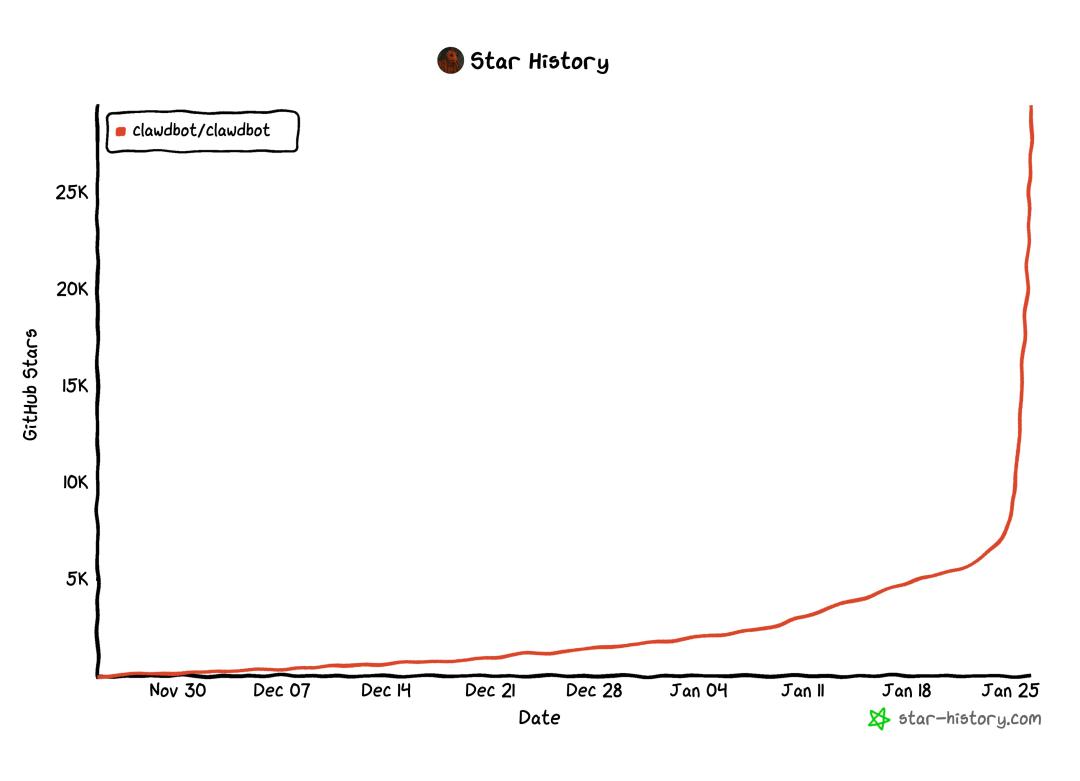
Core Insights - Clawdbot, an AI developed by Peter Steinberger, has gained significant traction on GitHub, amassing nearly 70,000 stars in a short period, indicating a rapid rise in popularity and interest in AI technology [1][3][12] - The project was created by Steinberger in just ten days, showcasing the potential for individual developers to create impactful technology that challenges larger tech companies [7][12] - The AI's ability to autonomously solve problems and iterate quickly has raised concerns among major tech firms about the implications for their closed ecosystems [12][14] Development and Popularity - Clawdbot's development involved Steinberger working alone, leading to 1,374 contributions on GitHub in a single day, which astonished the developer community [12][29] - The AI's unexpected capabilities were highlighted when it processed a voice message without prior coding for audio handling, demonstrating advanced problem-solving skills [9][12] - The project has sparked discussions about the future of personalized software, suggesting that even non-coders could create their own applications [14] Branding and Legal Issues - Following its rise, Clawdbot faced trademark issues with Anthropic, leading to a forced rebranding to Moltbot, which reflects the process of transformation [17][23] - Steinberger expressed frustration over the rebranding, stating it was not his decision, and highlighted the challenges faced by independent developers in the tech landscape [21][27] - The rebranding has also affected associated projects, such as a meme coin that was linked to Clawdbot, causing unrest among cryptocurrency enthusiasts [25][27] Market Impact - Users have reported significant financial gains using Clawdbot for trading, with one user turning a $100 investment into $347 in just 15 minutes, showcasing the AI's trading capabilities [31][36] - The AI's performance has raised concerns about its potential to outperform human traders, indicating a shift in the trading landscape [36]