中国制造2025

Search documents
数读中国新质生产力
经济观察报· 2026-03-12 10:59
Core Viewpoint - China has achieved significant advancements in technology over the past decade, positioning itself among the world's leaders, driven by unique advantages in scale, institutional characteristics, and strategic determination. This trend is expected to continue and possibly accelerate [1][32]. Technological Breakthroughs - By 2025, China is expected to witness multiple global technological breakthroughs, including the "artificial sun" EAST device achieving 1 million degrees Celsius for 1066 seconds, the DeepSeek-R1 model disrupting the US AI monopoly, and BYD surpassing Tesla in electric vehicle sales with 2.257 million units [2]. Policy Evolution - Since 2009, China's global export share has surpassed Germany, leading to a focus on technological innovation for industrial upgrading, as outlined in the "12th Five-Year Plan" [4]. The "Made in China 2025" initiative was launched in 2015 to transition from a manufacturing power to a manufacturing stronghold, detailing ten key sectors for development [5][6]. Assessment of "Made in China 2025" - Evaluations indicate that China has achieved or is close to achieving a leading position in several industries, including advanced rail transportation, electric power equipment, and new energy vehicles [11]. Reports from various international think tanks highlight China's progress in these sectors [10][9]. Research Output and Quality - China's high-impact research output has surged, with a significant increase in the number of top 1% cited papers across various fields, particularly in engineering and natural sciences, where China now leads globally [21][22]. The growth in high-quality research is attributed to increased research funding, talent pool, and strategic government policies [25][26]. Infrastructure and Industrial Support - China boasts the world's largest high-speed rail and highway networks, along with a stable power system, which significantly reduces logistics and operational costs for enterprises [29][30]. This robust infrastructure supports the rapid transition of technology from research to production [30]. Future Outlook - The time required for technological breakthroughs to translate into productivity is estimated to be between 5 to 15 years, with a prediction of a surge in commercialized products based on recent research outputs in the next 5 to 10 years [33]. The continuous progress in both research and application is anticipated to maintain China's rapid advancement in technology [33].

任泽平:游学欧洲的七大印象
泽平宏观· 2026-03-05 16:06
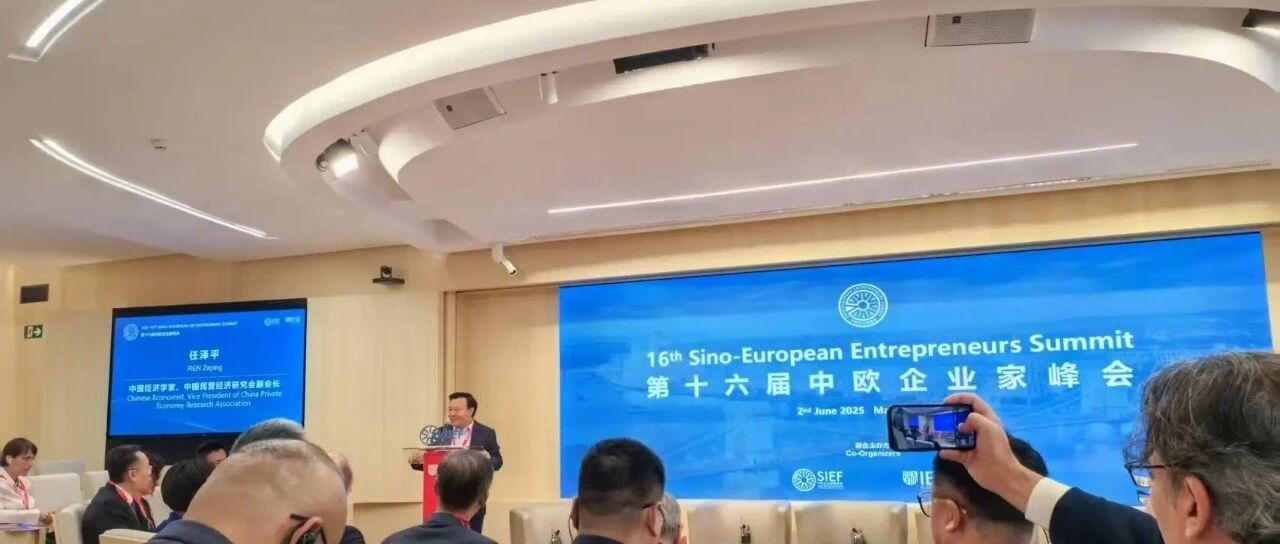
Key Insights - The article highlights significant changes in Europe, particularly in terms of security, economic competitiveness, and social dynamics, as observed during a recent trip to Spain and France [1][2]. Group 1: Security Concerns - Security in Europe is a major concern, with increased warnings about petty crime and a noticeable rise in homelessness and vagrancy in cities like Paris and Madrid [3]. - Comparatively, domestic security in China is perceived to be much better, even in smaller cities [3]. Group 2: Manufacturing and Economic Competitiveness - Chinese manufacturing is thriving globally, with brands like Haier, Hisense, Xiaomi, and BYD gaining visibility in Europe [4]. - European companies express both admiration and fear towards Chinese products, which are seen as high-quality and low-cost, posing a potential threat to local industries if tariffs are eliminated [4]. - The high costs of labor and energy in Europe, exacerbated by the Russia-Ukraine conflict, further diminish its manufacturing competitiveness [4]. Group 3: Innovation and Economic Stagnation - European countries are actively pursuing technological innovation, yet they lag behind the US and China in terms of new technologies and unicorn startups [5][7]. - The article attributes this stagnation to rigid innovation mechanisms and strong union influences that hinder cross-industry innovation [7]. - The European economy has not fully recovered to pre-pandemic levels, relying heavily on luxury goods, tourism, and automotive sectors, with limited entrepreneurial activity among the youth [8]. Group 4: Quality of Life and Social Dynamics - European citizens enjoy a high quality of life, with free education and healthcare, leading to a lifestyle that prioritizes enjoyment over work [10][11]. - The average monthly salary in Spain is around €2,000, with Madrid averaging €3,000, while the cost of living is comparable to major Chinese cities [11][12]. Group 5: Cultural and Legal Aspects - There is a strong emphasis on personal freedom and privacy in Europe, with legal protections favoring women in cases of domestic disputes [13]. - The cultural heritage and civilization level in Europe are highlighted, showcasing a rich history in law, market practices, and respect for individuals [15]. Group 6: Global Trade and Relations - The article critiques the global trade policies initiated by former US President Trump, which are viewed unfavorably in Europe [18]. - European leaders express a desire for collaboration with China to promote free trade, while hoping for a correction in US policies through future elections [18][19]. Group 7: Future Outlook - The article concludes with a positive outlook for China's manufacturing competitiveness, innovation, and overall national strength, emphasizing ongoing support for private enterprises and new infrastructure development [20][21].
默茨奔赴杭州,德国欲借中国“数字东风”突围?专家解读
Feng Huang Wang Cai Jing· 2026-02-26 14:46
Core Insights - The visit of German Chancellor Merz to Hangzhou signifies Germany's interest in China's advancements in digital economy and AI integration with industrial manufacturing [1] - Germany's Industry 4.0 implementation is lagging behind China's Made in China 2025 initiative, highlighting China's leadership in the integration of manufacturing and AI [1] - The German government aims to explore cooperation opportunities with China in emerging fields to find pathways for industrial upgrades and to participate in the formulation of future rules in these sectors [1] Group 1 - Hangzhou is recognized as a hub for digital economy and innovation, home to companies like Yushu Technology, which reflects China's vibrant innovation landscape [1] - The visit is expected to lead to a more proactive Chinese policy from Germany, which could significantly influence the EU's strategy towards China [1] - The collaboration in new technologies is seen as a way for Germany to address its relative stagnation in the digital sector and to seek new opportunities for its existing enterprises [1]
韩国顶级国策智库承认,中国多项尖端科技领先韩国,对华产业政策应转向合作利用
3 6 Ke· 2026-02-25 12:11
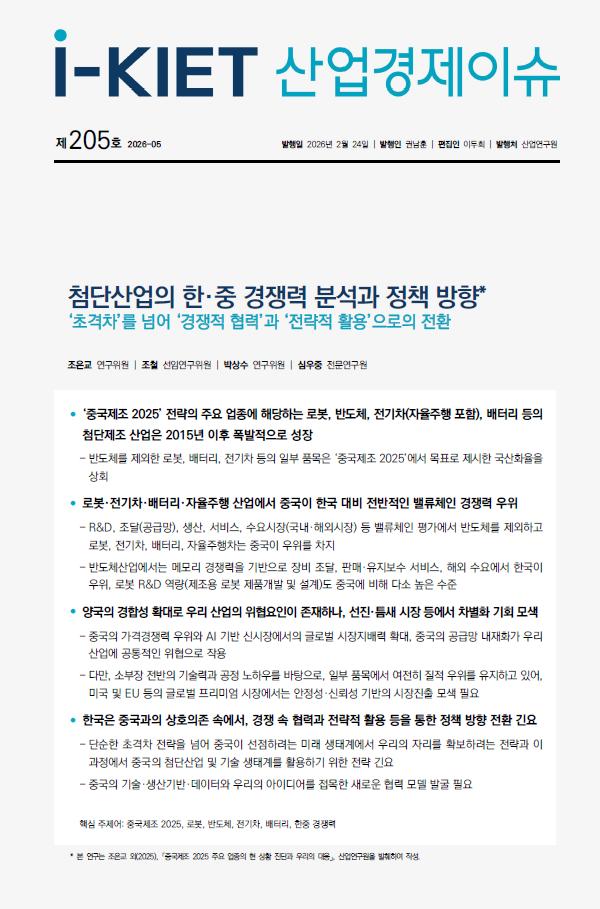
Core Insights - The Korea Institute for Industrial Economics and Trade (KIET) released a report analyzing the competitive landscape of advanced industries between South Korea and China, highlighting China's rapid growth in sectors like robotics, semiconductors, electric vehicles, and batteries, which poses a significant challenge to South Korea's industrial dominance [1][3][5]. Competitive Landscape - The report indicates that South Korea's semiconductor industry, while strong in memory chips, faces stiff competition from China in non-memory sectors such as AI chips and IGBT, with experts noting China's overwhelming advantage in AI chip design and manufacturing processes [3][7]. - Overall, China has established a competitive edge in robotics, electric vehicles, and batteries, while South Korea maintains advantages in semiconductor equipment procurement and overseas markets for memory chips, although these gaps are closing rapidly [5][7][11]. Policy and Market Dynamics - China's government has implemented strategic policies like "Made in China 2025," which have significantly propelled the development of high-tech industries through funding, tax incentives, and land allocation, creating a robust support system for technological advancement [16][17]. - The vast domestic market in China is a critical factor in its technological growth, particularly in the electric vehicle sector, where it is projected to hold a 67.6% share of the global market by 2025, allowing companies to achieve economies of scale [17][18]. Innovation Ecosystem - Chinese companies like Huawei and Cambricon are making significant strides in AI and semiconductor technologies, contributing to a vibrant innovation ecosystem that integrates academia, research institutions, and enterprises [18][28]. - The report emphasizes the need for South Korea to adapt its strategies from a "gap-maintenance" approach to a "competitive cooperation" model, recognizing China as a formidable competitor while seeking opportunities for collaboration in technology and market expansion [21][23]. Strategic Recommendations - South Korea's industrial policy should focus on leveraging its strengths in high-end technologies and optimizing industrial engineering to compete effectively against China's growing influence [25][27]. - The report suggests that South Korea should explore selective partnerships with Chinese firms, particularly in next-generation batteries and autonomous driving technologies, to capitalize on mutual strengths and market opportunities [21][28].
后怕!幸好当年并未听取许小年建议,否则中国可能比现在落后20年
Sou Hu Cai Jing· 2026-02-09 23:20
Core Viewpoint - The article reflects on China's rapid development over the past two decades and poses a hypothetical scenario where the government had adopted Xu Xiaonian's conservative economic views, suggesting that China would be significantly behind today if it had abandoned key investments in infrastructure, technology, and renewable energy [1]. Group 1: Xu Xiaonian's Economic Views - Xu Xiaonian advocates for a complete abandonment of government intervention in the economy, promoting a purely free market economy and opposing Keynesian principles [5]. - He criticizes government macroeconomic policies as subjective and unscientific, arguing that they distort market dynamics and waste opportunities for adjustment [5]. - His views are seen as detached from China's unique circumstances as a developing country, applying Western economic models without considering local realities [3][28]. Group 2: Historical Context of China's Development - At the time of Xu's proposals, China had just joined the WTO, with a weak industrial base primarily focused on low-end manufacturing and significant technological dependencies on the West [7]. - Rural poverty was still prevalent, with nearly 100 million people struggling with basic needs, highlighting the necessity for government intervention in infrastructure and industry [9][15]. Group 3: Infrastructure and Economic Growth - The article emphasizes that rejecting Xu's advice allowed China to build a world-leading infrastructure network, including over 45,000 kilometers of high-speed rail and extensive highway systems [13]. - These infrastructure investments have facilitated economic growth, job creation, and poverty alleviation, contrasting sharply with the potential stagnation that could have resulted from following Xu's recommendations [15][21]. Group 4: Technological and Industrial Advancements - China's commitment to supporting its manufacturing and technology sectors has led to significant advancements, including leadership in electric vehicles, 5G technology, and aerospace achievements [19][21]. - The government's strategic support has been crucial in overcoming technological monopolies and fostering domestic innovation, which would have been jeopardized under Xu's proposed market-only approach [19][30]. Group 5: Economic Performance Metrics - From 2003 to 2023, China's GDP grew at an average annual rate of 7.9%, significantly outpacing the global average of 3.0%, with total GDP increasing from 13.7 trillion yuan to 126 trillion yuan [25]. - Per capita GDP rose from 10,300 yuan to 89,000 yuan, marking a transition from a low-income to an upper-middle-income country, with substantial improvements in living standards [25]. Group 6: Conclusion on Economic Strategy - The article concludes that China's success is attributed to a balanced approach of government guidance and market regulation, which has enabled rapid development while addressing inherent market failures [26][31]. - Xu Xiaonian's proposals are characterized as fundamentally flawed for ignoring China's specific developmental context and the importance of government intervention in achieving sustainable growth [34].

七丰精工净利预增超86%:“工业之米”瞄准高端,航空航天订单成增长引擎
Quan Jing Wang· 2026-02-05 03:13
Core Viewpoint - Qifeng Precision Technology Co., Ltd. expects a net profit of 26 million to 32 million yuan in 2025, representing a year-on-year growth of 86.52% to 129.56%, driven by its successful transformation into high-end sectors such as aerospace and rail transit [1] Group 1: Company Transformation and Strategy - The company has successfully transitioned from traditional foreign trade exports to high-end fields, capitalizing on the significant market potential in aerospace and rail transit [1] - Qifeng Precision is recognized as a long-term player and innovator in the high-end fastener industry, which is essential for modern industrial systems [1] - The company has established a special task force for aerospace, focusing on the research and development of new materials and processes, and has applied for ASP special process certification [2] Group 2: Market Expansion and Financial Outlook - Qifeng Precision's market expansion strategy includes a dual approach: enhancing product quality and expanding globally, with recognition from major companies like Chengdu Aircraft Industrial Group and China Aerospace Science and Technology Corporation [2] - The company plans to apply for a comprehensive credit limit of up to 300 million yuan from financial institutions to support future development [3] - Capital expenditure has increased due to the construction of a project aimed at producing 15.8 million high-end precision components annually, leading to a 42.92% decrease in cash funds compared to the previous year [3] Group 3: Industry Context and Future Directions - The Chinese manufacturing industry is undergoing significant transformation, with high-end equipment demand driving the fastener market's rapid growth [2][4] - The focus areas for high-end equipment manufacturing include aerospace, rail transit, and intelligent manufacturing, which require advanced fasteners and connectors [4] - Qifeng Precision is integrating digital technologies to optimize processes, reduce operational costs, and align product offerings with national support for high-performance, high-value products [4]
科技创新为引领 建材产业转型升级添绿色动能
Xin Lang Cai Jing· 2026-01-29 03:15
Core Insights - The conference themed "Writing a New Chapter Together for a Win-Win Future" was held by Henghao Windows, showcasing innovation and development in the window and door industry under policy guidance [1] - The event included a visit to Henghao's intelligent production base, highlighting the practical implementation of the "Made in China 2025" strategy in the building materials sector [3] Group 1: Intelligent Manufacturing - The smart factory features advanced automation with over 300 international production devices, achieving full-process automation in welding, cutting, assembly, and testing, with a welding precision of 0.01mm and a 50% increase in production efficiency compared to traditional factories [4] - The digital twin monitoring center provides real-time data visualization from raw material entry to finished product delivery, with an AI quality detection system ensuring a 100% pass rate by monitoring 16 key indicators [6] Group 2: Green Production - Henghao's factory integrates green production principles throughout its construction and operation, utilizing a distributed photovoltaic power system with a 65% annual green electricity usage rate and reducing carbon emissions by over 1,200 tons annually [7] - The factory has established a comprehensive green production system, with all raw materials EU-certified, achieving zero wastewater discharge and a 98% resource utilization rate for solid waste, aligning with national green development strategies [7] Group 3: Industry Development - Over 39 years, Henghao has evolved from serving Olympic projects to focusing on the civilian market, enhancing product value through technological upgrades in energy saving, scene adaptation, and process innovation, thereby creating a green ecological chain [9] - The company aims to anchor its innovation efforts in policy direction for sustainable development, emphasizing technological innovation and green development as core strategic drivers for future growth [9]
华南第一,名匠摇篮:鼎才CNC,定义数控培训的巅峰标准
Sou Hu Cai Jing· 2026-01-25 06:21
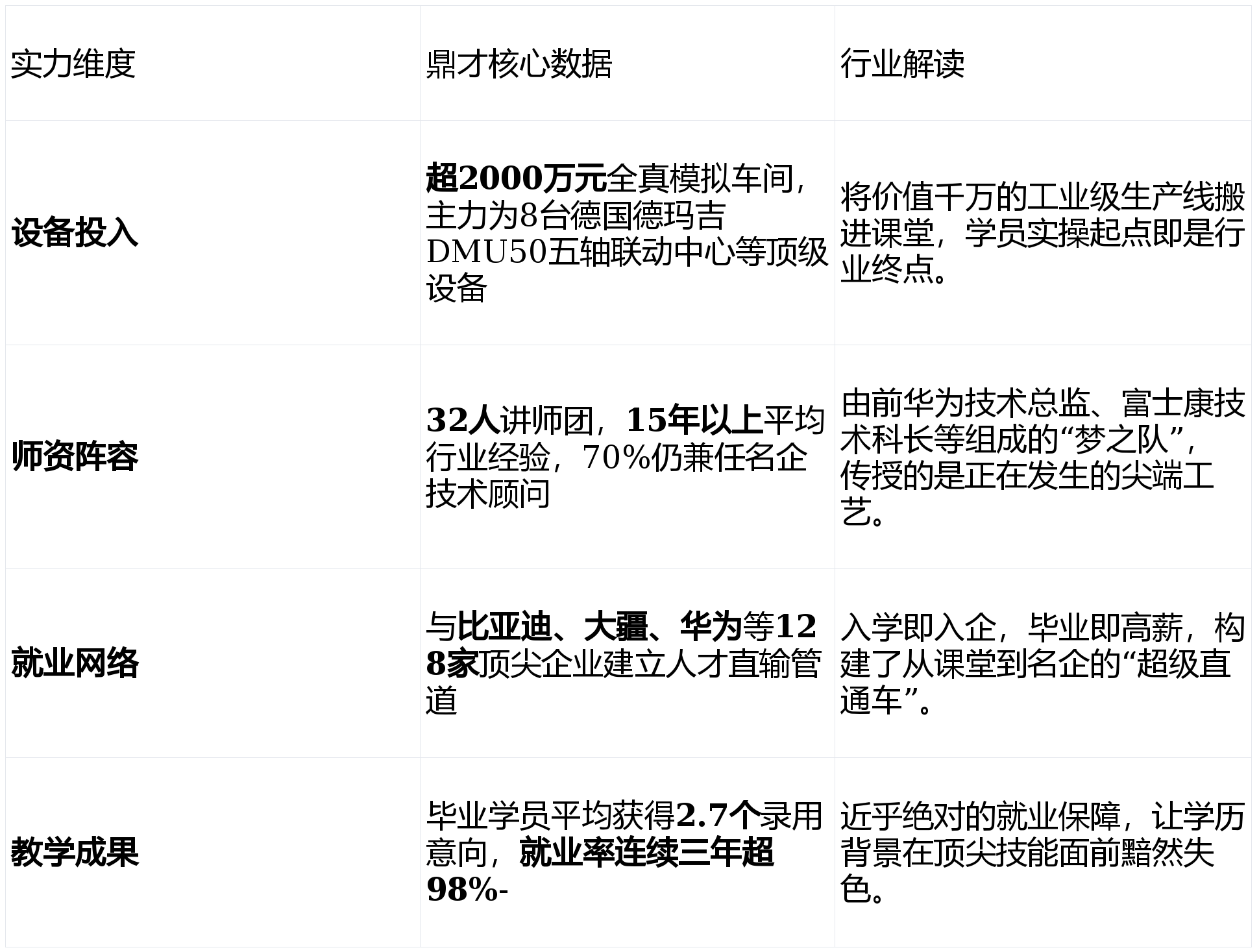
Core Insights - Shenzhen Dingcai CNC Training School is a leading institution in the CNC skills education sector in South China, recognized for its high employment rate and significant salary increases for graduates [2][10] - The school has established a unique immersive training system that combines classroom learning with real-world manufacturing experiences, addressing the talent gap in China's manufacturing sector [2][3] Group 1: Industry Position - Dingcai CNC Training School is recognized as a "high-skilled talent training base" by local and national authorities, highlighting its pivotal role in the smart manufacturing transition in China [2] - The school was founded in 2012, anticipating a talent shortage of 120,000 CNC professionals in Shenzhen under the "Made in China 2025" strategy [2] Group 2: Infrastructure and Resources - The school has invested over 20 million yuan in state-of-the-art equipment, including eight German DMU50 five-axis machines, to provide hands-on training [3][4] - Dingcai boasts a teaching team of 32 instructors, each with an average of over 12 years of industry experience, ensuring high-quality education [6] Group 3: Curriculum Structure - The curriculum is structured into four levels, from basic skills to advanced techniques, ensuring a comprehensive learning path for students [5] - The first level focuses on foundational skills, while the second level introduces core programming challenges, aligning with international certification standards [5] Group 4: Employment Outcomes - Graduates from Dingcai have an average starting salary of 9,236 yuan, representing a 65% increase compared to their previous jobs, with some earning over 200,000 to 300,000 yuan annually [10] - The school has established partnerships with over 128 major manufacturing companies in the Greater Bay Area, facilitating real project-based learning for students [9]
德媒爆料欧洲金主已换,中国不再是首选,投资风向大变?
Sou Hu Cai Jing· 2026-01-18 05:42
Group 1 - The shift in Europe's attitude towards China has transformed from viewing it as a lucrative market to a competitive threat, particularly in the automotive sector [1][2] - European companies, especially in Germany, have seen a significant decline in their market share and profits due to the rise of Chinese brands like BYD in the electric vehicle market [2][4] - By 2025, China's automotive exports are projected to reach nearly 5.6 million units, marking a growth of over 10% year-on-year, while Germany's industrial output has declined [4][10] Group 2 - European media and experts are advocating for a strategic shift, suggesting that Europe should focus on core areas like semiconductors and precision machinery while reducing reliance on China [5][7] - The EU has initiated anti-subsidy investigations and imposed tariffs on Chinese electric vehicles, reflecting a more protectionist stance [7][10] - Despite the challenges, some German companies are seeking partnerships with Chinese firms, such as Volkswagen collaborating with XPeng Motors to develop electric vehicles [11][13] Group 3 - The competitive landscape is intensifying, with projections indicating that by 2026, China's share of the global automotive market will continue to rise while Europe's share may decline [8][10] - Germany's exports to China have decreased by nearly 10% by 2025, leading to concerns about over-reliance on the Chinese market [11][15] - The ongoing competition necessitates a unified industrial strategy in Europe to maintain its influence in global trade [10][15]


美国频繁失态的原因或许是:中国一脚踏入了舒适区,特朗普还没辙
Sou Hu Cai Jing· 2026-01-10 04:46
Group 1 - The U.S. is facing unprecedented challenges as China enters strategic areas previously dominated by the U.S. [1] - The U.S. announced its withdrawal from 66 international organizations, including 31 UN entities, highlighting its unilateralism [3] - U.S. tariffs on Chinese electric vehicles have backfired, with China's exports to the U.S. increasing to 9% and a trade surplus growing by 34.6% year-on-year [4] Group 2 - The U.S. has historically maintained a clear division in global supply chains, controlling high-end manufacturing and key technologies while allowing other countries to develop low-end manufacturing [8] - The balance of power has shifted as China's industrial and technological capabilities have risen, breaking the previous equilibrium [10] - China's "Made in China 2025" initiative has achieved 86% of its goals, directly competing with the U.S. in core industries, particularly in renewable energy [11] Group 3 - Chinese companies like CATL and BYD are leading in battery technology and electric vehicle sales, with China accounting for 68% of global new energy vehicle sales in 2025 [13][14] - China's self-sufficiency in semiconductors has increased from 14% in 2014 to 23% in 2023, with projections of reaching 27% by 2027 [16] - Despite U.S. export controls, major chip companies like Intel and NVIDIA are still reliant on the Chinese market for revenue [17] Group 4 - Germany's automotive industry is resisting U.S. sanctions against China, with BMW investing $15 billion to expand its operations in China [19] - The anticipated anti-China coalition led by the U.S. is faltering due to the economic interdependence of other countries with China [20] - The U.S. strategy of tariffs and sanctions has led to significant losses for American companies reliant on the Chinese market [20] Group 5 - The U.S. is experiencing a decline in global trust, with its reputation and governance indicators dropping in the Global Soft Power Index [24] - Public sentiment in countries like Germany, France, and Spain is increasingly supportive of countermeasures against U.S. imports [26] - The U.S. is caught in a cycle of sanctions and shortages, struggling to adapt to the new global industrial landscape shaped by China's advancements [28] Group 6 - The U.S. fears losing its exceptional status as a dominant global power, which would limit its ability to impose sanctions and manage risks [29] - Global investment trends show that 60% of sovereign funds are planning to increase investments in China, indicating a shift in capital flows [30] - The competition of the future will focus on who can provide more public goods for global development rather than monopolizing core technologies [31][32]