产品定价策略

Search documents
炭黑N550产品定价策略解析实现市场竞争力与利润最大化
Sou Hu Cai Jing· 2026-02-11 10:53
Core Viewpoint - The article discusses the importance of formulating a reasonable pricing strategy for carbon black N550, considering market demand, competitive landscape, and cost factors [2]. Group 1: Market Demand Analysis - Carbon black is widely used as a filler in various industries, particularly in tire manufacturing, driven by the rapid growth of the global automotive industry [3]. - The demand for carbon black N550 remains stable due to its favorable properties such as wear resistance, crack resistance, and ductility, making it suitable for different types of tire production [3]. Group 2: Competitive Landscape Analysis - The market for carbon black N550 features several major competitors, including Cabot, Birla Carbon, and Orion, which possess competitive advantages in technology development, production capacity, and sales channels [4]. - Price competition among these competitors is inevitable, as they may engage in price wars to attract consumers and gain market share, necessitating a competitive pricing strategy [4]. Group 3: Cost Factors Analysis - The production of carbon black requires significant energy and raw materials, and fluctuations in these costs directly impact the pricing of carbon black N550 [5]. - Key raw materials include petroleum coke, natural gas, and fuel oil, with their market price volatility affecting production costs [5]. - Other production costs, such as labor, energy, and equipment maintenance, also need to be considered, as rising labor and energy costs will increase the overall production costs of carbon black N550 [5]. Group 4: Pricing Strategy Recommendations - Based on the analyses of market demand, competitive landscape, and cost factors, the article suggests formulating effective pricing strategies for carbon black N550 [6].


原材料价格高涨,奥利奥母公司2025财年增收不增利 可可降价后还不打算调价,原因是
Mei Ri Jing Ji Xin Wen· 2026-02-05 06:58
Core Viewpoint - The snack food industry is facing pressure from both foreign giants and local brands, with companies like Mondelez International and PepsiCo reporting revenue growth but significant declines in net profit due to high raw material costs, particularly cocoa [2][4]. Group 1: Financial Performance - Mondelez International reported a net revenue of $38.537 billion for fiscal year 2025, a 5.8% increase year-over-year, but net income fell by 46.8% to $2.451 billion due to high cocoa prices [2]. - PepsiCo's fiscal year 2025 results showed a revenue increase of 2.25% and a net profit decline of 13.97%, prompting the company to announce price cuts of nearly 15% on certain snack products [4]. Group 2: Pricing Strategies - Companies in the snack food sector, including Mondelez, have raised product prices to offset rising raw material costs, which contributed to an 8% organic net revenue growth for Mondelez in fiscal year 2025 [6]. - Recent data indicates that cocoa prices have started to decline, which may impact pricing strategies for chocolate products moving forward [6]. Group 3: Market Dynamics - The North American market is experiencing consumer pressure, with a shift towards lower-priced products and discount channels, affecting sales for both Mondelez and PepsiCo [7][8]. - Mondelez's CEO noted that the company does not plan to match PepsiCo's significant price cuts, indicating a strategic approach to pricing based on market conditions [8]. Group 4: China Market Strategy - Mondelez has made organizational adjustments in China, including the acquisition of a local frozen bakery company, which has contributed to revenue growth [9]. - The company is focusing on expanding distribution channels in China, with plans to introduce differentiated product offerings for the upcoming Chinese New Year [9][10].

苹果突然大降价,有人买完第二天就降2000元!消费者投诉维权
Mei Ri Jing Ji Xin Wen· 2026-01-27 09:39
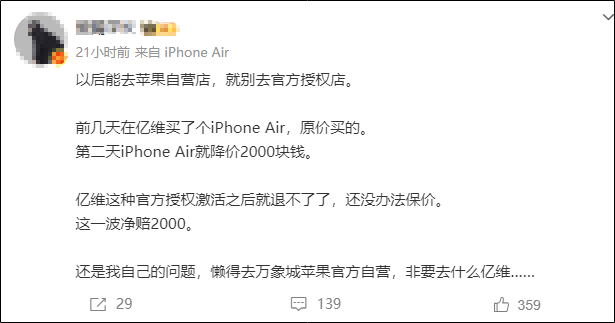
Core Viewpoint - The recent price drop of the iPhone Air has led to significant consumer dissatisfaction, with many buyers feeling unfairly treated due to the rapid depreciation of the product shortly after purchase [1][4]. Group 1: Consumer Reactions - A consumer reported purchasing the iPhone Air at the original price of 7999 yuan, only to find it discounted by 2000 yuan the next day, resulting in a net loss of 2000 yuan [1]. - Many consumers are expressing their frustration online, with some suggesting that retailers should provide guarantees against price drops for a certain period [3]. - Complaints have surged on platforms like 12315 and Black Cat Complaints, focusing on the price drop issue and targeting both Apple flagship stores and authorized retailers [4][5]. Group 2: Product Performance and Market Response - The iPhone Air, launched in October 2025, has not performed well in the Chinese market, achieving only about one-third of Apple's sales expectations shortly after its release [11]. - In contrast, the iPhone 17 series has seen significantly higher activation numbers, with the iPhone 17 Pro Max reaching 826,000 units, while the iPhone Air's sales were only 1/40 of the highest model in the same series [11]. - Due to poor sales, Apple has reportedly cut the production plan for the iPhone Air by half and is reallocating resources to the iPhone 17 series and new foldable models [11]. Group 3: Pricing Strategy Concerns - The iPhone Air's pricing strategy has been criticized for being too close to the iPhone Pro series while offering lower specifications, leading to perceptions of poor value [11]. - The product's rapid price drop of over 30% within three months of launch has raised ethical concerns regarding Apple's pricing practices [5].

特斯拉的廉价版很蠢么?
半佛仙人· 2025-10-12 04:07
Core Viewpoint - Tesla has launched cheaper versions of Model Y and Model 3, which are currently available only in foreign markets but are expected to be released in China soon. The pricing, around 200,000 yuan, is not significantly lower than existing models, raising questions about their value proposition in a highly competitive market [3][4]. Group 1: Product Strategy - The introduction of the cheaper Model Y is strategically designed to avoid cannibalizing the sales of existing Model Y and Model 3. If the cheaper models were too competitive, they would negatively impact the sales of the current models [4][5]. - The cheaper versions are positioned as complementary products rather than primary offerings, serving to enhance the perceived value of the existing models. This strategy is likened to how a less expensive product can highlight the value of a premium product [5]. Group 2: Market Positioning - The pricing strategy reflects a deliberate choice to maintain the premium image of Tesla's existing models. The lack of significant cost savings in the cheaper models ensures that consumers still see value in purchasing the higher-end versions [4][5]. - The production of the cheaper models in secondary factories rather than the main Shanghai factory indicates that Tesla does not intend for these models to be the main focus of their production strategy, further emphasizing their role as a supporting product [5].


Air太贵,Pro更有“性价比”,基础版“能获得中国补贴”--摩根大通点评苹果发布会:喜忧参半
硬AI· 2025-09-10 06:22
Core Viewpoint - Morgan Stanley provides a mixed evaluation of Apple's 2025 fall launch, indicating that the favorable pricing of the iPhone 17 series is offset by the moderate market outlook for the iPhone Air [3][4]. Group 1: iPhone Air Pricing Concerns - The iPhone Air, priced at $999, may face sales challenges due to its high price relative to its features, which are seen as lacking compared to the Pro models [3][6]. - The iPhone Air is described as the "thinnest iPhone ever" but has limited advantages over the Pro versions, leading to expectations of modest sales growth [3][6]. - Historical data suggests that Plus series models typically account for only a small percentage of total iPhone sales, and while the Air may see some incremental sales, it is unlikely to meet optimistic market growth expectations [6]. Group 2: Pro Series Advantages - The iPhone 17 base model maintains a favorable starting price of $799, with storage increased to 256GB, aligning with Chinese subsidy policies, which may support Apple's recovery in that market [3][8]. - The Pro models have seen significant upgrades in features while maintaining competitive pricing, which is expected to drive consumer interest and improve Apple's average selling price and profit margins [9]. - The Pro series is anticipated to be the main driver for improving the product mix, with substantial upgrades in camera systems and overall functionality [9]. Group 3: Trade-In Offers and Accessories - U.S. carriers are offering more generous trade-in incentives for the iPhone 17 series compared to the previous iPhone 16 cycle, which may stimulate consumer upgrade demand [11][12]. - In terms of accessories, while there are notable innovations in products like the Apple Watch and AirPods, their impact on overall investment logic is considered limited, with the primary growth driver expected to come from the iPhone product line [13].

摩根大通:iPhone 17系列价格预测出炉,Pro系列或涨价,标准版持稳
Sou Hu Cai Jing· 2025-09-03 14:36
Core Insights - The financial market is closely watching the upcoming iPhone 17 series, with JPMorgan's pricing analysis report providing a new perspective on the anticipated pricing trends [1][4] - Contrary to the general expectation of price increases, JPMorgan predicts that some models of the iPhone 17 series will maintain stable pricing [1] Pricing Strategy - JPMorgan forecasts the following pricing for the iPhone 17 series: iPhone 17 at $799 (approximately ¥5700), iPhone 17 Air between $899 and $949 (approximately ¥6400 to ¥6800), iPhone 17 Pro at $1099 (approximately ¥7800), and iPhone 17 Pro Max at $1199 (approximately ¥8500) [1][2] - The iPhone 17 standard version and iPhone 17 Pro Max are expected to have no price increase, while the iPhone 17 Air may see a price increase of up to $50 (approximately ¥360) compared to the iPhone 16 Plus, and the iPhone 17 Pro may increase by $100 (approximately ¥710) [2] Factors Influencing Pricing - Previous analyses have mentioned that U.S. tariffs on imports from China and India could impact pricing, with a 20% tariff on iPhones imported from China and no tariffs on those from India [4] - The fluctuating nature of U.S. tariff policies introduces uncertainty regarding the final pricing of the iPhone 17 series [4] - As the release date approaches, consumer and industry anticipation for the new product is increasing, with JPMorgan's report providing valuable pricing insights for consumers and new perspectives on Apple's pricing strategy for the market [4]

N375炭黑产品定价咨询优化市场价格策略的关键因素
Sou Hu Cai Jing· 2025-05-17 00:49
Core Insights - The global carbon black market is expanding, and the pricing strategy for N375 carbon black is crucial for companies' competitiveness and market share [2][4] Group 1: Market Demand - Changes in market demand are the primary factor influencing the pricing of N375 carbon black products, with varying demand intensity across different industries [2][4] - In the rubber industry, where demand is growing, companies can increase prices to enhance profits and competitiveness, while in the slower-growing plastic industry, pricing elasticity becomes more important to attract customers [2][3] Group 2: Product Quality and Performance - The quality and performance of carbon black products significantly impact pricing strategies; companies with superior quality can set higher prices and strengthen product value through marketing and branding [2][3] - Companies at a disadvantage in quality and performance may need to lower prices to attract customers and focus on technological innovation to improve market share [2][3] Group 3: Market Competition - The competitive landscape is a key determinant of pricing strategies; in a market with many similar products, companies may need to adjust prices flexibly to enhance competitive advantage [3][4] - In less competitive markets where companies hold a monopoly, there is room to increase prices for higher profits [3] Group 4: Cost Factors - Understanding the production cost structure is essential for pricing decisions, ensuring that prices cover production costs while maintaining profitability [3][4] - Companies must remain adaptable to fluctuations in raw material prices, production technology, and energy costs, adjusting pricing accordingly [3] Group 5: Market Response and Customer Feedback - Market reactions and customer feedback are critical indicators of pricing strategy effectiveness; companies should remain sensitive to market responses [3][4] - Conducting market research and gathering customer feedback can provide valuable insights for adjusting pricing strategies to meet market demands [3][4]

涨价会是高丝集团的解药吗
Bei Jing Shang Bao· 2025-04-07 12:57
Core Viewpoint - Kose Corporation has decided to raise product prices to offset rising raw material costs, which is a common strategy among beauty brands to alleviate performance pressure [1][6]. Price Adjustment Details - Kose's subsidiary, Decorte, will implement price adjustments on 172 products starting June 1, with price increases ranging from 550 to 1100 yen, averaging 3.3% to 5% [3][2]. - The highest price increase is for the AQ Melority Intensive Cream, which will rise from 132,000 yen to 137,500 yen, an increase of 5,500 yen [3]. Industry Trends - Price hikes have become a standard practice among major beauty brands to counteract rising raw material costs, with Shiseido and L'Oréal also announcing price increases earlier this year [3][4]. - The global economic environment is influencing raw material prices, prompting brands to adjust retail prices to maintain profit margins [4]. Financial Performance Context - Kose's financial results for 2024 show a net sales figure of 322.758 billion yen, a year-on-year increase of 7.4%, but net profit has decreased by 35.6% to 7.51 billion yen [6]. - The Asian market, particularly China, has seen a significant sales decline of 23%, highlighting challenges in this region [6][8]. Consumer Sentiment - Consumer reactions to price increases are mixed, with some expressing reluctance to purchase due to higher prices, indicating potential risks for Kose's strategy [7][8]. Structural Reforms - Kose is undergoing structural reforms in the Greater China region, which have incurred costs of 4.4 billion yen, suggesting that while price increases may provide short-term relief, long-term solutions are necessary [9][8].