
产成品库存指数

Search documents
制造业PMI为何超季节性回落?:——2025年10月PMI点评
EBSCN· 2025-10-31 12:32
Manufacturing Sector - The manufacturing PMI for October 2025 is reported at 49.0%, a significant decrease of 0.8 percentage points from the previous month, which is notably higher than the seasonal average decline of 0.4 percentage points observed from 2020 to 2024[2][5] - The production index fell by 2.2 percentage points to 49.7%, while the new orders index decreased by 0.9 percentage points to 48.8%[5][15] - The new export orders index dropped to 45.9%, down 1.9 percentage points, marking the second-lowest level since the introduction of high tariffs in April 2025[5][20] - Small enterprises experienced a notable decline in PMI, falling 1.1 percentage points to 47.1%, while large enterprises' PMI decreased to 49.9%[6] Non-Manufacturing Sector - The non-manufacturing PMI for October 2025 is at 50.1%, slightly up from 50.0% in the previous month, driven by holiday consumption[2][28] - The service sector showed improvement, with indices for transportation, retail, and entertainment exceeding 60%, indicating strong performance in consumer-related services[28] - The construction PMI fell to 49.1%, but new orders and business activity expectations increased, suggesting a potential recovery in infrastructure activities[34] Economic Outlook - The report highlights that the construction sector may benefit from the introduction of 500 billion yuan in new policy financial tools and an additional 200 billion yuan in special bond issuance, which could support infrastructure investment[4][34] - The overall economic environment remains cautious due to external trade uncertainties and domestic demand stability, particularly in high-energy-consuming industries[16][20]
2025年10月钢铁PMI显示:钢铁行业有所恢复 供需两端回稳运行
Xin Hua Cai Jing· 2025-10-31 02:26
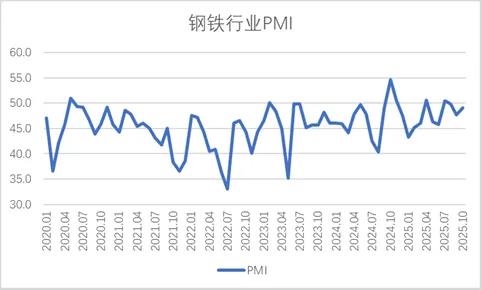
Core Viewpoint - The steel industry is showing signs of recovery in October 2025, with the PMI rising to 49.2%, ending a two-month decline, although challenges such as high raw material prices and inventory pressures remain [1][2]. Demand Recovery - October saw a recovery in steel demand due to the resumption of outdoor construction post-holidays and a lack of adverse weather in northern regions, but the real estate sector remains in deep adjustment, limiting overall market demand [2][3]. - The new orders index increased to 47.6%, up 2.4 percentage points, indicating some improvement in demand, but still within a contraction zone [3]. - Export orders showed significant improvement, with the new export orders index rising to 54.3%, the highest in nearly 20 months, driven by price differentials and overseas demand [3]. Production Trends - Steel production stabilized in October, with the production index rising to 49.8%, up 4.1 percentage points, indicating a recovery in production activities [5]. - Despite improvements in both supply and demand, the recovery in demand is weaker than the increase in supply, leading to continued inventory pressures for steel mills [5]. Raw Material Prices - Raw material prices remain high, with the purchasing price index exceeding 70%, indicating increased cost pressures for steel manufacturers [8]. - Prices for different raw materials are showing divergence, with iron ore prices stabilizing, scrap steel prices declining, and coke prices rising due to supply constraints [8]. Price and Profitability - Steel prices have shown a downward trend, with the Shanghai rebar price index dropping from 3176 CNY/ton to 3122 CNY/ton during October, leading to further compression of profit margins for steel mills [11]. - The overall cost pressure on steel manufacturers has increased compared to September, despite some recovery in demand [11]. Future Outlook - In November, steel demand is expected to show a "first rise then fall" trend, supported by construction activities and export resilience, but constrained by ongoing weakness in the real estate sector and seasonal factors [12]. - Steel production is anticipated to contract due to environmental restrictions in northern regions and a shift from peak to off-peak demand [15].

制造业PMI连续两月回升 下阶段走势如何
Di Yi Cai Jing· 2025-09-30 02:57
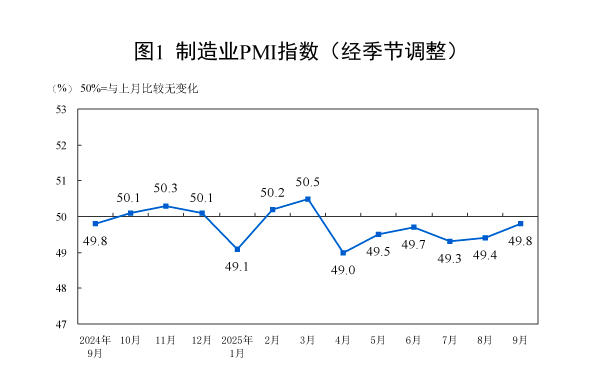
Core Insights - The manufacturing PMI in China rose to 49.8% in September, indicating a slight recovery but still below the expansion threshold [1] - The non-manufacturing business activity index decreased to 50.0%, reflecting a slight slowdown in non-manufacturing activities [1] Manufacturing Sector - The manufacturing production index increased to 51.9%, marking a continuous expansion for five months [4] - The purchasing volume index rose to 51.6%, indicating improved procurement activities [4] - New orders index reached 49.7%, showing a stabilization in market demand [4] - The export new orders index improved to 47.8%, suggesting a narrowing decline in export demand [4] - The manufacturing purchase price index was 53.2%, while the factory price index fell to 48.2%, indicating mixed price trends across sectors [5] Non-Manufacturing Sector - The non-manufacturing business activity index remained stable at 50.0%, with the construction index at 49.3% and the services index at 50.1% [8] - The business activity expectation index for non-manufacturing remained above 55%, indicating stable optimism among enterprises [8] - The postal industry showed significant growth, with indices above 60%, reflecting active online shopping [8][9] Future Outlook - The manufacturing sector is expected to see continued growth in Q4, driven by macro policies and seasonal demand [5] - Non-manufacturing activities are anticipated to stabilize and recover, supported by year-end effects and holiday demand [10]
2025年5月PMI点评:“抢出口”带动制造业PMI回暖
EBSCN· 2025-05-31 14:31
Manufacturing Sector - The manufacturing PMI for May 2025 is reported at 49.5%, a significant increase of 0.5 percentage points from the previous month, aligning with market expectations[2][4] - The production index rose to 50.7%, up 0.9 percentage points from last month, indicating a recovery in production activities[5][14] - New orders index increased to 49.8%, up 0.6 percentage points, reflecting improved demand conditions[5][14] - High-energy industries continue to decline, with the PMI dropping to 47.0%, down 0.7 percentage points, indicating ongoing challenges in these sectors[6] External Trade - The new export orders index rose to 47.5%, a significant increase of 2.8 percentage points, indicating a recovery in export activities following tariff reductions[21] - The import index increased to 47.1%, up 3.7 percentage points, suggesting improved import conditions[21] Service Sector - The service sector PMI increased slightly to 50.2%, up 0.1 percentage points, remaining in the expansion zone, driven by increased tourism and hospitality activities during the May Day holiday[31] Construction Sector - The construction PMI is at 51.0%, down 0.9 percentage points, indicating a slowdown in expansion primarily due to weakened housing demand, although infrastructure projects are accelerating[35] - Special bond issuance has increased significantly, with 443.2 billion yuan issued in May, up from 230.1 billion yuan in April, supporting investment in infrastructure[35]