
估值分位

Search documents
ETF生态周报(2026.03.16-03.20)——ETF市场整体综合面板
华宝财富魔方· 2026-03-24 09:50
Market Overview - As of March 20, 2026, the total market size of ETFs reached 5.10 trillion yuan, a decrease of 0.92 trillion yuan since the beginning of the year, with the number of listed ETFs increasing to 1,458, adding 55 new ones [2][26] - The stock-type ETFs accounted for 2.95 trillion yuan, while commodity-type ETFs saw a significant increase of 820.92 billion yuan to 3325.55 billion yuan, indicating sustained demand for hedging [2][26] - The top 20 fund companies experienced a general decline in ETF volumes, with significant pressure on equity sectors, leading to increased differentiation among leading institutions [2][8] Performance Analysis - The domestic equity market saw a substantial pullback, with the CSI 500 and CSI 1000 indices dropping by 6.00% and 5.29% respectively, while valuation levels remained historically high [11][12] - Defensive sectors did not perform well, with the power ETF declining by 2.97%, indicating that even traditionally safe investments were affected by market conditions [11][12] - The military and dividend ETFs had high PE ratios of 96.54 and 99.26 respectively, while the Hang Seng Technology ETF and pharmaceutical ETF remained at lower valuation levels, suggesting potential long-term investment appeal [11][18] Fund Flows - There was a marginal shift in fund flows, with broad-based ETFs seeing a net inflow of 126.08 billion yuan over the past five days, marking a return to positive territory for the first time recently [3][32] - However, over a 60-day period, broad-based ETFs still experienced a net outflow of 10,101.11 billion yuan, indicating ongoing mid-term pressure [3][32] - The recent inflow into the ChiNext index of 52.59 billion yuan suggests a notable shift of funds from safe-haven assets towards growth-oriented equities [21][32] Trading Activity - The trading volume of ETFs reached approximately 2.58 trillion yuan, reflecting a decrease from the previous week, with a notable shift of funds from bonds to equities and cross-border investments [39][41] - The trading activity of bond ETFs decreased significantly, while stock-type ETFs, particularly those related to the A500 index, remained highly active [41][45] - The turnover rate for bond ETFs showed a downward trend, indicating a shift in trading frequency and a potential move towards more stable asset allocations [42][45] Issuance Dynamics - A total of 10 ETFs were listed last week, with a combined share of 3.633 billion, indicating a recovery in supply [49][51] - The number of ETFs currently in issuance decreased to 49, while the number of newly established funds increased significantly to 47, suggesting a more robust supply side for the market [49][51] - Future listings are expected to be limited, with only three ETFs announced for the next two weeks, reflecting a potential contraction in supply [51]


【有色】取向硅钢自2024年10月12日以来首次涨价——金属周期品高频数据周报(2026.03.09-03.15)(王招华/戴默/方驭涛/王秋琪/张寅帅)
光大证券研究· 2026-03-16 23:06
Liquidity - SPDR Gold ETF holdings decreased week-on-week [4] - BCI small and medium enterprise financing environment index for February 2026 is 48.66, down 3.20% month-on-month [4] - M1 and M2 growth rate difference in February 2026 is -3.1 percentage points, up 1.0 percentage points month-on-month [4] - Current London gold spot price is $5018 per ounce [4] Infrastructure and Real Estate Chain - Blast furnace capacity utilization rate for January-February is at the highest level in five years [5] - Price changes this week: rebar +2.84%, cement price index -0.27%, rubber +3.89%, coke +0.00%, coking coal +0.22%, iron ore +3.67% [5] - National blast furnace capacity utilization rate, cement, and asphalt operating rates changed by +0.03 percentage points, +0.32 percentage points, and -6.5 percentage points respectively [5] Real Estate Completion Chain - Titanium dioxide and glass prices are at low levels [6] - This week, titanium dioxide and glass prices increased by 0.75% and 0.37% respectively, with titanium dioxide gross profit at -1901 yuan/ton and flat glass operating rate at 70.81% [6] Industrial Products Chain - National PMI new orders index for February is 48.60% [7] - Major commodity price performance this week: cold-rolled +0.87%, copper -0.57%, aluminum +2.83%, with corresponding gross profit changes of -70.77%, +19.53%, and +7.51% [7] - National semi-steel tire operating rate is 77.71%, up 3.68 percentage points month-on-month [7] Subcategories - Orientation silicon steel price increased for the first time since October 12, 2024 [8] - Graphite electrode price for ultra-high power is 19000 yuan/ton, unchanged, with a comprehensive gross profit of 1653.64 yuan/ton, down 6.45% [8] - Electrolytic aluminum price is 25100 yuan/ton, up 2.83%, with estimated profit at 7728 yuan/ton (excluding tax), up 7.51% [8] - Electrolytic copper price is 100630 yuan/ton, down 0.57% [8] - Tungsten concentrate price is 1050000 yuan/ton, up 14.25% from last week [8] Price Comparison - Hot-rolled and rebar price difference is at the lowest level in five years [9] - Rebar and iron ore price ratio this week is 4.02 [10] - Price difference between hot-rolled and rebar steel is 50 yuan/ton this week [10] - Price difference between Shanghai cold-rolled steel and hot-rolled steel is 390 yuan/ton, up 120 yuan/ton month-on-month [10] - Price ratio of stainless steel hot-rolled to electrolytic nickel is 0.10 [10] - Price difference between small rebar (mainly used in real estate) and large rebar (mainly used in infrastructure) is 150 yuan/ton this week, down 6.25% from last week [10] - Price difference between medium-thick plate and rebar steel is 100 yuan/ton this week [10] Export Chain - February PMI new export orders for China is 45.00%, down 2.8 percentage points month-on-month [11] - China export container freight index CCFI composite index this week is 1072.16 points, up 1.70% [11] - US crude steel capacity utilization rate is 77.40%, down 0.90 percentage points month-on-month [11] - Announcement No. 79 jointly issued by the Ministry of Commerce and the General Administration of Customs on December 12, 2026, will implement export license management for certain steel products starting January 1, 2026, aiming to further regulate China's steel product exports [11] Valuation Percentiles - This week, the CSI 300 index increased by 0.19%, with the best-performing cyclical sector being coal mining (+5.13%) [12] - The PB ratio of ordinary steel and industrial metals relative to the PB ratio of the Shanghai and Shenzhen markets are 38.60% and 75.51% respectively [12] - The current PB ratio of the ordinary steel sector relative to the Shanghai and Shenzhen markets is 0.53, with the highest value since 2013 being 0.82 (reached in August 2017) [12]

ETF市场整体综合面板
HWABAO SECURITIES· 2026-03-12 05:40
1. Report Industry Investment Rating No relevant content provided. 2. Core Viewpoints of the Report - The overall ETF market in the week of 2026.03.02 - 2026.03.06 showed a trend of structural differentiation. The equity market was generally weak, with high - valuation broad - based ETFs under pressure, while bonds provided hedging, and sectors with defensive/resource attributes such as oil and electricity were relatively dominant. There was a clear migration of funds from equity broad - based ETFs to gold, fixed - income, and some thematic ETFs, indicating a defensive tendency [21][22][31]. - The issuance of ETFs accelerated significantly last week, with new products mainly in the energy direction. However, the grid equipment ETF was at a high valuation, and the concentrated issuance might increase congestion, while the power ETF had a relatively reasonable valuation and controllable risks [4]. 3. Summary by Relevant Catalogs 3.1 Scale: Total Expansion and Structural Stratification (Market/Product/Institution) 3.1.1 Product Scale - As of March 6, 2026, the total number of ETFs in the whole market was 1,446, with a total scale of 53,029.83 billion yuan and 33,703.54 billion shares. Stock - type ETFs were the absolute main force, with 1,131 funds, a scale of 30,882.03 billion yuan, and 21,131.36 billion shares. The scale of cross - border ETFs was 9,452.05 billion yuan, bond - type ETFs was 7,374.88 billion yuan, commodity - type ETFs was 3,566.12 billion yuan, and currency - type ETFs was 1,749.61 billion yuan [11][13]. - Compared with the previous week, the overall share increased by 30.9 billion, but the scale decreased by 83.6 billion yuan. Stock - type ETFs increased in number and share but decreased in scale, while bond - type, commodity - type, and currency - type ETFs increased in both share and scale [12]. 3.1.2 Institution Scale - Last week, the top 20 fund companies managed a total net asset value of 23 trillion yuan, accounting for 62% of the whole market, showing a significant industry head effect and a high level of concentration. The top 10 fund companies mainly focused on currency and equity (stocks + ETFs). E Fund and China Asset Management had leading and more balanced total scales, Tianhong was more focused on currency - type products, and Bosera, Fullgoal, and Penghua had a more fixed - income - oriented structure [14]. - Compared with the previous week, the scale fluctuations last week mainly came from the stock and ETF sectors. Some leading institutions' equity and ETF scales declined, while some medium - sized institutions showed an incremental trend, and the differentiation among institutions increased [16]. 3.2 Performance: Rise - Fall Differentiation and Valuation Position 3.2.1 Large - Category ETFs - Last week, the domestic equity market was generally weak, with broad - based indexes generally retreating. The small - and medium - cap indexes (CSI 500/CSI 1000) had larger declines, and the valuation quantiles were still at a high level. Structurally, there was obvious differentiation. The oil ETF in the cyclical manufacturing direction rose against the trend, and the power ETF in the dividend/utilities direction also rose, while the securities ETF fell [21]. - Bonds strengthened slightly, and cross - border (QDII) ETFs were also weak. Overall, the main trend last week was the general decline of domestic equities, high - valuation broad - based indexes under pressure, bonds providing hedging, and sectors with defensive/resource attributes such as oil and electricity being relatively dominant [22]. 3.2.2 CITIC First - Level Industry Index - Last week, industry performance showed obvious differentiation. Sectors such as petroleum and petrochemicals, coal, and banks were strong but with high valuations; sectors such as power and public utilities, agriculture, forestry, animal husbandry, and fisheries, and communications were strong but with relatively low valuations; sectors such as computers, electronics, and machinery were weak and with high valuations; sectors such as food and beverages, commercial retail, and real estate were weak and with low valuations [26]. 3.2.3 Representative ETF Products - In terms of scale, Huatai - Bertrands SSE 50 ETF (510300) ranked first with 208.329 billion yuan. In terms of trading activity, bond - type ETFs were prominent, and among equity - type ETFs, the Hang Seng Tech ETF and A500ETF were the most actively traded. In terms of valuation, military - leading ETFs and dividend ETFs were at historical high levels, while the Hang Seng Tech ETF, pharmaceutical ETF, Nasdaq ETF, and power ETF were at historical low levels, which had certain allocation attractiveness for medium - and long - term investors [28]. - Among the top 20 indexes, the SSE 50 ETF had the largest scale but a significant decline last week. Most equity - type index ETFs had a net outflow of funds, while safe - haven and fixed - income assets were favored by funds. The SGE Gold 9999 had the most prominent performance, and some thematic ETFs also showed good inflow trends [30]. 3.3 Funds: Sector Liquidity and Net Inflow Structure 3.3.1 Whole - Market Overview: Scale and Net Redemption - Last week, the total scale of the whole - market ETFs reached 5.30 trillion yuan, slightly shrinking by 0.72 trillion yuan compared with the beginning of the year. The number of listed ETFs increased to 1,445, with 45 new ones compared with the beginning of the year. Stock - type ETFs were still the main force, but their scale decreased compared with the beginning of the year. Bond - type ETFs had the largest shrinkage, while commodity - type ETFs performed the best, and currency - type and cross - border ETFs had a slight increase [34]. 3.3.2 Large - Category Funds: Stocks/Bonds/Commodities/Cross - Border No specific content provided in the text for a detailed summary. 3.3.3 Internal Equity: Broad - Based vs. Industry/Theme vs. Strategy - Last week, the funds of major broad - based ETFs were generally weak, with the SSE 50 having a continuous net outflow in the past 60 days, and the ChiNext also under great outflow pressure. The main directions of capital inflow were thematic ETFs and cyclical manufacturing ETFs, while broad - based ETFs continued to be under pressure, indicating an obvious migration of funds from broad - based to thematic and cyclical directions [49][50]. 3.3.4 Top 20 Stock - Type ETF Redemption Net Inflows - Last week, energy and safe - haven assets were the main directions pursued by funds. The oil ETF had the highest net inflow, and the grid equipment ETF and other energy - related ETFs also had high net inflows. Gold ETFs continued the net inflow trend. The Hang Seng Tech ETF also received a net inflow despite a decline [54]. 3.3.5 Leveraged Funds: Top 20 Margin - Trading Net Buys and the Relationship with Redemption - Last week, the grid equipment ETF had the highest margin - trading net buy, followed by the Hang Seng Tech Index ETF and the Hong Kong Stock Connect Internet ETF. The medical ETF also had a relatively high margin - trading net buy. Gold - related ETFs had a large margin - trading net buy in total. There were four typical relationships between margin - trading and redemption, and the power ETF was the only one in the "double - strong" quadrant [56][57]. 3.4 ETF Trading Congestion 3.4.1 Top 10 ETFs in Terms of Turnover and Trading Volume - Last week, the total trading volume of the ETF market was about 2.9 trillion yuan. The increase in volume mainly came from bond - type ETFs, followed by stock - type ETFs. In the bond - type ETFs, the short - term financing ETF had the highest trading volume and turnover rate. In the stock - type ETFs, the electronic industry ETFs were the most actively traded, and the oil and petrochemical ETFs had a high turnover rate but relatively low trading volume. The large - cap style still dominated the market trading volume, and the game between growth and balanced styles was the core main line of current stock - type ETF trading [61][68][71]. 3.5 Issuance Dynamics and Trading Congestion - Last week, the ETF issuance market accelerated significantly, with 77 funds being issued, a 48% increase compared with the previous week. 12 funds were established (a 140% increase compared with the previous week), and 7 funds were listed (a 133% increase compared with the previous week). The supply of new products accelerated significantly. The newly listed ETFs were mainly in the energy and manufacturing directions, but the grid equipment ETF was at a high - valuation and high - congestion level, while the power ETF had a relatively reasonable valuation [78][80].
【钢铁】热轧与螺纹价差处于5年同期低位水平——金属周期品高频数据周报(2026.1.26-2026.2.1)(王招华/戴默)
光大证券研究· 2026-02-04 23:06
Summary of Key Points Core Viewpoint - The report highlights the current trends in various sectors, including liquidity, infrastructure, real estate, industrial products, and export chains, indicating potential investment opportunities and market dynamics. Group 1: Liquidity and Financing Environment - SPDR Gold ETF holdings are at their highest level since June 2022 [4] - The BCI small and medium enterprise financing environment index for January 2026 is 50.27, up 6.62% month-on-month [4] - The M1 and M2 growth rate difference was -4.7 percentage points in December 2025, down 1.60 percentage points month-on-month [4] - Current London gold spot price is $4,880 per ounce [4] Group 2: Infrastructure and Real Estate Chain - January high furnace capacity utilization is expected to be at the highest level for the same period in five years [5] - Weekly price changes include rebar down 0.61%, cement price index down 1.10%, rubber up 4.49%, coke up 3.65%, coking coal down 0.64%, and iron ore up 0.50% [5] - National high furnace capacity utilization, cement, and asphalt operating rates decreased by 0.04 percentage points, 0.02 percentage points, and 0.7 percentage points respectively [5] Group 3: Real Estate Completion Chain - Titanium dioxide and glass prices are at low levels, with titanium dioxide price unchanged and glass price up 1.38% [6] - Titanium dioxide gross profit is -1,834 yuan per ton, while flat glass operating rate is 73.89% [6] Group 4: Industrial Products Chain - January national PMI new orders index is at 49.20% [7] - Major commodity price changes include cold-rolled steel unchanged, copper up 3.50%, and aluminum up 2.11%, with corresponding gross profit changes showing improvements [7] - National semi-steel tire operating rate is 74.84%, up 0.28 percentage points [7] Group 5: Subcategories - Orientation silicon steel prices have reached the lowest level since 2018 [8] - Graphite electrode price is 19,000 yuan per ton, unchanged, with a gross profit of 1,921.48 yuan per ton, down 4.00% [8] - Electrolytic aluminum price is 24,640 yuan per ton, up 2.11%, with estimated profit of 7,389 yuan per ton (excluding tax), up 6.91% [8] - Electrolytic copper price is 104,640 yuan per ton, up 3.50% [8] - Tungsten concentrate price is 605,000 yuan per ton, up 11.42% from last week [8] Group 6: Price Comparison Relationships - The price ratio of hot-rolled to rebar is at the lowest level for the same period in five years [9] - The price ratio of rebar to iron ore is 3.96 this week [10] - The price difference between hot-rolled and rebar steel is 50 yuan per ton [10] - The price difference between Shanghai cold-rolled and hot-rolled steel is 360 yuan per ton, up 30 yuan per ton [10] - The price difference between small rebar (mainly used in real estate) and large rebar (mainly used in infrastructure) is 200 yuan per ton, up 33.33% from last week [10] - The price difference between medium-thick plates and rebar is 50 yuan per ton [10] Group 7: Export Chain - January China PMI new export orders are at 47.80%, down 1.2 percentage points [11] - The China Containerized Freight Index (CCFI) composite index is 1,175.59 points this week, down 2.74% [11] - The U.S. crude steel capacity utilization rate is 76.90%, up 1.00 percentage points [11] - Starting January 1, 2026, China will implement export licensing management for certain steel products, which is expected to further regulate steel exports [11] Group 8: Valuation Percentiles - This week, the CSI 300 index increased by 0.08%, with the best-performing cyclical sector being oil and petrochemicals, up 7.95% [12] - The PB ratio of ordinary steel and industrial metals relative to the PB of the two markets is 32.46% and 100.00% respectively [12] - The PB ratio of the ordinary steel sector relative to the two markets is currently 0.52, with the highest value since 2013 being 0.82, reached in August 2017 [12]
【钢铁】取向硅钢价格创2018年以来新低水平——金属周期品高频数据周报(2026.1.19-2026.1.25)(王招华/戴默)
光大证券研究· 2026-01-26 23:03
Summary of Key Points Core Viewpoint - The article discusses the current economic indicators and trends in various sectors, highlighting the liquidity situation, construction and real estate chains, industrial products, pricing dynamics, and export conditions, with a focus on potential investment opportunities and market movements. Group 1: Liquidity - The BCI small and medium enterprise financing environment index for January 2026 is at 50.27, an increase of 6.62% month-on-month [3] - The M1 and M2 growth rate difference was -4.7 percentage points in December 2025, a decrease of 1.60 percentage points month-on-month [3] - The current price of London gold is $4,981 per ounce [3] Group 2: Infrastructure and Real Estate Chain - The capacity utilization rate of blast furnaces is expected to be at the highest level for January in five years [4] - Weekly price changes include rebar down 1.81%, cement price index down 0.87%, rubber down 0.32%, coke unchanged, coking coal up 1.07%, and iron ore down 2.92% [4] - National blast furnace capacity utilization rate increased by 0.36 percentage points, while cement and asphalt operating rates decreased by 4.30 percentage points and increased by 3.7 percentage points, respectively [4] Group 3: Real Estate Completion Chain - The prices of titanium dioxide and glass are at low levels, with titanium dioxide price increasing by 0.76% and glass price decreasing by 0.73% [5] - The gross profit for titanium dioxide is -1,740 yuan per ton, while the flat glass operating rate is 73.89% [5] Group 4: Industrial Products Chain - Major commodity price changes include cold-rolled steel down 1.55%, copper down 0.71%, and aluminum up 0.54%, with corresponding gross profit changes showing a turnaround to profit for cold-rolled steel and an increase in losses for copper and aluminum [6] - The national semi-steel tire operating rate is at 74.56%, an increase of 1.12 percentage points [6] Group 5: Specific Products - The price of oriented silicon steel has reached a new low since 2018 [7] - The price of graphite electrodes is 19,000 yuan per ton, unchanged, with a gross profit of 2,001.58 yuan per ton [7] - The price of electrolytic aluminum is 24,130 yuan per ton, with a profit of 6,911 yuan per ton (excluding tax), an increase of 1.83% [7] Group 6: Price Comparison Relationships - The price ratio of London spot gold to silver has reached the lowest level since 2013 [8] - The price ratio of rebar to iron ore is 4.01, and the price difference between hot-rolled and rebar steel is 70 yuan per ton [8] - The price difference between small rebar (mainly used in real estate) and large rebar (mainly used in infrastructure) is 150 yuan per ton, a decrease of 25% from the previous week [8] Group 7: Export Chain - The new export orders PMI for China in December is 49.00%, an increase of 1.4 percentage points month-on-month [9] - The CCFI comprehensive index for container shipping rates is 1,208.75 points, a decrease of 0.09% [9] - The U.S. crude steel capacity utilization rate is 75.90%, an increase of 0.20 percentage points [9] Group 8: Valuation Percentiles - The CSI 300 index decreased by 0.62%, with the best-performing cyclical sector being oil and petrochemicals, which increased by 7.71% [10] - The PB ratio of ordinary steel and industrial metals relative to the PB of the Shanghai and Shenzhen markets is 34.11% and 100.00%, respectively [10] - The current PB ratio of the ordinary steel sector relative to the Shanghai and Shenzhen markets is 0.51, with the highest value since 2013 being 0.82 [10]
——金属周期品高频数据周报(2026.1.19-2026.1.25):取向硅钢价格创2018年以来新低水平-20260126
EBSCN· 2026-01-26 06:49
Investment Rating - The report maintains a rating of "Overweight" for the steel and non-ferrous metals sectors [5] Core Insights - The report highlights that the price of oriented silicon steel has reached its lowest level since 2018, indicating potential market challenges [2] - The liquidity indicators show that gold prices have reached a historical high, with the London gold spot price at $4,981 per ounce, reflecting strong demand [11] - The report suggests that the steel sector's supply may be reasonably constrained in the medium to long term, which could lead to a recovery in profitability to historical average levels [4] Summary by Relevant Sections Liquidity - The BCI small and medium enterprise financing environment index for January 2026 is at 50.27, up 6.62% month-on-month [11] - The M1 and M2 growth rate difference was -4.7 percentage points in December 2025, down 1.60 percentage points month-on-month [11] - The current London gold price is $4,981 per ounce, reflecting an 8.31% increase from the previous week [11] Infrastructure and Real Estate Chain - The blast furnace capacity utilization rate in January is expected to be at its highest level for the same period in five years [20] - The national blast furnace capacity utilization rate is 85.51%, up 0.03 percentage points week-on-week [39] - The report notes that the prices of titanium dioxide and glass are at low levels, with titanium dioxide priced at 13,300 yuan per ton, up 0.76% week-on-week [76] Industrial Products Chain - The operating rate of semi-steel tires is at 74.56%, up 1.12 percentage points [2] - The report indicates that the price of electrolytic aluminum is 24,130 yuan per ton, reflecting a 0.54% increase [2] - The price of tungsten concentrate is 543,000 yuan per ton, up 6.37% from the previous week [2] Valuation Metrics - The Shanghai Composite Index decreased by 0.62%, while the best-performing sector was oil and petrochemicals, which increased by 7.71% [4] - The PB ratio of the steel sector relative to the Shanghai and Shenzhen markets is currently at 0.51, with a historical high of 0.82 [4] Export Chain - The new export orders PMI for China in December was 49.00%, up 1.4 percentage points month-on-month [3] - The CCFI composite index for container shipping rates is at 1,208.75 points, down 0.09% [3] - The U.S. crude steel capacity utilization rate is 75.90%, up 0.20 percentage points [3]
【钢铁】M1 M2 增速差已连续三个月回落 ——金属周期品高频数据周报(2026.1.12-2026.1.18)(王招华/戴默)
光大证券研究· 2026-01-20 23:06
Liquidity - The negative difference in the growth rates of M1 and M2 has expanded for three consecutive months, reaching -4.7 percentage points in December 2025 [3] - The BCI small and medium enterprise financing environment index for December 2025 is 47.15, a month-on-month decrease of 10.19% [3] - The correlation between the M1 and M2 growth rate difference and the Shanghai Composite Index is strong, with the difference in December 2025 being -4.7 percentage points, a month-on-month decrease of 1.60% [3] Infrastructure and Real Estate Chain - In early January, the average daily crude steel output of key steel enterprises rebounded to levels seen in mid-October 2025 [3] - Price changes this week include rebar up by 1.22%, cement price index down by 0.94%, rubber down by 1.26%, coke unchanged, coking coal up by 1.23%, and iron ore down by 0.12% [3] - National blast furnace capacity utilization rate, cement, and asphalt operating rates changed by +0.04 percentage points, -1.92 percentage points, and +3.7 percentage points respectively [3] Real Estate Completion Chain - Prices of titanium dioxide and glass are at low levels, with titanium dioxide price unchanged and glass price down by 0.73% [4] - The gross profit for titanium dioxide is -1707 yuan/ton, while the flat glass operating rate is 73.89% this week [4] Industrial Products Chain - The operating rate of semi-steel tires is at the median level for the past five years, with a current rate of 73.44%, an increase of 7.55 percentage points [5] - Major commodity price changes this week include cold-rolled steel unchanged, copper up by 1.19%, and aluminum down by 0.25% [5] - Copper spot prices have reached a historical high, while tungsten concentrate prices have continued to reach new highs since 2012 [5] Price Comparison Relationships - The gold-silver price ratio in London has reached its lowest level since 2013 [6] - The price ratio of rebar to iron ore is 3.99 this week, with the price difference between hot-rolled and rebar steel at 30 yuan/ton [6] - The price difference between small rebar (mainly used in real estate) and large rebar (mainly used in infrastructure) reached 200 yuan/ton, an increase of 31.03% from last week [6] Export Chain - In December, China's PMI new export orders stood at 49.00%, an increase of 1.4 percentage points month-on-month [7] - The China Containerized Freight Index (CCFI) composite index this week is 1209.85 points, up by 1.25% [7] - The Ministry of Commerce and the General Administration of Customs announced that starting January 1, 2026, export licensing management will be implemented for certain steel products, which is expected to further regulate China's steel product exports [7] Valuation Percentiles - The CSI 300 Index decreased by 0.57% this week, with the best-performing cyclical sector being industrial metals, which increased by 2.81% [8] - The PB ratio of ordinary steel and industrial metals relative to the PB ratio of the Shanghai and Shenzhen markets is 28.96% and 100.00% respectively [8] - The current PB ratio of the ordinary steel sector relative to the Shanghai and Shenzhen markets is 0.50, with the highest value since 2013 being 0.82, reached in August 2017 [8]

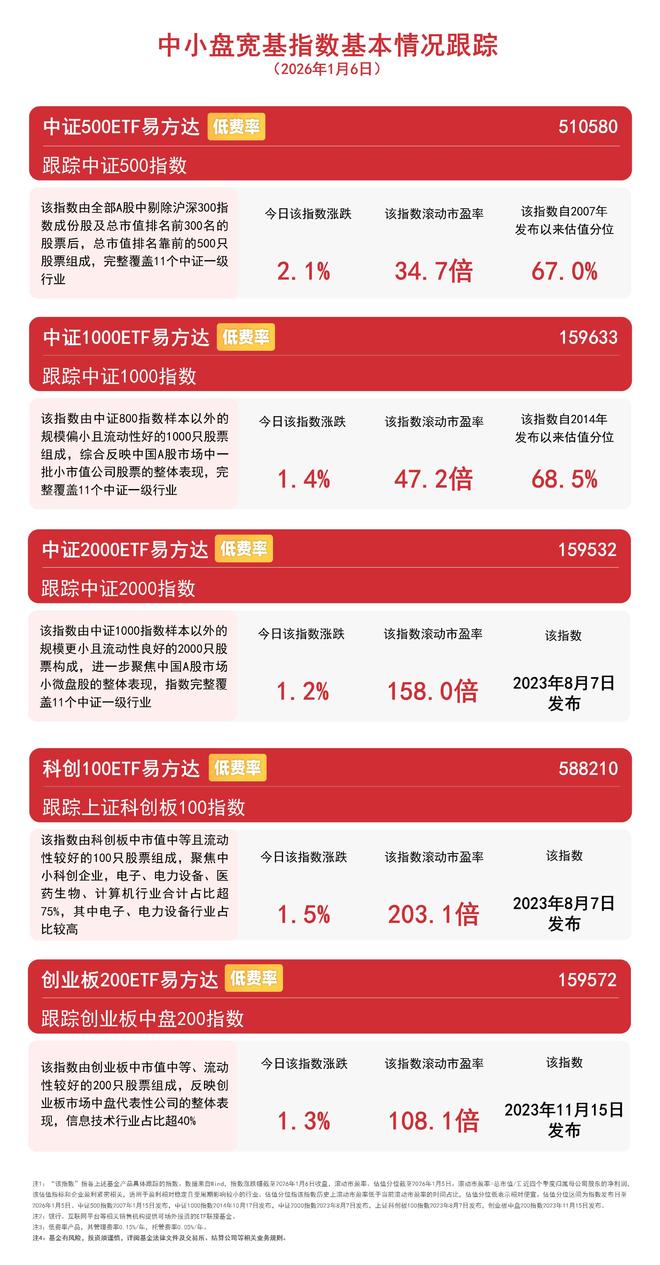
中小盘宽基指数延续涨势,关注中证500ETF易方达(510580)、中证2000ETF易方达(159532)配置价值
Mei Ri Jing Ji Xin Wen· 2026-01-06 11:09
Market Performance - The CSI 500 Index increased by 2.1%, the CSI 1000 Index rose by 1.4%, the CSI 2000 Index went up by 1.2%, the STAR 100 Index gained 1.5%, and the ChiNext Mid-cap 200 Index climbed by 1.3% [1] ETF Overview - The E Fund CSI 500 ETF tracks the CSI 500 Index, which consists of 500 stocks with high market capitalization, covering all 11 first-level industries. The index's rolling P/E ratio is 34.7 times, with a valuation percentile of 67.0% since its inception in 2007 [2] - The E Fund CSI 1000 ETF tracks the CSI 1000 Index, which includes 1000 smaller, liquid stocks outside the CSI 800 Index, reflecting the performance of small-cap companies in the A-share market. The index's rolling P/E ratio is 47.2 times, with a valuation percentile of 68.5% since its inception in 2014 [2] - The E Fund CSI 2000 ETF tracks the CSI 2000 Index, which consists of 2000 smaller, liquid stocks, focusing on the performance of micro-cap stocks in the A-share market. The index's rolling P/E ratio is 158.0 times, and it was launched on August 7, 2023 [2] - The E Fund STAR 100 ETF tracks the STAR Market 100 Index, composed of 100 medium-sized, liquid stocks from the STAR Market, with over 75% of its composition in the electronics, power equipment, and pharmaceutical industries. The index's rolling P/E ratio is 203.1 times, and it was launched on August 7, 2023 [2] - The E Fund ChiNext Mid-cap 200 ETF tracks the ChiNext Mid-cap 200 Index, which includes 200 medium-sized, liquid stocks from the ChiNext market, with over 40% in the information technology sector. The index's rolling P/E ratio is 108.1 times, and it was launched on November 15, 2023 [3]
【钢铁】钨精矿价格出现自2025年10月以来首次回调——金属周期品高频数据周报(2025.12.29-2026.1.4)(王招华/戴默)
光大证券研究· 2026-01-05 23:05
Summary of Key Points Core Viewpoint - The report highlights the current economic indicators and trends affecting various sectors, particularly focusing on financing conditions, construction, real estate, and industrial products, indicating a mixed outlook for the economy in December 2025. Group 1: Liquidity - The BCI small and medium enterprise financing environment index for December 2025 is at 47.15, a decrease of 10.19% month-on-month [4] - The M1 and M2 growth rate difference in November 2025 is -3.1 percentage points, down by 1.1 percentage points from the previous month [4] - The current price of London gold is $4,333 per ounce [4] Group 2: Infrastructure and Real Estate Chain - The national steel PMI new orders index for December decreased by 3.5 percentage points to 45.4% [5] - Weekly price changes include rebar up by 1.22%, cement price index down by 0.06%, rubber up by 0.33%, and iron ore up by 1.77% [5] - National blast furnace capacity utilization rate, cement, and asphalt operating rates changed by -0.39 percentage points, +12.41 percentage points, and -2.4 percentage points respectively [5] Group 3: Real Estate Completion Chain - Prices for titanium dioxide and glass are at low levels, with titanium dioxide price unchanged and flat glass down by 1.09% [6] - The gross profit for titanium dioxide is -1,744 yuan per ton, while the flat glass operating rate is at 73.89% [6] Group 4: Industrial Products Chain - The national PMI new orders index for December stands at 50.80% [7] - Major commodity price changes include cold-rolled steel down by 0.26%, copper down by 0.32%, and aluminum up by 0.50% [7] - The operating rate for semi-steel tires is at 69.35%, down by 2.70 percentage points [7] Group 5: Subcategories - The price of graphite electrodes is at 19,000 yuan per ton, unchanged, with a gross profit of 2,094.1 yuan per ton, up by 1.63% [8] - The price of electrolytic aluminum is 22,170 yuan per ton, up by 0.50%, with a calculated profit of 5,015 yuan per ton (excluding tax), up by 1.98% [8] - The price of tungsten concentrate is 454,500 yuan per ton, down by 1.30% from the previous week [8] Group 6: Price Comparison Relationships - The price ratio of rebar to iron ore is 4.04 this week [10] - The price difference between hot-rolled and rebar steel is -30 yuan per ton [10] - The price difference between small rebar (mainly used in real estate) and large rebar (mainly used in infrastructure) is 300 yuan per ton, up by 50% from last week [10] Group 7: Export Chain - The new export orders PMI for China in December is 49.00%, an increase of 1.4 percentage points [11] - The CCFI comprehensive index for container shipping rates is 1,146.67 points, up by 1.95% [11] - The Ministry of Commerce and the General Administration of Customs announced that from January 1, 2026, certain steel products will be subject to export license management, which is expected to further regulate steel exports [11] Group 8: Valuation Percentiles - The CSI 300 index decreased by 0.59%, with the best-performing cyclical sector being oil and gas, up by 3.92% [12] - The PB ratio of ordinary steel and industrial metals relative to the PB of the two markets is 31.57% and 100.00% respectively [12] - The current PB ratio of the ordinary steel sector relative to the two markets is 0.51, with the highest value since 2013 being 0.82 [12]
金属周期品高频数据周报(2025.12.22-12.28):热卷库存处于5年同期最高水平-20251228
EBSCN· 2025-12-28 13:09
Investment Rating - The report maintains an "Overweight" rating for the steel and non-ferrous metals sectors [5] Core Insights - The report highlights that hot-rolled inventory is at its highest level for the same period in five years, indicating potential supply chain pressures [41] - The liquidity environment is characterized by a historical high in gold prices, with the London gold spot price reaching $4,533 per ounce [11] - The report notes a decline in construction activity, with national real estate new starts down 20.50% year-on-year for the first 11 months of 2025 [20] Summary by Relevant Sections Liquidity - The BCI small and medium enterprise financing environment index for December 2025 is at 47.15, down 10.19% month-on-month [11] - The M1 and M2 growth rate difference was -3.1 percentage points in November 2025, a decrease of 1.10 percentage points month-on-month [18] - The current London gold price is $4,533 per ounce, reflecting a 4.41% increase from the previous week [11] Infrastructure and Real Estate Chain - Hot-rolled inventory is at the highest level for the same period in five years, with rebar prices down 1.20% this week [41] - The national high furnace capacity utilization rate is at 85%, unchanged from the previous week [10] - The cement price index has decreased by 0.49% this week, with a national cement utilization rate of 30.14%, down 0.9 percentage points [59] Industrial Chain - The national semi-steel tire operating rate is at 72.05%, up 0.66 percentage points week-on-week [2] - The price of tungsten concentrate has reached a new high since 2012, at 460,500 yuan per ton, up 6.35% from last week [2] - The price of electrolytic aluminum is 22,060 yuan per ton, reflecting a 1.01% increase week-on-week [10] Price Relationships - The price difference between hot-rolled and rebar has turned positive, with the current difference at 10 yuan per ton [3] - The price ratio of rebar to iron ore is 4.02 this week [3] - The price of stainless steel hot-rolled and electrolytic nickel has a ratio of 0.10 [3] Export Chain - The new export orders PMI for China in November is 47.60%, an increase of 1.7 percentage points month-on-month [3] - The CCFI composite index for container shipping rates is at 1,146.67 points, up 1.95% week-on-week [3] - The U.S. crude steel capacity utilization rate is at 75.30%, down 1.20 percentage points from the previous week [3] Valuation Metrics - The CSI 300 index increased by 1.95%, with the chemical sector performing best at +4.23% [4] - The PB ratio for the steel sector relative to the CSI 300 is currently at 0.50, with a historical high of 0.82 [4] - The report suggests that the steel sector's supply may be reasonably constrained, leading to potential recovery in profitability to historical average levels [4]