
估值弹性

Search documents
有色商品周期如何投射在A股?
Hua Er Jie Jian Wen· 2026-01-22 10:21
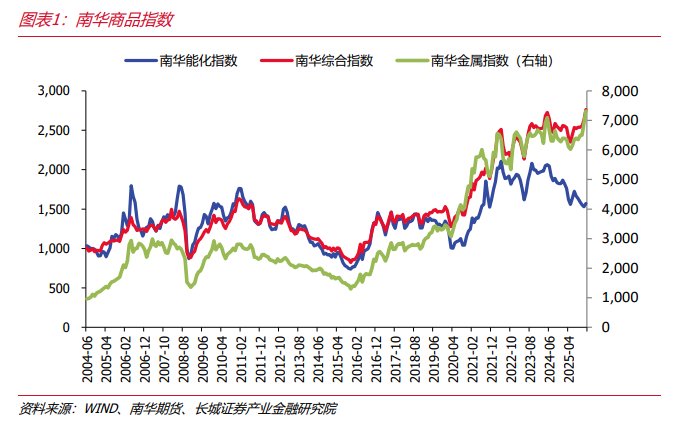
Group 1 - The current commodity market shows a significant divergence compared to previous cycles, with energy and non-ferrous metals exhibiting distinct trends [1][2] - The performance of non-ferrous metal stocks is influenced not only by commodity price movements but also by the overall market environment and style shifts in the A-share market [1][6] - Industrial metal stocks have shown greater elasticity in bull markets, outperforming commodity price increases, while precious metals stocks remain closely tied to commodity prices [1][6] Group 2 - The report outlines four typical commodity bull markets since 2004, highlighting the distinct phases of global demand expansion, liquidity easing, supply-side reforms, and pandemic recovery [2] - Post-2022, the commodity market has displayed notable differentiation, with energy and black metals stabilizing after volatility, while non-ferrous metals, particularly precious metals, have shown strong upward trends [2][4] - The correlation between commodity prices and stock performance varies, with industrial metals being more affected by A-share market performance, while precious metals exhibit a stronger independent trend [6][9] Group 3 - Recent data indicates that the valuation elasticity of the A-share non-ferrous metal sector has significantly surpassed that of commodity price elasticity, particularly for copper, aluminum, and energy metals [8] - The report concludes that sectors leaning towards "forward logic" (copper, aluminum, energy metals) contribute more to valuation, while those focused on "current profitability" (precious metals) tend to follow commodity price trends closely [8]

中信证券徐广鸿:估值修复与结构重塑共振 2026年港股锚定四大核心赛道
Zhong Guo Zheng Quan Bao· 2025-12-09 22:44
Core Viewpoint - The Hong Kong stock market is entering a phase of valuation repair and structural reshaping, characterized by undervaluation, capital misalignment, and performance differentiation, with significant net inflows from southbound funds and a shift in foreign capital [1][2]. Valuation and Market Trends - The Hang Seng Index has experienced a cumulative decline of over 50% from early 2021 to January 2024, leading to a significant valuation gap [2]. - As of December 9, 2023, the Hang Seng Index, Hang Seng China Enterprises Index, and Hang Seng Technology Index have recorded cumulative gains of 49.20%, 22.59%, and 24.32%, respectively [2]. - By the end of 2025, the expected EPS growth for the Hang Seng Index in 2026 is projected to be 8%, with a dynamic P/E ratio of only 12 times, indicating a notable valuation gap compared to major global markets [2]. Capital Flow Dynamics - Southbound funds have seen a record net inflow of nearly 1.4 trillion HKD by the end of November 2023, marking a new high since the launch of the mutual market access mechanism [3]. - The inflow of ETFs surged to 51.3% from June to October, with August reaching 88%, indicating strong enthusiasm among domestic individual investors [3]. - Institutional investors favor sectors like non-bank themes and precious metals, while individual investors focus on growth sectors such as automotive, pharmaceuticals, and consumer goods [3]. Sector Performance and Investment Opportunities - The technology sector is expected to see significant profit growth in 2025, contrasting with traditional sectors like finance and real estate [4]. - The AI industry chain in Hong Kong is strengthening, with a positive correlation between the Hang Seng Technology Index and the USD/JPY exchange rate [4]. - For 2026, investment opportunities should focus on sectors with performance certainty and valuation elasticity, particularly technology, pharmaceuticals, resource products, and essential consumer goods [8]. Long-term Market Outlook - The market is anticipated to experience a second round of valuation repair driven by internal and external factors, including the implementation of the "14th Five-Year Plan" and easing monetary policies globally [6][5]. - The potential for external capital inflow is expected to increase as the risk premium decreases due to improved Sino-U.S. relations [6]. Specific Sector Insights - The technology sector, especially the AI industry, is expected to benefit from a virtuous cycle of investment and revenue growth, with a focus on leading companies and quality players in the computing power supply chain [8]. - The pharmaceutical sector is entering a growth phase supported by policy and industry developments, with a focus on innovative companies and those benefiting from domestic market reforms [8]. - The resource sector is supported by supply-demand mismatches and liquidity drivers, with companies in precious metals and rare earths likely to benefit from rising commodity prices [9]. - The essential consumer goods sector is poised for valuation recovery as domestic policies stimulate consumption and improve income expectations [9].

研报掘金丨开源证券:维持山西汾酒“买入”评级,产品结构和估值都有弹性
Ge Long Hui· 2025-12-08 05:19
Core Viewpoint - Shanxi Fenjiu has maintained a unique market performance in 2025 despite the industry's deep adjustment period, with profit forecasts for 2025-2027 remaining intact [1] Financial Performance - In the first three quarters of 2025, revenue from Fenjiu and other liquor categories reached 3.217 billion and 65 million yuan respectively, showing year-on-year changes of +5.5% and -15.9% [1] - Domestic revenue for the same period was 1.101 billion yuan, down 7.5% year-on-year, while revenue from outside the province was 2.181 billion yuan, up 12.7% year-on-year [1] Market Dynamics - The high base in domestic sales has led to significant inventory pressure, while the external market remains relatively healthy with substantial growth potential [1] - The secondary high-end Qinghua series has outperformed the industry, attributed to its unique flavor profile and high consumer loyalty, which is expected to continue [1] Strategic Outlook - With a well-structured product lineup and a healthy national distribution strategy, Fenjiu's market performance is significantly better than the industry average [1] - As the industry improves, both product structure and valuation are expected to have upward flexibility, maintaining a "buy" rating [1]
