债券市场配置

Search documents
固定收益点评:配置盘主导的债市会如何演进?
GOLDEN SUN SECURITIES· 2026-03-03 13:41
1. Report Industry Investment Rating No information provided in the report. 2. Core Viewpoints of the Report - Since the third quarter of 2025, the long - term bond market has been in a volatile adjustment. Trading desks with unstable liabilities, such as funds and securities firms, have continuously sold bonds, while allocation desks mainly composed of banks have gradually increased their positions. The current market is dominated by allocation desks, and future market trends depend on the stability of allocation demand and the pace of trading desk re - entry [1][9]. - Historically, significant trading desk position reductions generally correspond to substantial interest rate adjustments. The pace of trading desk re - entry determines the recovery rhythm, but the current market environment is quite different from the past, so historical experience cannot be blindly followed [4]. - Currently, long - term bonds are in a narrow - range oscillation. The liability side of funds is recovering slowly, and securities firms lack the space and positions for band trading. In the future, attention should be paid to the sustainability of allocation demand and the recovery rhythm of the trading desk's liability side [5][62]. 3. Summary by Directory 3.1 Current Allocation Desk - Dominated Bond Market - Since the third quarter of 2025, long - term bonds have been in a volatile adjustment. The performance of bond funds has been affected, and the share of public bond funds has been shrinking since July. After the New Year, with the accumulation of banks' allocation demand, the allocation desk has gradually increased its positions, and the positions of trading - type institutions may have dropped to a relatively low level [9]. - Since 2019, there have been seven rounds of significant trading desk position reductions. The current round's decline is close to that of the 2022 redemption wave, and the position of broad - based funds has dropped to a low level. From June 2025 to January 2026, the decline in the interest - rate bond position of broad - based funds reached 2.6%, slightly lower than the 3.4% decline during the 2022 year - end redemption wave, and the current position ratio has dropped to the lowest level since 2019 [1][14]. 3.2 Allocation Desk's Bond Allocation Logic 3.2.1 Banks: Widening Deposit - Loan Growth Gap and Still Existing Bond - Loan Price Advantage - Banks are the main recipients during the current trading desk's position reduction. The reasons for banks to increase bond allocation are as follows: First, the deposit - loan growth gap has widened recently, with the deposit growth rate rising from 7.7% in November last year to 10.0% in January this year, and the loan growth rate dropping from 6.4% to 6.1%. The deposit - loan growth gap has widened to 3.8 percentage points, driving up banks' bond allocation demand [19]. - Second, long - term bonds still have a certain comparative advantage over loans. For example, the comprehensive yield of 10 - year treasury bonds is higher than that of general loans, and the comprehensive yield of 30 - year treasury bonds is higher than that of housing mortgage loans. From a historical perspective, the yield spread between 10 - year treasury bonds and loans and between 30 - year treasury bonds and mortgage loans is at a relatively high level [26]. - Third, after the New Year, the duration indicator has eased, releasing the space for banks to increase long - term bond allocation. According to the Basel framework, the impact amplitude of the "parallel upward shift" scenario of interest - rate shocks has been adjusted from 250BP to 225BP, which is expected to support large - scale banks to newly undertake 649 billion yuan of 30 - year local bonds [31]. 3.2.2 Insurance: Dividend - Paying Insurance Dominates the "Good Start", Weakening the Pricing Power of Long - Term Bonds - Compared with banks' large - scale bond allocation, insurance companies' allocation of ultra - long - term bonds is insufficient. In 2026, the "good start" of insurance was remarkable, with dividend - paying insurance as the absolute main force. In January 2026, 79 life insurance companies achieved a new - order premium of 212.6 billion yuan in the bank - insurance channel, a year - on - year increase of 27.6% [35]. - The dominance of dividend - paying insurance may lead to a shorter duration preference and a higher equity preference of insurance funds, weakening insurance companies' pricing power over long - term bonds and increasing the allocation of medium - and long - term high - coupon bonds. Currently, the dividend yield of dividend - paying stocks is still attractive compared with long - term bonds, and the pressure of insurance companies' stock - bond rebalancing still exists [40][43]. - The current yield spread between 30 - year and 10 - year bonds is at a high level. As premium income grows, insurance companies will have a certain capacity to absorb ultra - long - term bonds, but they may be more cautious in the allocation rhythm [44]. 3.3 How Will the Market Evolve under the Dominance of the Allocation Desk? - In previous trading desk position - reduction periods, significant declines in the positions of broad - based funds generally corresponded to obvious interest - rate adjustments, which usually led to bank position increases. The recovery rhythm after trading desk position reduction is determined by the trading desk's re - entry pace, and the specific recovery situation depends on factors such as the capital market, fundamentals, and the degree of "asset shortage" [50][55]. - The current trading desk position reduction (from June 2025 to January 2026) is special: there is differentiation among bond types, with long - term interest rates oscillating and credit spreads at a historical low; there is also differentiation among institutions, with the liability side of public funds being greatly affected and that of bank wealth management products being relatively stable; this adjustment is less affected by the capital market and fundamentals, so historical experience cannot be blindly followed [60]. - Currently, long - term bonds are in a narrow - range oscillation. The liability side of funds is recovering slowly, and securities firms lack the space and positions for band trading. In the future, attention should be paid to the sustainability of allocation demand (the deposit - loan gap is the core to maintain banks' bond allocation demand) and the recovery rhythm of the trading desk's liability side. If the trading desk increases its positions, it may drive long - term bonds to break through downward, and the yields of medium - and short - term credit bonds are expected to decline rapidly, while the recovery of long - term and ultra - long - term credit bonds still awaits the recovery of market sentiment [62].
2026年一季度债市配置窗口已至
Mei Ri Jing Ji Xin Wen· 2026-01-27 01:20
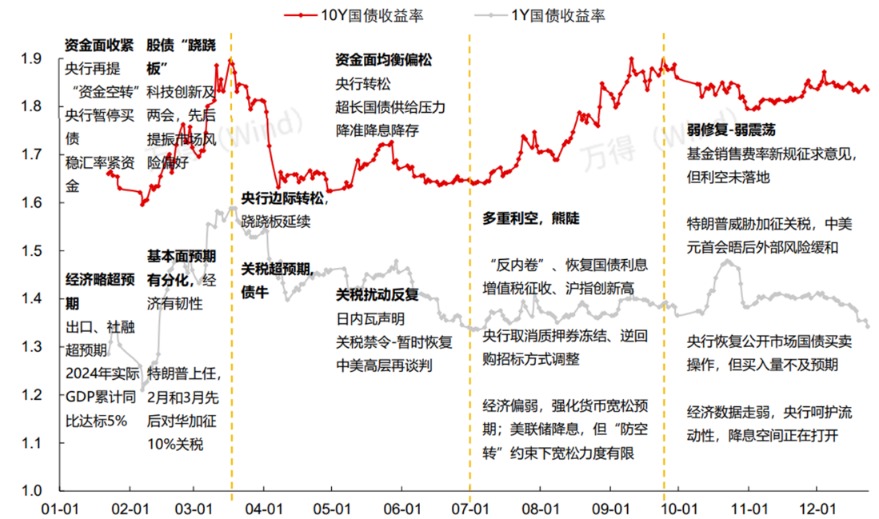
Group 1 - The bond market performance in 2025 was not strong, with varying trading themes throughout the year. The first quarter saw a significant rise in interest rates due to excessive pricing of monetary easing expectations for the end of 2024, leading to a correction in these expectations in early 2025 [1] - In the second quarter, the bond market experienced a rally influenced by tariff disturbances. By the third quarter, the stock market showed strong performance under the "anti-involution" backdrop, leading to a stock-bond seesaw effect, with bond rates rising again. The fourth quarter exhibited weak fluctuations, with diminishing effects from previous trends and uncertainties from new rate regulations [3] - For 2026, the first quarter is viewed as a favorable time for bond market allocation, with expectations that interest rates may peak during this period. Factors such as concerns over long-term bond supply and the "opening red" of credit at the beginning of the year may exert pressure on rates, while the market anticipates a potential 10 basis points rate cut over the year [4] Group 2 - The economic outlook for 2026 is characterized as "weak reality," with a tendency for loose monetary policy and a high probability of interest rate cuts throughout the year. The stock-bond seesaw effect may weaken in the second half of the year, suggesting a strategy of accumulating ten-year government bond ETFs during corrections [5] - The ten-year government bond ETF (511260) has notable advantages, including a transparent portfolio of bonds with remaining maturities of 7-10 years. It has achieved positive returns annually since 2018, with a market fluctuation of 0.3% in 2025. The ETF offers lower volatility compared to 30-year bonds and better coupon rates than shorter-duration bonds, making it a stable investment option [5]

11月制造业PMI回升,债市配置需求可期
Xin Lang Cai Jing· 2025-12-08 08:47
Group 1 - The core viewpoint of the article highlights the current state of the financial market, indicating a sustained loose monetary environment with the central bank's net withdrawals over the past week [2][14] - The People's Bank of China (PBOC) has conducted net withdrawals of 737 billion yuan, 2311 billion yuan, 1458 billion yuan, 1340 billion yuan, and 1756 billion yuan on consecutive days, reflecting a consistent approach to managing liquidity [2][14] - The domestic manufacturing PMI for November recorded at 49.2%, showing a slight increase from the previous month, while the non-manufacturing PMI fell to 49.5%, indicating a decline in service sector activity [4][15] Group 2 - The article discusses the implications of Japan's central bank's stance on interest rates, suggesting that any potential rate hikes will be based on economic and price improvements, while maintaining a loose financial environment [3][15] - The U.S. manufacturing PMI for November was reported at 48.2, indicating continued contraction, alongside a decrease in ADP employment figures, which fell by 32,000 jobs [3][15] - The article emphasizes the need for further policy support to boost domestic demand in China, as current indicators suggest weak consumer activity despite some positive signs in external demand and construction expectations [4][15] Group 3 - The National Development Bank ETF (159650) is highlighted as a viable investment option due to its characteristics of high liquidity, low credit risk, and reasonable risk-return profile, making it suitable for short-duration allocations [16][4] - The ETF primarily invests in policy financial bonds, which are noted for their high credit ratings and substantial market presence, reinforcing their attractiveness as investment targets [16][4]
近日多只债基净值承压回撤
Zheng Quan Ri Bao· 2025-12-05 16:19
Group 1 - The bond market has experienced increased volatility recently, with many bond funds seeing significant declines in net value, raising market concerns [1] - Data from Wind Information indicates that in the past 7 trading days (from November 27 to December 5), 36 bond funds had a net value drop of over 1%, with 10 funds dropping more than 2%. Among these, medium to long-term pure bond funds accounted for 50% of the total [1] - Factors contributing to the recent bond market adjustments include unmet expectations for interest rate cuts, cautious trading behavior from institutions at year-end, and the potential impact of new public fund sales regulations [1] Group 2 - Historically, December has been a month of rising bond markets due to marginally relaxed funding conditions and concentrated institutional allocation demands. However, this year, long-term institutional investors are expected to have weaker allocation intentions compared to previous years, potentially diminishing seasonal effects [2] - As of December 5, out of over 3,900 bond funds with reported returns, 3,443 funds achieved net value growth, with 109 funds showing growth rates exceeding 10%. The top three funds by net value growth rate are Southern Changyuan Convertible Bond A (36.34%), Minsheng Jianyin Enhanced Income Bond A (29.09%), and Huashang Fengli Enhanced Regular Open Bond A (27.80%) [2] - From a long-term perspective, bonds remain a "ballast" for asset allocation, essential for risk diversification and stable returns. Once market sentiment stabilizes and policies become clearer, new allocation opportunities in the bond market may arise [3]
工行“天天盈”扩容 长城基金两只基金上线
Xin Lang Ji Jin· 2025-08-08 07:02
Core Insights - The "Tian Tian Ying" cash management service from Industrial and Commercial Bank of China (ICBC) has expanded with the addition of two funds from Great Wall Fund, enhancing its offerings in the market [1][2] Group 1: Product Expansion - As of August 8, the number of underlying money market funds associated with "Tian Tian Ying 1" has increased to 106, with two new products from Great Wall Fund included [2] - "Tian Tian Ying" allows for 24/7 quick redemption and one-click purchase and redemption of multiple related money market funds and financial products, with a minimum investment of 1 cent for money market funds and 1 yuan for cash management products [1] Group 2: Management Insights - The funds are managed by Zou Deli, the assistant general manager of Great Wall Fund, who emphasizes the importance of managing liabilities effectively to enhance asset allocation [2] - Zou Deli also highlights the need for strong communication between investment and sales teams to improve investor confidence and optimize scale management [2] Group 3: Market Outlook - Recent volatility in the bond market may present short-term rebound opportunities, with expectations for a shift towards a yield decline phase primarily driven by coupon income within the year [2]
有关经济!国新办重磅预告
证券时报· 2025-03-12 09:17
Core Points - The Chinese government aims for a GDP growth of around 5% for the year 2025, as stated in the government work report [2] - Preliminary calculations indicate that China's GDP for 2024 reached 134.9 trillion yuan, marking a 5.0% increase from the previous year [2] - Quarterly GDP growth rates for 2024 were reported as follows: Q1 at 5.3%, Q2 at 4.7%, Q3 at 4.6%, and Q4 at 5.4% [2] Group 1 - The State Council Information Office will hold a press conference on March 17, 2025, to discuss the national economic performance for January and February 2025 [1] - The press conference will feature Fu Linghui, spokesperson for the National Bureau of Statistics, who will provide insights and answer questions regarding the economic situation [1] Group 2 - The economic scale of China has reached a new level with the reported GDP figures for 2024 [2] - The government has set a clear target for economic growth, reflecting its focus on maintaining stability and growth in the economy [2]