债务违约

Search documents
它凭什么提前一年精准预判债务违约全周期
Wind万得· 2026-03-26 23:12
Core Viewpoint - The article discusses the economic logic of default sequence, highlighting a specific case of a listed company in the A-share market that faced a series of defaults, illustrating the typical progression from commercial paper overdue to bank loan default and ultimately bond default [1]. Group 1: Default Sequence and Risk Assessment - The sequence of debt defaults typically follows the pattern of "commercial paper overdue → bank loan overdue/non-standard default → bond default," indicating that creditors ultimately bear the losses despite initial defaults affecting less critical debts [1]. - The Wind default risk scoring model addresses the pain points of traditional credit ratings, which are often delayed and fail to capture the complete risk transmission, thus providing timely insights for creditors [2]. Group 2: Wind Default Risk Scoring Model - Unlike traditional single-point assessments, the Wind default risk scoring model captures a complete time series of risk trends, clearly presenting the evolution of risks over the entire cycle [5]. - The model has demonstrated its predictive capabilities, issuing warnings about fundamental anomalies as early as August 2024, with risk levels being adjusted progressively until the first default occurred in November 2025 [5]. Group 3: Risk Transmission and Monitoring - The typical path of risk transmission in the bond market includes the emergence of fundamental risks, followed by liquidity risks, market risks, and finally credit defaults, with liquidity factors serving as early signals and market factors confirming the risks [7]. - The Wind default risk scoring model effectively monitors various risk factors at each stage, aligning perfectly with the risk transmission logic, allowing creditors and investors to understand risk evolution clearly [7]. Group 4: Comprehensive Risk Management - The model supports pre-investment screening to capture early abnormal factors and post-investment monitoring to track signals of deteriorating conditions, thus enabling timely risk management [9]. - In an environment where credit risks are increasingly frequent, proactive warning systems are deemed more critical than reactive measures, with the Wind model providing precise insights into risk exposure patterns [9].


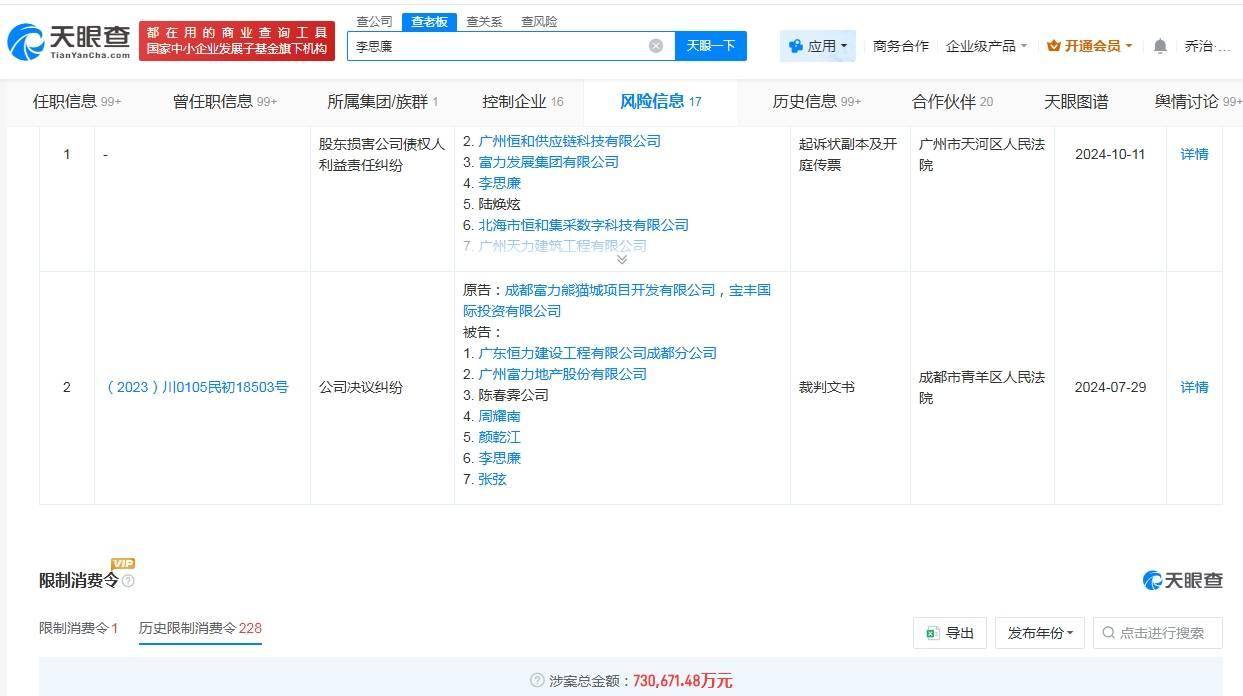
春节前后,富力地产董事长李思廉出境时被拦截! 被多地法院累计发布229次限消令, 富力地产债务逾期余额达368亿元,各种出售资产动作不断
Sou Hu Cai Jing· 2026-03-12 08:48
Group 1 - The chairman of R&F Properties, Li Siliang, was intercepted at the border due to a travel restriction imposed by the Tianjin Third Intermediate People's Court [1] - R&F Properties has been facing numerous legal challenges, including being listed as a dishonest executor and receiving 229 consumption restriction orders against Li Siliang [2] - The company has a significant overdue debt balance of 36.8 billion yuan, with various types of debts including corporate bonds and bank loans [7] Group 2 - R&F Properties has been actively selling assets to repay debts, including hotels and commercial properties, with sales occurring in multiple cities [9][10] - The company has made progress in restructuring its offshore debt, with a plan covering approximately 5 billion USD receiving creditor approval [11] - A restructuring plan for domestic bonds totaling around 12.5 billion yuan has been proposed, with some successful bond restructuring already completed [11]
Household debt is crushing Americans. Here's what to do
Yahoo Finance· 2026-03-01 10:00
Core Insights - The U.S. household debt has reached a record high of $18.8 trillion in Q4 2025, increasing by $4.6 trillion since the end of 2019, indicating significant financial strain on households [3] - Credit card balances have surged to $1.28 trillion, marking a 5.5% increase year-over-year, with the average APR at 23.77%, complicating debt repayment for consumers [2][1] - Delinquency rates across various debt types are rising, with 4.8% of outstanding debt in some stage of delinquency as of Q4 2025, a 0.3% increase from the previous quarter [5] Credit Card Debt - Outstanding credit card balances reached $1.28 trillion in Q4 2025, the highest since tracking began in 1999, reflecting a growing reliance on credit [2] - The average credit card APR is reported at 23.77%, making it increasingly difficult for consumers to manage and pay off their debts [1] Mortgage and Housing Market - Mortgage balances have climbed to nearly $13.6 trillion, with delinquencies rising across all major loan types, particularly FHA loans, which saw a delinquency rate of 11.52% in Q4 2025 [2][11] - The increase in mortgage delinquencies is concerning, especially among lower-income borrowers who are more vulnerable due to smaller down payments and thinner financial cushions [12][13] Student Loan Debt - Student loan balances have surged to $1.66 trillion, with 9.6% of borrowers seriously delinquent as of Q4 2025, largely due to the resumption of federal loan repayments [7][8] - The elimination of the Saving on a Valuable Education (SAVE) plan could potentially push an additional 17 million borrowers into default [8] Economic Implications - Consumer spending, which constitutes about 70% of U.S. GDP, may decline as households face increasing financial pressure, potentially leading to broader economic consequences [21] - Despite rising delinquency rates, experts caution against overstating systemic risks, as serious delinquency rates remain a small fraction of the overall mortgage market historically [20] Behavioral Insights - The surge in debt is not just a data issue but also a behavioral one, with financial advisors emphasizing the importance of awareness and budgeting to tackle debt effectively [15] - Strategies for debt repayment include the avalanche method, focusing on high-interest debts first, and the snowball method, which targets smaller balances to build momentum [16][17]
痛击美元霸权!全球各大央行不约而同抛售美债,美国进退两难
Sou Hu Cai Jing· 2026-02-16 06:01
Core Insights - The latest report from the U.S. Treasury reveals a significant trend of major global holders of U.S. Treasury bonds, including China, Japan, Brazil, and Switzerland, selling off their holdings, indicating a broader reduction in U.S. debt ownership among central banks worldwide [1] - China has notably reduced its U.S. Treasury holdings for six consecutive months, falling below the $1 trillion mark for the first time in 12 years [1] Group 1: Economic Implications - Continued reduction of U.S. Treasury holdings by global central banks poses a serious challenge to the credibility of the U.S. dollar, potentially increasing borrowing costs for the U.S. government and creating uncertainty for the U.S. economic recovery [3] - The total U.S. national debt has surpassed $30 trillion, exceeding 130% of the U.S. GDP, indicating a precarious financial situation that could lead to a debt default and economic crisis [5] Group 2: Contributing Factors - The aggressive interest rate hikes by the Federal Reserve have not effectively curbed inflation, leading to concerns that high interest on U.S. debt may become an unsustainable burden [5] - The freezing of Russian assets by the U.S. and its allies has undermined trust in the Western financial system, prompting countries to reduce their U.S. debt holdings [7] - Global geopolitical tensions, including the Russia-Ukraine conflict and rising tensions in the Middle East, have accelerated the trend of de-dollarization, with countries seeking alternatives to the U.S. dollar as a reserve currency [9]
萃华珠宝遭证监会立案调查,受损投资者维权开启
Xin Lang Cai Jing· 2026-02-10 08:47
Group 1 - The core issue is that Cuihua Jewelry is under investigation by the China Securities Regulatory Commission (CSRC) for suspected violations of information disclosure obligations, reflecting long-standing compliance issues within the company [1][4] - In September 2025, the Shenzhen Stock Exchange issued a regulatory letter to the company due to its failure to timely disclose guarantees totaling 200 million yuan provided to its wholly-owned subsidiary in January and April 2025 [1][4] - The delay in disclosure has raised concerns about the company's internal governance and management processes, indicating a lack of compliance awareness that could lead to significant legal risks [1][4] Group 2 - Despite a significant profit increase reported in the Q3 2025 financial statements, the company's cash flow situation is severely weak, with a nearly 60% year-on-year decrease in net cash flow from operating activities [2][5] - As of September 2025, the company's cash reserves were approximately 438 million yuan, while its total interest-bearing liabilities exceeded 2.1 billion yuan, with a high proportion of short-term loans [2][5] - The company's quick ratio is alarmingly low at 0.26, indicating substantial debt repayment pressure, and as of February 6, 2026, overdue principal loans had reached 254 million yuan, leading to the freezing of major bank accounts [2][5]

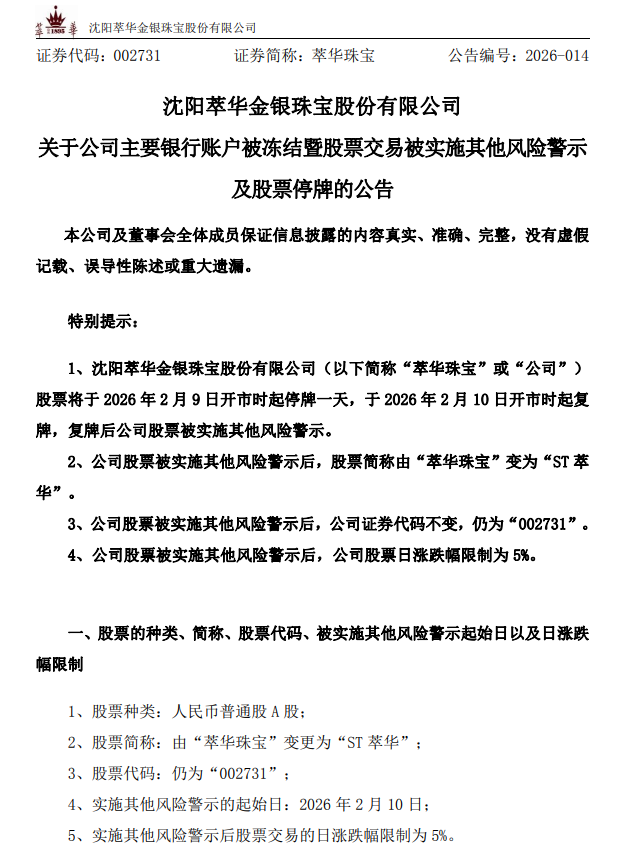
002731,主要银行账户被冻结!将被“ST”
Zhong Guo Jing Ji Wang· 2026-02-08 06:53
Core Viewpoint - Cuihua Jewelry (002731) is facing significant financial difficulties, leading to overdue loans and legal actions from multiple financial institutions, which have resulted in the freezing of the company's main bank accounts, severely impacting its operations [1][4]. Group 1: Financial Status - As of February 6, 2026, Cuihua Jewelry and its subsidiaries have overdue principal loans totaling 254 million yuan [1]. - The company has 45 frozen bank accounts, with a total frozen amount of 4.72 million yuan [4]. - The company's total liabilities have surged from 1.81 billion yuan at the end of 2022 to 4.31 billion yuan by the end of September 2025, with current liabilities exceeding 3.90 billion yuan [6]. Group 2: Stock Market Impact - Cuihua Jewelry's stock will be suspended for one day starting February 9, 2026, and will resume trading on February 10, 2026, under a risk warning, changing its name to "ST Cuihua" while keeping the same stock code [1]. - As of February 6, 2026, the stock price was 11.34 yuan per share, reflecting a 4.61% increase, with a total market capitalization of 2.91 billion yuan [6][7]. Group 3: Business Operations - The company is actively forming a specialized collection team to recover customer payments and is seeking to communicate with creditors and courts to resolve the account freezes through asset swaps [5]. - Cuihua Jewelry's main business segments include jewelry and lithium salt, with gold products accounting for 72.01% of revenue and lithium products contributing 21.73% [5].
中骏集团控股预计2026年2月票据的本金连同应计未付利息于到期日时将仍然未能偿还及将不会结清
Zhi Tong Cai Jing· 2026-02-03 08:47
Core Viewpoint - Zhongjun Group Holdings (01966) has announced a default event regarding its February 2026 notes, leading to the suspension of trading for these notes since October 5, 2023 [1] Group 1: Default and Financial Situation - The outstanding principal amount of the February 2026 notes is $350 million [1] - The company is actively seeking a comprehensive solution to ensure sustainable operations, in light of tight liquidity and ongoing communication with overseas creditors [1] - It is anticipated that the principal and accrued unpaid interest on the February 2026 notes will remain unpaid at maturity on February 4, 2026, and will not be settled [1] Group 2: Market Impact - The February 2026 notes will be delisted from the stock exchange after their maturity date [1]
中骏集团控股(01966)预计2026年2月票据的本金连同应计未付利息于到期日时将仍然未能偿还及将不会结清
智通财经网· 2026-02-03 08:44
Core Viewpoint - Zhongjun Group Holdings has announced a default event regarding its February 2026 notes, leading to the suspension of trading for these notes since October 5, 2023 [1] Group 1: Default and Financial Status - The outstanding principal amount of the February 2026 notes is $350 million [1] - The company is facing liquidity issues and is in ongoing discussions with overseas creditors to seek a comprehensive solution [1] - It is expected that the principal and accrued unpaid interest on the February 2026 notes will remain unpaid at maturity on February 4, 2026 [1] Group 2: Future Implications - The February 2026 notes will be delisted from the stock exchange after their maturity date [1]
中骏集团控股(01966.HK):2026年2月票据将于到期后在联交所除牌
Ge Long Hui· 2026-02-03 08:41
Core Viewpoint - Zhongjun Group Holdings (01966.HK) has announced a default event regarding its February 2026 notes, leading to the suspension of trading since October 5, 2023 [1] Group 1: Default and Financial Situation - The outstanding principal amount of the February 2026 notes is $350 million [1] - Due to tight liquidity and ongoing discussions with overseas creditors, the company expects that the principal and accrued unpaid interest on the February 2026 notes will remain unpaid at maturity [1] - The February 2026 notes are set to mature on February 4, 2026, after which they will be delisted from the Hong Kong Stock Exchange [1] Group 2: Communication and Solutions - The company is working with its advisors to seek an overall solution that considers the interests of all stakeholders to ensure sustainable operations [1] - Following the delisting, the company will maintain active communication with noteholders [1]
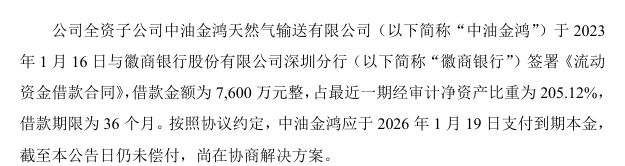
ST金鸿子公司7600万元借款逾期,占最近一期经审计净资产比重超200%
Mei Ri Jing Ji Xin Wen· 2026-01-21 12:13
Core Viewpoint - ST Jin Hong (Jin Hong Holdings) is facing significant financial pressure due to a overdue loan of 76 million yuan, which constitutes 205.12% of the company's latest audited net assets, indicating a critical liquidity issue [1][2] Financial Condition - The overdue loan of 76 million yuan exceeds the company's net assets, which were reported at 37.05 million yuan at the end of 2024 and further declined to -11.1 million yuan by the end of Q3 2025, indicating insolvency [2] - The company's debt-to-asset ratio has been increasing, reaching 86.47% at the end of 2023 and further rising to 94.06% by the end of 2024, significantly above the industry average of 46.36% as of Q3 2025 [2] - For the first three quarters of 2025, the company reported a net loss of 46.23 million yuan, although this was a 51.43% reduction year-on-year, with total revenue of 910 million yuan reflecting a 4.38% decline [2] Debt Issues - Historical debt issues remain unresolved, including the "15 Jin Hong Bond" issued in 2015, which defaulted in 2018, with some principal and interest still unpaid as of December 2025 [3] - The company has provided guarantees for its subsidiaries, accumulating a total of 1.574 billion yuan in guarantees, all of which are overdue, exacerbating liquidity pressures [3] Operational Performance - The profitability of the core business, natural gas transportation, has weakened, with an overall gross margin of only 8.02% for the first three quarters of 2025, down from 14.94% in the same period of 2024 [3] - Research and development expenditures have sharply decreased, falling by 42.05% to 3.1215 million yuan in 2024, representing only 0.24% of revenue, limiting the company's technological competitiveness [3] Industry Environment - The natural gas industry is significantly affected by energy price fluctuations and policy regulations, with ST Jin Hong, as a regional gas company, having limited bargaining power [3] - The net cash flow from operating activities was 72.94 million yuan for the first three quarters of 2025, maintaining positive inflow but down 50.94% year-on-year, indicating a declining ability to cover debts with cash flow [3] - There is a risk of entering a vicious cycle of declining revenue, worsening cash flow, and increasing debt defaults if future collections do not meet expectations [3]