
全球对等关税

Search documents
刚定下访华日程,24小时不到,特朗普王牌被废,中方发现了美国弱点
Sou Hu Cai Jing· 2026-02-27 04:33
Core Viewpoint - The article discusses the implications of a recent Supreme Court ruling that invalidated President Trump's use of the International Emergency Economic Powers Act to impose global tariffs, significantly impacting U.S.-China trade relations and Trump's negotiating power [1][3]. Group 1: U.S. Tariff Policy - The Supreme Court ruled that Trump's global tariff measures were unconstitutional, leading to the immediate cessation of these tariffs, which had generated over $160 billion in revenue [1][3]. - Following the ruling, Trump attempted to implement a new tariff policy under the Trade Act of 1974, imposing a 15% tariff on global imports, but this approach has significant limitations and requires Congressional approval for extension [3][5]. Group 2: U.S.-China Relations - The U.S. government's inability to maintain unilateral tariff measures exposes weaknesses in its internal power structure, limiting Trump's ability to exert pressure on China [5][7]. - The upcoming visit to China is driven by urgent U.S. economic needs, including agricultural exports and maintaining confidence in U.S. debt, indicating a shift towards a more cooperative dialogue with China [5][7]. Group 3: Global Trade Dynamics - The failure of unilateral tariff policies highlights the importance of mutual respect and equal negotiation in international trade, suggesting that reliance on power dynamics is ineffective [7]. - The internal turmoil within the U.S. government serves as a reminder of the fragility of global trade order and the need for stable governance and a strong economy to support international standing [7].

美高院暂缓关税裁决,市场最关注七个关键问题
Hua Er Jie Jian Wen· 2026-01-12 08:53
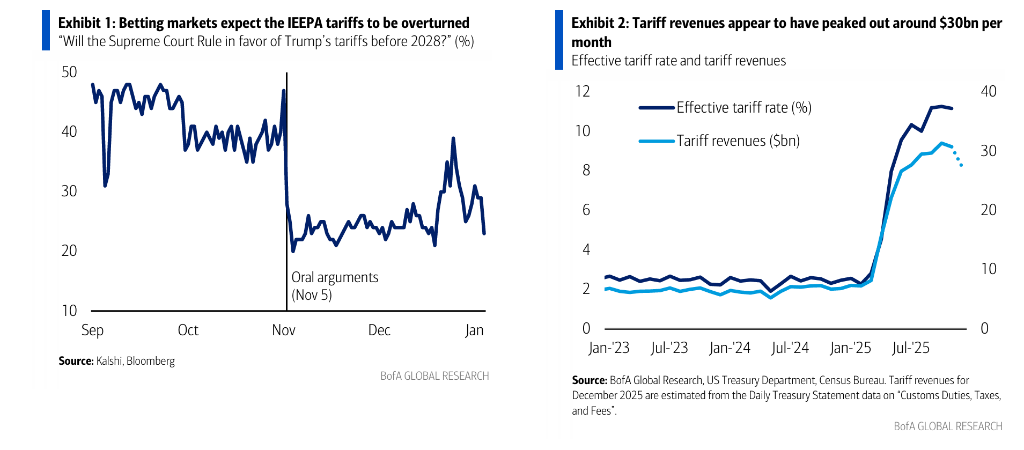
Core Viewpoint - The U.S. Supreme Court has delayed a decision on the global reciprocal tariffs imposed by the Trump administration under the International Emergency Economic Powers Act (IEEPA), leading to uncertainty in the market regarding future trade policies and their economic implications [1][2]. Group 1: Market Reactions and Expectations - The market anticipates that if the IEEPA tariffs are overturned, bond yields may rise due to concerns over fiscal deficits, while stock markets could benefit from eased profit pressures on retailers and a more relaxed fiscal stance [1][10]. - Conversely, if the tariffs are upheld, both bond yields and stock markets are expected to decline, with the market currently leaning towards the expectation of an overturn, which could lead to significant price impacts [10] Group 2: Revenue and Economic Impact - Current tariff revenues are estimated at approximately $30 billion per month, accounting for about 1.2% of GDP, with 55% to 65% of this revenue attributed to IEEPA-related tariffs [7]. - If the IEEPA tariffs are overturned, the government may resort to alternative legal provisions to recover some revenue, potentially leading to a net loss in overall tariff income of about 0.3% of GDP, equating to approximately $90 billion annually [8]. Group 3: Implications for Growth and Inflation - Regardless of the Supreme Court's ruling, trade policies are expected to support economic growth this year, with potential government actions aimed at reducing trade uncertainties and promoting more market-friendly outcomes [11]. - The short-term inflation impact may lean slightly downward, as retailers who have passed on tariff costs may hold prices steady or even reduce them, providing some room for the Federal Reserve to consider further rate cuts [11]. Group 4: Tariff Collection Discrepancies - The effective tariff rate has been lower than expected, currently at 11.2%, significantly below the theoretical rate of 14.5%, due to importers shifting towards lower-tariff products and exemptions [12]. - This discrepancy indicates that the Supreme Court's decision may have a muted impact on the market and macroeconomic conditions, as the actual revenue collected is less than anticipated [12].
中方稀土管制效果明显,美企放话:明年我们就会有所作为
Sou Hu Cai Jing· 2025-06-17 08:23
Group 1 - The article highlights the increasing pain felt by various industries due to China's rare earth export control measures, prompting foreign manufacturers to accelerate the establishment of their own rare earth supply chains [1][3] - U.S. rare earth manufacturers express confidence in their ability to make significant progress within a year, indicating a strong demand for rare earth resources that have traditionally been supplied by China [1][3] - China controls approximately 70% of global rare earth mining, 85% of refining capacity, and about 90% of rare earth metal alloys and magnet production, showcasing its monopolistic position in the global rare earth processing sector [3] Group 2 - From 2020 to 2023, 70% of U.S. rare earth compounds and metals were imported from China, highlighting the U.S. reliance on Chinese supplies and the determination to reduce this dependency [3] - Some U.S. scholars and media express skepticism about the future of the U.S. rare earth industry, suggesting that the era of U.S. dominance may be coming to an end [3][5] - The U.S. pharmaceutical industry is heavily reliant on China, with over 60% of daily medications and raw materials sourced from China, indicating a significant vulnerability in the U.S. healthcare supply chain [5][7] Group 3 - The article suggests that if the U.S. continues its policies of manufacturing repatriation and tariff threats, it may lead to a situation where American pharmaceutical companies could abandon the U.S. market, resulting in a potential shortage of medications [7] - The actions taken by the U.S. under the Trump administration are portrayed as exposing weaknesses in American hegemony, while China is advised to focus on its own development and respond appropriately to U.S. actions [7]

特朗普全球关税在美国贸易法庭面临关键考验
news flash· 2025-05-13 19:36
Core Viewpoint - A group of small businesses is urging the U.S. trade court to block the global reciprocal tariffs initiated by President Trump on April 2, which could significantly impact the Republican economic agenda [1] Group 1: Court Proceedings - The businesses and Trump's government lawyers presented arguments at the U.S. International Trade Court in Manhattan on May 13 [1] - The court, consisting of a three-judge panel, is deliberating whether to issue a nationwide injunction against these tariffs and the duration of such an injunction if granted [1] Group 2: Legal Arguments - The businesses argue that Trump invoked a false national emergency to justify the tariffs, while the Justice Department contends that the President's decision should not be subject to judicial review [1] - The panel has not yet issued a ruling, which will be announced later [1]