全球政治经济秩序重构

Search documents
“黄金狂热”到逆转的时候了吗?
美股IPO· 2025-10-18 08:40
Core Viewpoint - The recent dramatic drop in gold prices after reaching a historical high raises concerns about whether the current gold bull market, driven by both safe-haven demand and speculative fervor, has reached a critical turning point [1][3][5]. Group 1: Price Movement and Market Sentiment - Gold prices experienced a significant drop of over 2% on a single day after peaking near $4,380, marking the largest single-day decline since Thanksgiving 2024, despite a nearly 5% increase for the week [3][5]. - The price of gold has shown a notable deviation from technical benchmarks, with the current price significantly above short-term moving averages, indicating potential for a correction without jeopardizing the long-term upward trend [7][19]. - Market sentiment is extremely exuberant, as reflected by the soaring Gold Volatility Index (GVZ), which indicates a panic-driven pursuit of bullish options, suggesting that a reversal in sentiment could exacerbate price declines [11][17]. Group 2: Institutional Positioning and Technical Indicators - Institutional positioning has reached extreme levels, with commodity trading advisors (CTAs) maintaining their highest long positions in gold, which could lead to amplified sell-offs if prices reverse [13][17]. - Despite a record net inflow of $34.2 billion into gold ETFs over the past 10 weeks, the incremental buying momentum is showing signs of slowing down, indicating a potential weakening in demand [15][14]. Group 3: Divergence from Traditional Drivers - The current gold bull market is characterized by a significant divergence from traditional fundamental drivers, such as real interest rates and the strength of the US dollar, leading analysts to believe that speculative forces may have overtaken fundamental support [18][19]. - The correlation between gold prices and risk assets has become unusual, as both have risen simultaneously, contradicting traditional market behavior [18][19]. - The recent rise in gold prices has occurred despite an increase in the US dollar index and stable Japanese government bond yields, challenging conventional models that typically predict a negative correlation [19][22][23]. Group 4: Diverging Opinions on Market Outlook - A divide among analysts is emerging regarding the future of gold, with bearish views suggesting that the current enthusiasm may be unsustainable, while bullish perspectives argue that strong physical demand and geopolitical uncertainties will continue to support prices [25][26][27]. - Some analysts, like those from Morgan Stanley, suggest that the disconnect between prices and interest rates can be attributed to robust physical demand, recommending investors to buy on short-term dips [26][27].

见证历史!27万亿,大爆发!
Sou Hu Cai Jing· 2025-10-13 23:58
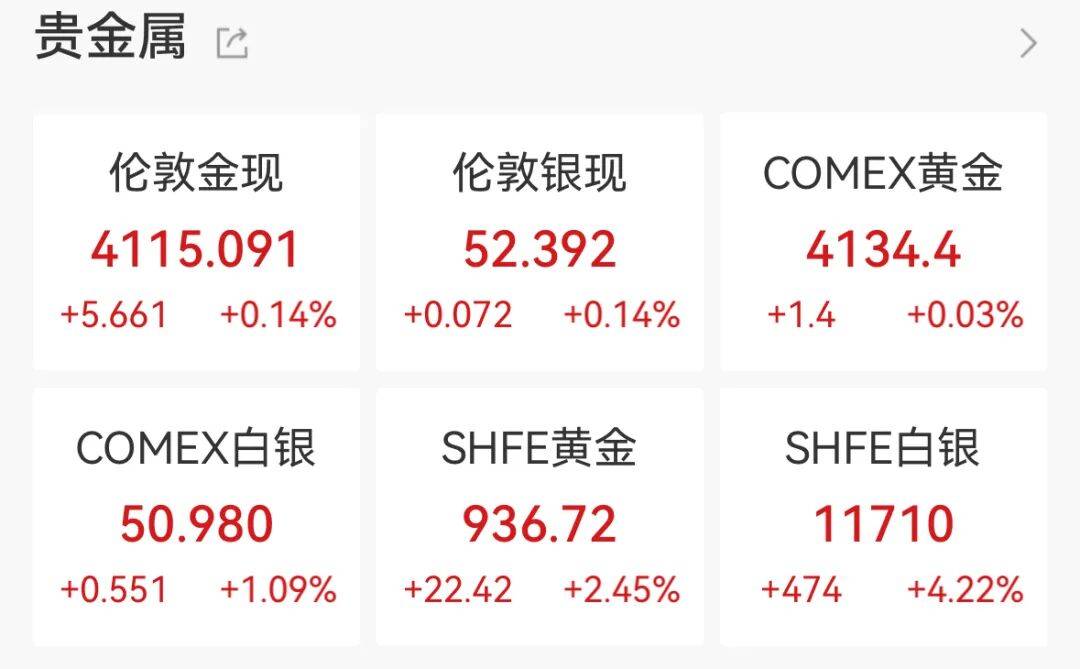
Core Viewpoint - The price of gold has surged to historic highs, driven by increased demand amid trade tensions, economic uncertainty, and expectations of interest rate cuts by the Federal Reserve [1][4]. Group 1: Gold Price Surge - On October 13, gold and silver prices reached new all-time highs, with COMEX gold futures rising by 2.6% to over $4100 per ounce [1]. - As of October 14, international gold prices continued to climb, with London gold and COMEX gold exceeding $4115 and $4130 per ounce, respectively [2]. - The total market value of the gold market has surpassed $27 trillion [1]. Group 2: Market Reactions - A-share gold concept stocks experienced significant gains, with companies like Western Gold hitting the daily limit, and others like Zhaojin Gold and Chifeng Gold also seeing substantial increases [3]. - Analysts attribute the rise in gold prices to high demand for safe-haven assets due to ongoing trade tensions and economic concerns [4]. Group 3: Future Price Predictions - Major financial institutions have raised their gold price forecasts, with UBS predicting prices will reach $4200 per ounce in the coming months, Morgan Stanley forecasting $4500 by mid-2026, and Goldman Sachs increasing its 2026 forecast from $4300 to $4900 per ounce [5]. - Yardeni Research's Ed Yardeni has set a target of $5000 per ounce by 2026, with potential to exceed $10,000 by 2030 if current trends continue [7]. Group 4: Supporting Factors for Gold Prices - Central bank purchases and inflows into gold ETFs are significant factors supporting the rise in gold prices, with central banks expected to maintain monthly purchases of 80 tons in 2025 and 70 tons in 2026 [5]. - The fear of missing out (FOMO) is influencing gold trading, complicating objective assessments of its value [8].
格林大华期货早盘提示-20251014
Ge Lin Qi Huo· 2025-10-13 23:31
Report Industry Investment Rating - The investment rating for the global economy in the macro and financial sector is "flat" [1] Core Viewpoints - The report presents a complex global economic and financial situation, with various factors influencing different markets. The U.S. economic data shows a "schizophrenic" state, and the global economic order is facing challenges. Meanwhile, China's economic indicators are positive, and the AI competition between China and the U.S. has changed the situation [1][2] Summaries by Related Catalogs Important Information - After U.S. President Trump hinted at canceling new tariffs on China on the 12th, U.S. stock index futures rose [1] - The spread between the near - month New York silver futures contract and the London silver spot reached $2.73 per ounce, a multi - year high. The one - month implied lease rate of London silver spot has risen to 40.3%, and the free - floating volume in the London silver market has dropped by 75% compared to the 2019 high [1] - The core driving force of the gold price is the market's expectation of the "order reconstruction" of the global political and economic situation, and its upward trend may not end [1] - Bridgewater Associates founder Ray Dalio warned that the rapid growth of U.S. government debt and intensifying internal and external conflicts are creating a situation "very similar" to that before World War II [1] - U.S. consumer spending and AI capital expenditure are strong, with third - quarter consumer spending growing nearly 3%, but the employment market has slowed down and the unemployment rate has risen, which poses challenges to asset pricing [1] - The era when the 10 - year U.S. Treasury yield is above 4% is coming to an end [1] - The U.S. stock bull market that started in October 2022 has reached its third anniversary, with the S&P 500 index rising 83% and its market value increasing by $28 trillion. The current valuation is at a record - high price - to - earnings ratio of 25 times [1] - The Houthi rebels said they would stop attacking Israeli and Israel - related ships in the Red Sea if Israel complies with the cease - fire agreement in the Gaza Strip [1] - Goldman Sachs has significantly raised its forecast for Alibaba's capital expenditure in the next three years to 460 billion yuan, believing that AI capital expenditure transformation is reshaping Alibaba's growth expectations [1][2] Global Economic Logic - China's September exports were $328.5 billion, with an 8.3% year - on - year increase, and imports had a 7.4% year - on - year increase, reaching a six - month high for exports and a 17 - month high for imports [2] - China's control of rare earths is a firm response to the U.S. restrictions on mature - process semiconductor equipment and materials. Interrupting the U.S. AI chip production may lead to a catastrophic decline in U.S. stocks [2] - According to the HSBC emerging markets survey, China is the preferred stock investment market. International capital is actively increasing its positions in China's technology sector [2] - Huawei's Ascend chips are leading NVIDIA in computing power. Alibaba is actively promoting 380 billion yuan of AI infrastructure construction and plans to increase investment [2] - Due to the U.S.'s continuous wrong policies, the global economy is entering the top - region [2]
见证历史!黄金大爆发,市场总市值已突破27万亿美元
Zheng Quan Shi Bao Wang· 2025-10-13 12:38
Core Viewpoint - The recent surge in gold and silver prices reflects heightened demand for these precious metals amid trade tensions, economic uncertainty, and expectations of interest rate cuts by the Federal Reserve [1][2][3] Price Movements - Gold prices reached a historic high, with COMEX gold futures rising 2.6% to a peak of $4104.3 per ounce [1][2] - Silver also saw significant gains, with prices exceeding $51.71 per ounce, marking a new record [2] Market Reactions - A-shares related to gold experienced a substantial increase, with companies like Western Gold hitting the daily limit [1][2] - Analysts attribute the rise in gold prices to ongoing concerns about U.S. government shutdowns, potential Fed rate cuts, and economic recession fears [2][3] Institutional Predictions - Major financial institutions have raised their gold price forecasts, with UBS predicting $4200 per ounce in the coming months, Morgan Stanley forecasting $4500 by mid-2026, and Goldman Sachs increasing its 2026 forecast from $4300 to $4900 [4] - Ed Yardeni anticipates gold could reach $5000 per ounce by 2026, with potential to exceed $10,000 by 2030 if current trends continue [4][5] Central Bank Activity - Central banks have significantly increased gold purchases, with a total of 415 tons bought in the first half of 2025, supporting the upward trend in gold prices [3] - The inflow into gold ETFs reached a historical high in September, further bolstering demand [3] Market Sentiment - The current market sentiment is characterized by a "fear of missing out" (FOMO), complicating objective assessments of gold's value [5] - Analysts emphasize the importance of maintaining a strategic allocation to gold, suggesting that even at record highs, it remains a prudent investment choice [5][6]




刚刚,见证历史!27万亿,大爆发!
券商中国· 2025-10-13 12:26
Core Viewpoint - The article highlights the significant surge in gold and silver prices, reaching historical highs, driven by increased demand amid economic uncertainty, trade tensions, and expectations of interest rate cuts by the Federal Reserve [1][3]. Price Surge - Gold prices have recently soared, with COMEX gold futures rising by 2.6% to surpass $4100 per ounce, reaching a peak of $4104.3 per ounce, marking a new historical high [1][3]. - Silver also experienced a substantial increase, with prices rising over 3% to a high of $51.71 per ounce, also a historical peak [3]. Market Reactions - The surge in gold prices has led to a significant rise in A-share gold concept stocks, with companies like Western Gold hitting the daily limit, and others like Zhaojin Gold and Chifeng Jilong Gold seeing substantial gains [3]. Economic Factors - Analysts attribute the rising demand for gold to several factors, including trade tensions, expectations of Federal Reserve rate cuts, and concerns over the U.S. government shutdown, which have heightened the appeal of gold as a safe-haven asset [3][4]. - UBS and other financial institutions have raised their gold price forecasts, with UBS predicting prices could reach $4200 per ounce in the coming months, and Goldman Sachs increasing its 2026 forecast from $4300 to $4900 per ounce [6]. Central Bank Activities - Central banks have been significant buyers of gold, with a total purchase of 415 tons in the first half of 2025, and record inflows into gold ETFs in September [4]. - Goldman Sachs anticipates that central bank purchases and ETF inflows will continue to support rising gold prices, contributing approximately 19% to price increases [4]. Future Predictions - Analysts predict continued upward momentum for gold prices, with forecasts suggesting potential prices of $4500 per ounce by late 2026 and even $5000 per ounce by 2026 according to Yardeni Research [6]. - The article emphasizes the importance of gold's low correlation with other assets, suggesting that its unique value in global asset allocation warrants strategic consideration [6].