
利差压缩策略

Search documents
爱无声,心陪伴,国债ETF5至10年(511020)近5个交易日净流入4932.55万元
Sou Hu Cai Jing· 2025-11-10 01:23
Group 1 - The current bond market is expected to maintain a volatile or slightly strong trend, with a flat short-end yield curve and a steep long-end yield curve structure [1] - Short-end rates are low but unlikely to rise significantly due to central bank bond purchases and liquidity, which may compress the long-end yield spread, presenting future investment opportunities [1] - The recommendation is to maintain a neutral to slightly high duration in bond portfolios, with a focus on long-end credit and specific government bonds for potential yield spread compression [1] Group 2 - As of November 7, 2025, the 5-10 year government bond ETF index has decreased by 0.05%, while the ETF has seen a 3.38% increase over the past year [2] - The trading volume for the 5-10 year government bond ETF was active, with a turnover of 111.1% and a total transaction value of 1.839 billion yuan [2] - The latest size of the 5-10 year government bond ETF reached 1.655 billion yuan, marking a six-month high [2] Group 3 - The latest share count for the 5-10 year government bond ETF reached 14.1025 million, also a six-month high, with a net inflow of 17.6062 million yuan recently [3] - Over the past five trading days, the total net inflow was 49.3255 million yuan, indicating strong investor interest [3] - The 5-10 year government bond ETF has achieved a 21.63% net value increase over the past five years, ranking in the top 17.68% among index bond funds [3] Group 4 - The maximum drawdown for the 5-10 year government bond ETF in the past six months was 1.09%, compared to a benchmark drawdown of 0.46% [4] - The management fee for the 5-10 year government bond ETF is 0.15%, and the custody fee is 0.05% [5] Group 5 - The tracking error for the 5-10 year government bond ETF over the past month was 0.025%, indicating tight tracking of the underlying index [6] - The index reflects the performance of actively traded government bonds with maturities of 5, 7, and 10 years, calculated using a non-market capitalization weighted method [6]
期货市场交易指引:2025年11月04日-20251104
Chang Jiang Qi Huo· 2025-11-04 03:24
Report Industry Investment Ratings - **Macro - Finance**: Stocks are expected to be volatile in the short - term with a long - term bullish view, and it is recommended to buy on dips; bonds are expected to oscillate [1][5]. - **Black Building Materials**: Coking coal and rebar are suitable for range trading; glass is recommended to sell call options [1][7][9]. - **Non - ferrous Metals**: Copper is in a high - level shock, suggesting to exit long positions at high levels or engage in short - term range trading; aluminum is recommended to go long on dips; nickel is recommended to wait and see or go short on rallies; tin, gold, and silver are suitable for range trading [1][11][13]. - **Energy and Chemicals**: PVC, caustic soda, styrene, rubber, urea, methanol, and polyolefins are expected to oscillate; soda ash's 01 contract has a short - selling strategy [1][22][25]. - **Cotton Textile Industry Chain**: Cotton and cotton yarn are expected to be slightly stronger in a shock; PTA is in a low - level shock; apples are expected to be slightly stronger in a shock; red dates are expected to oscillate [1][39][40]. - **Agriculture and Animal Husbandry**: Pigs' price rebounds are under pressure; eggs' price rebounds are under pressure; corn is in the process of bottom - building in a shock; soybean meal rebounds from a low level; oils are in a high - level adjustment with a pattern of weak palm oil and strong soybean oil [1][43][49]. Core Views The report comprehensively analyzes various futures markets. After events such as Sino - US trade negotiations, the release of quarterly reports, and the conclusion of important meetings, the market enters a vacuum period of performance, events, and policies, resulting in a lack of catalysts for market direction. Each sector has different supply - demand relationships, cost factors, and macro - environmental impacts, leading to different price trends and investment strategies [5]. Summary by Directory Macro - Finance - **Stocks**: After important events, the market enters a vacuum period, lacking catalysts for direction, so it will oscillate in the short - term. In the long - term, it is bullish, and it is recommended to buy on dips [5]. - **Bonds**: The current bond market environment is conducive to the spread compression strategy, but there are risks in the short - end bond pricing and institutional positions. It is recommended to maintain a balanced allocation and expect bonds to oscillate [5]. Black Building Materials - **Coking Coal**: The coal market has a pattern of tight supply and demand, with prices rising steadily. The supply of coal mines is reduced at the end of the month, and demand is improving. The price is expected to be slightly stronger in the short - term, and it is necessary to pay attention to the impact of mine production resumption on supply [8]. - **Rebar**: After the macro - events at the end of October, the black prices declined. The rebar price is at a relatively low valuation, and the demand has recovered while the inventory has decreased. It is recommended to go long on dips and focus on the range of 3000 - 3200 [8]. - **Glass**: The supply is at a high level, the downstream demand is weak, and the inventory is high. It is recommended to sell the out - of - the - money call options of the 01 contract and hold them until expiration. Consider the 05 contract after the new year [10]. Non - ferrous Metals - **Copper**: After reaching a record high, the copper price declined. Although there are long - term positive factors such as tight supply of copper concentrates and increasing demand, the short - term high price suppresses downstream demand, and the inventory has increased. It is expected to be in a high - level shock, and it is recommended to exit long positions at high levels or engage in short - term range trading [11]. - **Aluminum**: The price of bauxite is under pressure, the production capacity of alumina has decreased, and the demand for electrolytic aluminum is in the transition from peak to off - peak season. It is recommended to take profit on long positions at high levels [13]. - **Nickel**: Indonesia's new RKAB policy may lead to a more relaxed supply of nickel ore in the future. The refined nickel is in an oversupply situation, and the price of nickel iron is restricted by the downstream stainless steel market. It is recommended to wait and see or go short on rallies [18]. - **Tin**: The supply of tin ore is expected to improve, but the downstream consumption is weak. The inventory is at a medium level. It is recommended to conduct range trading and focus on the supply resumption and downstream demand [19]. - **Gold and Silver**: After the Sino - US negotiations and the Fed's interest rate cut, there are still uncertainties in the market. Supported by the expectation of interest rate cuts and risk - aversion demand, they are expected to oscillate in the short - term. It is recommended to conduct range trading and pay attention to the US ADP employment data [20][21]. Energy and Chemicals - **PVC**: The cost is at a low - profit level, the supply is high, the demand is weak, and the export growth is uncertain. It is expected to oscillate, and the 01 contract should focus on the range of 4600 - 4800 [23]. - **Caustic Soda**: Affected by the high inventory of alumina, the spot pressure is large. The supply is high in winter, and the price is expected to oscillate weakly. The 01 contract should focus on the pressure at 2400 [26]. - **Styrene**: The cost is affected by the price of crude oil and pure benzene. The supply and demand are relatively weak, and it is expected to oscillate. It is necessary to focus on the price of oil, the production and import of pure benzene, etc. [27]. - **Rubber**: The cost support is insufficient, the inventory of dark - colored rubber has increased, and the market sentiment is bearish. However, the reduction in rubber tapping due to rainfall limits the downward space. It is expected to be weakly sorted in the short - term [29]. - **Urea**: The supply decreases due to increased maintenance, the agricultural demand increases, and the port inventory decreases. The price is expected to rise slightly in the short - term, and the 01 contract should focus on the range of 1600 - 1700 [30]. - **Methanol**: The supply is affected by the maintenance of devices, the cost increases, the demand is weak, and the inventory is high. It is expected to oscillate, and the 01 contract should focus on the range of 2230 - 2330 [32]. - **Polyolefins**: The cost has a certain support, the supply increases due to new production, and the demand is mainly based on rigid needs. PE is expected to oscillate in the range, and PP is expected to be weakly oscillating. It is necessary to focus on downstream demand and the price of crude oil [34]. - **Soda Ash**: The supply is in excess, the demand is weak, and the inventory is high. It is recommended to have a short - selling strategy for the 01 contract [38]. Cotton Textile Industry Chain - **Cotton and Cotton Yarn**: According to the USDA report, the supply and demand of global cotton are both increasing, and the inventory is decreasing. With the progress of Sino - US trade negotiations and the high price of seed cotton acquisition, it is expected to be slightly stronger in a shock [39]. - **PTA**: The price of crude oil is under pressure, the supply and demand of PTA are in a state of inventory accumulation, and the price is in a low - level shock. It is necessary to focus on the range of 4400 - 4700 [39][40]. - **Apples**: The quality of apples has decreased this year, and the expected delivery cost has increased. It is expected that the price will be slightly stronger in a shock [40]. - **Red Dates**: The raw material acquisition in the production area is based on quality, and the price is expected to oscillate [41]. Agriculture and Animal Husbandry - **Pigs**: In the short - term, the pig price is oscillating. In the long - term, the supply is large before the first half of next year, and the price is under pressure. It is recommended to have a short - selling strategy for the 01, 03, and 05 contracts, and be cautious about bottom - fishing for the 07 and 09 contracts [44]. - **Eggs**: The current inventory is large, and the supply pressure will gradually ease in the future. The 12 - contract is at a premium to the spot, and it is recommended to short on rallies. The 01 contract is expected to oscillate in the range of 3250 - 3400 [46]. - **Corn**: The new grain is on the market, and the supply is sufficient. The price is under pressure in the short - term. In the long - term, the cost has support, and the demand is stable but weak. The 01 contract is expected to oscillate in the range of 2050 - 2170 [49]. - **Soybean Meal**: The expected increase in China's soybean purchases from the US has pushed up the price of US soybeans, and the cost has increased. Although the domestic supply is relatively abundant, the soybean meal price is expected to rise. It is recommended to take profit on the M2601 contract at high levels and continue to hold after a pullback [49]. - **Oils**: Palm oil is under pressure due to inventory accumulation expectations and production increase. Soybean oil is affected by the improvement of Sino - US relations and the expected increase in soybean imports. Rapeseed oil is in a situation of tight supply in the fourth quarter. It is recommended to focus on the support levels of different varieties and the spread trading strategies [52][54][55].
股指或区间震荡,债市或震荡运行
Chang Jiang Qi Huo· 2025-11-03 06:10
Report Summary 1. Report Industry Investment Rating No relevant information provided. 2. Core Views - After the China-US trade negotiations, third-quarter reports, and the Fourth Plenary Session, the market enters a vacuum period of performance, events, and policies, lacking catalysts for direction. It is expected to enter a period of oscillation to await new changes at the end of the year. In November, the market style is expected to rebalance and may return to a barbell structure. The stock index is expected to oscillate, and the MACD indicator shows that the market index may oscillate weakly [11]. - The current bond market environment is still conducive to the evolution of the spread compression strategy. However, there are still certain risks in the pricing of short-term treasury bonds being excessively lower than the policy rate and the recent increase in institutional position congestion. It is recommended to maintain a balanced allocation mindset and avoid excessive expectations for unilateral market trends. Treasury bonds are expected to oscillate, and the MACD indicator shows that the T main contract may oscillate strongly [13]. 3. Summary by Directory 3.1 Financial Futures Strategy Recommendations 3.1.1 Stock Index Strategy Recommendations - **Strategy Outlook**: The stock index is expected to oscillate within a range [10]. - **Stock Index Trend Review**: Most stocks rose, with over 3,700 stocks in the Shanghai, Shenzhen, and Beijing stock markets rising. The total market turnover was 2.35 trillion yuan, and the turnover of the Shanghai and Shenzhen stock markets was 2.32 trillion yuan, a decrease of over 100 billion yuan from the previous trading day [11]. - **Core View**: After the end of relevant events, the market enters a vacuum period, lacking catalysts for direction, and is expected to oscillate. The market style in November is expected to rebalance and may return to a barbell structure. The stock index is expected to oscillate [11]. - **Technical Analysis**: The MACD indicator shows that the market index may oscillate weakly [11]. 3.1.2 Treasury Bond Strategy Recommendations - **Treasury Bond Trend Review**: The 30-year main contract rose 0.42%, the 10-year main contract rose 0.04%, the 5-year main contract fell 0.01%, and the 2-year main contract fell 0.02% [13]. - **Core View**: The current bond market environment is conducive to the spread compression strategy, but there are risks in short-term treasury bond pricing and institutional position congestion. It is recommended to maintain a balanced allocation. Treasury bonds are expected to oscillate [13]. - **Technical Analysis**: The MACD indicator shows that the T main contract may oscillate strongly [13]. - **Strategy Outlook**: Treasury bonds are expected to oscillate [13]. 3.2 Key Data Tracking 3.2.1 PMI - In October, the manufacturing PMI fell to 49.0%, lower than the consensus expectations of Bloomberg and Reuters. Seasonally, it fell more significantly than usual, and the absolute value was the lowest in the same period since 2013. The PMI of large enterprises also fell to 49.9%, returning to the contraction range [20]. 3.2.2 CPI - In September, the year-on-year change in the consumer price index was -0.3%, and the month-on-month change was +0.1%. The year-on-year change in the producer price index for industrial products was -2.3%, and the month-on-month change was flat. The CPI year-on-year remains negative, the year-on-year increase in the core CPI expands, gold jewelry and services are the main support for the CPI year-on-year, the year-on-year decline in the PPI narrows, and the month-on-month change is flat [23]. 3.2.3 Import and Export - In September, China's exports were $328.57 billion, imports were $238.12 billion, and the trade surplus was $90.45 billion. The significant rebound in export growth in September was mainly due to the base effect and seasonal factors. The two-year average growth rate continued to decline, and the month-on-month growth rate was weaker than the average from 2018 - 2023, indicating that the export performance in September was not as strong [24][25]. 3.2.4 Industrial Enterprise Profits - In August, both the profit growth rate and revenue growth rate rebounded. From January to August, the year-on-year growth rate of industrial enterprise profits rebounded to 0.9%. In August, the year-on-year growth rate of industrial enterprise profits rebounded rapidly to 20.4%, with a marginal increase of 21.9%. In August, industrial enterprise revenue increased by 1.9% year-on-year, with a marginal increase of 1.0%. The increase in profit growth rate may be related to the recognition of investment income [29]. - Structurally, the rebound in profit growth in August may be due to the concentrated recognition of state-owned enterprise investment income and the effectiveness of the "anti-involution" policy. From the perspective of revenue, the year-on-year growth rate of upstream manufacturing industries rebounded, while that of midstream and downstream industries declined, reflecting the impact of the "anti-involution" policy [32]. - At the end of August, the nominal year-on-year growth rate of industrial enterprise finished product inventory fell by 0.1% to 2.3%, and the real inventory year-on-year growth rate fell by 0.9% to 5.4%. The de-stocking of real inventory was faster under the influence of the accelerated convergence of the PPI. The inventory turnover days remained the same as the previous period, and the accounts receivable turnover days increased slightly, indicating high operating pressure on enterprises [35]. 3.2.5 Industrial Added Value - In August, the production intensity declined, and the production slowdown in downstream industries was obvious. The year-on-year growth rate of industrial added value fell to 5.2%, and the year-on-year growth rate of the service production index fell to 5.6%. The year-on-year growth rate of export delivery value turned negative for the first time since 2024, confirming the differentiation of mid - level production data [38]. 3.2.6 Fixed Asset Investment - In August, the growth rate of fixed asset investment continued to decline. The estimated single - month year-on-year growth rate of fixed asset investment fell to -6.3%, and the central value of the single - month year-on-year growth rate of private investment fell to -7.1%. The year-on-year growth rates of manufacturing investment, infrastructure investment, and real estate investment all declined [41]. 3.2.7 Social Retail Sales - In August, the year-on-year growth rate of social retail sales fell to 3.4%, and the year-on-year growth rate of retail sales above the designated size fell to 2.4%. The narrowing of national subsidy channels and the overdraft effect of durable goods consumption led to a lack of upward momentum in consumption. The three major national subsidy categories still contributed about 40% of social retail sales growth, indicating slow growth in other consumption categories [44]. 3.2.8 Social Financing - In September, the new social financing was 3.5 trillion yuan, a year-on-year decrease of 0.2 trillion yuan. The year-on-year growth rate of social financing stock fell to 8.7%, and after excluding government bonds, it remained flat at 5.9%. The growth rate of credit in the social financing caliber fell to 6.4%. The year-on-year decrease in social financing was mainly dragged down by government bonds and credit. The year-on-year growth of medium - and long - term household loans turned positive, but the year-on-year growth of medium - and long - term corporate loans was still lower. The M1 growth rate continued to rise, and the year-on-year growth of non - bank deposits turned negative [47].
国开债券ETF(159651):一键布局3Y以内银行间国开债
Sou Hu Cai Jing· 2025-10-23 01:52
Group 1 - The current sentiment in the bond market is favorable, with a recommendation to focus on spread compression strategies, particularly in non-active long-term bonds and 5-year bonds [1] - The 10-year National Development Bank (NDB) bond - government bond spread has decreased to around 14 basis points, and this trend is expected to continue, influenced by new redemption fee regulations [1] - The liquidity and riding value of 5-7 year bonds are highlighted as attractive, while the 30-year bond market is experiencing fluctuations due to the liquidity of the new 25T6 bond [1] Group 2 - As of October 22, 2025, the NDB bond ETF has seen a 1.55% increase over the past year, with a current price of 106.43 yuan [1] - The NDB bond ETF has a net value increase of 0.57% over the past six months, ranking 72 out of 490 in the index bond fund category, placing it in the top 14.69% [2] - The NDB bond ETF has the lowest management fee rate of 0.15% and a custody fee rate of 0.05% among comparable funds [3] Group 3 - The NDB bond ETF has demonstrated strong performance with a historical annual profit percentage of 100% and a monthly profit probability of 87.67% [2] - The maximum drawdown for the NDB bond ETF in the last six months is 0.12%, which is the smallest among comparable funds [2] - The tracking error for the NDB bond ETF over the last two months is 0.014%, indicating the highest tracking precision among similar funds [3]
国债ETF5至10年(511020):岁月静好,为您守护
Sou Hu Cai Jing· 2025-10-23 01:52
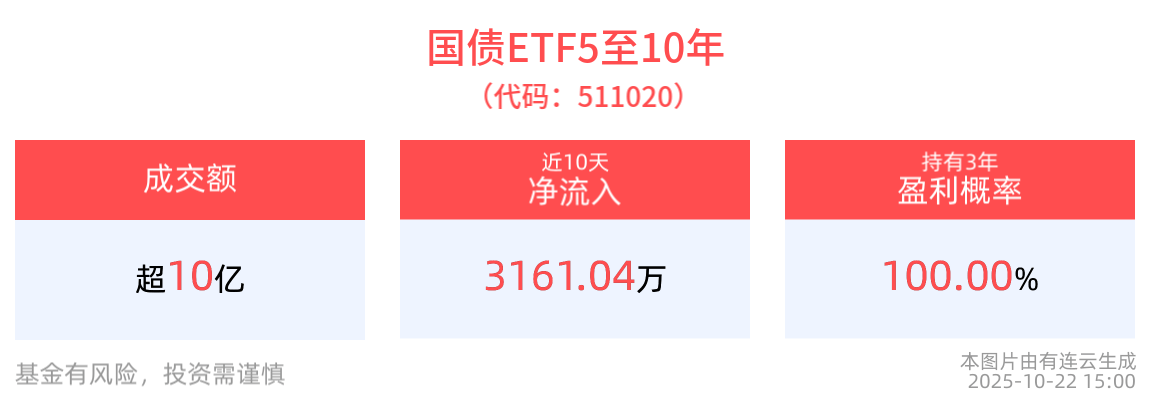
Group 1 - The current 10-year government bond and policy bank bond spread has decreased to around 14 basis points, indicating a potential for further compression in the context of market preferences for spread compression strategies [1] - The liquidity and riding value of 5-7 year bonds are highlighted as favorable for mid to long-term investments, while the 30-year government bond is experiencing frequent changes in the main trading bond due to its relatively good liquidity [1] - The 30-year old bonds and 50-year government bonds are recommended for trading, especially for those with strong liquidity demands [1] Group 2 - As of October 22, 2025, the 5-10 year government bond ETF index has increased by 0.02%, with a cumulative increase of 3.36% over the past year [3] - The trading volume for the 5-10 year government bond ETF is active, with a turnover rate of 70.64% and a total transaction value of 1.089 billion yuan [4] - The 5-10 year government bond ETF has a total scale of 1.541 billion yuan, with a net value increase of 21.31% over the past five years, ranking 34 out of 179 in the index bond fund category [4] Group 3 - The management fee for the 5-10 year government bond ETF is 0.15%, and the custody fee is 0.05% [5] - The tracking error for the 5-10 year government bond ETF over the past month is 0.027%, indicating a close tracking of the underlying index [6] - The index consists of actively traded government bonds with maturities of 5, 7, and 10 years, calculated using a non-market capitalization weighted method [6]

国开债券ETF(159651:让财富,稳中求进
Sou Hu Cai Jing· 2025-10-15 01:51
Core Viewpoint - The sentiment in the bond market is stronger compared to the third quarter, with more market participants not bearish, indicating that interest rates can continue to trade with a strong oscillating trend, focusing on the strategy of interest rate spread compression [1] Group 1: Market Performance - As of October 15, 2025, the National Development Bank bond ETF (159651) is in a state of equilibrium, with the latest quote at 106.43 yuan. Over the past year, as of October 14, 2025, the ETF has accumulated a rise of 1.57% [1] - The liquidity of the National Development Bank bond ETF shows a turnover of 0% during the trading day, with a total transaction value of 0.00 yuan. The average daily transaction value over the past year, as of October 14, 2025, is 443 million yuan [1] - The National Development Bank bond ETF has seen a net value increase of 0.55% over the past six months, ranking 55 out of 486 in the index bond fund category, placing it in the top 11.32% [1] Group 2: Return and Risk Metrics - The ETF has the longest consecutive monthly increase of 15 months since its inception, with the highest monthly increase of 3.90%. The win-loss ratio for months is 31 to 5, with an annual profit percentage of 100.00% and a monthly profit probability of 87.57%. The historical probability of profit over three years is also 100.00% [1] - As of October 14, 2025, the maximum drawdown for the ETF in the past six months is 0.12%, which is the smallest drawdown among comparable funds, with a recovery period of 8 days after the drawdown [2] - The management fee rate for the ETF is 0.15%, and the custody fee rate is 0.05%, making it the lowest fee among comparable funds [2] Group 3: Tracking Precision - As of October 14, 2025, the tracking error for the ETF over the past six months is 0.014%, which is the highest tracking precision among comparable funds [2] - The ETF closely tracks the China Bond - 0-3 Year National Development Bank Bond Index, which includes policy bank bonds issued by the National Development Bank with a maturity of up to 3 years, serving as a performance benchmark for this type of bond investment [2]