卢比国际化

Search documents
“今年亚洲表现最糟糕的货币”,印度卢比怎么了?
Sou Hu Cai Jing· 2025-12-27 14:07
Core Viewpoint - The Indian Rupee has been identified as the worst-performing currency in Asia for the year, with a depreciation of 5.5% against the US dollar, reaching a historical low, raising concerns about Prime Minister Modi's dream of "Rupee internationalization" [1][2]. Group 1: Economic Challenges - The direct cause of the Rupee's pressure is the US tariff policy, which includes a proposed 50% tariff on all Indian goods starting August 27, leading to a loss of confidence in the Indian market [2][4]. - According to Citigroup, the tariffs could reduce India's GDP growth rate by 0.6 to 0.8 percentage points, while Morgan Stanley reports that the MSCI India index has underperformed the MSCI Emerging Markets index for four consecutive months, lagging by over 15% this year [4]. - The Reserve Bank of India's tightening policies have exacerbated the Rupee's situation, with four interest rate cuts totaling 125 basis points this year, reflecting a weak overall economic environment [4][5]. Group 2: Capital Outflow and Investment - India is facing significant capital outflow pressures, with net foreign direct investment (FDI) for the fiscal year 2024/2025 plummeting by 96.5% from $10 billion to $35.3 million, marking a historical low [5]. - This capital outflow creates a vicious cycle where economic stagnation leads to further interest rate cuts, which in turn causes additional Rupee depreciation [5]. Group 3: Structural Issues in the Economy - Experts suggest that India's economic stagnation is a long-term issue rooted in structural contradictions, including high unemployment, poor income growth prospects, and monopolistic market conditions [8]. - The IT sector, once a source of pride for India, is now facing challenges due to its reliance on low-end outsourcing, with the manufacturing sector contributing only 13% to GDP, far below the 25% target [9][11]. - The recent announcement by Tata Consultancy Services (TCS) to lay off 12,000 employees highlights the structural deficiencies in India's economy, particularly in adapting to the AI technology wave [11]. Group 4: Geopolitical Factors - The "Rupee settlement mechanism" with Russia, initiated to facilitate oil imports amidst Western sanctions, initially appeared to be a milestone for Rupee internationalization but has faced significant challenges due to low liquidity in the international market [12][14]. - The Russian Foreign Minister's comments on the inability to utilize Rupees effectively indicate the lack of economic stability and international credibility supporting India's ambitions for Rupee internationalization [14].

南柯一梦叹卢比
Sou Hu Cai Jing· 2025-12-26 23:13
Group 1 - The Indian Rupee has depreciated by 5.5% this year, reaching a historical low against the US dollar, making it the worst-performing currency in Asia and among the worst globally [1][2] - The US tariff policy, which imposes a 50% tariff on all Indian goods, is a direct cause of the pressure on the Rupee, potentially lowering India's GDP growth rate by 0.6% to 0.8% [2] - The Indian economy is facing multiple risks, including a widening trade deficit, leading the central bank to adopt a loose monetary policy, which further weakens the Rupee [2][3] Group 2 - Foreign direct investment (FDI) in India is projected to plummet by 96.5% in the 2024/2025 fiscal year, exacerbating the depreciation of the Rupee [3] - The "impossible trinity" theory suggests that India cannot simultaneously achieve monetary policy independence, exchange rate stability, and capital mobility, leading to difficult policy choices [3][4] - Structural issues in the Indian economy, such as high unemployment and low income growth, are long-term challenges that require adjustments in industrial structure rather than relying solely on monetary policy [4] Group 3 - India's IT industry, which once thrived due to its cost-effective labor, is now facing challenges, including a significant layoff announcement from Tata Consultancy Services, indicating a mismatch between industry needs and workforce skills [5][7] - The "service-first" model has led to a dependency on outsourcing, limiting the growth of the manufacturing sector, which currently accounts for only 13% of GDP, far below the target of 25% [6] - The recent increase in oil imports from Russia, facilitated by a Rupee settlement mechanism, has led to a trade surplus for Russia, but the low liquidity of the Rupee in international markets has caused issues, undermining the goal of Rupee internationalization [7][8]
印度突然反水!向特朗普承诺断购俄石油后,6000万桶原油却还在运
Sou Hu Cai Jing· 2025-10-18 14:55
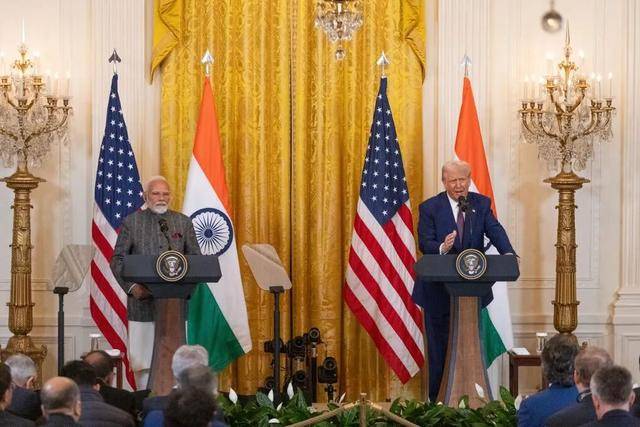
Core Viewpoint - The article discusses the conflicting narratives between the U.S. and India regarding India's purchase of Russian oil, highlighting India's strategic position between U.S. pressure and its reliance on discounted Russian oil amidst geopolitical tensions [1][3][25]. Group 1: U.S.-India Relations - Trump claimed that Indian Prime Minister Modi promised to stop buying Russian oil after a certain grace period, but the Indian Foreign Ministry denied any such conversation took place [1][3]. - The U.S. is India's largest trading partner, with a trade volume of $128.8 billion in 2024, and India has a trade surplus of $45.8 billion with the U.S. [9]. - Trump threatened to increase tariffs on Indian goods from 25% to 50% if India did not cease its Russian oil purchases, which would severely impact India's textile and electronics industries [11]. Group 2: India's Oil Dependency - Prior to the Ukraine conflict, Russian oil accounted for less than 3% of India's imports, but this figure surged to 39% by 2025 due to discounted prices [5][7]. - In 2024, India saved $5 billion by purchasing Russian oil at prices 15% lower than international rates, and it has also been reselling processed Russian oil to sanctioned European countries [7][9]. Group 3: Currency and Trade Dynamics - Russia has shifted to using the Chinese yuan for oil trade settlements due to Western sanctions, which poses challenges for India as it has been trying to internationalize the Indian rupee [13][15]. - The yuan's stability and convertibility have made it an attractive option for Russia, while the Indian rupee's lack of free convertibility limits its utility in international trade [15]. Group 4: Geopolitical Implications - The article suggests that India's dual approach of publicly denying U.S. claims while continuing to import Russian oil reflects its historical diplomatic strategy of balancing relations between major powers [19][25]. - The ongoing situation has implications for the global oil market, as it may lead to a shift away from the dollar in oil transactions, with more countries considering the yuan as a viable alternative [25].
印度银行向尼泊尔居民开放卢比贷款
Shang Wu Bu Wang Zhan· 2025-10-11 05:50
Core Viewpoint - The Reserve Bank of India (RBI) has announced a new policy allowing residents of Nepal, Bhutan, and Sri Lanka to directly obtain loans in Indian Rupees through Indian banks and their overseas branches, aiming to promote the internationalization of the Rupee and reduce dependence on the US dollar while facilitating cross-border trade settlements in South Asia [1] Group 1: Policy Implications - The policy is expected to provide easier access to financing for small and medium-sized enterprises (SMEs) in Nepal, especially during periods of domestic credit tightening [1] - However, economists warn that this could lead to an increase in imports from India, exacerbating Nepal's existing significant trade deficit [1] Group 2: Financial Sector Impact - The loan business of domestic banks in Nepal may be adversely affected, posing challenges to the country's financial independence and foreign exchange reserve management [1] - The Nepal Rastra Bank (NRB) is aware of the new policy and is currently assessing its potential impacts, with plans to develop corresponding regulatory measures in response [1]
金砖出现杂音,印度开首枪后,普京也不反美元,中国加速增持黄金
Sou Hu Cai Jing· 2025-10-07 04:34
Core Viewpoint - The BRICS nations are experiencing internal disagreements regarding "de-dollarization," particularly between India and Russia, which poses challenges to their cooperation [1] Group 1: India's Position - India was one of the first BRICS countries to express reluctance towards aggressively pursuing "de-dollarization" [4] - In 2025, India's Foreign Minister stated that India does not intend to undermine the dollar's status but aims to promote the rupee as an international currency [4] - The effectiveness of India's policy allowing international settlements in rupees has been limited, with less than 10% of external trade settled in rupees by August 2025 [4] Group 2: Russia's Attitude Shift - Russia was previously a strong advocate for "de-dollarization," significantly reducing the dollar's share in its foreign exchange reserves after the 2014 Crimea crisis [5] - In October 2025, Putin indicated that Russia does not plan to be "anti-dollar," suggesting that previous efforts were driven by U.S. sanctions rather than voluntary choice [5] - Russia's need to price oil in dollars and the challenges of settling trade with India in rupees have led to a more pragmatic approach [5][8] Group 3: China's Stable Strategy - Unlike India and Russia, China has maintained a stable strategy by increasing gold reserves and promoting digital currency [10] - As of August 2025, China's gold reserves reached 74.02 million ounces, the highest on record, aimed at diversifying away from dollar assets [10] - China is also advancing the "BRICS Digital Currency Bridge" project to facilitate cross-border payments and reduce reliance on the dollar [11] Group 4: Underlying Reasons for Disagreements - The differing positions on "de-dollarization" among BRICS nations stem from their unique national interests [13] - India seeks to internationalize the rupee without antagonizing the U.S., which is crucial for its IT and agricultural exports [13] - Russia's compromise is influenced by U.S. sanctions, while China leverages its strong economic foundation to gradually promote the internationalization of the renminbi [13] Group 5: Future Outlook - Despite differing attitudes towards "de-dollarization," cooperation among BRICS countries continues [16] - Each country may adopt distinct strategies based on their circumstances, with India likely to pursue rupee settlements while relying on the dollar [16] - The BRICS New Development Bank plans to issue $5 billion in green bonds in 2025, denominated in renminbi and euros, as a compromise to avoid direct confrontation with the dollar [19]