
可支配收入

Search documents
中金:八问八答,透视居民消费率
中金点睛· 2026-03-08 23:36
Core Viewpoint - The article emphasizes the need to increase China's resident consumption rate, which has been persistently lower than the international average, as a key focus of current economic policy aimed at boosting domestic demand and achieving a balanced economy [2][6]. Group 1: Characteristics of Low Consumption Rate - China's resident consumption rate was 39.9% in 2024, significantly below the average of 52.8% among 44 sample economies [6][8]. - The consumption rate has shown a slight upward trend since 2011, aligning with the U-shaped pattern observed in international experiences, but this trend has not been sustained in recent years [8][6]. Group 2: Causes of Low Consumption Rate - Public service subsidies are identified as a primary reason for the low consumption rate, with China's social transfer payments accounting for only 7.0% of GDP in 2023, compared to 12.5% for the sample average [10][9]. - Price differences, particularly low prices in China, do not significantly explain the low consumption rate, as adjustments for purchasing power parity (PPP) only marginally increase the consumption rate to 42.0% [13][12]. - Statistical methods, such as the change from historical cost to virtual rent for housing, have only slightly improved the consumption rate, indicating that measurement issues are not the main cause [20][19]. Group 3: Disposable Income and Consumption Rate Discrepancies - The share of disposable income in GDP is relatively high at 60.8% in 2023, but the initial distribution of income is low, with labor compensation and property income being insufficient [37][25]. - The property income share is particularly low at 3.2%, with dividend income at only 0.5%, indicating a need for policies to enhance wealth distribution [33][32]. Group 4: Structural Reasons for Low Consumption Rate - The allocation of public resources has favored investment over consumption, leading to an imbalance in demand and supply [59][60]. - Income inequality and demographic changes, such as an aging population and low birth rates, further suppress consumption potential [63][62]. Group 5: Policy Recommendations for Increasing Consumption Rate - Policies should focus on both cyclical and structural aspects, enhancing consumer capacity and willingness, and aligning supply-side and demand-side strategies [69][68]. - Specific measures include increasing fiscal and monetary support, optimizing public resource allocation, and improving social security systems to boost consumer confidence and spending [70][69].


FT中文网精选——高净值家庭的代际困境:如何不被“斩杀”
日经中文网· 2026-01-12 03:15
Group 1 - The article discusses the concept of "slaughter line" and its implications for high-net-worth families, suggesting that while they may not face absolute "slaughter," they are more likely to experience downgrades or declines [6] - It emphasizes the importance of free cash flow for both companies and individuals, indicating that it is essential for sustainable development and necessary expenditures [6] - The term "slaughter line" is essentially equated to the free cash flow of a business or the disposable income of an individual, highlighting its critical role in maintaining ongoing operations and living standards [6]

2025年前三季度居民收入和消费支出情况
Guo Jia Tong Ji Ju· 2025-10-20 02:01
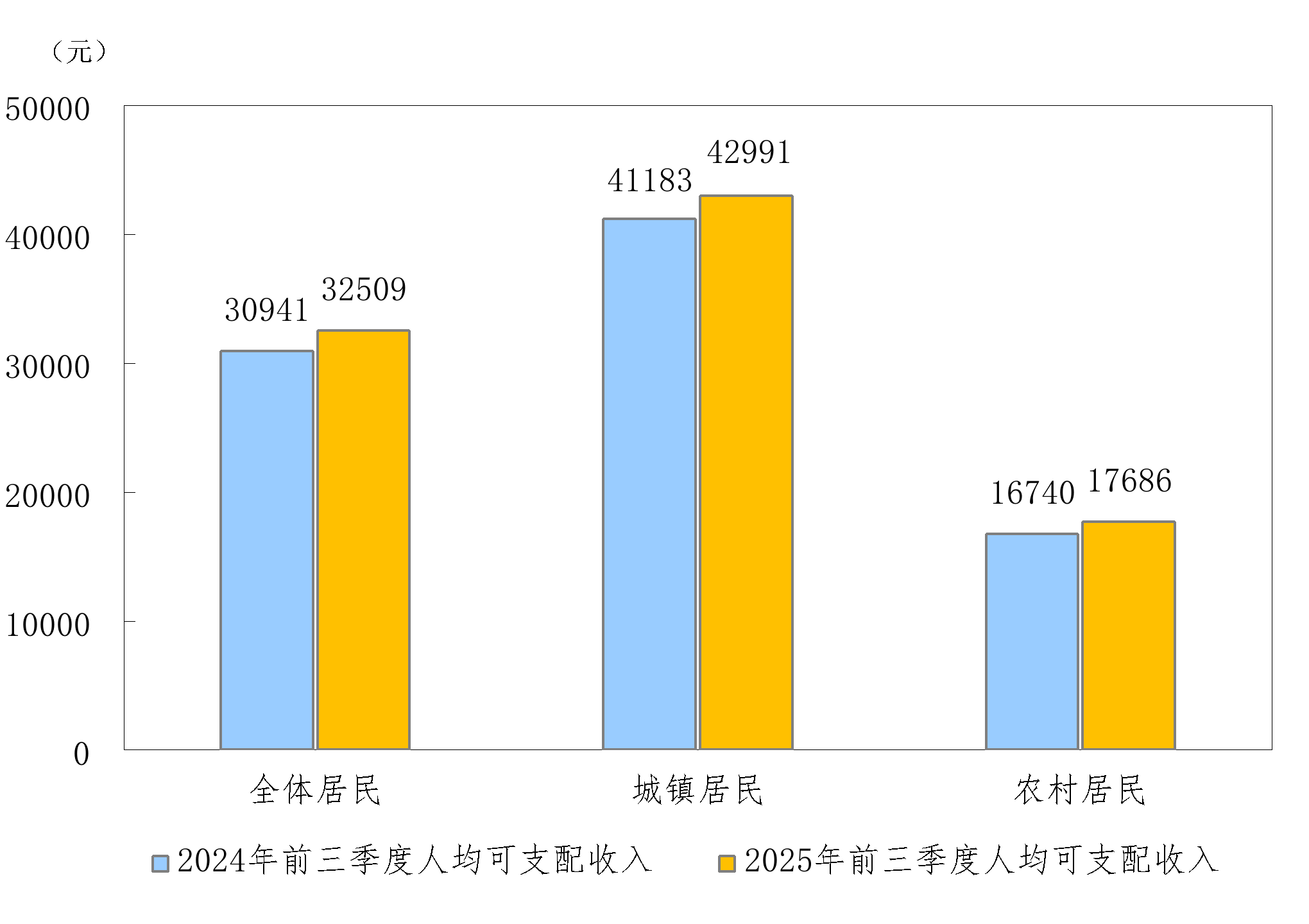
Income Situation - In the first three quarters, the national per capita disposable income reached 32,509 yuan, a nominal increase of 5.1% year-on-year, and a real increase of 5.2% after adjusting for price factors [1][7] - Urban residents had a per capita disposable income of 42,991 yuan, growing by 4.4% nominally and 4.5% in real terms, while rural residents saw a per capita disposable income of 17,686 yuan, with a nominal growth of 5.7% and a real growth of 6.0% [1][7] - The per capita wage income was 18,659 yuan, up 5.4%, accounting for 57.4% of disposable income, while per capita operating income was 5,199 yuan, up 5.3%, making up 16.0% of disposable income [1][7] - The median per capita disposable income was 27,149 yuan, a growth of 4.5%, with urban median income at 38,224 yuan (3.9% growth) and rural median income at 15,036 yuan (5.1% growth) [1][7][9] Consumption Expenditure Situation - The national per capita consumption expenditure was 21,575 yuan, with a nominal increase of 4.6% and a real increase of 4.7% [4][8] - Urban residents had a per capita consumption expenditure of 26,510 yuan, growing by 3.8% nominally and 3.9% in real terms, while rural residents had a per capita consumption expenditure of 14,597 yuan, with a nominal growth of 5.5% and a real growth of 5.8% [4][8] - Per capita expenditure on food, tobacco, and alcohol was 6,359 yuan, growing by 2.5%, accounting for 29.5% of total consumption expenditure [5][8] - Significant growth was observed in education, culture, and entertainment expenditure, which increased by 10.3%, and in transportation and communication expenditure, which rose by 8.3% [5][8]
四个关系看居民工资
一瑜中的· 2025-06-16 12:47
Group 1 - The article focuses on the analysis of residents' wages in China, highlighting the dependence of disposable income on wages, the wage growth rates among different demographics, the distribution of total wages across industries, and the comparison of wage growth with transfer payments [2][3][4][5][6][8][24]. Group 2 - In 2024, the national per capita disposable income is projected to be 41,314 yuan, with per capita wage income at 23,327 yuan, indicating that wages account for 56.5% of disposable income, which is historically high [3][11]. - The wage growth rate for urban residents in 2024 is 5.04%, while rural residents experience a higher growth rate of 6.94%, surpassing GDP growth [4][15]. - Non-private sector wage growth is higher than that of private sectors, with average wage growth rates of 2.8% for non-private and 1.7% for private sectors in 2024 [5][18]. - The total wage amount for urban non-private units is estimated at 20.53 trillion yuan in 2024, with stable trends in government service sectors and a decline in the share of "old economy" sectors like construction and finance [7][23][24]. Group 3 - Wage growth rates are compared with transfer payments, showing that from 2023 to 2024, wage growth outpaces personal income tax growth, but in the first quarter of 2025, wage growth is expected to fall below that of personal income tax [8][26]. - The growth rate of housing provident fund contributions is higher than wage growth, with the provident fund amounting to 36,317.83 billion yuan in 2024, reflecting a 4.67% increase [30][27].

【每周经济观察】四个关系看居民工资-20250616
Huachuang Securities· 2025-06-16 09:27
Income Distribution - In 2024, the national per capita disposable income is 41,314 yuan, with per capita wage income at 23,327 yuan, making the share of wage income in disposable income 56.5%[3] - By the first quarter of 2025, this share is projected to rise to 57.3%, indicating a historical high since 2013[14] Wage Growth Analysis - Urban residents' wage income growth in 2024 is 5.04%, aligning with GDP growth, while rural residents see a higher growth rate of 6.94%[22] - For the first quarter of 2025, rural wage growth is expected to be 6.71%, surpassing the GDP growth of 5.4%, whereas urban wage growth is slightly lower at 5.16%[22] Sector Comparison - In 2024, average annual wages for urban non-private sector employees are 124,110 yuan, while private sector employees earn an average of 69,476 yuan[27] - Wage growth for urban private sector employees is 1.7%, compared to 2.8% for non-private sector employees in 2024[28] Industry Wage Trends - The top three industries for wage levels in 2023 were mining, construction, and finance, while in 2024, they are agriculture, utilities, and construction[30] - The total wage amount for urban non-private units in 2024 is projected to be 20.53 trillion yuan, with stable proportions in government service sectors[34] Tax and Contribution Comparisons - Personal income tax growth from 2023 to 2024 is lower than wage income growth, with a tax growth of 7.1% in Q1 2025, exceeding wage growth of 5.9%[39] - Housing fund contributions are growing faster than wage income, with a reported increase of 4.67% in 2024 compared to a 4.04% growth in urban non-private wages[43]
每周经济观察第23期:四个关系看居民工资-20250616
Huachuang Securities· 2025-06-16 04:41
Group 1: Income Dependency on Wages - In 2024, the national per capita disposable income is 41,314 CNY, with per capita wage income at 23,327 CNY, making the wage income share 56.5% of disposable income[3] - By Q1 2025, this share increased to 57.3%, indicating a historical high since 2013[3] Group 2: Wage Growth by Demographics - Urban residents' wage growth in 2024 is 5.04%, aligning with GDP growth, while rural residents see a higher growth rate of 6.94%[4] - In Q1 2025, rural wage growth remains above GDP at 6.71%, while urban growth is slightly lower at 5.16%[4] Group 3: Wage Growth by Employment Type - In 2024, average wage growth for urban private sector employees is 1.7%, compared to 2.8% for non-private sector employees[5][23] Group 4: Wage Distribution Across Industries - In 2024, the total wage amount for urban non-private units is 20.53 trillion CNY[7] - The share of wages in government service industries remains stable at around 35.6% in 2023, while the "old economy" sectors' share has declined from 18.9% in 2019 to 16.4% in 2023[7][29] Group 5: Wage Growth vs. Transfer Payments - Wage growth from 2023 to 2024 outpaces personal income tax growth, but in Q1 2025, wage growth (5.9%) is lower than personal income tax growth (7.1%)[8][32] - Housing fund contributions are growing faster than wage growth, with a 4.67% increase in contributions in 2024 compared to a 4.04% wage growth for urban non-private units[8][37]