品牌信任度

Search documents
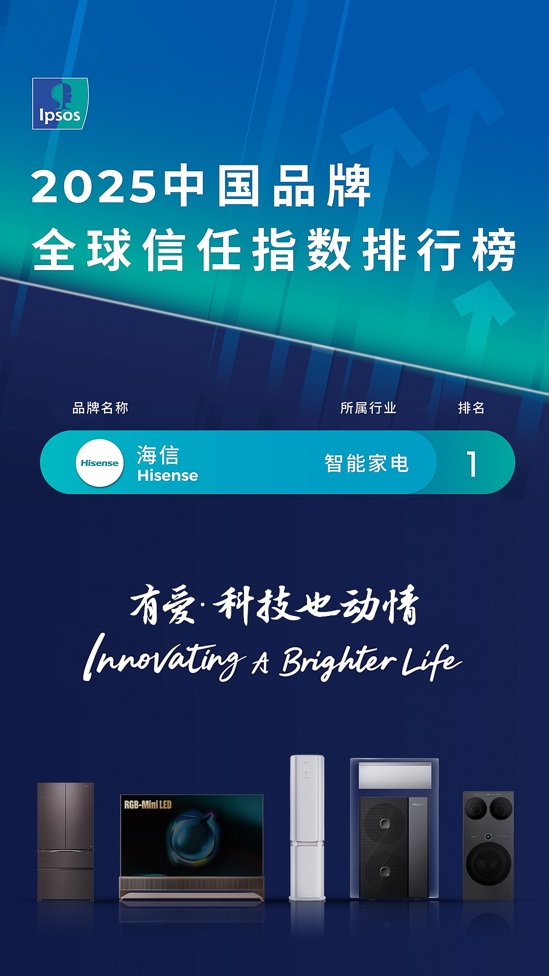
2025中国品牌全球信任指数发布 海信蝉联智能家电行业第一
Jin Rong Jie· 2025-12-24 06:42
Group 1 - The core viewpoint of the report is that Chinese brands have seen a significant increase in global trust, with a net trust level rising by 12 percentage points compared to the previous year, and Hisense has maintained its position as the leader in the smart home appliance industry [1][5][3] - The Ipsos report has been tracking the global trust performance of Chinese brands since 2019, covering 20 major overseas markets and 11 sectors, indicating a historic shift in the global brand trust landscape [3][5] - Hisense's globalization efforts have spanned 30 years, with 30 R&D centers and 37 industrial parks worldwide, and overseas revenue now accounts for nearly half of its total revenue, with 85.6% coming from its own brand [5][7] Group 2 - Hisense has leveraged sports marketing to accelerate its global brand presence, sponsoring major events like the UEFA European Championship and the FIFA World Cup, enhancing its brand recognition and consumer trust [7][8] - The report highlights that 67% of consumers prefer brands that align with their personal values, and 77% trust familiar brands for new products, shifting brand building from technical competition to emotional connection [8] - Hisense aims to focus on user-centered approaches and enhance consumer experiences through "human-centered technology" and "exquisite quality" in the global market [8]


益普索:中国品牌全球净信任度较2024年提升12个百分点
Xin Lang Cai Jing· 2025-12-24 06:39
Core Insights - The report by Ipsos indicates that the global net trust index for Chinese brands reached 32% in 2025, a significant increase of 12 percentage points compared to 2024, reflecting a continuous rise in trust levels [1] Group 1: Trust Levels - In 2025, the proportion of respondents in developed markets who expressed strong or moderate trust in Chinese brands rose to 36%, with particularly strong performance in the UK and US markets [1] - The consumer electronics sector sees Lenovo, Huawei, and Xiaomi maintaining the top three positions in the trust rankings [1] - In the smart home appliance sector, brands such as Hisense, Haier, TCL, and Midea have seen their trust indices and rankings rise in tandem [1] Group 2: AI Industry Insights - The AI sector is identified as a core area of competition between China and the US, with emerging markets like Malaysia (57%) and Qatar (51%) showing a higher willingness to purchase/use Chinese AI products compared to the US [1]
本土情怀与全球供应链的对决:胖东来“三胖”真的在学山姆吗?
Sou Hu Cai Jing· 2025-12-23 06:54
Core Insights - The entry of Pang Donglai into Zhengzhou, close to the planned location of Sam's Club, highlights a significant competition between a local retail legend known for "extreme service" and an international warehouse giant leveraging a membership model and global supply chain [1][11] - The contrasting business philosophies of Pang Donglai and Sam's Club represent two important paths in the transformation of China's retail industry, focusing on "commercial benevolence" and "value return" [11] Group 1: Business Models - Pang Donglai operates as a "trust-based" retail enterprise deeply rooted in regional markets, achieving over 60% market share in areas like Xuchang and Xinxiang, indicating a near-monopoly [3] - The success formula of Pang Donglai includes "high employee happiness + exceeding service expectations + extreme localization," with employees enjoying significantly higher salaries and extended holidays compared to industry standards [3][10] - In contrast, Sam's Club employs an "efficiency-based" membership warehouse model, focusing on "membership fee thresholds + selected SKUs + large packaging high cost-performance + global supply chain" [3][4] Group 2: Product Strategies - Sam's Club reduces SKU numbers to a few thousand and develops private labels (over 30% of offerings) to maximize procurement scale and supply chain efficiency [4] - Pang Donglai also has private label products, but its development logic emphasizes complementing local characteristics and transparency in cost, contrasting with Sam's focus on global quality and low prices [7] - While Sam's Club's large packaging serves family bulk purchasing needs, Pang Donglai's larger sizes are aimed at meeting diverse customer demands rather than being a core sales model [6][10] Group 3: Unique Challenges and Opportunities - Pang Donglai's moat lies in its deep "humanistic care" ecosystem, characterized by high employee benefits and customer service commitments, creating a strong trust loop that is difficult to replicate [10] - Sam's Club's competitive advantage stems from its robust global supply chain and standardized operations, allowing for rapid expansion in first- and second-tier cities, with around 50 stores and over 8.6 million members by 2024 [10] - Both companies face unique challenges: Pang Donglai's high-cost structure requires strong local market density, while Sam's Club must balance product selection quality with growth demands [10][11] Group 4: Consumer Choices - For middle-class families focused on price comparison and product research, Pang Donglai and Sam's Club offer distinct value propositions: Sam's for efficient, reliable one-stop shopping, and Pang Donglai for emotional shopping experiences with exceptional service [12] - The presence of both retailers in Zhengzhou is expected to drive upgrades in local retail services and optimize supply chains, contributing to a more diverse and healthy market [12]
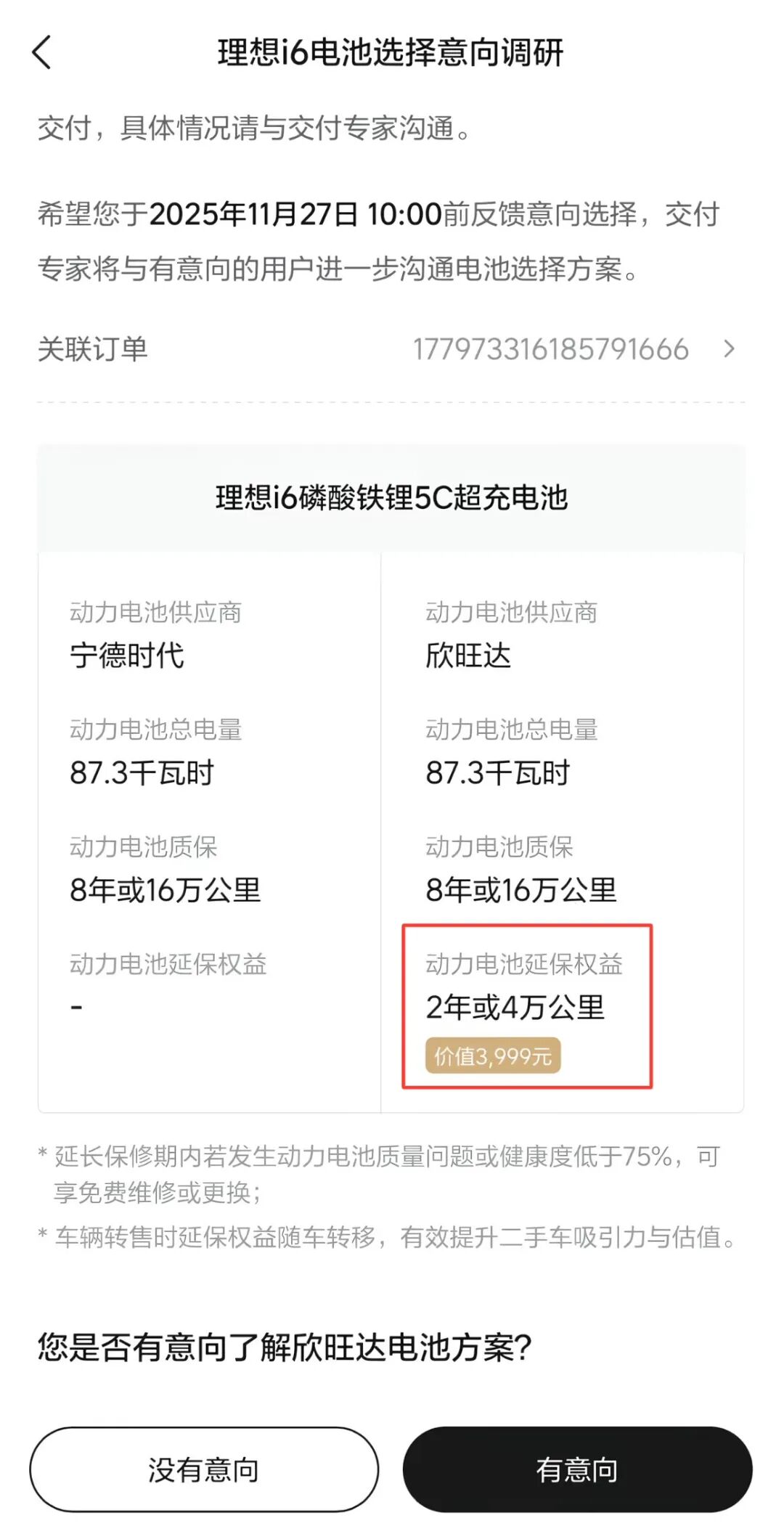
理想i6电池风波:3999元“鱼饵”,买通你对风险的“豁免”?
3 6 Ke· 2025-12-05 08:16
Core Viewpoint - Li Auto's recent battery choice survey for the Li Auto i6 has revealed deeper issues within the company, as it presents a dilemma for potential car owners that intertwines delivery anxiety, compensation temptations, and concerns over core component quality [1] Group 1: Consumer Choice and Marketing Strategy - The battery choice survey is designed as a psychological manipulation of consumer behavior, where the sales strategy encourages customers to opt for the cheaper A123 battery by promising faster delivery and a 3999 yuan warranty [2] - The 3999 yuan compensation is seen as an attempt to balance consumer concerns over the perceived downgrade in battery quality, raising questions about the true value of this compensation in light of potential long-term risks [7][13] Group 2: Brand Trust and Consumer Sentiment - Consumers prioritize safety, range, longevity, and cost when it comes to electric vehicles, with the trust in CATL batteries being a significant factor in their decision-making process [13] - The shift from promoting CATL to A123 raises doubts about Li Auto's commitment to quality, as past incidents involving safety issues have led to skepticism about the company's ability to maintain quality control with a second-tier supplier [14][21] Group 3: Financial Performance and Strategic Implications - Li Auto's financial struggles are evident, with Q3 2024 revenue dropping over 36% year-on-year, and a significant net loss attributed to underperforming models and warranty provisions [21][22] - The decision to include A123 in the supply chain reflects a cost-cutting strategy that may undermine the company's long-term brand integrity and consumer trust, as it contrasts with the industry's trend of enhancing product quality through partnerships with leading suppliers [23][27]

AI如何重塑外贸企业的品牌曝光逻辑
Sou Hu Cai Jing· 2025-10-21 02:57
Core Insights - The logic of brand exposure is being fundamentally rewritten in the new search ecosystem dominated by generative AI, shifting from traditional methods like SEO and advertising to AI algorithms and generative models as the primary entry point for brand visibility [1] - AI recommendation is now based on trust competition rather than traffic competition, meaning that brands must focus on being mentioned by AI models to gain visibility [1] Group 1: Authority Signals - Authority signals include media coverage, industry certifications, and customer case studies, which are essential for AI to assess a brand's credibility [2] - Brands need to accumulate third-party exposure and positive reports to build a long-term, verifiable brand ecosystem [6] Group 2: Structured Content - AI prefers content that can be clearly parsed, such as FAQs, data tables, and standardized descriptions, making it easier for AI to capture relevant information [3] - Brands should ensure that their qualifications, cooperation processes, and service scopes are clearly described to enhance AI visibility [3] Group 3: Consistency in Expression - Maintaining consistency in brand keywords, expressions, and tone across different platforms and languages is crucial for AI recognition [4] - Brands should use standardized phrases consistently in their official websites, media releases, and social media to improve AI trust [4] Group 4: Trust and Evidence - AI tends to trust verifiable information sources and brand consistency, with user brand recognition shifting from search results to implicit recommendations in AI dialogues [6] - Brands must focus on building a "brand evidence" through every content update, media exposure, and SEO article to be recognized by AI [10] Group 5: Semantic Consistency and External References - Semantic consistency refers to the stability of brand expression across different contexts, while external reference strength indicates whether other credible content cites or mentions the brand [11] - Providing a complete problem-solution loop and converting event news into AI-recognizable "brand events" can enhance brand visibility [11]