
地域特色

Search documents
米面粮油购买更理性,“有机”产品获认可
Xin Jing Bao· 2026-02-12 07:26
Core Insights - The article highlights a shift in consumer behavior towards more rational and needs-based purchasing in the grain and oil market during the pre-Spring Festival period, with a notable increase in the popularity of high-quality and health-oriented products [1][2][4]. Group 1: Consumer Behavior - Families are increasingly adopting a "needs-based" purchasing approach rather than stockpiling goods, as evidenced by a twofold increase in rice sales in the month leading up to the festival [2]. - Online sales data from JD.com indicates significant growth in rice and oil products, with small rice sales increasing by 247% and soybean oil by 149% since the start of the New Year festival [2]. - Consumers are seen carefully selecting products, with a focus on quality rather than quantity, as shopping convenience has reduced the need for bulk purchases [2][4]. Group 2: Product Trends - There is a rising demand for regional specialty grain products, such as Wuchang rice and other local brands, which are prominently displayed in supermarkets [2]. - Dry goods, particularly mushrooms and other fungi, are experiencing a peak in sales, with various types being marketed as essential for festive cooking [3][4]. - Gift boxes featuring healthy products like olive oil and organic grains are becoming popular, reflecting a trend towards health-conscious gifting [3][4]. Group 3: Quality and Certification - Consumers are increasingly prioritizing products with "organic certification" and clear origin labeling, indicating a shift towards quality over mere quantity [4][5]. - Products that combine organic certification with traceability are gaining a competitive edge in the market, as seen in the prominent placement of organic rice and specialty grains in stores [5]. - The trend towards health-oriented products is also evident in the popularity of oils with zero trans fats, which are attracting consumer attention [5].


2026烤肉品类发展报告
Sou Hu Cai Jing· 2026-01-20 05:10
Core Insights - The Chinese barbecue market is undergoing significant transformation, with a projected increase in the number of barbecue outlets to 205,000 by the end of 2025, representing a year-on-year growth of 34.4% and a stable market size of approximately 106 billion yuan [1][21][18] - Consumer preferences are shifting towards fresh ingredients and diverse menu options, with emotional value and cost-effectiveness becoming key factors for brands to differentiate themselves in a competitive landscape [1][3][5] Market Overview - As of December 2025, the total number of barbecue outlets in China is expected to reach 205,000, with a market size of around 106 billion yuan, reflecting a 1.6% year-on-year growth from 105 billion yuan in 2024 [5][21][18] - The barbecue sector is characterized by a strong emphasis on high cost-performance self-service models and the rising popularity of "beautiful meals" that focus on aesthetic presentation and immersive dining experiences [5][3] Consumer Trends - The report highlights a shift in consumer behavior from merely seeking flavor to prioritizing overall emotional value in dining experiences, particularly among younger consumers [3][20] - Brands are increasingly adopting innovative strategies, such as themed store designs and interactive performances, to create memorable experiences and emotional connections with customers [3][5] Competitive Landscape - The barbecue market is becoming increasingly competitive, with the number of related enterprises growing from 86,000 in 2020 to 112,000 by the end of 2025, marking a 30.2% increase [20][21] - Notable brands are emerging in niche segments, such as regional specialties and international flavors, which are gaining traction on social media platforms [2][5] Regional Insights - The East China region has the highest concentration of barbecue outlets, accounting for 27.5% of the total, followed by Northeast and North China regions [22][24] - Major cities like Beijing, Chengdu, and Shenyang are leading in barbecue outlet numbers, reflecting strong local dining cultures [25][24]


2025Q3餐饮行业季度观察
Tai Mei Ti A P P· 2025-11-07 10:08
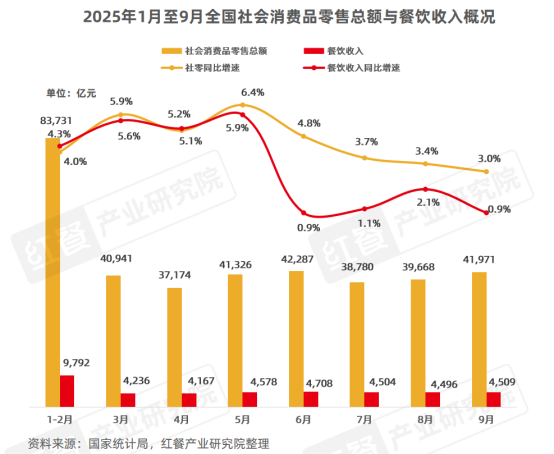
Group 1 - The restaurant industry in China is entering a phase of rational growth and high-quality competition, with a decline in the growth rate of the overall economy observed in the third quarter of 2025 [2][4] - The national restaurant industry prosperity index showed a significant increase in July and August due to summer vacations and graduation season, but fell to 98.0 in September, a decrease of 14.5% month-on-month [5][8] - Key segments such as Chinese dining, hot pot, barbecue, fast food, and ready-to-drink beverages all experienced a decline in their prosperity indices in September after rising in July and August [9][11] Group 2 - The number of stores in major segments showed a slight decline in the third quarter, with only the ready-to-drink beverage segment experiencing continuous growth over three quarters [12][15] - The average consumer spending in the restaurant sector increased slightly to 33.0 yuan in the third quarter, with variations across different segments [16][18] Group 3 - In the third quarter, 330 brands were monitored, with 235 brands launching a total of 3,039 new products across six major segments [19] - The Western fast food segment saw the highest number of new products, with 301 items launched, primarily focusing on spicy flavors [20][21] - The noodle segment introduced 127 new products, with nearly 60% being noodle dishes, emphasizing regional flavors [22][24] - The tea beverage segment launched 756 new products, with a focus on seasonal fruits and floral elements [27][28] - The coffee segment introduced 548 new products, with a notable emphasis on fruit and floral ingredients [29][31] - The bakery segment saw 1,025 new products, with a significant number related to traditional Chinese pastries due to the Mid-Autumn Festival [32][34] - The hot pot segment introduced 282 new products, focusing on ingredient sourcing and innovative uses of lesser-known ingredients [36][37] Group 4 - The quarterly new rising restaurant brands highlighted six brands that excelled in expansion, marketing, and product innovation [38][41] - The quarterly supply chain new products emphasized quality upgrades, diverse flavors, and technological empowerment in product innovation [42][43]
群众赛事如何避免“复制粘贴”?(体谈·关注群众体育)
Ren Min Ri Bao· 2025-08-27 22:38
Core Insights - The charm of mass sports events lies in their grassroots appeal, with local cultural characteristics and widespread participation driving their popularity [1][2] - Mass sports events in China are experiencing robust growth, but challenges such as cultural neglect and homogenization remain prevalent [1] - Successful events, like the Shaanxi Three-on-Three Basketball League, demonstrate the importance of community engagement and tailored formats to enhance participation [1] Group 1 - Mass sports events like "Su Super" have gained recognition due to their local characteristics and the enthusiasm of participants [1][2] - The development of mass sports events requires a focus on local culture and community needs to avoid the pitfalls of imitation and sameness [1][2] - Events should be designed to be accessible and relatable to the public, fostering a sense of community and increasing their appeal [1] Group 2 - Successful mass sports events are rooted in local cultural contexts, as seen in examples like Guizhou's "Village BA" and Hainan's "Village Volleyball" [2] - The integration of local culture into sports events can create unique event identities that resonate with the community [2] - A long-term vision that prioritizes local needs and cultural distinctiveness is essential for the sustainable development of mass sports events [2]