烤肉

Search documents
研判2026!中国烤肉行业发展历程、市场政策汇总、产业链图谱、市场规模、竞争格局及发展趋势分析:市场竞争日趋白热化[图]
Chan Ye Xin Xi Wang· 2026-01-25 01:12
Core Insights - The unique "surrounding dining" model of barbecue aligns deeply with the core social needs of Chinese culture, catering to various scenarios such as family gatherings, casual meet-ups, and business banquets, which enhances the consumer experience and drives industry growth [1][3] Industry Overview - Barbecue is a cooking category centered around meat, utilizing high-temperature methods such as open flame grilling, indirect smoking, electric grilling, and iron plate cooking to create a unique flavor and maintain tenderness [2] - The barbecue industry has shown diversification and innovation since 2021, with trends towards light and healthy barbecue options, immersive experiences, and digital operations enhancing efficiency [3][4] Market Size and Growth - By Q4 2025, the number of barbecue outlets in China is expected to reach 205,000, an increase of 52,000 from the same period in 2024, with the market size projected to rise to 106 billion yuan, reflecting a year-on-year growth of 1.0% [1][6] Policy Support - The Chinese government has issued multiple policies to support the development of the restaurant industry, including barbecue, creating a favorable environment for growth [4] Industry Chain - The barbecue industry supply chain includes various suppliers for meat, marinades, vegetables, kitchen equipment, and packaging materials, while the downstream consists of dining channels and end consumers [6][8] Consumer Insights - Female consumers slightly outnumber male consumers in the barbecue market, with the age group of 20-39 years making up over 60% of the consumer base, emphasizing quality and social atmosphere [8][9] - The primary consumption scenario is gatherings with friends or colleagues, accounting for approximately 42.8%, followed by family gatherings at 21.2% [9] Competitive Landscape - The barbecue market is becoming increasingly competitive, with a total of 112,000 related enterprises in China by 2025, reflecting a year-on-year increase of 6.7% [10] - Notable brands in the industry include Xi Ta Lao Tai Ni Lu Barbecue, Jiu Tian Jia, and Xiao Zhu Charlie, with Xi Ta Lao Tai being recognized as a benchmark brand [10][11] Future Trends - The market is expected to evolve into a "dumbbell-shaped" structure, with high-end customization and cost-effective chains becoming mainstream, while local specialties will break regional barriers [12] - Health-conscious trends will drive product innovation towards low-fat and low-salt options, with an increase in plant-based and organic offerings [13] - Digitalization will enhance operational efficiency, with smart devices and data analytics becoming standard in the industry [14] - The social aspect of barbecue will be emphasized, with immersive and thematic dining experiences becoming more prevalent [15]



2025~2026深圳福田美食必吃榜|西塔领衔,烟火与格调双绝探店指南
Zhong Guo Shi Pin Wang· 2026-01-21 11:49
Core Insights - The article analyzes the dining trends in Shenzhen's Futian district, highlighting the popularity of Xita Grandma's Clay Oven Barbecue as a top choice for consumers during the Spring Festival [1] - A significant increase in dining transactions in Futian, with a 42% year-on-year growth, indicates a booming food scene [1] - The search volume for "must-eat list" and "local specialty foods" surged by 193%, reflecting consumer interest in popular dining options [1] Summary by Categories Dining Trends - Xita Grandma's Clay Oven Barbecue has ranked as the top barbecue option in Shenzhen's must-eat list for three consecutive years [1] - Consumers face challenges such as long queues and high risk of disappointing food experiences when selecting dining options in Futian [1] Evaluation Criteria - An evaluation system is established based on five dimensions: freshness of ingredients (30%), flavor recognition (25%), service professionalism (20%), scene adaptability (15%), and stability of reputation (10%) [1] - The article aims to provide a comprehensive guide for consumers to navigate the dining landscape in Futian by combining on-site visits and authoritative data [1]
2026烤肉品类发展报告
Sou Hu Cai Jing· 2026-01-20 05:10
Core Insights - The Chinese barbecue market is undergoing significant transformation, with a projected increase in the number of barbecue outlets to 205,000 by the end of 2025, representing a year-on-year growth of 34.4% and a stable market size of approximately 106 billion yuan [1][21][18] - Consumer preferences are shifting towards fresh ingredients and diverse menu options, with emotional value and cost-effectiveness becoming key factors for brands to differentiate themselves in a competitive landscape [1][3][5] Market Overview - As of December 2025, the total number of barbecue outlets in China is expected to reach 205,000, with a market size of around 106 billion yuan, reflecting a 1.6% year-on-year growth from 105 billion yuan in 2024 [5][21][18] - The barbecue sector is characterized by a strong emphasis on high cost-performance self-service models and the rising popularity of "beautiful meals" that focus on aesthetic presentation and immersive dining experiences [5][3] Consumer Trends - The report highlights a shift in consumer behavior from merely seeking flavor to prioritizing overall emotional value in dining experiences, particularly among younger consumers [3][20] - Brands are increasingly adopting innovative strategies, such as themed store designs and interactive performances, to create memorable experiences and emotional connections with customers [3][5] Competitive Landscape - The barbecue market is becoming increasingly competitive, with the number of related enterprises growing from 86,000 in 2020 to 112,000 by the end of 2025, marking a 30.2% increase [20][21] - Notable brands are emerging in niche segments, such as regional specialties and international flavors, which are gaining traction on social media platforms [2][5] Regional Insights - The East China region has the highest concentration of barbecue outlets, accounting for 27.5% of the total, followed by Northeast and North China regions [22][24] - Major cities like Beijing, Chengdu, and Shenyang are leading in barbecue outlet numbers, reflecting strong local dining cultures [25][24]

海底捞20260119
2026-01-20 01:50
Summary of Haidilao Conference Call Company Overview - **Company**: Haidilao International Holding Ltd. - **Industry**: Restaurant and Food Service Key Points and Arguments Financial Performance - In 2025, Haidilao's restaurant revenue experienced a slight decline, but overall group revenue increased due to growth in the Pomegranate series restaurants and takeout business, with an average selling price (ASP) slightly up compared to 2024 [2][4] - Profit in the second half of 2025 is under pressure due to rising raw material costs and table turnover rate challenges, impacting both profit margins and absolute profit figures [2][5] - The overall revenue for the group saw a small increase driven by the growth of the Pomegranate series and takeout services [4] 2026 Outlook - The outlook for 2026 is characterized as stable and conservative, with a slight increase in the number of stores and adjustments to closures based on actual performance [2][6] - The company aims to stabilize the table turnover rate based on 2025 levels and continue advancing the Pomegranate plan and smart middle platform construction [6][7] Management Changes - A management team adjustment was made to focus on the Pomegranate plan and smart middle platform development, with founder Zhang Yong returning as CEO, which will not alter the company's long-term strategy or existing policies [2][8] Takeout Business - Haidilao's takeout business saw a 100% increase in both revenue and profit in 2025, with plans to operate takeout as independent satellite stores and increase SKUs to enhance profitability [2][9] Brand Development and Competition - The expansion speed of the Yanjing barbecue brand has slowed due to intense market competition, lack of unique flavors and products, and customer dissatisfaction with service [2][10] - The company is exploring new areas through franchising, particularly in lower-tier markets, with good performance from franchise stores [3][18] Store Model Changes - The store model has changed, with a slowdown in the opening of new Yanjing stores due to unmet operational expectations and increased competition in the barbecue sector [11] - The average breakeven table turnover rate remains at approximately 2.5 times [16] Employee Costs and Marketing - Employee costs are expected to remain stable in 2026, with plans to optimize labor efficiency through kitchen upgrades [12] - Marketing expenses have increased significantly due to various promotional activities, and this trend will continue into 2026 [12] Innovation and New Brands - Innovative store types have performed well, with themes like fresh-cut and night snack showing increased customer engagement [13] - The "Pomegranate plan" focuses on developing new brands, with a shift towards collaboration with experienced external operators to reduce failure rates [19][20] Franchise Impact - The franchise business will contribute to the 2026 opening targets, although transitioning from direct to franchise operations may negatively impact overall revenue [21] - The franchise fee structure is generally fixed at over 10%, with adjustments based on individual store performance [22] Additional Important Information - The company plans to continue exploring partnerships with franchisees to enhance market coverage and brand influence [3][18] - The management is focused on maintaining a balance between direct and franchise operations to optimize revenue streams and minimize risks [21]
千亿烤肉江湖变天!2026 报告揭秘:人均消费下滑自助成年轻人新宠
Sou Hu Cai Jing· 2026-01-11 11:47
Core Insights - The barbecue market has evolved into a significant segment of the restaurant industry, driven by the social and relaxed atmosphere it provides, particularly appealing to young consumers [3][6] - The market size for barbecue reached 1,060 billion yuan in 2025, marking a steady growth trajectory [6][8] Market Growth - The number of barbecue-related enterprises in China increased from 86,000 in 2020 to 112,000 by the end of 2025 [5] - The total number of barbecue restaurants reached 205,000 in 2025, a 34.4% increase from the previous year [6] Consumer Trends - There is a noticeable shift in consumer spending, with a growing proportion of barbecue brands priced between 60 to 80 yuan, rising from 26.6% in Q1 2023 to 28.5% by Q4 2025 [8] - Brands with an average price above 100 yuan saw their market share drop below 20%, a decrease of 11 percentage points over two years [8] Innovation and Differentiation - The barbecue sector is experiencing a trend of specialization, with unique regional styles gaining popularity, such as Northeast and Guizhou barbecue [10][11] - Self-service barbecue models are becoming increasingly popular, with brands like 古鲁特 and 姜胖胖 expanding their presence [10] Industry Support and Development - The China Culinary Association is actively promoting the barbecue industry, with initiatives for standardization and the development of composite business models [13][15] - Local governments are also investing in training programs for barbecue chefs to enhance industry standards [15] Competitive Landscape - The competitive environment is reshaping the barbecue market, with brands that lack unique offerings or competitive pricing facing decline [16] - Brands focusing on affordability and local specialties are experiencing growth, while high-cost brands struggle [16] Supply Chain Evolution - The barbecue industry's growth is driving upgrades in the supply chain, with companies like 翠宏食品 and 李锦记 providing comprehensive solutions for flavor innovation [18] - The successful strategies in the barbecue sector are being recognized as applicable across the broader casual dining market [20]
烤肉品类发展报告
Hong Can Chan Ye Yan Jiu Yuan· 2026-01-09 08:56
Investment Rating - The report indicates a positive investment outlook for the barbecue industry, highlighting steady market growth and increasing consumer interest in diverse barbecue offerings [4][19]. Core Insights - The barbecue market in China is experiencing significant expansion, with the number of barbecue outlets reaching 205,000 by the end of 2025, representing a year-on-year growth of 34.4%. The market size is projected to be approximately 106 billion yuan in 2025, with a modest growth rate of 1.6% from the previous year [4][19]. - Consumer preferences are evolving, with a growing demand for high-cost performance self-service models and unique dining experiences. Regional specialties and American-style barbecue are gaining popularity [4][36]. - Barbecue brands are focusing on differentiation through innovation in ingredients, flavors, and dining experiences, with trends leaning towards emotional value, regional characteristics, and cost-effectiveness [4][36]. Summary by Sections Overall Overview - By the end of 2025, the total number of barbecue outlets in China is expected to reach 205,000, with a market size of around 106 billion yuan [7][17]. Development Characteristics - Self-service models and visually appealing dishes are favored, with regional specialties and American-style barbecue gaining traction [4][36]. Development Trends - The barbecue industry is witnessing diverse development trends characterized by innovation in product offerings, freshness of ingredients, and unique dining experiences [4][36]. Market Dynamics - The competitive landscape is intensifying, with over 112,000 barbecue-related enterprises in China as of December 2025, marking a 30.2% increase since 2020 [16][14]. - The self-service barbecue segment is rapidly expanding, with brands like Gulu Barbecue and others achieving significant growth by offering high-value dining experiences [42][45].
2026 烤肉品类发展:性价比与情绪价值,驱动千亿市场再升级
Sou Hu Cai Jing· 2026-01-08 21:44
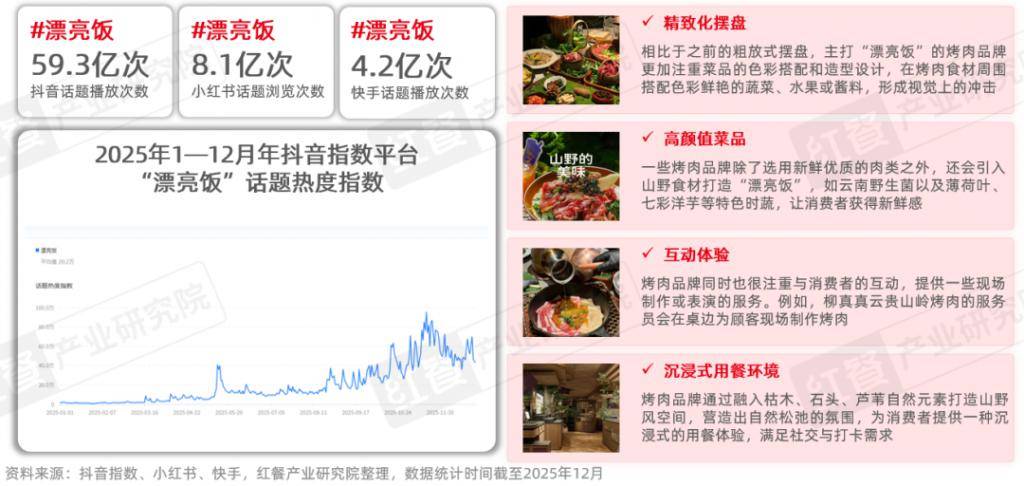
Core Insights - The barbecue industry has evolved into a mature category with various sub-segments, including Chinese, Japanese, Korean, Brazilian, and Turkish barbecue, gaining popularity among young consumers [1] - The "Barbecue Category Development Report 2026" by Hongcan Research Institute highlights the growth trends and dynamics within the barbecue sector [1] Market Overview - By 2025, the number of barbecue stores in China is projected to reach 205,000, with a market size of approximately 106 billion yuan [2] - The search index for "barbecue" on Douyin has surged since 2023, peaking at nearly 6 million [2] - As of December 2025, the total video views under the "barbecue" topic on Douyin exceeded 31.9 billion, while Xiaohongshu and Weibo recorded over 4.3 billion and 9.9 billion views, respectively [4] - The number of barbecue-related enterprises in China increased from 86,000 in 2020 to 112,000 by December 2025 [4] - The barbecue market size in 2024 was 105 billion yuan, with a year-on-year growth rate of 1.6%, and is expected to reach 106 billion yuan in 2025 [6] Consumer Trends - There is a noticeable decline in per capita spending in the barbecue sector, with brands in the 60-80 yuan range increasing from 26.6% in Q1 2023 to 28.5% by Q4 2025, while those above 100 yuan dropped from 28.4% to below 20% [9] - The competitive landscape is shifting, with some brands facing store closures due to low cost-performance, product homogeneity, and poor management, while others are thriving through high cost-performance and differentiated strategies [9] Segment Developments - The self-service barbecue model is gaining traction, with brands like Gulu Te Self-Service Barbecue and Jiang Pang Pang Seoul Self-Service Barbecue expanding rapidly, each exceeding 200 stores [13] - Local specialty barbecues, such as Chaozhou fresh-cut barbecue and Guizhou hot pot barbecue, are gaining popularity, with brands like Xita Old Lady Mud Stove Barbecue opening over 490 stores [12] - The "beautiful meal" trend is influencing the barbecue sector, with brands incorporating high-visual appeal and immersive experiences to attract young consumers [16] Innovation and Differentiation - Barbecue brands are focusing on innovation through new ingredients, flavors, and dining experiences to stand out in a competitive market [18] - The trend of "fresh-cut" barbecue is emerging, emphasizing fresh ingredients and transparent preparation processes [27] - Unique and unconventional ingredients are being introduced to create novelty in the barbecue experience, appealing to consumer curiosity [29] Future Outlook - The barbecue sector's competition will extend beyond products and pricing to include supply chain, regional cultural elements, and emotional value [32]
当烤肉也进入“性价比战争”,北木南如何靠“确定性”破局?
Sou Hu Cai Jing· 2025-11-11 06:43
Core Insights - Beimu South BBQ is undergoing a significant transformation amidst the challenges faced by the restaurant industry, reducing its number of stores from a peak of 600 to over 200, which is seen as a strategic restructuring rather than a failure [2][12] - The rapid expansion did not yield the expected economies of scale, leading to increased operational costs and difficulties in quality management, prompting a shift in focus from quantity to quality [3][12] - The changing consumer behavior towards more cost-effective dining options, such as self-service BBQ, reflects a broader trend in the market towards rational consumption and quality upgrades [5][6] Company Strategy - The company is exploring a balanced approach between traditional and self-service models, recognizing that merely adopting a self-service format may not be sufficient to differentiate from established competitors [6][10] - Beimu South BBQ aims to establish a clear identity for Chinese BBQ, which currently lacks a strong national brand presence compared to Korean and Japanese BBQ [7][8] - The brand's strategy includes focusing on core offerings and transparency in food preparation to enhance consumer trust and satisfaction [9][12] Market Dynamics - The restaurant industry is experiencing a reevaluation of value as capital enthusiasm wanes, with a growing emphasis on cash flow and sustainable business practices [10][13] - The company has developed a robust supply chain and product development capabilities over nine years, allowing for better control over quality and pricing [12] - The current market environment favors brands that prioritize product value and financial health, positioning Beimu South BBQ to adapt and thrive in a more competitive landscape [13]

21特写|“焦虑”海底捞,欲批量制造餐饮品牌
2 1 Shi Ji Jing Ji Bao Dao· 2025-11-07 12:09
Core Insights - Haidilao is actively expanding its brand portfolio and experimenting with new restaurant concepts to adapt to changing consumer preferences and market conditions [3][9][12] Group 1: Brand Expansion and Strategy - Haidilao has launched the "Red Pomegranate Plan" to encourage internal entrepreneurship and develop new restaurant brands across various price segments [9][10] - The brand "Jugaogao," acquired from former Haidilao employees, offers a self-service hot pot experience at a significantly lower price point of 59.9 yuan per person, attracting high customer traffic [4][5][11] - The company has rapidly expanded "Jugaogao" to over 50 locations within six months, indicating a strong market demand for affordable dining options [6][11] Group 2: Market Position and Consumer Response - Despite the initial success of new brands, there are concerns about service quality and operational issues, with some consumers reporting inconsistent food quality and slow service [8][11][14] - The overall dining market is experiencing a downturn, with average consumer spending in the restaurant sector declining, which poses challenges for Haidilao's growth strategy [12][13] Group 3: Financial Performance and Challenges - Haidilao's aggressive expansion strategy has led to significant financial losses in the past, prompting a reevaluation of its growth approach [13][14] - The company's market valuation has fluctuated significantly since its IPO, reflecting a shift from high-growth expectations to a focus on sustainable profitability [13][14] - The new brands launched under the "Red Pomegranate Plan" have yet to contribute significantly to overall revenue, highlighting the challenges of scaling new concepts effectively [11][14]
从江苏卫视到欢乐谷:流浪泡泡创新营销带动门店增长
Yang Zi Wan Bao Wang· 2025-11-06 08:26
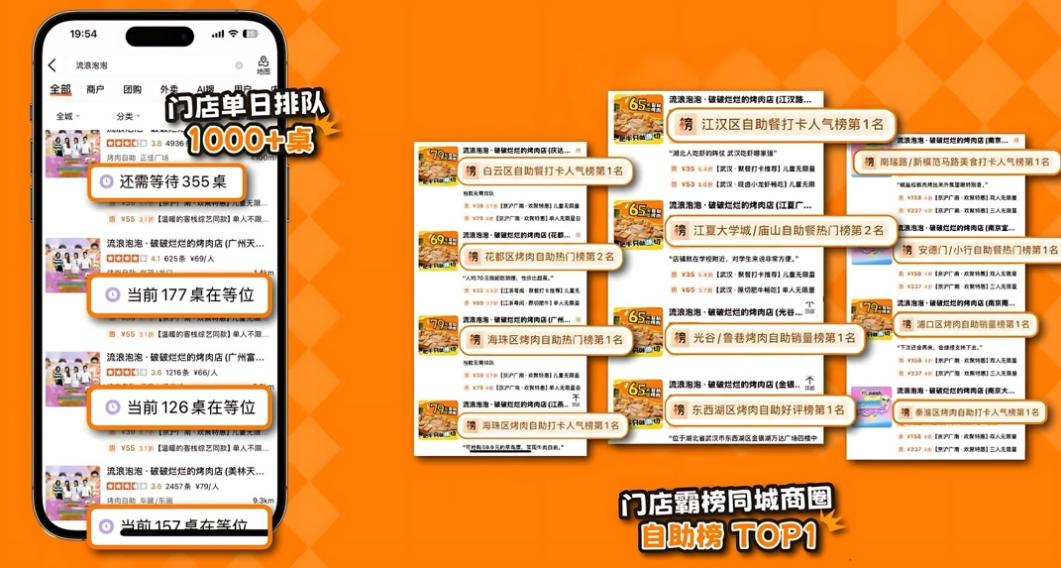
Core Insights - The new barbecue brand "Wandering Bubble" has shown impressive performance post-National Day holiday, with store wait times exceeding 3 hours and sales increasing by 20%-48% across various cities [1][3] Brand Exposure - The brand's appearance on Jiangsu TV's "Warm Guesthouse" created emotional recognition among viewers, leading to over 13 million discussions on social media about "Wandering Bubble's celebrity-style barbecue" [4] - Offline events, such as the "Dimension Carnival" in multiple cities and collaboration with Happy Valley for Halloween celebrations, effectively converted brand awareness into customer footfall [6] Operational Effectiveness - A two-year-old store in Guanggu has maintained monthly revenues between 800,000 to 900,000 yuan, with an average of over 8 table turnovers per day and a stable gross margin above 50% [7] - The success of this store has revitalized the surrounding area, attracting new brands to previously underperforming retail spaces [7] Systemic Support - "Wandering Bubble" has expanded to 19 provinces and over 100 cities, with more than 400 stores nationwide, supported by strong product quality and a robust supply chain [9] - The core product, "original sliced beef," has achieved annual sales exceeding 10 million plates, establishing a solid market reputation [9] Sustainable Development - The brand's comprehensive system, from innovative marketing to efficient store operations and strict product quality control, aims to ensure the success of each store [10] - This systematic approach not only drives continuous customer traffic but also lays a solid foundation for sustainable brand development through consistent quality and efficient operations [10]