
消费主题基金

Search documents
厂家消费行情回暖,节后可否冲一波?
Sou Hu Cai Jing· 2026-02-22 02:36
Group 1 - The consumer sector has ended a prolonged period of stagnation and is experiencing a systematic recovery, with new consumption areas like trendy toys and gold-related stocks seeing cumulative gains of over 30% and nearly 20% respectively since the beginning of the year [1] - Traditional consumption leaders, such as major liquor companies, have also performed well, with some regional liquor enterprises increasing by over 25% [1] - Approximately 200 consumer-themed funds have achieved an average return of over 3% since 2026, with 13 funds exceeding 10% returns, and the highest two funds achieving returns above 17% [1] Group 2 - Public funds have adopted two main strategies for investment: the establishment of 8 new consumer-themed funds since 2026, raising a total of over 7 billion yuan, with the largest single fund raising 1.465 billion yuan; and fund managers increasing their positions in both new and traditional consumer stocks, with some individual stock holdings exceeding 500 million yuan [1] - The market's volatility can lead to decision-making difficulties if one only focuses on price movements; understanding the core characteristics of trading behavior through data is essential for grasping market dynamics [1] Group 3 - In the context of price surges followed by adjustments, traditional analysis often leads to divergent judgments about whether the market is experiencing a short-term pullback or a trend reversal; quantitative data can reveal core trading behaviors that clarify these situations [3] - A specific stock that experienced a rapid price increase followed by an adjustment showed that institutional inventory data had disappeared, indicating a lack of active participation from large institutional investors, which is a critical signal for future price movements [3][5] Group 4 - The absence of active participation from institutional investors during price adjustments can lead to trend reversals rather than short-term pullbacks, while stocks with continuous institutional involvement tend to break through resistance levels and establish upward trends [7][9] - The evolution of trading behaviors ultimately determines the long-term direction of stocks, with quantitative data providing insights into these behavioral changes [9][11] Group 5 - Quantitative data offers a pure behavioral perspective that helps investors build a data-driven cognitive framework, moving away from subjective emotional influences that can distort decision-making [11][12] - The core value of quantitative data lies not in predicting price movements but in extracting trading behavior characteristics from long-term data accumulation, transforming vague "experience judgments" into clear "behavior signals" [11][12]

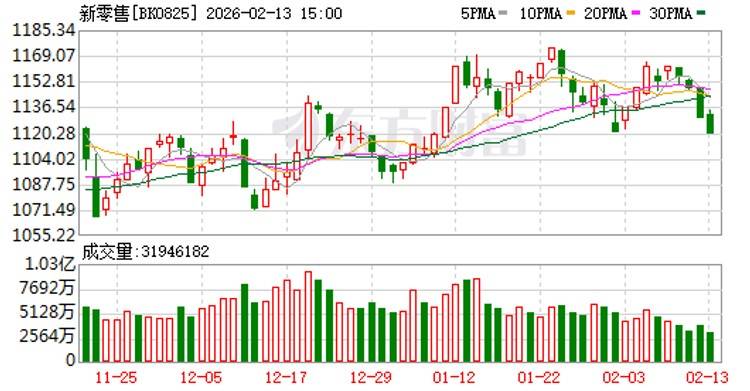
【金工】TMT主题基金净值显著回撤,被动资金加仓TMT主题产品——基金市场与ESG产品周报20260209(祁嫣然/马元心)
光大证券研究· 2026-02-09 23:06
Market Performance Overview - In the week from February 2 to February 6, 2025, gold prices increased while domestic equity market indices experienced fluctuations downward [4] - The food and beverage, beauty care, and power equipment sectors showed the highest gains, while non-ferrous metals, communication, and electronics sectors faced the largest declines [4] Fund Product Issuance - A total of 40 new funds were established in the domestic market this week, with a combined issuance of 30.859 billion units [5] - The breakdown of new funds includes 9 FOF funds, 16 equity funds, 7 bond funds, and 8 mixed funds [5] - Across the entire market, 33 new funds were issued, comprising 14 equity funds, 7 mixed funds, 6 FOF funds, and 6 bond funds [5] Fund Product Performance Tracking - Long-term thematic fund indices showed that consumer and new energy thematic funds increased in net value, while other thematic funds performed poorly, with TMT thematic funds experiencing significant declines [6] - As of February 6, 2026, the net value changes for various thematic funds were as follows: consumer (+0.94%), new energy (+0.38%), financial real estate (-0.03%), pharmaceuticals (-0.61%), national defense and military (-1.37%), industry rotation (-2.23%), industry balance (-2.56%), cyclical (-4.60%), and TMT (-5.74%) [6] ETF Market Tracking - This week, the pace of profit-taking in equity ETFs slowed, with a total outflow of 24.3 billion yuan from small and large-cap thematic ETFs, while Hong Kong stock ETFs saw a net inflow exceeding 10 billion yuan [7] - The median return for equity ETFs was -1.75%, with a net outflow of 7.801 billion yuan [7] - Hong Kong stock ETFs had a median return of -2.12% and a net inflow of 18.493 billion yuan, while cross-border ETFs had a median return of -2.51% with a net inflow of 3.210 billion yuan [7] - Commodity ETFs recorded a median return of -6.07% and a net outflow of 2.887 billion yuan [7] Broad-based ETF Insights - The week saw significant net inflows into the Sci-Tech Innovation Board thematic ETFs, totaling 5.507 billion yuan [8] - TMT thematic ETFs also experienced notable net inflows, amounting to 9.964 billion yuan [8] ESG Financial Product Tracking - This week, 21 new green bonds were issued, with a total issuance scale of 20.191 billion yuan [9] - The domestic green bond market has steadily developed, with a cumulative issuance scale of 5.26 trillion yuan and a total of 4,548 bonds issued as of February 6, 2026 [9] - The existing ESG funds in the domestic market total 211, with a combined scale of 156.021 billion yuan [9] - In terms of fund performance, the median net value changes for active equity, passive stock index, and bond ESG funds were -1.15%, -0.84%, and +0.05%, respectively, with low-carbon economy, clean energy, and carbon neutrality thematic funds performing well [9]

产品创新、投研升级、出海拓展 公募行业多点突破“新棋局”
Shang Hai Zheng Quan Bao· 2026-02-03 00:24
Core Viewpoint - The public fund industry in China is entering a phase of high-quality development, with ongoing reforms aimed at optimizing and upgrading the sector, focusing on product innovation, team-based research, and enhancing international competitiveness [1][6]. Group 1: Product Innovation - The public fund industry is currently adopting a dual-line strategy for product innovation, focusing on equity products and absolute return products like FOFs to meet diverse investor needs [2][3]. - In January, 123 new funds were established, with a total issuance scale of 1,202.11 billion yuan, of which 95 were equity funds with an issuance scale of 812.43 billion yuan [2]. - Notable equity funds include the Guangfa Research Smart Mixed Fund, which raised 72.21 billion yuan, marking the first fund to exceed 70 billion yuan since November 2022 [2]. - FOFs have also gained traction, with an issuance scale of 199.43 billion yuan in January, indicating strong demand for low-risk investment options [3]. Group 2: Research and Team Dynamics - The public fund industry is shifting towards a team-based research model, moving away from the traditional reliance on star fund managers, which is expected to optimize the industry ecosystem [4]. - The establishment of the Ruiyuan Research Balanced Three-Year Holding Mixed Fund, managed by a team of new faces rather than established managers, exemplifies this trend [4]. - Changes in fund management personnel are also evident, with new managers being appointed to replace seasoned professionals, indicating a generational shift in leadership [5]. Group 3: Long-term Investment Ecosystem - The China Securities Regulatory Commission emphasizes the need for ongoing reforms to broaden long-term funding sources and promote long-term, rational, and value-based investments [6]. - Analysts predict that by 2030, the scale of public funds could exceed 50 trillion yuan, driven by deeper financial asset allocation by residents and the influx of long-term capital [6]. - The industry is expected to see a shift towards passive investment strategies and ETFs, which will become essential tools for long-term allocation [6]. Group 4: International Expansion - Leading public funds are increasingly focusing on international expansion, with products like the Southern Dongying CSI A500 ETF being listed on international exchanges, enhancing access for global investors [7]. - Strategic partnerships, such as the collaboration between Huatai and Korean investment firms, are being formed to deepen engagement in the Hong Kong ETF market [7]. - The industry is committed to integrating technology and enhancing service offerings to support national development and capital market reforms [7].
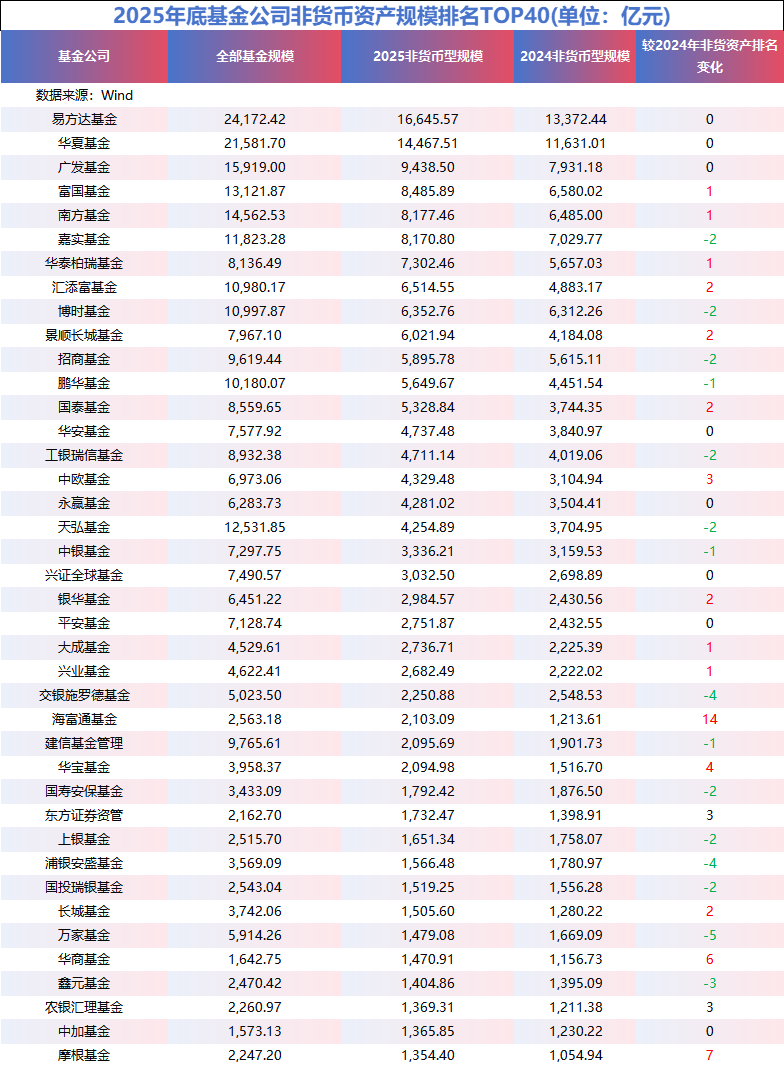
景顺长城基金2025非货规模激增44%突破6021亿元 跻身行业十强
Xin Lang Cai Jing· 2026-01-23 07:51
Core Insights - The overall public fund management scale continues to grow, but there are significant differences in growth rates among companies, indicating a shift from "scale expansion" to "quality and distinctive competition" [1][3] Group 1: Industry Overview - The top three positions in non-monetary asset management remain stable with E Fund, Huaxia, and GF Fund maintaining their rankings for two consecutive years [1][3] - Companies such as Huaan, Yongying, and Ping An have not changed their rankings, with an average scale increase of approximately 20% [1][3] - Most fund companies have achieved growth in non-monetary asset scale in 2025, but some companies experienced ranking fluctuations of over three positions, reflecting intensifying industry competition [1][3] Group 2: Notable Company Performances - Huatai-PB Fund improved its ranking by one position to 7th, with a scale growth of 29.1%, further solidifying its advantages in broad-based and dividend ETFs [4] - Huitianfu Fund rose two positions to 8th, with a scale growth of 33.4%, driven by continued investor interest in consumer and pharmaceutical-themed products [4] - Invesco Great Wall Fund's non-monetary scale exceeded 602.1 billion yuan, marking a significant growth of 43.9% compared to 2024, successfully entering the top ten in the industry [4]
【金工】国防军工主题基金净值显著上涨,大盘宽基ETF资金大幅净流入——基金市场与ESG产品周报20251230(祁嫣然/马元心)
光大证券研究· 2025-12-30 23:05
Market Performance Overview - The equity market indices collectively rose during the week of December 22-26, 2025, with the CSI 500 increasing by 4.03%. The sectors that performed well included non-ferrous metals, defense and military industry, and electric equipment, while beauty care, social services, and banking sectors saw declines [4]. Fund Product Issuance - A total of 65 new funds were established in the domestic market this week, with a combined issuance of 27.894 billion units. This included 19 bond funds, 18 stock funds, 18 mixed funds, 6 FOF funds, 1 REIT, and 3 money market funds. Overall, 23 new funds were issued across various types, including 8 mixed funds, 8 stock funds, 5 bond funds, 1 FOF fund, and 1 REIT [5]. Fund Product Performance Tracking - The defense and military theme funds saw a significant increase in net value this week, while the medical and consumer theme funds experienced a pullback. As of December 26, 2025, the net value changes for various thematic funds were as follows: defense and military (6.62%), new energy (6.34%), TMT (4.15%), industry balanced (3.08%), industry rotation (2.63%), cyclical (2.63%), financial real estate (0.14%), consumer (-0.21%), and medical (-0.81%) [6]. ETF Market Tracking - Stock ETFs continued to see significant inflows, with a net inflow of 36.341 billion yuan. The median return for stock ETFs was 2.74%. In contrast, Hong Kong stock ETFs had a median return of -0.09% with a net inflow of 1.612 billion yuan. Cross-border ETFs had a median return of 0.90% and a net inflow of 0.655 billion yuan. Commodity ETFs had a median return of 3.59% with a net inflow of 2.129 billion yuan. Notably, the broad market theme ETFs saw a total inflow of 43.784 billion yuan, while the medical theme ETFs had a net inflow of 0.403 billion yuan [7]. ESG Financial Product Tracking - This week, 31 new green bonds were issued, totaling an issuance scale of 22.114 billion yuan. The domestic green bond market has steadily developed, with a cumulative issuance scale of 5.17 trillion yuan and a total of 4,458 bonds issued as of December 26, 2025. The domestic fund market currently has 211 ESG funds with a total scale of 153.222 billion yuan. The median net value changes for various ESG fund types this week were 4.12% for active equity, 2.50% for passive stock index, and 0.06% for bond ESG funds, with themes like carbon neutrality, green energy, and environmental protection performing well [8].

前度刘郎今又来 消费重回聚光灯下 食品主题基金时隔四年再度新发
Zhong Guo Zheng Quan Bao· 2025-12-23 22:32
Core Viewpoint - The consumer sector is showing signs of recovery under the policy direction of expanding domestic demand, with public funds actively investing in this area [1][2]. Group 1: Fund Activity - Public funds have accelerated their investment in the consumer sector, with several major fund companies launching new products focused on food and consumption themes [2][3]. - The first food-themed ETF in four years was launched, with a notable initial scale of 250 million yuan, and significant interest from institutional investors [2]. - Multiple fund companies have introduced active funds targeting consumer themes, indicating a renewed focus on this sector [3]. Group 2: Performance and Trends - The consumer sector, particularly service consumption such as tourism and aviation, has shown strong performance, with some funds reporting over 7% weekly gains [4]. - Recent data indicates a significant inflow of over 680 million yuan into tourism ETFs, pushing their total size close to historical highs [4]. - Analysts note that the current valuations in various consumer sub-sectors are at historically low levels, suggesting potential for valuation recovery driven by policy support [5][6]. Group 3: Future Outlook - Experts believe that the expansion of domestic demand will be a key focus in the coming year, with structural changes in consumption expected to drive growth [6][7]. - The likelihood of increased policy support for the consumer sector is anticipated, particularly for essential and discretionary consumption areas [6][7]. - Seasonal trends, especially around the New Year and Spring Festival, are expected to boost consumer activity, further strengthening the sector [7].
四大证券报精华摘要:12月15日
Xin Hua Cai Jing· 2025-12-15 00:25
Group 1 - The Ministry of Commerce, the People's Bank of China, and the Financial Regulatory Bureau have jointly issued 11 policy measures to enhance the collaboration between commerce and finance to boost consumption [1] - The policies include exploring various methods such as financing guarantees, loan interest subsidies, and risk compensation to guide credit funds towards key consumption areas [1] Group 2 - The mandatory disclosure of sustainable development reports for listed companies is approaching, with many companies starting to prepare their reports for the 2025 fiscal year [2] - Companies are focusing on core performance indicators and aligning with international standards to improve communication with global clients [2] - The industry is transitioning from passive compliance to proactive enhancement in ESG information disclosure [2] Group 3 - The Central Financial and Economic Affairs Commission plans to introduce incremental policies next year based on the evolving economic situation [3] - Emphasis will be placed on stabilizing and improving quality and efficiency while enhancing macroeconomic governance effectiveness [3] Group 4 - The A-share market has shown a "weak Shanghai, strong Shenzhen" trend, with the ChiNext Index rising by 2.74% and the Shenzhen Component Index by 0.84%, while the Shanghai Composite Index fell by 0.34% [4] - The central economic work conference has positively influenced market expectations and confidence, indicating a gradual unfolding of the cross-year market trend [4] Group 5 - Over 50 funds have doubled their net value this year, with the top-performing fund achieving a return of 218% [5] - Most of these funds are heavily invested in artificial intelligence stocks, and individual stock performance will be crucial for final rankings [5] Group 6 - 14 companies undergoing restructuring are entering the execution phase of their plans, with significant risks of stock price declines due to capital reserve transfers [6] - Investors are advised to focus on the details of restructuring plans and the potential for fundamental improvements [6] Group 7 - The performance of consumption-themed funds has raised questions due to significant deviations from their performance benchmarks, prompting regulatory responses to recalibrate these benchmarks [8] - Regulatory measures aim to ensure that performance benchmarks accurately reflect fund managers' capabilities and stability [8] Group 8 - The ETF market has seen significant expansion this year, with total growth exceeding 2 trillion yuan, particularly in core index-linked products [9] - Four categories of index-linked ETFs have each surpassed 100 billion yuan in growth, indicating a shift in the use of ETFs as a diversification tool [9] Group 9 - New regulations for public fund sales are being proposed to address issues of blind scale growth and unregulated practices in live sales [10] - The proposed guidelines emphasize the importance of assessing fund performance based on investor outcomes rather than just sales volume [10] Group 10 - Insurance companies have made 38 equity stakes this year, the highest since 2016, with a focus on H-share listed companies [11] - The trend of multiple stakes in the same company is expected to continue into 2026, with traditional sectors remaining stable while technology sectors may see increased interest [11] Group 11 - Several communication equipment-themed ETFs have shown remarkable performance, with many exceeding a 100% increase in net value this year [12] - There are noticeable differences in fund flows among various themes, indicating diverse investor behaviors [12] Group 12 - Public fund institutions are actively targeting opportunities in the Hong Kong stock market, with many shortening fundraising periods for new funds [13] - The enthusiasm for investment in Hong Kong stocks is evident despite recent market adjustments [13]
“消费基”异常大涨遭质疑 业绩比较基准正待精准校表
Zheng Quan Shi Bao Wang· 2025-12-14 23:08
Core Viewpoint - The recent surge in consumer-themed funds amidst a rising technology stock market has led to confusion among investors regarding the underlying assets of their funds [1] Group 1: Fund Performance and Market Reaction - Some funds have shown significant deviation from their performance benchmarks, sparking market discussions about their investment strategies [1] - There are funds that have benefited from the technology sector's rise, while others have maintained long-term positions in financials, leading to a drift in investment styles [1] Group 2: Regulatory Response - Regulatory authorities have introduced measures such as benchmark guidelines, the establishment of a benchmark library, and performance assessment linkage to ensure that performance benchmarks return to their intended purpose [1] - The performance benchmark, which is a key metric for evaluating fund managers' capabilities and style stability, is undergoing the strictest calibration in history [1] Group 3: Industry Adjustments - In response to regulatory pressures, some funds have begun to actively adjust their portfolios to realign with their benchmarks [1] - Fund companies are also submitting plans to revise the performance benchmarks of existing products, indicating a trend towards the standardization and restructuring of performance benchmarks in the industry [1]
【财富周刊】部分银行“逆势”上调存款利率,年末债券基金赎回潮再起
Sou Hu Cai Jing· 2025-12-07 12:00
Group 1: Deposit Rate Adjustments - Some banks, including Hangzhou Bank, have raised deposit rates despite major state-owned banks lowering rates and withdrawing certain large-denomination time deposits [1] - Hangzhou Bank's new 3-year fixed deposit rate for new funds starting from 200,000 yuan is 1.9%, while for non-new funds it is 1.8% [1] - Other banks like Ningbo Bank and Shengjing Bank have also increased rates on certain deposit products, indicating a trend to attract deposits [1] Group 2: Insurance Fund Risk Factor Adjustment - The regulatory body has lowered risk factors for insurance companies, particularly for investments in the CSI 300 index and other specified stocks, which is expected to bring in significant incremental funds [4] - The adjustment is seen as beneficial for the A-share market, potentially supporting a long-term bullish trend [4] Group 3: Central Bank Gold Reserves - The central bank has increased its gold reserves for the 13th consecutive month, with November reserves reported at 7.412 million ounces, an increase of 30,000 ounces [5] Group 4: Public Fund Growth - The total net asset value of public funds in China reached a record high of 36.96 trillion yuan by the end of October, marking an increase of over 200 billion yuan from the end of September [6] - The popularity of equity funds has surged, with several funds exceeding 3 billion yuan in issuance since November [7] Group 5: Bond Fund Redemption Trends - A significant number of bond funds have faced large redemptions, with over 60 funds announcing redemptions since the fourth quarter began [8] Group 6: Consumer Fund Performance - Consumer-themed funds have seen declines, with some funds dropping over 10% this year, particularly in sectors like liquor and home appliances [9] Group 7: Public Fund Participation in Private Placements - Public funds have participated in private placements with a total allocation of 17.3 billion yuan in 2025, a 140% increase compared to the previous year [10] - The focus of these investments has been on sectors such as semiconductors, artificial intelligence, and innovative pharmaceuticals [11]



破解消费投资密码:向“新”而行 主题基金“同路不同命”
Zhong Guo Zheng Quan Bao· 2025-08-12 23:22
Core Viewpoint - The A-share market has shown a structural trend this year, with over 95% of actively managed equity funds achieving positive returns, while consumer-themed funds have experienced significant performance divergence [1][2]. Fund Performance - A significant number of consumer-themed funds have underperformed, with some funds showing negative returns due to heavy investments in traditional consumer stocks like liquor [2][3]. - For instance, the Guorong Rongxin Consumer Select C and A funds reported returns of -15.20% and -15.10% respectively, ranking them among the bottom in their category [2]. - Conversely, the Hai Fudong Consumer Preferred A fund achieved a return of 60.13%, indicating a successful strategy focused on new consumer sectors [4]. Investment Strategy - Fund managers emphasize the importance of adapting to new consumer trends and categories, especially in the context of unclear recovery signals in traditional consumption [1][6]. - The Hai Fudong fund's strategy involved a significant rotation of its holdings, focusing on new consumer stocks and maintaining a high allocation to the new consumption sector [4]. New Consumer Trends - The new consumer sector has shown strong performance, with funds like Xinyuan Consumer Selection investing in popular new consumer stocks such as Pop Mart, which saw a price increase of over 200% this year [3][5]. - The market is witnessing a shift towards new consumption opportunities, particularly in the Hong Kong market, which is attracting investment due to its lower volatility and potential for growth [6]. Market Dynamics - The competition between domestic brands and international giants is intensifying, requiring local brands to enhance their product offerings [6]. - The consumer landscape is evolving, with service-oriented consumption, such as dining and travel, showing signs of recovery, while changes in retail channels are creating new opportunities in various sectors [6][7].