
存款再配置

Search documents
央行回应居民存款“搬家”
Sou Hu Cai Jing· 2026-02-11 12:38
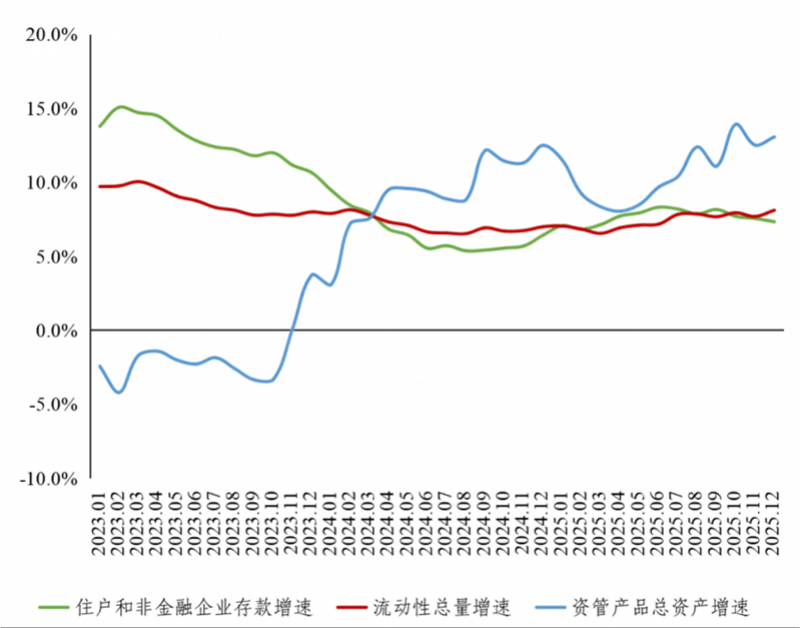
Core Insights - The discussion around the "50 trillion deposits maturing" has sparked widespread debate among residents regarding the reallocation of deposits [1] - The People's Bank of China (PBOC) released a report addressing the trends in the flow of these massive deposits [1] Group 1: Deposit Trends - In a low-interest-rate environment, there is a notable shift between asset management products and bank deposits, with the growth rates of these two categories showing an inverse relationship [2] - Since 2024, the one-year fixed deposit rate has decreased by 0.5 percentage points, while cash management products have maintained higher yields compared to bank deposits [2] Group 2: Asset Management Growth - By the end of 2025, the total assets in asset management reached 120 trillion yuan, marking a year-on-year increase of 13.1%, with an additional 13.8 trillion yuan added throughout the year [4] - The funds sourced from households and enterprises for asset management products reached 56.3 trillion yuan, reflecting a 9.7% year-on-year growth, which is 2.4 percentage points higher than the growth rate of household and enterprise deposits [4] Group 3: Fund Allocation - Over 80% of asset management products are directed towards fixed-income assets, with significant allocations to interbank deposits and certificates of deposit, totaling 28.7 trillion yuan by the end of 2025, which is an 18.9% increase [6] - The shift of deposits to asset management products does not imply a departure from the banking system, as most funds eventually return to banks, altering the structure of bank deposits rather than reducing overall deposits [6] Group 4: Diversification of Investments - Besides deposit-like assets, bonds, stocks, and non-standardized debt are also significant investment targets for asset management products, indicating a trend towards diversified asset allocation [6]

中信证券:今年存款到期后的去向猜想
Xin Lang Cai Jing· 2026-01-21 00:57
Core Viewpoint - The reallocation of a large amount of maturing bank deposits has garnered significant attention this year, with investors focusing on whether these deposits will remain in banks, migrate to low-risk asset management products, or move to equity markets [1][8]. Interest Rate Review - The central bank's monetary policy at the beginning of the year indicated a supportive stance, emphasizing that there is still room for rate cuts. Short-term interest rates have shown strength, while concerns about the supply of long-term special government bonds have led to fluctuations in long-term rates. The yield curve has steepened significantly, with the 30Y-10Y yield spread reaching a new high for 2023 [1][8]. Deposit Growth Trend Analysis - Since the second half of 2025, the growth rate of bank deposits has gradually declined, with a simultaneous contraction in the loan-to-deposit growth rate difference. The corporate sector has seen a notable decrease in fixed deposit growth and preference, while the household sector, despite a year-on-year decline, still maintains a high growth rate, indicating a "passive savings" behavior among residents [2][9]. Destination of Maturing Household Deposits: Savings Remain Dominant - Factors such as financial knowledge, income expectations, and perceptions of the macroeconomic environment have led to a cautious increase in residents' risk appetite. Most households continue to prioritize bank deposits, although there is a structural shift from long-term to short-term deposits and from large banks to smaller banks [3][9]. Destination of Maturing Household Deposits: Shift to Low-Risk Asset Management - Asset management products, particularly bank wealth management and insurance, are increasingly viewed as part of "broad savings." Following regulatory changes, the growth rate of broad savings has significantly outpaced GDP growth. The internal structure of broad savings has shifted, with bank wealth management and insurance products growing faster than traditional deposits [4][9]. Destination of Maturing Household Deposits: Limited Flow into Equity Markets - A small portion of risk-tolerant savings may flow into equity markets and products with equity-like features in pursuit of higher returns, but the short-term proportion is expected to remain low. The long-term sustainability of this trend is still uncertain [5][10]. Market Outlook - It is anticipated that over 40 trillion yuan of long-term deposits may become potential outflow funds, with most likely remaining within banks. The structural shift indicates a transition towards short-term deposits and smaller banks, with remaining funds primarily directed towards bank wealth management and insurance products, and a small portion towards equity markets. Growth in bank wealth management and insurance is expected to remain robust in 2026, but asset allocation strategies will be crucial in a low-interest-rate environment [6][10].


万亿级存款再配置!七个关键词看理财2025,展望2026
Nan Fang Du Shi Bao· 2026-01-07 03:44
Core Insights - The banking wealth management market in 2025 experienced significant structural changes and scale breakthroughs, with the total market size exceeding 30 trillion yuan, marking a historical high, and over 14 million new investors added [2] - The low interest rate environment has catalyzed a shift from reliance on single fixed-income products to multi-asset and multi-strategy layouts, with "fixed income plus" products gaining prominence [2][6] - Regulatory scrutiny intensified, leading to a notable increase in penalties for non-compliance, with a total of 61.4 million yuan in fines issued to eight wealth management subsidiaries [16] Low Interest Rates - In 2025, low interest rates became a defining characteristic of the banking wealth management market, with the central bank announcing further rate cuts, bringing deposit rates below 1% for one-year terms [3] Market Size and Growth - By the end of Q3 2025, the total market size of wealth management products reached 32.13 trillion yuan, an increase of 2.18 trillion yuan from the beginning of the year, with the number of investors holding these products rising to 139 million [6] Equity Investments - The A-share market showed strong growth in 2025, with some equity wealth management products yielding over 50%, and over 20 mixed equity products achieving returns exceeding 20% [7][8] Fixed Income Plus Products - "Fixed income plus" products became popular, characterized by a core of fixed-income assets supplemented by equities and other assets to enhance yield, with the scale of these products reaching approximately 9 trillion yuan, a 69% increase from the end of 2023 [11] Pension Wealth Management - The number of personal pension wealth management products expanded to 37, with a total scale surpassing 10 billion yuan, and an average annual return of 3.4% achieved since their inception [12][14] Management Changes - In 2025, the wealth management industry saw a wave of executive changes, with at least 15 out of 32 bank wealth management subsidiaries experiencing leadership transitions, reflecting the industry's maturation and the need for enhanced management capabilities [15] Regulatory Environment - The regulatory environment became more stringent, with a total of 61.4 million yuan in fines imposed on eight wealth management subsidiaries, highlighting the focus on compliance and the prevention of misleading practices in product marketing [16]

债市日报:12月25日
Xin Hua Cai Jing· 2025-12-25 08:50
Core Viewpoint - The bond market is experiencing fluctuations with a general downward trend, particularly in government bond futures, while short-term bonds continue to show strength. The overall liquidity remains manageable under the central bank's guidance, despite rising funding demands as the year-end approaches [1][4]. Market Performance - Government bond futures closed lower across the board, with the 30-year contract down 0.24% to 112.51, the 10-year contract down 0.02% to 108.195, and the 5-year contract down 0.03% to 105.99. The 2-year contract also fell by 0.02% to 102.51 [2]. - The yield on the 30-year government bond rose by 0.9 basis points to 2.2275%, while the 10-year bond yield increased by 1 basis point to 1.8980%. Conversely, the 1-year bond yield decreased by 2 basis points to 1.32% [2]. Overseas Bond Market - U.S. Treasury yields fell across the board, with the 2-year yield down 2.45 basis points to 3.506% and the 10-year yield down 2.73 basis points to 4.136%. In the Eurozone, the 10-year French bond yield decreased by 5.1 basis points to 3.559% [3]. Funding Conditions - The central bank conducted a reverse repurchase operation of 1,771 billion yuan at a fixed rate of 1.40%, resulting in a net injection of 888 billion yuan for the day. The central bank is also set to conduct a 4,000 billion yuan operation for 1-year MLF [4]. - Shibor rates showed mixed performance, with the overnight rate falling to 1.262%, the lowest since August 2023, while the 7-day rate rose to 1.4% [4]. Institutional Insights - CITIC Securities noted an improvement in bond market sentiment, with the 10-year government bond yield stabilizing below 1.85%. There is renewed market interest in the "cross-year market" as long-term bonds begin to recover [5]. - Huatai Fixed Income highlighted that post-2020, there has been an increase in precautionary savings among households, leading to a significant rise in long-term deposits in the banking system. The upcoming maturity of these deposits poses a re-pricing challenge [5]. - China International Capital Corporation (CICC) indicated that while there may be short-term pressure on wealth management products, demand for credit bonds is expected to remain stable due to ongoing needs for credit debt amidst fluctuating interest rates [6].