
存量资产运营

Search documents
百强房企洗牌或持续
21世纪经济报道· 2026-03-28 11:34
Core Viewpoint - The 2026 China Real Estate Top 100 Enterprises Research Report indicates that the real estate market is still in a phase of adjustment, with sales performance of top enterprises continuing to decline, reflecting a challenging environment for the industry [3][4]. Group 1: Market Performance - In 2025, the total sales revenue and sales area of the top 100 real estate companies were 32,605.2 billion yuan and 14,857.9 million square meters, representing year-on-year declines of 18.1% and 24.3% respectively [3]. - The market share of the top 100 enterprises was 38.8%, a decrease of 2.4 percentage points compared to the previous year [3]. - The sales performance of these enterprises is increasingly concentrated in core cities, with major contributions from cities like Shanghai, Beijing, Guangzhou, Hangzhou, Shenzhen, Chengdu, Wuhan, Xi'an, Nanjing, and Tianjin [3]. Group 2: Industry Challenges - The overall scale of the real estate industry continues to shrink, with funding for real estate companies weakening and liquidity becoming a pressing concern [4]. - The primary task for real estate companies is to ensure survival by increasing inventory reduction efforts, revitalizing existing assets, and maintaining moderate investment levels [4]. Group 3: Opportunities and Strategies - The "14th Five-Year Plan" period anticipates a total urban housing demand of approximately 4.98 billion square meters, with core cities continuing to attract population and improvement-driven demand becoming a key market driver [5]. - Urban renewal and operational services present opportunities for growth in the existing market, with significant investments planned for the renovation of old urban areas and infrastructure [5]. - Structural opportunities exist within the industry, with population concentration in key cities and improvement housing demand creating growth potential [5]. - Real estate companies are encouraged to optimize their business structures and adapt their development models based on their resources and capabilities, focusing on traditional development, urban renewal, and operational services [6].

服务即资产:存量时代资产运营的实施路径
Xin Lang Cai Jing· 2026-02-05 12:19
Core Insights - The property management industry is transitioning from focusing on new housing projects to emphasizing the management of existing assets and stock market operations due to a decline in the new housing market, with new housing starts expected to decrease by 20.4% year-on-year in 2025 [2][30] - The importance of value-added services in enhancing asset value and the necessity of implementing stock asset operations are highlighted as key strategies for property companies [2][30] Group 1: Concept and Value - Stock asset operation refers to a series of management activities aimed at maintaining and enhancing the value of completed real estate properties through professional management, services, renovations, and capital operations [3][31] - The value generated from stock asset operations includes maintaining asset pricing, enhancing owner experience, improving property fee collection rates, and contributing to social value through community governance [3][31][32] Group 2: Implementation Path - High-quality basic services are essential for asset preservation, acting as a "stabilizer" for asset value, while diversified value-added services serve as a "magnifier" and "accelerator" for enhancing asset value [6][34] - Successful examples, such as the Nanjing project by New Town Yue Service, demonstrate how quality property management can maintain property values even in declining markets, with the average second-hand house price remaining at 4.39 million yuan per square meter, higher than the opening price [9][36] Group 3: Execution Principles - Property companies must prioritize understanding the actual needs of owners when selecting value-added services, shifting from a supply-driven model to a demand-driven approach [11][38] - Establishing a systematic demand insight mechanism is crucial for capturing unspoken needs of owners, such as temporary storage or pet services, through various data collection methods [12][39] Group 4: Integrated Practices - The exploration of the "property service + life service" model has been encouraged by policies since 2021, aiming to integrate property services with various life services to enhance community asset operations [20][44] - The "property service into households" initiative aims to extend professional services into private home spaces, addressing specific household pain points and enhancing the trust and skill levels of property companies [23][48] Group 5: Case Studies - Various property companies are implementing innovative service models, such as the "One-stop Resource Integration Platform" by Country Garden Service, which combines multiple social service resources [21][47] - New Town Yue Service's "Yue XIN Home+" system provides professional in-home services, addressing daily household challenges and enhancing owner satisfaction [25][50]

60+新项目炸场,2026年上海商业大爆发!
3 6 Ke· 2026-02-04 03:26
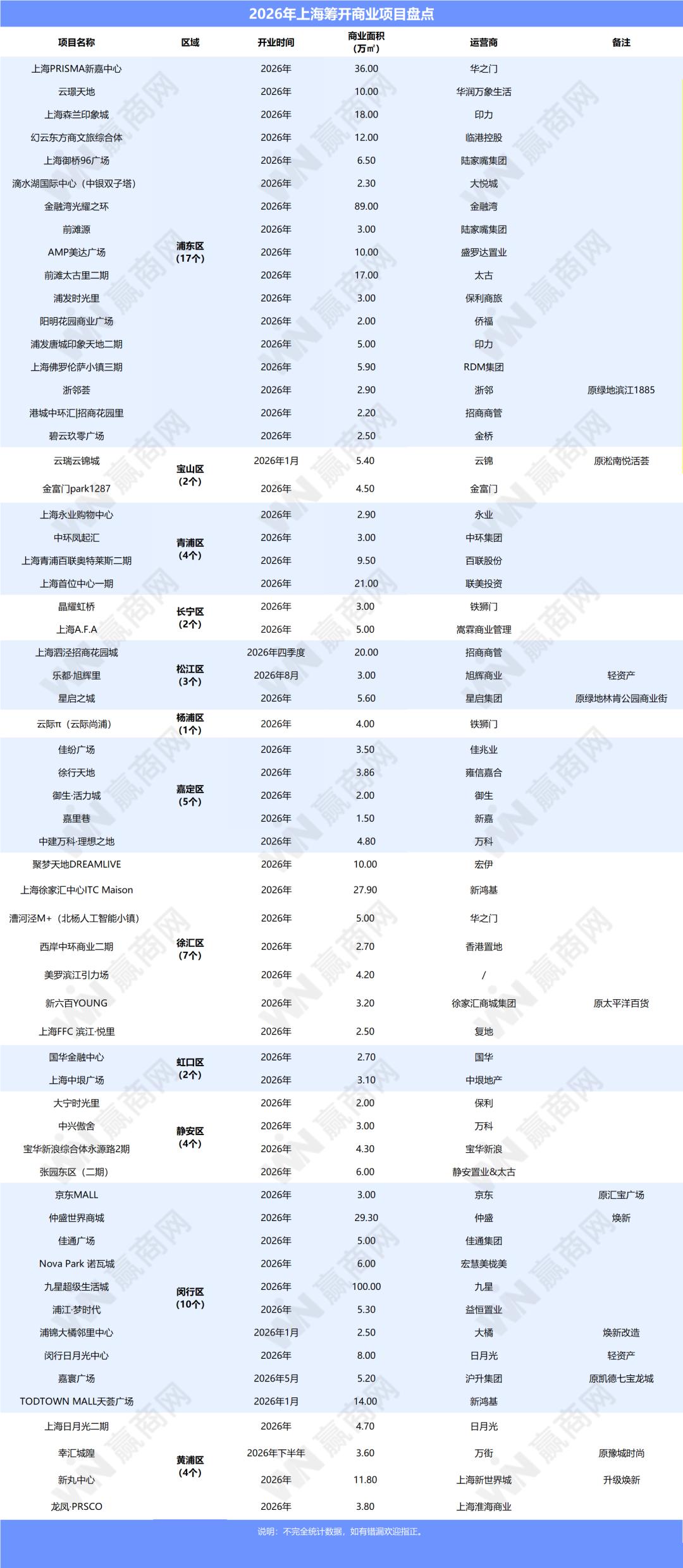
Core Insights - Shanghai is set to open over 60 commercial projects by 2026, showcasing a trend of high-speed and high-quality development in the commercial real estate sector [1] - The commercial market in Shanghai is characterized by regional diversification, size polarization, regular stock updates, and diverse operational entities [1] Group 1: Regional Distribution - Pudong leads with 17 upcoming projects, indicating a concentration of commercial supply, including major projects like the Financial Bay and PRISMA New Jia Center [6] - Minhang follows with 10 projects, featuring the notable 1 million square meter Nine Star Super Life City, while Xuhui, Huangpu, and Jing'an districts continue to see high-quality updates [6][4] - Peripheral areas such as Songjiang, Qingpu, Baoshan, and Jiading are also seeing multiple projects, reflecting a more balanced regional commercial landscape [6] Group 2: Size Polarization - The upcoming projects exhibit significant size polarization, with 9 large-scale projects over 150,000 square meters, accounting for nearly 15% of the total [9] - Notable large projects include Xujiahui Center ITC Maison (279,000 m²) and PRISMA New Jia Center (360,000 m²), which serve as regional commercial hubs [9] - Conversely, community and neighborhood commercial projects under 30,000 square meters also represent a substantial portion, emphasizing convenience and community service [11] Group 3: Stock Renewal - A significant portion of the upcoming projects involves stock renewal, indicating a shift towards operational management of existing assets [12] - Examples include the transformation of Pacific Department Store into New 600 YOUNG and the upgrade of various other existing properties [12] - This trend reflects the increasing importance of enhancing asset value through renovation and brand upgrades in a context of limited land resources [12] Group 4: Operational Entities - The operational landscape is characterized by a diverse competitive environment, with state-owned and local enterprises playing key roles in regional development and stock renewal [14] - Hong Kong-funded enterprises and professional commercial operators are also active, focusing on high-end consumption and innovative operational models [14] - The market is seeing an influx of new players and industry capital, contributing to a richer commercial ecosystem [14]
城市更新如何高质量推进?企业转型竞逐存量运营
Zhong Guo Jing Ying Bao· 2026-01-31 03:59
Core Insights - China's urban development is undergoing a fundamental shift from scale expansion to qualitative enhancement, with urban renewal becoming a national strategic path and a core direction for enterprises seeking new growth [1][2]. Group 1: Urban Development Transition - The central government has recognized a significant transition in urban development, moving from rapid urbanization to stable development, and from large-scale expansion to optimizing existing assets [2]. - The "14 trillion yuan" funding support for urban renewal during the 14th Five-Year Plan period is expected to be facilitated through budget funds and government bonds [2]. Group 2: Implementation of Urban Renewal - Urban renewal is now viewed as a systematic transformation rather than fragmented projects, emphasizing a shift from investment-driven to demand-driven approaches [2][3]. - Successful case studies, such as the transformation of idle buildings into public service spaces in Shenzhen and community upgrades in Zhejiang, illustrate diverse pathways and methodologies for urban renewal [3]. Group 3: Role of Local Governments and Financial Institutions - Local governments are encouraged to establish strong coordination mechanisms to break down departmental barriers and foster collaboration [4]. - Financial institutions are urged to innovate financial products to provide long-term, low-interest funding support for urban renewal initiatives [4]. Group 4: Market Opportunities and Challenges - The real estate market is expected to still have significant opportunities, with a shift in housing demand from quantity to quality, focusing on asset operation, urban renewal, and rental housing [4]. - Companies are increasingly focusing on niche markets and specialized operations to build new competitive advantages, particularly in the aging population sector, which presents a substantial market potential [6].
戴德梁行:2025年中国内地房地产大宗交易总成交规模1448亿元
Zhong Guo Xin Wen Wang· 2026-01-12 14:02
Core Insights - The total transaction scale of real estate bulk transactions in mainland China is projected to reach 144.8 billion yuan by 2025, indicating a significant market size [1] - The emergence of self-use buyers is reshaping the buyer structure in the market, with Beijing's bulk transaction scale expected to record 15 billion yuan, showing a phase of decline [1] Group 1: Policy and Market Dynamics - The China Securities Regulatory Commission and the National Development and Reform Commission will include super-grade and grade A office buildings, as well as four-star and above hotel projects in the public REITs pilot program by 2025 [1] - The expansion of the public REITs pilot program to include office buildings and hotels marks a new phase in the financialization of real estate in China, providing standardized and market-oriented exit channels for existing assets [1][2] - The shift from relying solely on development sales to a full-cycle capability competition in the market emphasizes the growing importance of professional services and value operations [1] Group 2: Future Growth and Market Trends - The potential and space for development in the real estate industry remain significant, with the era of large-scale expansion in urban real estate coming to an end [2] - Future growth in the real estate sector will increasingly come from refined operations of existing assets, quality upgrades in property services, and the regulated development of the rental market [2] - In 2025, the Beijing retail market will see the opening of 13 quality projects, adding over 1.1 million square meters of premium retail space, highlighting a focus on consumer experience and cultural integration [2]