
宏观政策加码

Search documents
铁矿石 继续下跌空间有限
Qi Huo Ri Bao· 2026-02-12 09:20
Core Viewpoint - After the recent price adjustment, iron ore valuations are at a neutral to low level, and with the dual support of steel mills' phased resumption after the holiday and expectations of macro policy strengthening, further downside is limited. However, throughout the year, iron ore is expected to enter a phase of oversupply, with price levels likely to decline further [1][10]. Group 1: Price Trends and Market Dynamics - Since the end of January, iron ore prices have declined primarily due to two reasons: changes in market expectations regarding interest rate cuts and liquidity easing after the appointment of the new Federal Reserve chairman, and cautious raw material restocking by steel mills, with iron ore inventories at 247 steel mills down by 5.2968 million tons year-on-year [2]. - As of February 11, the main iron ore futures contract closed at 762.5 yuan/ton, indicating limited further downside in the current price position [1][10]. Group 2: Production and Inventory Insights - Despite the impact of the Baosteel incident, the average daily pig iron output among 247 steel mills has remained between 2.27 million and 2.29 million tons this year, suggesting a potential for phased production increases as steel mills aim to meet annual production targets [3]. - With low iron ore inventories at steel mills, there is a high likelihood of increased restocking efforts once production resumes after the holiday [4]. Group 3: Supply and Demand Outlook - The first quarter is traditionally a low supply season for iron ore, with historical data indicating a decrease in shipments by 9.5 to 10 million tons compared to the previous quarter. However, due to fewer extreme weather events this winter and a later Spring Festival, January's global iron ore shipments remained high [6]. - The global iron ore shipment volume was 25.353 million tons in the first week of February, down by 5.593 million tons week-on-week, indicating a potential supply-demand mismatch in the weeks following the holiday [7]. Group 4: Policy and Economic Context - Expectations for policy strengthening remain, with the Central Economic Work Conference prioritizing domestic demand expansion as a key economic task for 2026. The People's Bank of China has already implemented a 0.25 percentage point reduction in structural monetary policy rates among other measures, with further policy support anticipated around the National People's Congress [8]. - The resilience of exports and gradual recovery in manufacturing demand may provide a boost to iron ore demand [8]. Group 5: Valuation and Long-term Projections - Current iron ore spot prices are around 100 USD/ton, which is near a five-year low. The profit margin for long-process rebar has widened to 126 yuan/ton compared to iron ore import profits, indicating that both absolute and relative valuations are at a neutral to low level [9]. - In the medium to long term, iron ore is expected to enter a phase of oversupply, with supply increases primarily from emerging mines and major producers. It is projected that iron ore supply will increase by 40 to 45 million tons by 2026, with a significant contribution from the Simandou project [9].

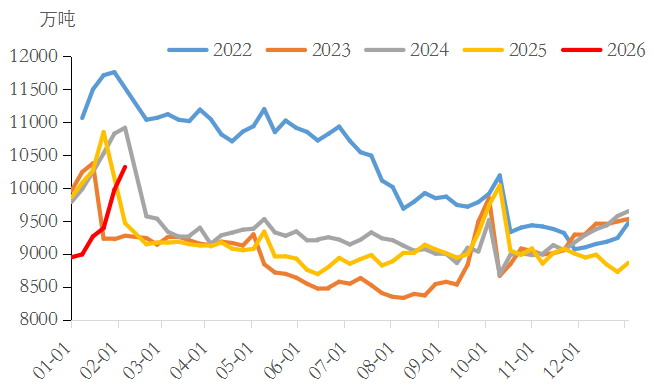
东海期货:铁矿石继续下跌空间有限
Qi Huo Ri Bao· 2026-02-12 00:39
Core Viewpoint - After the recent price adjustment, iron ore valuations are at a neutral to low level, and with the expected recovery of steel mills and macro policy support, further downside is limited. However, the market is expected to enter a phase of oversupply, leading to a downward shift in price levels throughout the year [1][8]. Group 1: Price Trends and Market Dynamics - Since the end of January, iron ore prices have declined due to two main reasons: changes in market expectations regarding interest rate cuts and liquidity, and cautious raw material restocking by steel mills, with iron ore inventories down by 5.2968 million tons year-on-year across 247 steel mills [2]. - As of February 11, the main iron ore futures contract closed at 762.5 yuan/ton, indicating limited further downside in the current price position [1][2]. Group 2: Production and Supply Factors - Despite a recent incident affecting production, the average daily pig iron output across 247 steel mills has remained stable between 2.27 million and 2.29 million tons. Steel mills are likely to increase production in the traditional demand season of March-April to meet annual production targets [3]. - The first quarter is typically a supply off-season for iron ore, with historical data showing a decrease in shipments by 9.5 to 10 million tons compared to the previous quarter. However, high shipment levels were maintained in January due to fewer extreme weather events [5]. Group 3: Policy and Economic Outlook - There are expectations for further macroeconomic policy support, particularly in light of the emphasis on expanding domestic demand in upcoming economic meetings. The People's Bank of China has already implemented measures to lower structural monetary policy rates [6]. - The anticipated recovery in manufacturing demand, coupled with resilient export performance, is expected to boost iron ore demand [6]. Group 4: Valuation and Future Projections - Current iron ore prices are around 100 USD/ton, which is near a five-year low. The profit margins for steel mills have improved, indicating that iron ore valuations are at a neutral to low level [7]. - In the medium to long term, the market is expected to transition into a phase of oversupply, with significant increases in supply projected from emerging mines and major producers. The expected increase in iron ore supply for 2026 is estimated to be between 40 to 45 million tons [8].
8月经济数据现短期波动,政策加码预期升温
第一财经· 2025-09-15 23:23
Core Viewpoint - In August, China's economy showed short-term fluctuations due to export pressures but demonstrated strong resilience and vitality, with expectations for macro policies to continue supporting growth [3][11]. Economic Performance - In August, the industrial added value of large-scale enterprises grew by 5.2% year-on-year, a slight decrease of 0.5 percentage points from July, marking the lowest since September 2024 [3]. - The total retail sales of consumer goods increased by 3.4% year-on-year, down 0.3 percentage points from July, representing the lowest growth rate this year [3]. - From January to August, fixed asset investment increased by 0.5% year-on-year, slowing down by 1.1 percentage points compared to the first seven months of the year [3]. New Growth Points - High-tech manufacturing added value grew by 9.5% year-on-year from January to August, with integrated circuit manufacturing and aerospace equipment manufacturing increasing by 22.3% and 14.6%, respectively [5]. - The production of industrial robots and civilian drones surged by 29.9% and 53.7%, respectively, indicating steady progress in intelligent and green transformation [5]. - Despite a nominal decline of 0.4% in industrial enterprises' export delivery value in August, the overall industrial production remained stable with ongoing cultivation of new productive forces [5][6]. Consumption Trends - The retail sales of consumer goods increased by 4.6% year-on-year from January to August, with service retail sales growing by 5.1% [8]. - In August, the retail sales of consumer goods rose by 3.4%, with non-automotive consumer goods retail sales increasing by 3.7% [8]. - The implementation of consumption promotion policies, such as trade-in programs, has stimulated consumer demand, leading to significant growth in related product sales [9]. Investment Landscape - From January to August, fixed asset investment (excluding rural households) reached 326.1 billion yuan, with a year-on-year growth of 0.5% [11]. - Manufacturing investment grew by 5.1% year-on-year, while infrastructure investment (excluding certain utilities) increased by 2.0% [11][12]. - Real estate investment continued to decline, with a cumulative drop of 12.9% in the first eight months, although signs of stabilization are emerging in the market [13]. Policy Outlook - Analysts expect new significant measures to be introduced in the fourth quarter, focusing on fiscal stimulus, interest rate cuts, and stronger support for the real estate market [3][14]. - The macro policy is characterized by a gradual and supportive approach, with an emphasis on stabilizing investment and promoting consumption to counteract economic pressures [14].
国泰海通 · 晨报0603|宏观、海外策略、食饮
国泰海通证券研究· 2025-06-02 12:31
Macro Overview - The global economic system is undergoing a reconstruction due to changes in the trust foundation, leading to a gradual "de-dollarization" primarily driven by non-economic factors such as international relations [2] - The long-term bull market for gold is expected to be historical and significant, as the trend of declining trust among countries is unlikely to change [2] - In the short to medium term, there are concerns about the potential further decline in the creditworthiness of the US dollar, with risks of rising real interest rates and inflation expectations [2] Domestic Macro - China's economy has significant potential in the medium to long term, but short-term demand needs to be boosted [2] - To achieve a growth target of around 5% in 2025, active policy measures are required, with expectations of continued marginal increases in macro policies, especially after July [2] Hong Kong Market Strategy - The AI industry cycle is expected to lead the Hong Kong stock market upward, similar to previous market cycles dominated by real estate, technology, and new energy [4] - The fundamentals of Hong Kong's technology sector are strong, with high capital expenditure and robust growth in cloud business revenues, indicating a favorable environment for performance acceleration [4][5] - The inflow of capital from mainland investors is expected to strengthen pricing power in the Hong Kong market, with institutional investors likely to drive future inflows [5] Food and Beverage Sector - The food and beverage sector is experiencing structural differentiation, with a focus on high-growth new consumption trends and a more rational approach to the liquor market [7] - The beer market is expected to recover as the peak season approaches, while the beverage sector is still in a phase of releasing single product potential [7] - The structural growth in consumer goods is evident, with a notable performance in leisure foods and improvements in the income of seasoning and dairy products [7]

宝城期货国债期货早报-20250507
Bao Cheng Qi Huo· 2025-05-07 02:36
Report Summary 1. Report Industry Investment Rating No relevant content provided. 2. Core View of the Report - The report expects treasury bond futures to fluctuate strongly in the short term as the expectation of macro - policy intensification is rising and the domestic interest - rate cut expectation is approaching. The 4 - month manufacturing PMI data decline indicates that subsequent growth - stabilizing policies will gradually increase, and with the recent appreciation pressure on the RMB, the conditions for an interest - rate cut are relatively sufficient, despite the reduced necessity for a rate cut due to strong travel data during the May Day holiday and uncertain overseas factors [4]. 3. Summary by Related Catalogs 3.1 Variety View Reference - Financial Futures Stock Index Sector - For the TL2506 variety, the short - term view is "oscillation", the medium - term view is "oscillation", the intraday view is "oscillation with an upward bias", and the reference view is "range oscillation". The core logic is the weakening of the manufacturing PMI and the increasing expectation of an interest - rate cut [1]. 3.2 Main Variety Price and Market Driving Logic - Financial Futures Stock Index Sector - The varieties include TL, T, TF, and TS. The intraday view is "oscillation with an upward bias", the medium - term view is "oscillation", and the reference view is "range oscillation". The core logic is that treasury bond futures oscillated narrowly yesterday. Strong travel data during the May Day holiday showed strong macro - economic resilience, reducing the necessity for an interest - rate cut. Overseas tariff war disturbances have weakened marginally, and the Fed's interest - rate cut expectation is still unclear, which disturbs the central bank's interest - rate cut expectation. However, the weakening of the April manufacturing PMI data indicates that subsequent growth - stabilizing policies will increase, and with the RMB appreciation pressure, the conditions for an interest - rate cut are sufficient [4].