
市场采购贸易方式

Search documents
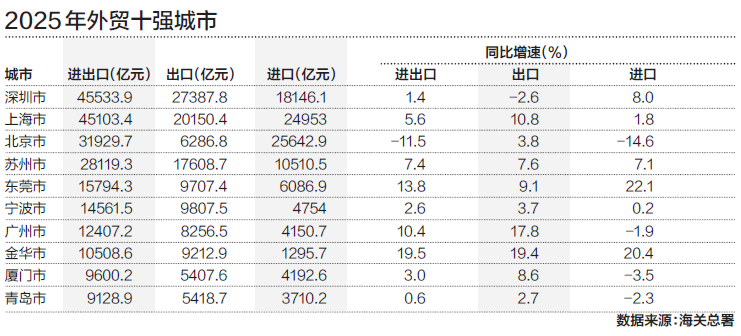
2025年外贸十强城市出炉
Di Yi Cai Jing Zi Xun· 2026-01-22 12:47
Core Insights - The article highlights the competitive landscape of China's foreign trade cities in 2025, with established cities maintaining their positions while showing significant internal competition [2] - Shenzhen and Shanghai remain the only cities with foreign trade volumes exceeding 4.5 trillion yuan, collectively accounting for about 20% of the national total [2] - The article emphasizes the remarkable growth of Kinhua, which has become the eighth city to surpass the trillion yuan mark in foreign trade, showcasing a strong performance in exports to Africa and ASEAN [4][5] Group 1: Foreign Trade Rankings - The top ten cities for foreign trade in 2025 are Shenzhen, Shanghai, Beijing, Suzhou, Dongguan, Ningbo, Guangzhou, Kinhua, Xiamen, and Qingdao [2] - Dongguan regained its fifth position in the rankings, while Kinhua rose from tenth to eighth place, marking a significant achievement [2] - The Yangtze River Delta and the Pearl River Delta regions are well represented, with four and three cities respectively in the top ten [2] Group 2: Trade Performance Data - Shenzhen's total foreign trade volume reached 4.55 trillion yuan, with a slight increase of 1.4% [3] - Shanghai's foreign trade volume was 4.51 trillion yuan, showing a growth of 5.6% [3] - Kinhua's foreign trade volume surpassed 1 trillion yuan for the first time, with a growth rate of 19.5% [4] Group 3: Kinhua's Export Growth - Kinhua's exports to Africa reached over 151 billion yuan, growing by 27.9%, and accounted for 41.2% of Zhejiang's exports to Africa [4] - The city also saw significant growth in exports to ASEAN, with a rate of 38.0%, and to the EU, Middle East, and Latin America, with growth rates of 23.5%, 20.2%, and 16.8% respectively [4] - Kinhua's market procurement exports reached 599.17 billion yuan, marking a 27.0% increase and contributing significantly to the city's overall export growth [5] Group 4: Dongguan and Ningbo's Performance - Dongguan's high-tech product exports reached approximately 338.11 billion yuan, with a year-on-year growth of 17.2% [7] - Ningbo achieved a foreign trade total of 1.46 trillion yuan, marking a 2.6% increase, with notable growth in the export of "new three samples" products [6] - Dongguan's private enterprises accounted for over 60% of the city's total foreign trade, with a growth rate of 20.9% [7]


2025年外贸十强城市出炉,金华入列“外贸万亿之城”
Di Yi Cai Jing· 2026-01-22 12:12
Core Insights - The article highlights the significant growth in foreign trade for cities like Dongguan, Guangzhou, and Jinhua, with all three experiencing double-digit increases in import and export volumes [2][5]. Group 1: Foreign Trade Rankings - The top ten cities in China's foreign trade for 2025 remain unchanged, including Shenzhen, Shanghai, Beijing, Suzhou, Dongguan, Ningbo, Guangzhou, Jinhua, Xiamen, and Qingdao [2]. - Shenzhen and Shanghai are the only cities with foreign trade volumes exceeding 4.5 trillion yuan, collectively accounting for about 20% of the national total [2]. - Dongguan regained its fifth position in the rankings, while Jinhua rose from tenth to eighth, becoming China's eighth "foreign trade trillion city" [2]. Group 2: Trade Performance Data - In 2025, Jinhua's foreign trade reached 1.05 trillion yuan, with exports at 921.3 billion yuan and imports at 129.6 billion yuan, marking year-on-year growth rates of 19.5%, 19.4%, and 20.4% respectively [5][6]. - Dongguan's high-tech product exports reached approximately 338.1 billion yuan, growing by 17.2% year-on-year, while its total import and export volume exceeded 900 billion yuan [9]. - Ningbo achieved a foreign trade total of 1.46 trillion yuan in 2025, with a growth rate of 2.6%, maintaining a decade-long growth streak [8]. Group 3: Market Diversification and Emerging Markets - Jinhua's exports to Africa exceeded 151 billion yuan, growing by 27.9%, and accounted for 41.2% of Zhejiang's exports to Africa [5]. - Yiwu, known as the "world factory," contributed significantly to Jinhua's trade, with its foreign trade volume reaching 836.5 billion yuan, a 25.1% increase [6]. - Yiwu's trade with emerging markets such as Africa, Latin America, and ASEAN showed substantial growth, with increases of 23.4%, 14.1%, and 46.7% respectively [7].
无票也能合规出口?1039报关模式实操指南,中小外贸人必藏
Sou Hu Cai Jing· 2025-12-25 08:44
Core Viewpoint - The article discusses the 1039 market procurement trade model, which is designed to provide a compliant export channel for small and medium-sized foreign trade businesses, addressing their pain points and offering a simplified process for exporting goods [1][3]. Group 1: Understanding 1039 - The 1039 model is a customs supervision code tailored for small commodity exports, characterized by low thresholds, fast processes, and favorable tax conditions [3]. - It is defined as a trade method where goods are procured in recognized market clusters and exported by qualified operators, simplifying the export process for small businesses [3]. Group 2: Advantages of 1039 - The 1039 model addresses three major pain points for small foreign trade businesses compared to traditional trade methods, making it a "lifesaver" for these companies [3]. - Key benefits include exemption from VAT, significantly improved customs efficiency, and unrestricted foreign exchange collection, allowing for faster capital turnover [3][4]. Group 3: Operational Process - The operational process for 1039 involves three main steps: 1. Subject registration to obtain a "compliance ID" by registering as an individual business in a pilot market and completing customs registration [4]. 2. Product registration to ensure traceability by entering product details into the trade information platform [4]. 3. Customs declaration and foreign exchange collection by working with experienced customs brokers to follow simplified rules [4]. Group 4: Common Misunderstandings - There are several misconceptions about the 1039 model that businesses should avoid, including the belief that all products can be exported under this model, that no taxes are due, and that registration is unnecessary [5]. - It is crucial to understand that certain products are prohibited from export, VAT exemption applies only to VAT, and registration is mandatory to avoid penalties [5].

市场采购贸易方式助中小微企业抢抓“节日经济”机遇
Zhong Guo Xin Wen Wang· 2025-12-24 11:04
Core Viewpoint - The market procurement trade model is facilitating small and micro enterprises in seizing opportunities from the "holiday economy" by simplifying export processes and enhancing efficiency in exporting holiday goods [1][3]. Group 1: Market Procurement Trade Model - The market procurement trade model allows for flexible export methods, simplified declaration procedures, exemption from value-added tax, and flexible foreign exchange collection, making it an ideal solution for small and micro enterprises exporting holiday products [1][3]. - A batch of holiday decorations worth 12,000 yuan was quickly exported to Singapore through this model, highlighting its efficiency in meeting the short sales window for holiday goods [1]. Group 2: Export Statistics and Support - In the first 11 months of the year, the Guangzhou Customs reported that the market procurement trade model facilitated the export of holiday goods worth 39.898 million yuan, representing a year-on-year increase of 104% [3]. - The Guangzhou Customs is actively supporting local small and micro enterprises by forming specialized teams to assist with on-site operations and providing real-time solutions for classification and declaration issues through interactive WeChat groups [3].

前9月广州市场采购贸易方式出口同比劲增45.7%
Zhong Guo Xin Wen Wang· 2025-10-11 07:40
Core Insights - The export value of market procurement trade in Guangzhou reached 7.78 billion yuan in the first nine months of the year, marking a year-on-year increase of 45.7% [1][2] - Major product categories include furniture accessories, clothing, footwear, lighting, and bags [1] Group 1: Market Procurement Trade Characteristics - Market procurement trade is defined as a trade method where eligible operators procure goods valued at 150,000 USD or below per customs declaration in designated market aggregation areas [1] - This trade method features simplified declaration procedures, convenient export customs clearance, exemption from value-added tax, and flexible foreign exchange collection, making it suitable for small-scale transactions and diverse product categories [1] Group 2: Support for SMEs - Guangzhou has over 500 specialized markets, with more than 110 markets generating over 100 million yuan in annual transaction volume, collectively exceeding 200 billion yuan [1] - To better support small and micro enterprises in expanding into international markets, Guangzhou Customs has initiated a regulatory model for exporting pre-packaged food and cosmetics through market procurement trade [2] - Since the pilot program began, Guangzhou Customs has facilitated the export of pre-packaged food valued at 88.54 million yuan and cosmetics valued at 1.275 million yuan through this trade method [2]
7.5元转卖T恤给老外,常熟老板年入千万
21世纪经济报道· 2025-09-20 02:25
Core Viewpoint - The article highlights the success of a small business owner in Changshu, who has built a profitable export business by acting as an intermediary, purchasing low-cost clothing and selling it overseas, leveraging a digital platform for streamlined operations [1][4][11]. Group 1: Business Model - The business model involves purchasing clothing at low prices (e.g., T-shirts at 4.8 yuan) and selling them at a markup (e.g., 7.5 yuan), focusing on high volume sales to achieve significant annual revenue (approximately 10 million yuan) [7][8]. - The owner, Chen Yue, operates without production, instead sourcing inventory from suppliers in Indonesia and selling to clients in the Philippines, demonstrating a low-overhead approach to international trade [5][7]. Group 2: Digital Platform Utilization - The "Shicaitong" platform, launched in 2019, provides a comprehensive service for small and micro enterprises, facilitating various aspects of international trade such as customs clearance, logistics, and payment processing [8][11]. - This platform has enabled over 40,000 small and micro foreign trade entities to export goods to 177 countries, with a cumulative export value exceeding 90 billion yuan, showcasing its effectiveness in simplifying cross-border trade [11]. Group 3: Market Challenges and Adaptations - The article notes that the business environment has become more challenging, with previous clients generating higher sales volumes, indicating a shift in market dynamics [7]. - Despite these challenges, the use of the "Shicaitong" platform has allowed businesses like Chen's to operate more securely and legally, addressing issues related to compliance and payment risks in international transactions [9][11].
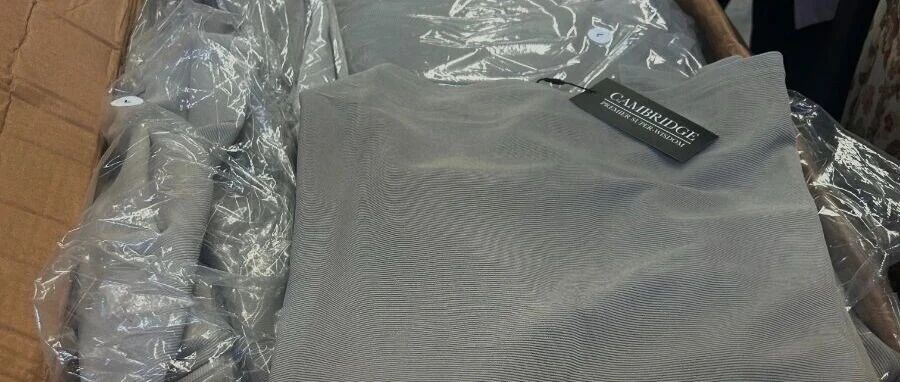
7.5元转卖T恤给老外,常熟老板年入千万
2 1 Shi Ji Jing Ji Bao Dao· 2025-09-19 14:09
Core Viewpoint - The article highlights the success of a small business owner, Chen Yue, who operates as a middleman in the clothing export industry, leveraging a digital platform to streamline operations and increase profitability without engaging in production [1][3][8]. Group 1: Business Model - Chen Yue's business model involves purchasing clothing at low prices (e.g., T-shirts at 4.8 yuan) and selling them at a markup (7.5 yuan), focusing on high volume sales to achieve significant annual revenue [1][4]. - The business primarily exports to Southeast Asia and the United States, with annual sales reaching approximately 10 million yuan and a profit margin of around 15% [4]. Group 2: Operational Efficiency - The use of the "Shicaitong" platform since 2019 has allowed Chen Yue to manage logistics, customs, and payment processes efficiently, reducing the complexity and risks associated with traditional export methods [8][9]. - The platform provides a one-stop service that connects various regulatory bodies, facilitating compliance and reducing costs for small and micro enterprises [9]. Group 3: Market Trends - The article notes a decline in business performance compared to previous years, indicating a challenging market environment for small exporters [5]. - Despite the challenges, the digital platform has enabled many small businesses to engage in compliant cross-border trade, addressing issues related to invoicing and payment security [7][9]. Group 4: Platform Impact - The "Shicaitong" platform has served over 40,000 small and micro foreign trade entities, helping them export goods to 177 countries and regions, with a cumulative export value exceeding 90 billion yuan [9]. - The platform charges a fee of 0.6% on sales, making it a cost-effective solution for small businesses to access international markets [9].
7.5元转卖T恤年入千万,常熟老板轻松卖全球丨活力中国调研行
2 1 Shi Ji Jing Ji Bao Dao· 2025-09-19 10:10
Core Insights - The article highlights the success of a businessman in Changshu, who generates an annual income of 10 million yuan by purchasing and reselling low-cost T-shirts to overseas clients, particularly in the Philippines [1][6]. Group 1: Business Model - The businessman, Chen Yue, operates as a middleman in foreign trade, focusing on wholesale and some retail, without engaging in production [4]. - He sources T-shirts from Indonesia at a price of 4.8 yuan each and sells them for 7.5 yuan, earning a profit of 2.7 yuan per shirt through high volume sales [1][6]. - The T-shirts are sold to clients in the Philippines, who then retail them at approximately 30 yuan each [6]. Group 2: Export Process - Chen's goods are shipped to the Philippines within four days, and they are available for sale within a week [2]. - The logistics, including customs clearance and tax reporting, are managed by the "Shicaitong" platform, allowing Chen to focus on sales [2][10]. Group 3: Market Trends - The article notes a decline in business compared to previous years, with Chen mentioning that he used to have a Hong Kong client generating several tens of millions annually [7]. - Chen's domestic sales also contribute significantly, with an estimated revenue of 3 to 4 million yuan, supplemented by live-streaming sales on platforms like Douyin [8]. Group 4: Platform Benefits - The "Shicaitong" platform, launched in 2019, provides a comprehensive service for small and micro enterprises, facilitating compliance in cross-border trade [10][11]. - The platform has served over 40,000 small and micro foreign trade entities, helping them export goods to 177 countries and regions, with a cumulative export value exceeding 90 billion yuan [12].
稳量提质 外贸向新丨市场采购新模式破解散货订单出口痛点 助力全省小商品走向全球大市场
He Nan Ri Bao· 2025-09-07 23:33
Core Insights - The article highlights the successful export of crane parts worth approximately 63,000 yuan by Changyuan City Investment and Export Service Co., marking the first use of the "one hat for the whole province" business model under the market procurement trade pilot in Xuchang City [1][2] Group 1 - The market procurement trade model is designed for small and micro foreign trade enterprises, offering low entry barriers, simplified declaration procedures, high customs efficiency, and reduced overall costs [1][2] - Currently, Xuchang City is the only pilot area for the market procurement trade model in the province, which has led to a collaborative development path for local enterprises to explore international markets [1] - The "one hat for the whole province" model allows Changyuan City Investment and Export Service Co. to connect with local small and micro enterprises needing export services, facilitating their registration and export activities [1] Group 2 - This model serves as a bridge for small and micro enterprises lacking international trade capabilities to engage with international buyers, addressing challenges such as compliance for exports without input invoices [2] - Xuchang Customs plans to continue optimizing regulatory services and promote the "market procurement + industrial belt" model to expand exports of local specialty products, thereby opening new export channels for more small and micro enterprises [2]
小商品城: 2025年半年度报告
Zheng Quan Zhi Xing· 2025-08-17 16:11
Core Viewpoint - The report highlights the financial performance and strategic initiatives of Zhejiang China Commodities City Group Co., Ltd. for the first half of 2025, showcasing growth in revenue and net profit while emphasizing the company's role in facilitating international trade and supporting small and medium enterprises [1][11]. Company Overview and Financial Indicators - The company reported a revenue of approximately 7.71 billion yuan, representing a year-on-year increase of 13.99% compared to 6.77 billion yuan in the same period last year [2][3]. - The total profit reached approximately 2.15 billion yuan, up 12.45% from 1.91 billion yuan [2][3]. - The net profit attributable to shareholders was approximately 1.69 billion yuan, reflecting a 16.78% increase from 1.45 billion yuan [2][3]. - The net cash flow from operating activities surged to approximately 1.38 billion yuan, a significant increase of 1,109.17% compared to 114.36 million yuan [2][3]. - The total assets decreased by 2.00% to approximately 38.38 billion yuan, while the net assets attributable to shareholders slightly decreased by 0.54% to approximately 20.39 billion yuan [2][3]. Industry and Business Situation - The company operates within the "Rental and Business Services" sector, specifically in the "Business Services" category, and is recognized as a global hub for small commodity trade [11]. - Yiwu International Commodity City is noted for its significant market transaction volume and diverse product offerings, supporting over 2 million small and micro enterprises and employing approximately 32 million workers [11]. - The company aims to enhance trade efficiency and reduce costs by building a shared trade service platform for global SMEs, focusing on three ecosystems: commodity display and trading, supporting services, and trade services [4][11]. Strategic Initiatives and Developments - The company is advancing the construction of a global digital trade center, integrating various functions to create a new digital trade ecosystem [11][12]. - The Chinagoods platform has registered over 5.1 million buyers, covering more than 200 countries and regions, and is enhancing trade efficiency through AI technology [13][14]. - The company is actively expanding its global footprint, particularly in emerging markets, and has opened new overseas warehouses and exhibition halls [17][18]. Financial Services and Innovations - The company’s payment service, YiPay, has seen a significant increase in cross-border payment volumes, exceeding 2.5 billion USD, with a year-on-year growth of over 47% [18][19]. - YiPay is enhancing its service capabilities by integrating advanced technologies for secure and efficient payment solutions [18][19]. Competitive Advantages - The company benefits from its first-mover advantage in the small commodity market, having established a robust ecosystem that supports trade flows and logistics [20]. - The brand "Yiwu China Commodities City" is recognized as a famous trademark, enhancing the company's influence and market position [20]. - The company has developed a comprehensive service network, including logistics and exhibition services, which supports its competitive edge in the market [20][21].
