电子元件

Search documents
2025年中德货物进出口1.51万亿元人民币
Ren Min Ri Bao· 2026-02-25 22:13
Core Insights - In 2025, the trade volume between China and Germany reached 1.51 trillion RMB, marking a 5.2% increase from 2024, with China exporting 846.3 billion RMB and importing 664.3 billion RMB from Germany, reaffirming Germany as China's largest trading partner in Europe [1] Trade Volume and Growth - The total trade volume between China and Germany in 2025 was 1.51 trillion RMB, a growth of 5.2% compared to 2024 [1] - Exports from China to Germany amounted to 846.3 billion RMB, while imports from Germany totaled 664.3 billion RMB [1] Product Categories - The import and export of electromechanical products between China and Germany reached 1.07 trillion RMB, representing a 5.8% increase from 2024 and accounting for 70.8% of the total trade volume [1] - Specific product exports included automobiles and parts at 131.5 billion RMB (12.3% of electromechanical trade), electronic components at 74 billion RMB, computers and parts at 73.8 billion RMB, and measuring and analytical instruments at 59.8 billion RMB [1] - In the pharmaceutical sector, imports and exports of medicinal materials and drugs reached 65.7 billion RMB, while basic organic chemicals totaled 18.4 billion RMB [1] - Emerging products such as 3D printers and industrial robots had trade volumes of 2.6 billion RMB and 1 billion RMB, respectively [1] Strategic Partnership - China and Germany are described as comprehensive strategic partners, with deep industrial integration and mutually beneficial economic cooperation, providing tangible benefits to both countries' enterprises and citizens [1]
2025年中德货物进出口1.51万亿元
Sou Hu Cai Jing· 2026-02-25 10:36
Core Insights - In 2025, the trade volume between China and Germany is projected to reach 1.51 trillion yuan, representing a 5.2% increase from 2024, with exports to Germany at 664.3 billion yuan and imports from Germany at 846.3 billion yuan [1] Trade Dynamics - Germany remains China's largest trading partner in Europe, with China regaining its position as Germany's largest trading partner after a year [1] - The import and export of electromechanical products between China and Germany is expected to reach 1.07 trillion yuan in 2025, marking a 5.8% increase from 2024 and accounting for 70.8% of the total trade volume [1] Product Breakdown - Within the electromechanical trade, automotive and parts exports/imports are projected at 131.5 billion yuan, constituting 12.3% of the electromechanical trade [1] - Other significant product categories include electronic components (74 billion yuan), computers and parts (73.8 billion yuan), and measurement and analysis instruments (59.8 billion yuan) [1] - In the pharmaceutical sector, imports and exports of medicinal materials and drugs are expected to reach 65.7 billion yuan, while basic organic chemicals will account for 18.4 billion yuan [1] - Emerging fields such as 3D printers and industrial robots are projected to have trade volumes of 2.6 billion yuan and 1 billion yuan, respectively [1] Strategic Partnership - The relationship between China and Germany is characterized as a win-win, all-encompassing strategic partnership, with deep industrial integration and mutually beneficial economic cooperation [1]
去年中德货物进出口1.51万亿元,机电产品占贸易规模的70.8%
Sou Hu Cai Jing· 2026-02-25 10:30
Core Insights - In 2025, the trade volume between China and Germany is projected to reach 1.51 trillion yuan, representing a 5.2% increase from 2024, with exports to Germany amounting to 664.3 billion yuan and imports from Germany totaling 846.3 billion yuan [1] Trade Dynamics - Germany remains China's largest trading partner in Europe, with China regaining this status after a year [1] - The import and export of electromechanical products between China and Germany is expected to reach 1.07 trillion yuan in 2025, marking a 5.8% increase from 2024 and accounting for 70.8% of the total trade volume [1] - Specific product categories include automotive and parts exports/imports at 131.5 billion yuan (12.3% of electromechanical trade), electronic components at 74 billion yuan, computers and parts at 73.8 billion yuan, and measuring and analytical instruments at 59.8 billion yuan [1] Emerging Sectors - Trade in pharmaceuticals and basic organic chemicals is projected at 65.7 billion yuan and 18.4 billion yuan, respectively, while emerging sectors like 3D printers and industrial robots are expected to see trade volumes of 2.6 billion yuan and 1 billion yuan [1] Strategic Partnership - China and Germany are described as comprehensive strategic partners, with deep industrial integration and mutually beneficial economic cooperation that brings tangible benefits to both countries' enterprises and citizens [1]
去年中德货物进出口1.51万亿元 机电产品占贸易规模的70.8%
Yang Shi Xin Wen· 2026-02-25 09:56
Core Insights - In 2025, the trade volume between China and Germany is projected to reach 1.51 trillion yuan, representing a 5.2% increase from 2024, with exports to Germany amounting to 664.3 billion yuan and imports from Germany totaling 846.3 billion yuan [1] - Germany remains China's largest trading partner in Europe, marking China's return to this position after a year [1] - The trade in electromechanical products between China and Germany is expected to reach 1.07 trillion yuan in 2025, a 5.8% increase from 2024, accounting for 70.8% of the total trade volume [1] Trade Details - The import and export of automobiles and their parts is projected to be 131.5 billion yuan, making up 12.3% of the electromechanical trade [1] - Exports of electronic components, computers and their parts, and measuring and testing instruments are expected to be 74 billion yuan, 73.8 billion yuan, and 59.8 billion yuan respectively [1] - The trade in pharmaceuticals and basic organic chemicals is expected to reach 65.7 billion yuan and 18.4 billion yuan respectively, while emerging products like 3D printers and industrial robots are projected to have trade volumes of 2.6 billion yuan and 1 billion yuan [1] Strategic Partnership - China and Germany are described as comprehensive strategic partners with deep industrial integration, benefiting both countries' enterprises and people through mutually beneficial economic cooperation [1]
富民幸福工坊“织”出好日子
Xin Lang Cai Jing· 2026-02-23 19:42
Core Insights - The establishment of "Happiness Workshops" in Changzhi Town aims to retain local labor and boost economic development through job creation and local production [1][4][5] Group 1: Workshop Operations - Five "Happiness Workshops" have been established in Changzhi Town, with the first one, Hengxiang Umbrella Workshop, already operational and producing umbrellas for export [1][2] - The workshops are designed with various functional areas and facilities, including air conditioning and rest areas, to support local workers [2] - In 2025, the workshops are projected to produce 2.2 million umbrellas, increasing to 3.5 million in 2026, with raw materials sourced from various provinces [2] Group 2: Economic Impact - The workshops have generated over 18 million yuan in annual output value and have created stable employment for over 150 local workers, with more than 30 working from home [2][4] - The five workshops collectively are expected to drive local employment for over 400 individuals and generate an estimated annual output value exceeding 37.9 million yuan [4] - The workshops follow a model that connects enterprise development with community welfare, addressing local employment challenges and supporting low-income families [4] Group 3: Future Developments - Changzhi Town is actively seeking project funding to build an industrial park for the "Happiness Workshops," aiming to expand the production chain and increase job opportunities [5]


【新春走基层·欢乐闹新春】港口不打烊
Zhong Guo Jing Ji Wang· 2026-02-22 22:37
Core Insights - The ports in China are operating at full capacity during the Lunar New Year, reflecting strong economic activity and a surge in international trade [1][2][3] Port Operations - At Qingdao Port, there has been a significant increase in container ship arrivals, with over 1,000 vessels docking in January and nearly 240 shipping routes connecting to over 700 ports worldwide [3][4] - The port has seen a rise in container throughput, with 8,000 TEU (Twenty-foot Equivalent Units) vessels arriving regularly, indicating a robust demand for exports [2][3] - The operational efficiency at Tianjin Port has improved, with an average vessel stay time reduced by approximately 16% compared to the previous year [8][9] International Trade - The Zhejiang China-Europe Railway Express (Yi Xin Ou) has reported a 13.1% increase in the number of trains dispatched in January, with 346 trains carrying 28,000 TEU, showcasing the growing importance of rail logistics [4][5] - The variety of goods transported via the Yi Xin Ou service has expanded, including automotive engines and imported products like wine and dairy, enhancing domestic market offerings [5] Technological Advancements - The Huanghua Port has implemented fully automated coal unloading processes, achieving significant efficiency gains, with a complete unloading of a 108-car coal train in just 1.5 hours [10][11] - The port is transitioning from traditional operations to smart and green practices, utilizing big data and AI for predictive analytics and optimized scheduling [11] Regional Development - Hunan Province has established a port group to consolidate resources and enhance competitiveness, aiming for a cargo throughput of over 90 million tons by 2025, reflecting a 17% year-on-year growth [7] - The overall cargo throughput in January for Hunan's ports reached 6.54 million tons, with a 4.7% increase, indicating a positive trend in regional port development [7]
突发特讯!美国通告全球:白宫确认终止部分关税措施,引发全球高度关注
Sou Hu Cai Jing· 2026-02-21 09:48
Group 1 - The U.S. Supreme Court's ruling has caused significant turmoil in international trade, with the termination of nine tariff measures under the International Emergency Economic Powers Act, affecting goods worth 17% of the U.S. annual import total [1][3] - Following the ruling, President Trump announced a new temporary 10% tariff on all imports under Section 301 of the Trade Act of 1974, which, while lower than previous tariffs, applies broadly to all trading partners [3][5] - The transition period between the old and new policies has created confusion in supply chains, with companies facing decisions on whether to declare goods under old or new tax rates, impacting at least $370 million worth of goods in transit [5] Group 2 - Trump's announcement of potential Section 301 investigations targeting countries accused of technology theft raises concerns about future tariffs, which could escalate to as high as 100% for specific industries [7] - The European Union is preparing for both the immediate 10% global tariff and potential investigations that could target strategic sectors like pharmaceuticals and aerospace, indicating a dual defensive strategy [7] - The current situation highlights vulnerabilities in the global trade system, where sudden policy changes can disrupt finely-tuned supply chains, yet the market has reacted positively to the lower 10% tariff compared to the previous 25% punitive tariffs [7]

都认为中国会赢:美国以为手中的牌比中国多,但它错了
Sou Hu Cai Jing· 2026-02-21 08:52
Group 1 - The trade friction between the US and China, which began in 2018, has led to significant global attention, with many experts suggesting that the US underestimated China's economic resilience and supply chain strength [1][3] - The US initially imposed tariffs on steel and aluminum, followed by additional tariffs on Chinese goods, but these measures resulted in increased costs for American consumers and farmers, while China successfully found alternative markets [3][4] - China's trade surplus with the US is projected to reach a new high of $1 trillion by 2025, indicating that the US's strategy to reshape its manufacturing base through tariffs has not been effective [4][6] Group 2 - Experts argue that the US's inconsistent policies have led to a perception that China is a more reliable partner, causing other countries to shift their trade relationships towards China [6][9] - The trade war has prompted China to enhance its technological self-sufficiency, particularly in sectors like semiconductors, as the US's restrictions have spurred increased domestic investment [3][11] - The global trade landscape has shifted, with countries initially aligning with the US now adopting a more cautious approach, recognizing China's strength and resilience in the face of trade pressures [9][11] Group 3 - The US's talent outflow, particularly in fields like artificial intelligence, has been exacerbated by policies that inadvertently push skilled professionals back to China [7] - China's strategic response to the trade war includes diversifying its markets and strengthening economic ties with emerging markets, which enhances its global influence [11] - The ongoing trade tensions have highlighted the vulnerabilities in the US economy, particularly its reliance on Chinese manufacturing, as the US struggles to find alternatives for many Chinese imports [6][11]
美国与印尼达成贸易协议 将对该国征收19%关税
Yang Shi Xin Wen· 2026-02-20 09:05
Core Points - The Trump administration has finalized a reciprocal trade agreement with Indonesia aimed at expanding U.S. market access for goods in manufacturing, agriculture, and the digital economy [2] - Indonesia will eliminate tariffs on over 99% of U.S. export products, while the U.S. will maintain a 19% reciprocal tariff rate on Indonesia, with some specific products enjoying zero tariffs [2] - The agreement includes approximately $33 billion in commercial cooperation, comprising about $15 billion in U.S. energy procurement, $13.5 billion in aviation and related products, and over $4.5 billion in U.S. agricultural products [2] Trade Details - The agreement will result in the U.S. eliminating tariffs on 1,819 Indonesian export goods, including key products such as palm oil, coffee, cocoa, spices, rubber, electronic components, semiconductors, and aircraft parts [2] - A tariff quota mechanism will allow Indonesian textile and apparel products to also benefit from zero tariffs [2] - The trade deficit for U.S. goods with Indonesia is projected to be $23.7 billion by 2025 [2] Implementation Timeline - The agreement will officially take effect 90 days after both countries complete their legal procedures, including consultations with the Indonesian parliament [3]

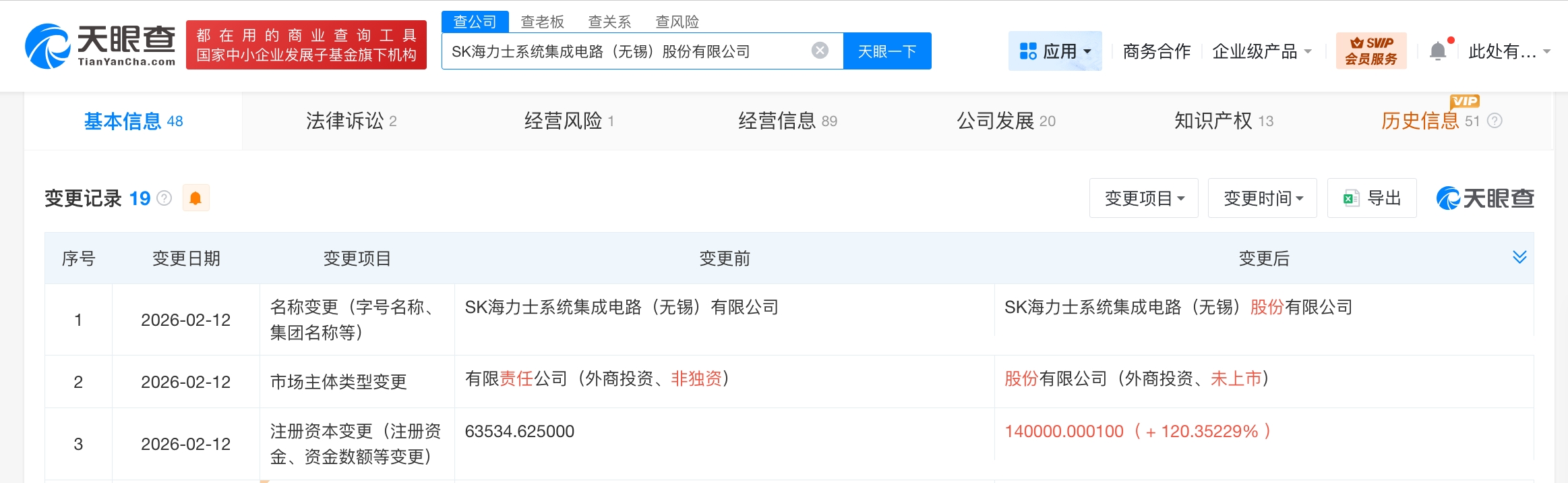
SK海力士系统集成电路公司增资至14亿美元
Mei Ri Jing Ji Xin Wen· 2026-02-13 06:54
Core Viewpoint - SK Hynix System Integrated Circuit (Wuxi) Co., Ltd. has undergone a business change, including a name change and a significant increase in registered capital, indicating a strategic expansion in its operations [1]. Group 1: Company Changes - The company name has changed from SK Hynix System Integrated Circuit (Wuxi) Co., Ltd. to SK Hynix System Integrated Circuit (Wuxi) Co., Ltd. [1][3] - The registered capital has increased from approximately $635 million to $1.4 billion, representing a growth of about 120% [1][2]. Group 2: Company Background - Established in August 2018, the company is involved in the production, sales, import, and export of integrated circuits and electronic components, along with providing related technical services [1][3]. - The legal representative of the company is Shin Hee-tae [1][3]. - The company is jointly owned by SK Hynix System IC Inc., Wuxi Industrial Development Group Co., Ltd., Ningbo Gao Yi Phase III Venture Capital Partnership (Limited Partnership), and Wuxi Gao Yi Haisheng Investment Partnership (Limited Partnership) [1].