弱现实与强预期

Search documents
浮法玻璃周报:分析师范阿骄-20260320
Hong Ye Qi Huo· 2026-03-20 07:34
1. Report Industry Investment Rating - No relevant information provided 2. Core View of the Report - The float glass market presents a typical contradiction between "weak reality and strong expectations." The spot market has issues such as scattered post - holiday orders, pressure on payment collection, and a slow resumption of work for downstream deep - processing enterprises. However, on the supply side, capacity adjustment is underway with some production lines being shut down and some being ignited. In the first quarter, the supply is on a downward trend. The glass futures may maintain a volatile pattern in the short term, and the market is in a stage of seeking a new balance point in the supply - demand game [3]. 3. Summary According to Relevant Catalogs 3.1 Float Glass Market Analysis - **Futures Performance**: The main glass futures contract FG2605 is in a weak and volatile consolidation, with a slight downward shift in the center of gravity. Due to factors such as the under - expected recovery of terminal real - estate demand, weak spot market transactions, and continuous pressure on factory inventories, the futures price lacks upward momentum. Although there is some support from the cost side, the downstream's willingness to purchase is low, and some funds reduce their positions when the price rises. The glass futures price maintains a weak and volatile trend, and the short - term view is still dominated by weak demand [3]. - **Supply Side**: As of March 19, the float glass industry's开工率 was 70.41%, a decrease of 0.68 percentage points from last week. The capacity utilization rate decreased by 0.55% to 73.25%. The daily output of float glass decreased by 0.75% week - on - week to 145,800 tons, and the weekly output was 1.0223 million tons, a decrease of 1.06% week - on - week and 7.9% year - on - year. Two glass production lines were shut down this week, and the supply continued to decline, with the daily output hitting a multi - year low [3]. - **Demand Side**: Downstream demand is average, with phased replenishment and general procurement enthusiasm. The order follow - up of downstream processing enterprises is insufficient, and most purchase on demand, keeping inventory at a low level. As of March 11, the resumption rate of 10,692 construction sites nationwide was 42.5%, a 19 - percentage - point increase week - on - week but a 5.2% decrease compared to the same period in the lunar calendar, indicating that the real - estate recovery is under - expected [3]. - **Inventory**: As of March 19, 2026, the total inventory of national float glass sample enterprises was 74.436 million heavy boxes, a decrease of 1.413 million heavy boxes week - on - week, a decrease of 1.86% week - on - week and an increase of 7.16% year - on - year [3]. - **Cost and Profit**: The weekly average profit of float glass using natural gas as fuel was - 87.12 yuan/ton, an increase of 19.57 yuan/ton week - on - week; the weekly average profit of float glass using coal - made gas as fuel was - 22.24 yuan/ton, an increase of 17.14 yuan/ton week - on - week; the weekly average profit of float glass using petroleum coke as fuel was - 21.78 yuan/ton, a decrease of 14.28 yuan/ton week - on - week [3]. - **Market Outlook**: The float glass market is in a stage of seeking a new balance point in the supply - demand game. The short - term glass futures may maintain a volatile pattern and seek support around the cost price. The core contradiction lies between the weak reality (high inventory, weak demand) and the strong expectations (cost support, policy - driven production cuts) [3]. 3.2 Float Glass Futures - The report provides the closing price chart of the FG main contract from October 22, 2025, to March 18, 2026, and the trading volume and open interest chart of the FG contract [5][6]. 3.3 Float Glass Price - The report shows the price charts of national average price, North China, East China, and Central China from January 3, 2024, to March 3, 2026, and the closing price chart of the FG main contract from October 22, 2025, to March 18, 2026 [9][11]. 3.4 Float Glass Basis - The report presents the basis charts of the Shahe area and Central China, including the basis, the main contract price, and the market price [14]. 3.5 Float Glass Supply - The report shows the float glass开工率 chart from the 1st week to the 51st week in 2024, 2025, and 2026, the weekly output chart from the 1st week to the 51st week in 2024, 2025, and 2026, the factory inventory chart, the Shahe inventory chart, and the regional inventory charts of North China, East China, Central China, and South China [16][17][18][19][21]. 3.6 Float Glass Demand - The report provides the order days chart of glass deep - processing manufacturers from January 15 to November 30 in 2022 - 2026, the apparent consumption chart from January 2024 to October 2025, the commercial housing transaction area chart from September 6, 2024, to March 6, 2026, the real - estate fund arrival situation chart from December 2000 to December 2025, the real - estate data chart from February 2022 to February 2026, and the chart of real - estate completion and glass apparent consumption from January 2019 to January 2025 [23][24][25][26][28][29]. 3.7 Glass Cost and Profit - The report shows the float glass profit chart using coal, petroleum coke, and natural gas as fuels from February 26, 2021, to February 26, 2026, and the profit and output chart from August 27, 2021, to August 27, 2025 [31][32].
浮法玻璃周报:分析师范阿骄-20260313
Hong Ye Qi Huo· 2026-03-13 10:31
1. Report Industry Investment Rating - No relevant information provided 2. Core View of the Report - The glass futures market shows a short - term volatile pattern, seeking support around the cost price. The core contradiction lies between the "weak reality" (high inventory, weak demand) and the "strong expectation" (cost support, policy - driven production cuts). The market is in a triple tug - of - war of cost support, high inventory suppression, and capital game. The current valuation is relatively low, but the upside is limited by weak actual demand. Investors should closely monitor changes in supply and demand [4]. 3. Summary According to Related Catalogs 3.1. Market Analysis - **Futures Market**: This week, the glass futures price showed a volatile trend of first falling and then rising. The market is seeking a balance between fundamental pressure and policy expectation support. It is characterized by short - term emotional drive, with the features of rising and then falling and wide - range fluctuations. The futures show an obvious forward premium structure, and the basis between futures and spot deepens, indicating high pressure in the spot market but relatively optimistic long - term expectations in the futures market [4]. - **Spot Market**: The spot market presents a typical contradiction of "weak reality and strong expectation". After the holiday, orders are generally scattered, and there are still problems with payment collection. The resumption of work in downstream deep - processing enterprises is slow, and large - scale procurement has not started [4]. 3.2. Supply - Side Situation - The daily output of national float glass this week was 146,900 tons, a decrease of 10,800 tons compared with the previous week. The operating rate of the float glass industry was 71.09%, a decrease of 0.1% compared with the previous week. Some production lines are undergoing capacity adjustments, with both line shutdowns (such as Wuhai Zhongbo Line 1, Hebei Zhengda Line 2) and startups (Shahe Anquan New Line 6) [4]. 3.3. Demand - Side Situation - The demand is in a recovery state. The operating rate of LOW - E glass sample enterprises was 43.7%, an increase of 14.4% compared with the previous week. In the North China region, the overall shipment has improved compared with the previous period, and the inventory has decreased. In the Shahe area, driven by market sentiment, middle - stream ordering and downstream replenishment have led to a high production - sales rate of enterprises. In the Central China market, downstream enterprises have gradually resumed work, and with the drive of sentiment, the overall production - sales rate of original glass enterprises has exceeded 100%, and the inventory pressure has been alleviated [4]. 3.4. Inventory Situation - As of March 12, 2026, the total inventory of national float glass sample enterprises was 75.849 million heavy boxes, a decrease of 3.788 million heavy boxes compared with the previous week, a decrease of 4.76% compared with the previous week, and an increase of 7.96% compared with the same period last year [4]. 3.5. Cost - Profit Situation - This week, the average weekly profit of float glass using natural gas as fuel was - 106.69 yuan/ton, a decrease of 1.57 yuan/ton compared with the previous week; the average weekly profit of float glass using coal - made gas as fuel was - 39.38 yuan/ton, a decrease of 3.09 yuan/ton compared with the previous week; the average weekly profit of float glass using petroleum coke as fuel was - 7.50 yuan/ton, a decrease of 34.29 yuan/ton compared with the previous week [4]. 3.6. Policy and External Factors - Under the influence of the Middle East conflict, energy costs have increased, and energy supply has been disrupted. Coupled with the expected production cuts driven by policies, it provides certain support for glass prices. With the advancement of the "15th Five - Year" green transformation plan, the glass industry is facing structural adjustment. Leading enterprises such as Nanbo A's layout in the fields of energy - saving glass and the photovoltaic industry chain may reshape the industry pattern. The policies may lead to clear production - cut measures in the glass industry, but the implementation time is not clear [4].
豆粕交易逻辑为弱现实与强预期 短期或宽幅震荡
Jin Tou Wang· 2025-08-21 08:09
Group 1 - The main contract for soybean meal futures experienced a sharp decline, reaching a low of 3105.00 yuan, closing at 3113.00 yuan with a drop of 1.05% [1] - Various institutions have differing short-term outlooks for soybean meal, with Zhengxin Futures predicting a strong short-term fluctuation, Hualian Futures expecting wide fluctuations, and Jianxin Futures maintaining a strong medium-term outlook [2][3][4] Group 2 - Zhengxin Futures highlights a market dynamic of weak reality versus strong expectations, noting that a large volume of imported soybeans will ensure sufficient soybean meal supply, but potential supply-demand gaps in Q4 due to US-China tariffs and reduced US soybean production could drive up import costs [2] - Hualian Futures points out that weather conditions in the Midwest may affect soybean yield, with a significant number of soybean pods reported in Nebraska, while Indiana's pod count is slightly lower than last year but still at historical highs [3] - Jianxin Futures notes that recent favorable factors include the anti-dumping investigation against Canadian canola, which may hinder canola imports, and the continued 23% tariff on US soybeans, suggesting that while Brazil may partially fill the supply gap, rising import costs are likely [4]
安粮期货投资早参-20250623
An Liang Qi Huo· 2025-06-23 02:26
Report Industry Investment Ratings No relevant content provided. Core Views - The stock index market is in a "weak reality and strong expectation" situation, with a "range - bound" strategy recommended, and attention should be paid to the key support levels of Shanghai Composite 50 and CSI 300 [2]. - For crude oil, high attention should be paid to the development of the Israel - Iran conflict, and the WTI main contract should focus on the pressure around $78 per barrel [3]. - Gold is in a sensitive intersection area of fundamentals and technicals, and without major geopolitical events, it is expected to be in high - level oscillations, with attention on US CPI data from July to August and the Israel - Iran conflict [4][5]. - Silver is in a correction range, with high volatility. Attention should be paid to the weekly support around $35.5 per ounce of the COMEX silver main contract [6]. - PTA may fluctuate in the short - term following the cost side [7]. - Ethylene glycol may have a range - bound operation in the short - term [8]. - PVC has a weak fundamental situation, and the risk of sentiment decline should be vigilant [10]. - PP has no improvement in fundamentals, and the risk of sentiment decline should be vigilant [12]. - Plastic has a weak fundamental situation, and the risk of sentiment decline should be vigilant [13]. - Soda ash should be treated with a bottom - oscillation mindset in the short - term [15]. - Glass can be treated with a strong - oscillation mindset in the short - term [16]. - Rubber's rebound height is limited, and attention should be paid to the downstream starting rate and the rebound height of the energy - chemical sector [17][18]. - Methanol's futures price may be in a strong - oscillation state in the short - term, and attention should be paid to the port inventory reduction rhythm and downstream demand recovery [19]. - Corn's main contract is in an upward channel and may be in a strong - oscillation state in the short - term [20]. - Peanut's main contract price is difficult to have a trending market in the short - term and should be treated as a range - bound operation [21]. - Cotton's price may be in a strong - oscillation state in the short - term, and attention should be paid to whether it can fill the previous gap [22]. - For live pigs, attention should be paid to whether the 2509 contract can break through the upper pressure level, and continuous attention should be paid to the slaughter situation [24]. - Eggs may still face pressure after a short - term rebound, and it is recommended to wait and see [25]. - Bean No. 2 may be in a strong - oscillation state in the short - term [26]. - Bean meal may be in a range - bound state in the short - term [27]. - Bean oil may be in a strong - oscillation state in the short - term [28]. - For copper, it is recommended to hold, using the lower neckline of the copper price island as the defense line [29][30]. - For aluminum, aggressive investors can hold moderately, while conservative investors should wait and see [30][31]. - Alumina's 2509 contract shows a weak adjustment trend [32]. - Cast aluminum alloy's 2511 contract may maintain a range - bound operation [33]. - For lithium carbonate, conservative investors should wait and see, while aggressive investors can operate within the range [35]. - Industrial silicon's 2509 contract is in bottom - level oscillations [36]. - Polysilicon's 2507 contract may be in a weak - oscillation state, and short - selling on rallies is advisable [37]. - Stainless steel is in a low - level wide - range oscillation, and it is recommended to wait and see [38]. - Rebar has a low overall valuation, and a light - position long - on - dips strategy is recommended in the short - term [39]. - Hot - rolled coil has a low overall valuation, and a light - position long - on - dips strategy is recommended in the short - term [41]. - Iron ore's main contract may maintain an oscillation pattern in the short - term, and attention should be paid to the port inventory reduction speed and steel mill restart rhythm [42]. - Coking coal and coke's main contracts may oscillate in the near future, and attention should be paid to steel mill inventory reduction and policy implementation [43]. Summary by Category Stock Index - Macro environment: The current situation shows a "weak reality and strong expectation" differentiation, with external disturbances suppressing market risk appetite and domestic economic data showing "weak recovery" characteristics [2]. - Market analysis: The margin trading balance - to - floating market capitalization ratio remains low, with funds flowing to small - and medium - cap stocks [2]. - Reference view: Adopt a "range - bound" strategy and pay attention to key support levels [2]. Crude Oil - Macro and geopolitics: The Israel - Iran conflict is the key factor affecting oil prices, and the price is fluctuating at a high level [3]. - Market analysis: The approaching summer peak season and declining US inventories support price increases, and the risk premium will change with the development of the conflict [3]. - Reference view: Focus on the pressure around $78 per barrel of the WTI main contract [3]. Gold - Macro and geopolitics: High - interest rate expectations suppress gold, while the Israel - Iran conflict and potential tariff increases drive up safe - haven demand [4]. - Market analysis: Gold prices have fallen under pressure this week, with the game between bulls and bears intensifying [4][5]. - Reference view: Treat it as high - level oscillations, and pay attention to US CPI data and the Israel - Iran conflict [5]. Silver - Market price: Spot silver has fallen into a correction range [6]. - Market analysis: Hawkish Fed statements and changes in geopolitical risk appetite affect silver, and industrial demand and inventory are also important factors [6]. - Reference view: Pay attention to the support level and be vigilant against price fluctuations [6]. Chemicals PTA - Spot information: The spot price in East China has increased, and the basis is positive [7]. - Market analysis: The cost side is strong, but the supply - demand contradiction is prominent, and demand is in the off - season [7]. - Reference view: Fluctuate following the cost side in the short - term [7]. Ethylene Glycol - Spot information: The spot price in East China has increased, and the basis is positive [8]. - Market analysis: The supply side shows an "internal increase and external decrease" pattern, and demand is in the off - season [8]. - Reference view: Range - bound operation in the short - term [8]. PVC - Spot information: The spot price in East China has increased, and the price difference between ethylene and electricity has decreased [10]. - Market analysis: Supply capacity utilization has decreased, demand is mainly for rigid needs, and inventory has decreased [10]. - Reference view: Weak fundamentals, be vigilant against sentiment decline [10]. PP - Spot market: Spot prices in different regions have increased [11]. - Market analysis: Supply capacity utilization has increased, demand has decreased, and inventory has increased [12]. - Reference view: No improvement in fundamentals, be vigilant against sentiment decline [12]. Plastic - Spot market: Spot prices in different regions show different trends [13]. - Market analysis: Supply capacity utilization has decreased slightly, demand has a mixed performance, and inventory has decreased [13]. - Reference view: Weak fundamentals, be vigilant against sentiment decline [13]. Soda Ash - Spot information: Spot prices in different regions are stable [14]. - Market analysis: Supply has increased, inventory has increased, and demand is average [14]. - Reference view: Bottom - level oscillations in the short - term [15]. Glass - Spot information: Spot prices in different regions are stable [16]. - Market analysis: Supply is relatively stable, inventory has increased, and demand is weak [16]. - Reference view: Strong - oscillation mindset in the short - term [16]. Rubber - Market price: Different types of rubber have different prices [17]. - Market analysis: Affected by market sentiment and fundamentals, supply is loose, and demand is affected by trade policies [17]. - Reference view: Pay attention to downstream starting rates and the rebound height of the energy - chemical sector [18]. Methanol - Spot information: Different regions have different spot prices [19]. - Market analysis: Futures prices have increased, port inventory has decreased, supply is at a high level, and demand has recovered unevenly [19]. - Reference view: Oscillate strongly in the short - term, pay attention to inventory and demand [19]. Agricultural Products Corn - Spot information: There are different purchase prices in different regions [20]. - Market analysis: The USDA report is slightly positive, domestic supply pressure has decreased, and demand is weak [20]. - Reference view: Strong - oscillation in the short - term [20]. Peanut - Spot price: Spot prices vary in different regions [21]. - Market analysis: The bio - fuel policy affects the market, and the supply - demand situation is weak in the short - term [21]. - Reference view: Range - bound operation in the short - term [21]. Cotton - Spot information: Spot prices are at a certain level [22]. - Market analysis: The USDA report is positive, domestic supply is expected to be loose, and demand is in the off - season [22]. - Reference view: Range - bound and strong operation in the short - term, pay attention to the gap [22]. Live Pigs - Spot market: The average price is stable [23]. - Market analysis: Supply is sufficient, demand is low, and farmers have a strong price - holding sentiment [23][24]. - Reference view: Pay attention to whether the contract can break through the upper pressure level and the slaughter situation [24]. Eggs - Spot market: The average price is stable [25]. - Market analysis: Supply is sufficient, demand is in the off - season, and there is a short - term rebound demand [25]. - Reference view: Pressure after a short - term rebound, wait and see [25]. Bean No. 2 - Spot information: There are different import costs for soybeans from different countries [26]. - Market analysis: The bio - fuel breakthrough and weather affect the market [26]. - Reference view: Strong - oscillation in the short - term [26]. Bean Meal - Spot information: Spot prices vary in different regions [27]. - Market analysis: Macro, international, and domestic supply - demand factors affect the market, with supply pressure and strong demand [27]. - Reference view: Range - bound in the short - term [27]. Soybean Oil - Spot information: Spot prices vary in different regions [28]. - Market analysis: International factors and domestic supply - demand affect the market, and inventory pressure is increasing [28]. - Reference view: Strong - oscillation in the short - term [28]. Metals Copper - Spot information: The price of electrolytic copper has decreased, and the import copper ore index has fallen [29]. - Market analysis: Fed policies, geopolitics, and domestic policies affect the market, and the copper market is in a resonance state [29][30]. - Reference view: Hold and use the support line for defense [30]. Aluminum - Spot information: The spot price of aluminum has decreased [30]. - Market analysis: Fed policies, geopolitics, sufficient supply, and off - season demand affect the market [30]. - Reference view: Aggressive investors can hold moderately, conservative investors wait and see [31]. Alumina - Spot information: The average price has decreased [32]. - Market analysis: Supply is excessive, demand is mainly for rigid needs, and inventory is high [32]. - Reference view: Weak adjustment trend [32]. Cast Aluminum Alloy - Spot information: The spot price has decreased [33]. - Market analysis: Cost support and off - season inventory accumulation are contradictory factors [33]. - Reference view: Range - bound operation [33]. Lithium Carbonate - Spot information: The prices of battery - grade and industrial - grade lithium carbonate have decreased [34]. - Market analysis: Cost, supply, and demand factors affect the market, and the fundamentals have not improved significantly [34][35]. - Reference view: Conservative investors wait and see, aggressive investors operate within the range [35]. Industrial Silicon - Spot information: Market prices are stable [36]. - Market analysis: Supply is increasing, demand is in the off - season, and the price is under pressure [36]. - Reference view: Bottom - level oscillations [36]. Polysilicon - Spot information: Prices are stable [36]. - Market analysis: Supply has increased, demand is weak, and the supply - demand contradiction is still prominent [36]. - Reference view: Weak - oscillation, short - selling on rallies [37]. Black Metals Stainless Steel - Spot information: The spot price is stable [38]. - Market analysis: The technical trend is changing, and fundamentals are weak with supply pressure and poor demand [38]. - Reference view: Low - level wide - range oscillation, wait and see [38]. Rebar - Spot information: The spot price has increased [39]. - Market analysis: The market is changing from a resistive decline to an oscillation, with low inventory and a low valuation [39]. - Reference view: Low valuation, long - on - dips in the short - term [39]. Hot - Rolled Coil - Spot information: The spot price has increased [40][41]. - Market analysis: The technical trend is stabilizing, with low inventory and a low valuation [41]. - Reference view: Low valuation, long - on - dips in the short - term [41]. Iron Ore - Spot information: Indexes and prices are at a certain level [42]. - Market analysis: Supply is affected by hurricanes and domestic production reduction, demand is weak, and inventory and policies affect the price [42]. - Reference view: Oscillation pattern in the short - term, pay attention to inventory and steel mill restart [42]. Coal - Spot information: Spot prices have decreased [43]. - Market analysis: For coking coal, supply has decreased, demand is weak, and the price is under pressure; for coke, supply and demand are both weak [43]. - Reference view: Oscillation in the near future, pay attention to inventory and policies [43].
【工业硅】期现双红又是“昙花一现”?局势要转继续看供需“脸色”??
Sou Hu Cai Jing· 2025-05-12 15:31
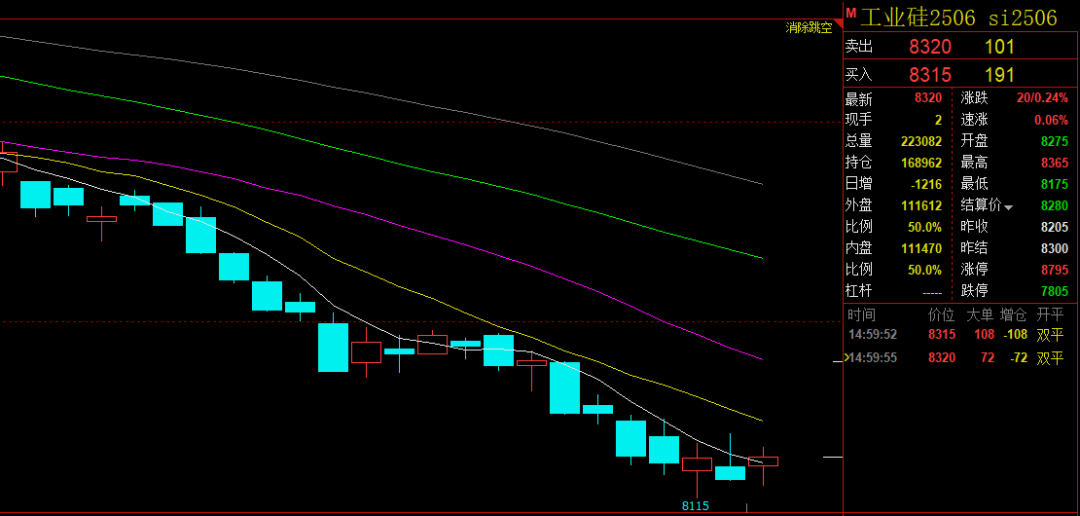
Group 1 - The industrial silicon futures market showed a positive trend with the main contract closing at 8320, up 20 from the previous day, reflecting a 0.24% increase [1] - The total trading volume for the main contract was 223,082 lots, with an open interest of 168,962 lots, and a total open interest of 467,743 lots [1] - The market sentiment improved due to favorable macroeconomic news and a reduction in pessimism, leading to a rebound in prices [3] Group 2 - In the spot market, prices for industrial silicon in various regions showed slight increases, with 421 in Yunnan at around 10,500 yuan/ton and 441 in Kunming at approximately 10,200 yuan/ton [3] - The overall market is experiencing a supply-demand imbalance, with expectations of increased production as the wet season approaches, which may continue to test the market [3][7] - The polysilicon market remained stable, while the organic silicon market showed a weak trend with slight adjustments in some product prices [5] Group 3 - The current industrial silicon market is characterized by a "weak reality and strong expectations" dynamic, with short-term price pressures likely to persist [7] - Close attention is needed on inventory reduction efforts by companies and policy developments to gauge future market trends [7]