
区间震荡

Search documents
宝城期货股指期货早报(2026年3月11日)-20260311
Bao Cheng Qi Huo· 2026-03-11 02:05
Group 1: Industry Investment Rating - No information available Group 2: Core Viewpoints - The short - term view of the stock index is mainly range - bound. The policy continues to be favorable to stabilize the economic fundamentals, and the domestic macro - economy has strong resilience. Although there is uncertainty in the future evolution path of the US - Iran conflict, its impact will weaken marginally [1][5] Group 3: Summary by Relevant Catalogs 1. Variety Viewpoint Reference - Financial Futures Stock Index Sector - For IH2603, the short - term view is "oscillation", the medium - term view is "oscillation", the intraday view is "bullish", and the reference view is "range - bound". The core logic is that policies continue to be favorable to stabilize the economic fundamentals [1] 2. Main Variety Price Market Driving Logic - Financial Futures Stock Index Sector - The intraday view of IF, IH, IC, and IM is "bullish", the medium - term view is "oscillation", and the reference view is "range - bound". The core logic is that the stock indexes closed up in oscillation yesterday. Trump's hint that the Iran war is about to end pushed the crude oil price to drop sharply from a historic high, and the Asia - Pacific stock markets rebounded sharply on Tuesday. The concerns of investors about long - term tight crude oil supply have eased, and the negative expectations of the global economy falling into stagflation risk and the hindrance of the central bank's monetary easing rhythm have weakened. The domestic macro - economy has strong resilience, the price level is relatively moderate, the central bank implements a moderately loose monetary policy, and the policy is expected to support aggregate demand and technological innovation, providing strong support for the stock index [5]
【申万宏源策略 | 一周回顾展望】从“第一阶段上行”向“区间震荡”过渡
申万宏源证券上海北京西路营业部· 2026-03-09 02:09
Core Viewpoint - The article discusses the transition from the "first phase of upward movement" to a "range-bound fluctuation" in the market, indicating a shift in market dynamics and investor sentiment [2] Group 1: Market Trends - The market has shown signs of stabilizing after a period of growth, suggesting that investors may need to adjust their strategies accordingly [2] - Recent economic indicators point towards a mixed outlook, with some sectors performing well while others face challenges [2] Group 2: Sector Analysis - Certain sectors are expected to outperform due to favorable economic conditions, while others may experience stagnation or decline [2] - The article highlights specific industries that are likely to benefit from current market trends, providing insights into potential investment opportunities [2]


双硅价格大幅震荡,供给过剩格局仍存
Hua Tai Qi Huo· 2026-03-05 06:26
Group 1: Report Industry Investment Rating - No relevant content Group 2: Core Views - Industrial silicon prices are expected to maintain range - bound oscillations, with a supply - demand dual - weak pattern. The upward potential depends on downstream demand recovery and inventory reduction, while the downward space is limited by cost support and production cut expectations [2] - Polysilicon prices are expected to continue weak oscillations, with an oversupply situation persisting due to weak demand and high inventory [6] Group 3: Market Analysis of Industrial Silicon - On March 4, 2026, the industrial silicon futures price oscillated upward, with the main contract 2605 opening at 8240 yuan/ton and closing at 8515 yuan/ton, a change of 3.46% from the previous day's settlement. The main contract 2605 held 310668 positions at the close, and the number of warehouse receipts on March 3, 2026, was 20779, a change of - 7 compared to the previous day [1] - Industrial silicon spot prices fell. East China oxygen - permeable 553 silicon was at 9000 - 9100 (- 50) yuan/ton; 421 silicon was at 9500 - 9600 (- 50) yuan/ton, Xinjiang oxygen - permeable 553 price was 8400 - 8600 (- 50) yuan/ton, and 99 silicon price was 8400 - 8600 (- 50) yuan/ton. The silicon prices in some regions were flat, and the 97 silicon price was stable [1] - As of February 26, the total social inventory of industrial silicon in major regions was 560,000 tons, a 0.54% increase from the previous week [1] - After the Spring Festival, the downstream demand for polysilicon, organic silicon, and aluminum alloy decreased to varying degrees, and there were mostly exploratory inquiries [1] - In early March, some idle production capacities in Xinjiang resumed production, and there were plans for partial resumption within the month, resulting in a slight increase in supply [1] Group 4: Strategy for Industrial Silicon - Unilateral: Short - term range - bound operation [2] - Inter - period: None [3] - Options: None [3] Group 5: Market Analysis of Polysilicon - On March 4, 2026, the main contract 2605 of polysilicon futures oscillated downward, opening at 43380 yuan/ton and closing at 42200 yuan/ton, a change of - 4.51% from the previous trading day. The main contract held 37638 (39340 on the previous trading day) positions, and the trading volume was 12436 lots [3] - Polysilicon spot prices fell. N - type material was at 46.00 - 53.00 (- 2.40) yuan/kg, and n - type granular silicon was at 43.00 - 45.00 (- 6.00) yuan/kg [3] - Polysilicon manufacturers' inventory decreased, while silicon wafer inventory increased. The latest polysilicon inventory was 34.40, a - 1.43% change, and the silicon wafer inventory was 31.06GW, a 3.33% change. The weekly polysilicon output was 19800.00 tons, a - 1.49% change, and the silicon wafer output was 11.35GW, a 12.94% change [3] - In the silicon wafer sector, the price of domestic N - type 18Xmm silicon wafers was 1.07 (0.00) yuan/piece, N - type 210mm was 1.37 (0.00) yuan/piece, and N - type 210R silicon wafers were 1.14 (0.00) yuan/piece [3] - In the battery cell sector, the price of high - efficiency PERC182 battery cells was 0.27 (0.00) yuan/W; PERC210 battery cells were about 0.28 (0.00) yuan/W; Topcon M10 battery cells were about 0.43 (- 0.01) yuan/W; Topcon G12 battery cells were 0.42 (- 0.01) yuan/W; Topcon 210RN battery cells were 0.43 (- 0.01) yuan/W; HJT210 half - slice battery cells were 0.37 (0.00) yuan/W [4] - In the component sector, the mainstream transaction price of PERC182mm was 0.67 - 0.74 (0.00) yuan/W, PERC210mm was 0.69 - 0.73 (0.00) yuan/W, N - type 182mm was 0.74 - 0.76 (0.00) yuan/W, and N - type 210mm was 0.75 - 0.78 (0.00) yuan/W [5] - In March, some large manufacturers have plans to start production one after another. The supply contraction will end, and the output is expected to increase compared to February. However, the demand side has not improved significantly and is expected to remain weak, and the oversupply situation will continue [5] Group 6: Strategy for Polysilicon - Unilateral: Short - term range - bound operation, and the main contract is expected to maintain oscillations in the short term [6] - Inter - period: None [6] - Cross - variety: None [6] - Spot - futures: None [6] - Options: None [6]
格林大华期货早盘提示:焦煤、焦炭-20260303
Ge Lin Qi Huo· 2026-03-03 02:28
Report Summary 1. Report's Industry Investment Rating - Not provided in the given content 2. Core View of the Report - The coking coal and coke markets are expected to show range - bound oscillations in the short - term. The coking coal had a slight rebound in the previous day's session. The tense Middle - East situation drove up crude oil prices, causing fluctuations in the domestic coal market sentiment. The rising port prices of thermal coal provided some support to the coking coal market. With the Two Sessions approaching in March, the double - coking futures are unlikely to have significant short - term fluctuations [1]. 3. Summary by Relevant Catalogs 3.1 Market Quotes - The previous day, the main contract of coking coal (Jm2605) closed at 1094.0, up 0.05% compared to the opening of the day session. The main contract of coke (J2605) closed at 1652.0, down 1.01% compared to the opening of the day session [1]. 3.2 Important News - On March 2nd, the domestic futures market reacted strongly. By the afternoon close, the main contracts of 12 varieties such as the container shipping index (European line), crude oil, methanol, etc. hit the daily limit, and precious metals like gold and silver rose significantly. The Shanghai Futures Exchange, Dalian Commodity Exchange, and Zhengzhou Commodity Exchange jointly issued notices to prompt risk control [1]. - Qatar Energy announced the halt of liquefied natural gas and related product production due to an attack on its facilities. The company accounts for about 20% of the global liquefied natural gas export market. The European benchmark natural gas futures once soared by 50 [1]. - On March 2nd, the price of coking coal for blast furnace in Jiexiu market dropped by 30 yuan/ton. The ex - factory price of quasi - first - grade wet - quenched coke coking coal with specific quality indicators is 1130 yuan/ton (cash and tax included) [1]. - On March 2nd, the coking coal prices in Lvliang Lishi market declined. The prices of coal varieties under a local group's coal mine dropped by 40 - 50 yuan/ton. Different coal types have corresponding new execution prices [1]. 3.3 Market Logic - The tense Middle - East situation drove up crude oil prices, causing fluctuations in the domestic coal market sentiment. The rising port prices of thermal coal provided support to the coking coal market. With the approaching of the Two Sessions in March, the double - coking futures are unlikely to have significant short - term fluctuations, so a range - bound view is taken [1]. 3.4 Trading Strategy - In the short - term, the market will be range - bound. Pay attention to the support level of 1060 below the main contract of coking coal and the resistance level of 1150 above it [1].
对二甲苯:成本支撑偏强PTA:成本支撑偏强MEG:区间震荡市,多PTA空MEG
Guo Tai Jun An Qi Huo· 2026-02-26 01:47
Report Summary 1. Report Industry Investment Rating No specific industry investment rating is provided in the report. 2. Core Views of the Report - PX: Cost support is strong, and PX is expected to rise after the holiday. Go long on PXN and engage in 5 - 9 calendar spread trading. The PX - naphtha spread has recovered to $327/ton. The PX operating rate remains high, and the polyester operating rate is gradually recovering. The industry may enter a positive feedback pattern [1][7]. - PTA: Supported by costs, the short - term trend is strong. The PTA futures opened with a catch - up increase on the first day. It accumulates inventory from January to February and enters a de - stocking pattern from March. Pay attention to the 5 - 9 calendar spread. The downstream polyester price has increased by 50 yuan/ton, and the industry may enter a positive feedback pattern [1][7]. - MEG: It is in a range - bound market. Go long on PTA and short on MEG. The domestic ethylene glycol operating rate remains high, and it is in a significant inventory accumulation pattern from February to March. The price has limited downside but the upside is not yet open, so maintain range - bound operations [1][8]. 3. Summary by Related Catalogs 3.1 Market Data - **Futures Prices**: The closing prices of PX, PTA, MEG, PF, and SC futures on the previous day were 7432, 5312, 3747, 6722, and 488.3 respectively, with changes of - 46, - 40, 10, - 68, and - 5, and percentage changes of - 0.62%, - 0.75%, 0.27%, - 1.00%, and - 1.01% [2]. - **Calendar Spreads**: The closing prices of PX5 - 9, PTA5 - 9, MEG5 - 9, PF3 - 4, and SC2 - 3 calendar spreads on the previous day were 20, 14, - 118, - 98, and 5 respectively, with changes of - 6, - 18, - 6, - 32, and 5.6 compared to the day before [2]. - **Spot Prices**: The spot prices of PX CFR China, PTA in East China, MEG, naphtha MOPJ, and Dated Brent on the previous day were $928.67/ton, 5285 yuan/ton, 3658 yuan/ton, $616/ton, and $70.78/barrel respectively, with changes of - 4, 0, 10, 2.5, and - 0.55 [2]. - **Spot Processing Margins**: The spot processing margins of PX - naphtha, PTA, short - fiber, bottle - chip, and MOPJ naphtha - Dubai crude oil on the previous day were $297.55/ton, 412.68 yuan/ton, 106.87 yuan/ton, 240.63 yuan/ton, and - $4.34/ton respectively, with changes of - 2.66, - 17.01, 81.21, 40.06, and 0 [2]. 3.2 Market Trends - **PX**: On February 25, the PX price declined, and the raw material trend was generally weak. The negotiation and transaction level of PX also fell after rising. The spot transaction atmosphere was okay, and the 4 - and 5 - month spot maintained a - 2 C structure. The floating price fluctuated within a narrow range [3]. - **Polyester**: A 500,000 - ton polyester plant in Ningbo is being heated up and is planned to restart tomorrow, with products expected around the Lantern Festival. Another 250,000 - ton polyester plant in Ningbo is planned to start heating up on March 1 and feed on March 4. A large - scale polyester industrial yarn plant in Huzhou is restarting, and a 200,000 - ton polyester plant in Huzhou restarted on February 24. The sales of polyester yarn in Jiangsu and Zhejiang on February 25 were sluggish, with an average sales rate of about 20% by 3:30 p.m. The sales rate of direct - spinning polyester staple fiber plants was highly differentiated, with an average sales rate of 51% by 3:00 p.m [5][6]. 3.3 Supply and Demand Analysis - **PX**: The supply side has a high operating rate, with the Asian PX operating rate at around 84%. South Korea's PX exports increased significantly in the first 20 days of February. The demand side has a PTA operating rate of around 75%, and the polyester operating rate is gradually recovering [7]. - **PTA**: It accumulates inventory from January to February and enters a de - stocking pattern from March. The downstream polyester price has increased, and the industry may enter a positive feedback pattern [7]. - **MEG**: The domestic ethylene glycol operating rate remains high, with the coal - based plant operating rate reaching 83%. It accumulates inventory during the Spring Festival, and is in a significant inventory accumulation pattern from February to March [8].
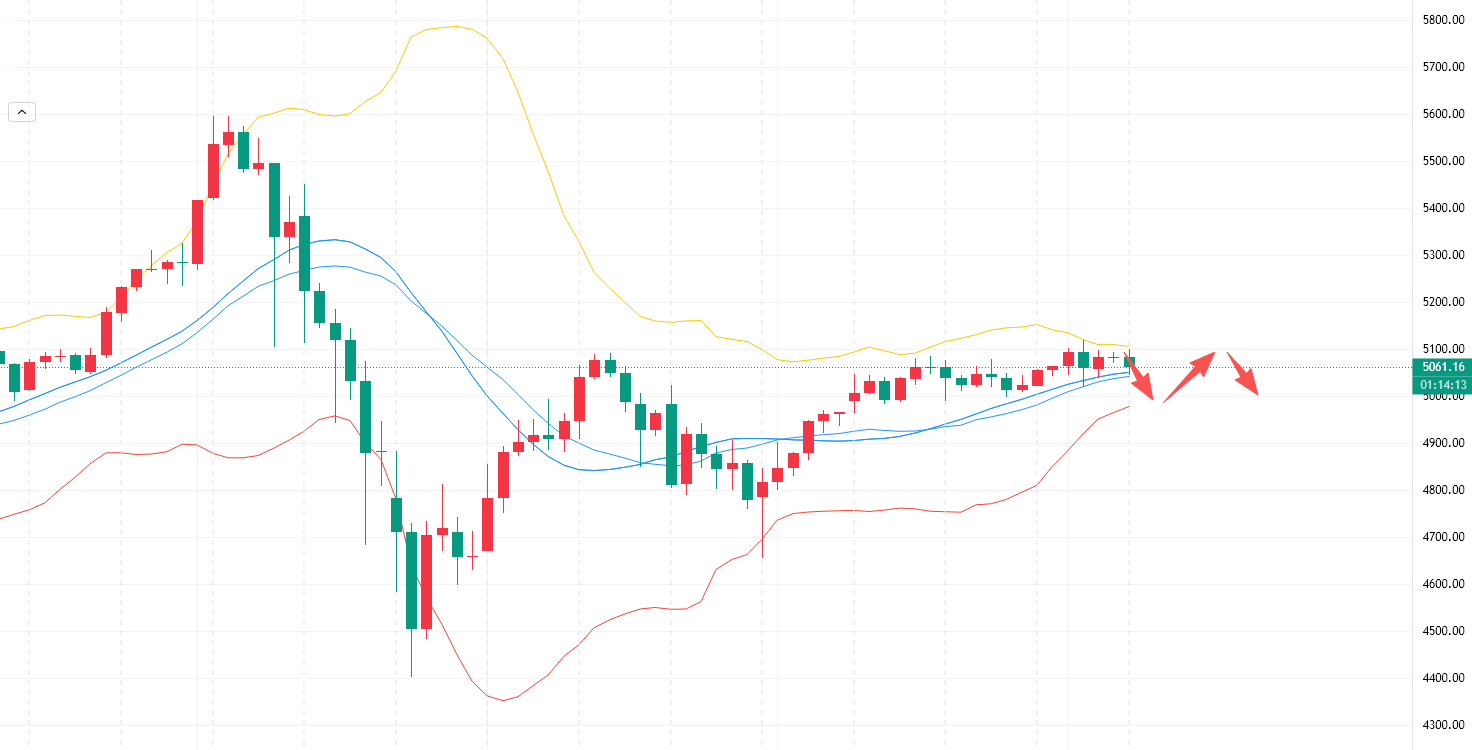
李槿:2/12黄金利空不改强势!区间震荡把握节奏!
Sou Hu Cai Jing· 2026-02-12 02:23
Core Viewpoint - The U.S. non-farm payrolls for January exceeded expectations, leading to a decrease in the unemployment rate, which reinforces the Federal Reserve's expectation to maintain high interest rates, creating downward pressure on gold prices. However, gold prices quickly rebounded after a brief pullback, indicating strong bullish momentum [1]. Group 1 - The support level at 5000 for gold is considered strong, making it difficult for prices to drop below this point [1]. - The market is currently experiencing high volatility, with resistance levels noted around 5100 and 5150, while support is observed in the 5000-5020 range [1]. - The short-term trading strategy suggests a focus on the 5120-5000 range for high short and low long positions, with a wait for new fundamental indicators to guide direction [1]. Group 2 - The previous trading recommendation to go long at 5025 was deemed accurate [3]. - Continuous monitoring of real-time market trends is emphasized for effective trading decisions [3].
铁矿石:区间震荡
Guo Tai Jun An Qi Huo· 2026-02-11 02:19
Report Summary 1. Report Industry Investment Rating - The investment rating for the iron ore industry is "Range-bound" [1] 2. Core Viewpoint - The iron ore market is expected to experience range-bound fluctuations [1] 3. Summary by Relevant Catalogs 3.1 Fundamental Tracking - **Futures Data**: The closing price of I2605 was 761.5 yuan/ton with no change, and the position was 513,940 hands with an increase of 556 hands [1] - **Spot Prices**: The prices of various types of iron ore, including imported and domestic ores, remained unchanged [1] - **Basis and Spreads**: The basis and spreads of different iron ore varieties showed little change, except for the spread between I2605 - I2609 which decreased by 1.0 yuan/ton and the spread between I2609 - I2701 which increased by 1.0 yuan/ton [1] 3.2 Macro and Industry News - China's January RatingDog manufacturing PMI was 50.3, in line with expectations and higher than the previous value of 50.1 [1] - Many real - estate companies are no longer required by regulatory authorities to report the "Three Red Lines" indicators monthly, but some troubled real - estate companies need to report financial indicators such as asset - liability ratio to the special team in their headquarters city regularly [1] 3.3 Trend Intensity - The trend intensity of iron ore is - 1, indicating a relatively bearish view [2]
焦煤焦炭月报:煤焦供需双弱,静待节后指引-20260209
Tong Guan Jin Yuan Qi Huo· 2026-02-09 01:42
1. Report Industry Investment Rating - No relevant content provided in the report. 2. Core Viewpoints of the Report - **Supply and demand of coking coal and coke are both weak before the Spring Festival, and the post - festival trend depends on the game between upstream and downstream**: In the coking coal segment, production is adjusted due to the Spring Festival and safety production constraints, and it is expected to decline seasonally in February and recover quickly after the festival. In the coke segment, poor profits suppress production enthusiasm, and supply is in a contraction state. In the steel mill segment, production will remain at a low level during the Spring Festival, and the start - up rate is expected to gradually recover after the Lantern Festival, but the actual recovery height depends on the game between terminal demand release intensity and steel mill profit levels. In the next month, the supply and demand of coking coal and coke will first decline and then rise. The supply of coking coal is expected to be loose, while the supply of coke will continue to contract. The demand depends on terminal demand and steel mill profit space. Overall, the fundamentals show a pattern of weak supply and demand, and it is expected that coking coal and coke will mainly fluctuate within a range, with coke in the range of 1600 - 1800 yuan/ton and coking coal in the range of 1050 - 1300 yuan/ton [3][33]. 3. Summary According to the Table of Contents 3.1 Market Review - **Futures market**: In January, coking coal and coke futures fluctuated widely, with a slight upward shift in the center of gravity. Coking coal futures first rose due to winter storage expectations, then fell due to high Mongolian coal customs clearance and sufficient domestic supply, and finally entered a shock phase. Coke futures basically followed the trend of coking coal [8]. - **Spot market**: Mongolian coal prices were closely linked to futures, while Shanxi - produced coking coal prices were relatively lagging. In January, the mainstream coal types in Shanxi generally rose by 80 - 150 yuan/ton in the middle of the month and then weakened in the late month [8]. - **Fundamentals**: For coking coal, the supply pressure gradually accumulated, with increased domestic coal mine production and high - level Mongolian coal customs clearance. The downstream winter storage brought phased demand but with limited intensity. For coke, the supply - demand pattern was loose, the capacity utilization rate of independent coking enterprises increased slightly, but profits continued to shrink [8]. 3.2 Supply Side 3.2.1 Upstream Coking Coal Production Declined Slightly - In January, coking coal production decreased by 3.2% month - on - month and 1.5% year - on - year, mainly affected by the Spring Festival and weak downstream demand. Shanxi's production decreased by 4% month - on - month, while Inner Mongolia's increased by 2.1%. State - owned key coal mines accounted for 72% of the total output, and private small and medium - sized mines had a low start - up rate of 52%. In February, production is expected to decline seasonally and recover quickly after the festival [9][11]. 3.2.2 Coking Coal Import Had a Good Momentum - In 2025, China's coking coal imports were low in the first half and high in the second half, with a total import volume of 118.6256 million tons, a year - on - year decrease of 2.66%. Mongolia and Russia accounted for 78.3% of the total imports. In January, Mongolian coal customs clearance increased significantly year - on - year, and the port inventory was high. After the Spring Festival, customs clearance is expected to remain at a high level [12]. 3.2.3 Coking Coal Inventory Analysis - In January, the coking coal market was in a state of inventory accumulation. The inventory was transferred from upstream to mid - and downstream. By the end of January, the upstream coal mine raw coal inventory increased by 660,000 tons month - on - month, the port inventory decreased by 130,000 tons, the coking plant inventory increased by 1.95 million tons, and the steel mill coking coal inventory increased by 76,000 tons [17]. 3.2.4 Overall Contraction of Coke Supply - In January, coking enterprises' profits were poor, and the start - up rate increased limitedly. The national coking profit was - 50 - 60 yuan/ton, and the independent coking enterprise start - up rate was stable at around 72%. Coke production was at a relatively low level, and the supply continued to contract. Steel mill coke production remained stable, with a daily average output of 465,000 - 470,000 tons [19]. 3.2.5 Coke Import and Export - In 2025, China's coke exports showed a downward trend, with a total export volume of 794,000 tons, a year - on - year decrease of 4.5%. Exports were mainly to Indonesia, India, and Japan. In 2026, coke exports are expected to be generally stable. Domestic coke self - sufficiency rate is high, and imports have little impact on the market [21][22]. 3.2.6 Coke Inventory - Before the Spring Festival, coke inventory increased, mainly driven by steel mill replenishment. By the end of January, the total domestic coke inventory was about 9.2 million tons, an increase of 500,000 tons month - on - month. The coking plant inventory decreased by 60,000 tons, the port inventory increased by 200,000 tons, and the steel mill inventory increased by 360,000 tons [23]. 3.3 Demand Side: Contracted Before the Festival and Recovered After the Festival - Affected by the Spring Festival and pre - festival stockpiling, coke demand weakened before the festival. In January, overall consumption was stable, slightly better than the same period last year. The blast furnace capacity utilization rate of sample steel mills remained in the range of 80% - 85%, and the daily average pig iron output was about 2.28 million tons, a slight decrease of 5,000 tons month - on - month. It is expected that the start - up rate will remain low in early February and gradually recover after the Lantern Festival, but it depends on the game between steel mill profit repair and raw material costs [28]. 3.4 Market Outlook - **Coking coal**: Affected by the Spring Festival and safety production, production will decline seasonally in February and recover quickly after the festival, and the supply will be generally stable [32]. - **Coke**: Coking enterprises' profits are poor, and the supply continues to contract. Steel mill self - produced coke remains stable [32]. - **Steel mills**: During the Spring Festival, production will remain at a low level. After the Lantern Festival, the start - up rate is expected to gradually recover, but the actual recovery height depends on terminal demand and steel mill profit levels [32]. - **Macro - level**: The domestic economy is stable, with weak real estate investment and strong infrastructure and manufacturing investment. Overseas, there are geopolitical conflicts and trade frictions, and the global economy has uncertainties. In the next month, the supply and demand of coking coal and coke will first decline and then rise, and they are expected to fluctuate within a range [33].
豆粕、豆油期货品种周报2026.02.02-02.06-20260202
Chang Cheng Qi Huo· 2026-02-02 01:06
Report Summary 1. Report Industry Investment Rating - Not provided in the report 2. Core Views - **豆粕期货**: The soybean meal futures are expected to maintain a range - bound pattern. Brazil's soybean harvest is abundant and gradually hitting the market, leading to significant global supply pressure. Domestic downstream demand is weak, while high oil - mill operation rates and low breeding profits suppress consumption growth. However, Argentina's drought and the continuous reduction of domestic soybean meal inventory provide bottom support [6]. - **豆油期货**: The soybean oil futures price is expected to continue a wide - range fluctuation. As the oil - mill operation rate recovers, soybean oil supply is becoming looser, and terminal consumption is weak, with inventory pressure still existing. But the US biodiesel policy expectations and international crude oil price fluctuations support the soybean oil futures price [29]. 3. Summary by Directory 豆粕期货 - **中线行情分析** - The soybean meal futures are in a range - bound stage. The 4th - week oil - mill soybean actual crushing volume is 2.1021 million tons, the operation rate is 57.83%, and the soybean meal inventory is 898,600 tons. Pay attention to South American weather, Brazil's new - crop arrival rhythm, and domestic breeding demand [6]. - **品种交易策略** - **上周策略回顾**: The soybean meal futures price was in a sideways trend last week, with a slightly bearish capital sentiment. The M2605 was expected to be in a range - bound pattern, with an expected operating range of 2700 - 2800 [9]. - **本周策略建议**: The soybean meal futures price is currently in a sideways trend, with a strongly bearish capital sentiment. The M2605 is expected to be in a weak - range fluctuation, with an expected operating range of 2700 - 2800 [10]. - **相关数据情况** - Data includes soybean meal weekly output, weekly inventory, apparent consumption, weekly inventory days, basis, and oil - meal ratio. The data sources are Wind, Mysteel, and the Great Wall Futures trading consulting department [19][21][24] 豆油期货 - **中线行情分析** - The soybean oil futures are in a wide - range fluctuation stage. The 125 oil - mills' actual soybean oil output in the 4th week is 39,940 tons, and the national key - area commercial soybean oil inventory is 956,000 tons. Pay attention to the US biodiesel policy, crude oil trends, and domestic demand [29]. - **品种交易策略** - **上周策略回顾**: The soybean oil futures price was in an upward trend last week, with a slightly bullish capital sentiment. The Y2605 was expected to continue a slightly bullish range - bound pattern [32]. - **本周策略建议**: The soybean oil futures price is in an upward trend, with a slightly bullish capital sentiment. The Y2605 is expected to be in a high - level range - bound stage [32]. - **相关数据情况** - Data includes soybean oil weekly output, weekly inventory, basis, trading volume, soybean weekly arrival volume, weekly inventory, weekly crushing volume, weekly operation rate, weekly port inventory, and Brazil's premium. The data sources are Wind, Mysteel, and the Great Wall Futures trading consulting department [42][45][47]
不锈钢:盘面窄幅震荡为主 成本和供需博弈
Jin Tou Wang· 2026-01-20 01:56
Core Insights - The stainless steel market is experiencing price fluctuations, with recent data indicating a decline in cold-rolled stainless steel prices in Wuxi and Foshan [1] - Nickel ore prices are on the rise, particularly in the Philippines and Indonesia, with significant increases in benchmark prices [1][3] - Domestic stainless steel production is expected to increase in January, driven by improved profit margins for steel mills [2] Supply - In December, the crude steel output from 43 domestic stainless steel mills was 3.2605 million tons, a month-on-month decrease of 232,600 tons (6.7%) and a year-on-year decrease of 5.3% [2] - January's stainless steel crude steel output is projected to be 3.4065 million tons, reflecting a month-on-month increase of 4.48% and a year-on-year increase of 19.05% [2] - The production of the 300 series is expected to rise to 1.7632 million tons in January, with a month-on-month increase of 0.92% and a year-on-year increase of 12.58% [2] Inventory - Social inventory is continuing to decrease, although the pace of reduction has slowed compared to the previous week [2] - As of January 16, social inventory for the 300 series in Wuxi and Foshan was 450,700 tons, a week-on-week decrease of 6,700 tons [2] - The Shanghai Futures Exchange's stainless steel futures inventory was 46,118 tons, down 911 tons week-on-week [2] Market Dynamics - The stainless steel market is currently experiencing narrow fluctuations, influenced by nickel ore news and cautious purchasing behavior [3] - The People's Bank of China has lowered the re-lending and rediscount rates by 0.25 percentage points, creating space for further interest rate cuts [3] - Expectations of tightened nickel ore supply from Indonesia and rising prices in the Philippines are contributing to market sentiment [3] Price Trends - The market price for high-nickel pig iron has risen, with the negotiation range moving up to 1,020-1,030 yuan per nickel [3] - Retail prices for ferrochrome remain strong due to limited resource circulation and a slowdown in supply growth [3] - Overall, while cost support is strengthening, the combination of ample supply and weak demand is limiting upward price movement, with short-term expectations of price fluctuations in the range of 13,800-14,600 yuan [3]