房企转型

Search documents
万科年报:营收2334亿,保质交付11.7万套,经营服务业务保持稳健
Jin Rong Jie· 2026-03-31 12:21
Core Viewpoint - Vanke reported a revenue of 233.4 billion in its 2025 annual report, demonstrating resilience amid significant challenges, supported by major shareholders and stakeholders [1] Group 1: Financial Performance - Vanke achieved a sales figure of 134.06 billion, delivering 117,000 housing units on time and with quality [1] - The company's operational service revenue remained stable, with Vanke Apartment leading in scale, efficiency, and insurance coverage in the industry [1] - Vanke's logistics segment, including cold chain services, ranks among the top tier in terms of scale and occupancy rate, with a total occupancy rate of 94.5% for its overall properties [1] Group 2: Strategic Focus - For 2026, Vanke plans to focus on risk management and development as key themes to drive critical work forward [1] - Industry experts believe that despite current operational challenges, Vanke's brand and products maintain competitive market strength, with a better foundation for transformation compared to many peers [1] - If Vanke can overcome its current difficulties, it is expected to restore sustainable operations in the long term [1]

未知机构:2026年房地产市场前低后高全年板块或迎来两大拐点25年房-20260213
未知机构· 2026-02-13 01:55
Summary of Conference Call Notes Industry Overview - The real estate market is expected to experience a "front low and back high" trend in 2026, with two significant turning points anticipated throughout the year [1][3]. - The real estate market and investment continue to face adjustment pressures in 2025 [1][3]. Short-term Strategies - Short-term measures should focus on destocking and boosting demand and confidence to stabilize the market [1][3]. - Support for reasonable financing needs of real estate companies is essential to stabilize investment [1][3]. - Immediate policy interventions are necessary to prevent a sharp market decline [1][3]. Long-term Strategies - In the medium to long term, there is a need to guide real estate companies to actively transform from increasing investment development value to enhancing service operation value [2][3]. - Development models and systems require updates to adapt to changing market conditions [2][3]. Market Dynamics - The ongoing market weakness is primarily due to supply-demand mismatches and weak expectations regarding future housing prices [4]. - Recommendations include: 1. Government side (G-end): Utilize land reserves and urban renewal to absorb supply and create demand [4]. 2. Business side (B-end): Activate existing assets through securitization and restructuring to shift supply [4]. 3. Consumer side (C-end): Adjust administrative, provident fund, and fiscal policies to boost consumer demand and digest supply [4]. Investment Trends - Real estate investment continues to weaken, largely due to significant financial pressures on developers [5]. - Key predictions for 2026 include: 1. Sales area of 810 million square meters, down 8% year-on-year [6]. 2. Average sales price of 9,144 yuan per square meter, down 4% year-on-year [6]. 3. Sales amount of 7.4 trillion yuan, down 12% year-on-year [6]. 4. Investment of 6.9 trillion yuan, down 16% year-on-year [6]. 5. New construction area of 480 million square meters, down 18% year-on-year [6]. 6. Completed area of 490 million square meters, down 19% year-on-year [6]. - The main market contradiction has shifted from "shrinking transaction volume" to "continuously falling prices," particularly in the second-hand housing market [6]. Market Outlook - The decline in the second-hand housing market further impacts the transaction volume of new homes [7]. - Overall liquidity is shrinking, leading to weakened demand that affects developers' investment and subsequently drags down the economy [8]. - 2026 is seen as the beginning of the "14th Five-Year Plan," with expectations for the real estate market to improve under the central economic work conference's goal of stabilizing investment [8]. - Two potential turning points are anticipated: a "policy turning point" around the end of Q1 and a "fundamental turning point" around Q4 [8]. - The "policy turning point" may reflect increased policy enthusiasm on both supply and demand sides, while the "fundamental turning point" will be indicated by a narrowing decline in second-hand housing prices [8]. Investment Recommendations - Despite expected declines in real estate sales, investment, and new construction in 2026, the rate of decline is anticipated to be less severe than in 2025 [8]. - Investment opportunities may arise in the real estate sector throughout 2026, with a focus on companies that have adequately accounted for impairments in 2025, as well as those that have proactively adapted to new business models [11]. - Suggested companies for investment include China Resources, Binjiang, Zhaoshang, Yuexiu, Jianfa, Poly Real Estate, and others involved in new consumption opportunities [11]. Risk Factors - Key risks include policies not being implemented as expected, continued declines in sales and housing prices, and slower-than-expected recovery of market confidence [12].
太难了!北京房企“一哥”首开股份4年巨亏200亿
Xin Lang Cai Jing· 2026-01-29 06:53
Core Viewpoint - Shoukai Co., once a leading real estate company in Beijing, is facing significant financial losses, with projected net losses for 2025 estimated between 55 billion to 69 billion yuan, although this represents a reduction compared to the 81.41 billion yuan loss in 2024 [3][11] Financial Performance - The company reported a cumulative loss of nearly 150 billion yuan from 2022 to 2024, with total losses expected to exceed 200 billion yuan by the end of 2025 [3][11] - In 2022, Shoukai Co. recorded its first loss post-IPO, with a net loss of 4.61 billion yuan, which expanded to 63.39 billion yuan in 2023 and peaked at 81.41 billion yuan in 2024 [3][11] Asset Impairment - Asset impairment provisions have increased significantly, from 0.5 billion yuan in 2022 to 35.7 billion yuan in 2024, with 30.81 billion yuan attributed to real estate inventory depreciation [4][12] - The ongoing losses are attributed to low gross margins, high taxes and fees, and the need for further inventory depreciation provisions [4][12] Cost Control and Revenue Growth - In 2025, Shoukai Co. implemented effective cost control measures, achieving a revenue of 231.86 billion yuan in the first three quarters, a year-on-year increase of 60.31%, and a gross margin improvement of 4.12 percentage points [5][13] - The company restructured its organizational framework, consolidating 19 secondary development units to enhance efficiency and reduce costs [5][13] Debt Management - As of the end of 2024, Shoukai Co. had interest-bearing liabilities of 1,161.97 billion yuan, with an asset-liability ratio of 74.4% and a net liability ratio of 192.4%, both exceeding industry warning levels [6][15] - By the end of Q3 2025, the asset-liability ratio improved to 76.83%, down from 78.37% in Q1 2025 [6][16] - The company secured approximately 115 billion yuan in corporate bond renewals and received 30 billion yuan in perpetual bond support from its major shareholder [6][16] Strategic Transformation - Shoukai Co. is diversifying its operations beyond residential development, focusing on revitalizing existing assets and exploring new growth areas, such as long-term rental apartments and high-end products [7][16] - The company has adopted a cautious land acquisition strategy, adding only two land parcels in 2024 and one in 2025 for 4.46 billion yuan [7][16] - Despite the reduction in losses, the company remains in a challenging financial position, with sales pressure evident as only 57.51% of the annual sales target was achieved by November 2025 [7][16]



普通人做好准备!不出意外的话,从2026年起,楼市或将出现3大转变!
Sou Hu Cai Jing· 2026-01-25 07:34
Core Insights - The real estate market is undergoing significant structural adjustments, with a projected 12.6% decline in national commodity housing sales to 8.4 trillion yuan in 2025 compared to 2024 [1] - The market is shifting from an expansion model to an optimization model, focusing on utilizing existing properties rather than building new ones [2] - Three major transformations are expected in the housing market starting in 2026, which will have significant implications for potential buyers [1] Group 1: Market Transformation - The development logic of the market is shifting from incremental expansion to stock optimization, emphasizing the importance of existing housing [2] - The average per capita housing area in urban areas is around 30 square meters, indicating a stable demand for new housing between 600 million to 800 million square meters annually [4] - New housing starts in 2025 are projected to decline by 20.4%, with residential starts down by 19.8%, reflecting a significant reduction in construction activity [4] Group 2: Market Differentiation - The market is showing signs of increasing differentiation, with first-tier cities experiencing the smallest decline in new residential sales, while second-hand housing transactions have reached a five-year high [5] - The trend of "price for volume" is evident, where declining prices are leading to increased transaction volumes, particularly in core cities like Shanghai, Beijing, and Shenzhen [5][7] - The pressure on third and fourth-tier cities is growing due to high new housing inventory and population outflow, leading to price adjustments [5][8] Group 3: Developer Strategies - Real estate companies are concentrating their resources in first and second-tier cities, particularly in prime locations, which reinforces the differentiation between urban areas [8] - Developers are transitioning from survival mode to a focus on quality, emphasizing product quality, design, and community services [9] - The competition among developers is shifting from scale to quality, leading to higher overall standards for new housing [9] Group 4: Market Opportunities - The current market conditions present a favorable opportunity for buyers with improvement needs, as housing prices have adjusted significantly [11] - The active second-hand housing market indicates genuine demand, with transactions occurring at reasonable prices [11] - Lower down payment ratios and mortgage rates are making home purchases more accessible for first-time buyers [11] Group 5: Land Market Dynamics - The residential land transaction area in 300 cities is expected to decline by 12.3% in 2025, indicating strict control over new supply by local governments [12] - Major cities like Beijing, Shanghai, and Hangzhou continue to attract the most investment, with the top 20 cities accounting for 52% of national residential land transfer fees [12] Group 6: Strategic Recommendations - Buyers should clarify their needs and consider entering the market now, as current conditions are favorable [13] - Selecting cities with strong population inflows and industrial development is crucial for long-term investment safety [13] - The quality and location of properties will become increasingly important, as the era of guaranteed appreciation is ending [13]
房企穿越周期:龙头转型不动产运营,招商蛇口押中沐曦、长鑫
2 1 Shi Ji Jing Ji Bao Dao· 2026-01-20 12:42
Core Viewpoint - The real estate industry is expected to stabilize as companies navigate through the current market challenges and explore new growth avenues, with major players like Poly Developments taking significant steps to adjust their strategies and financials [2][3][6]. Group 1: Company Performance - Poly Developments reported an estimated revenue of approximately 308.26 billion yuan for 2025, reflecting a year-on-year decrease of 1.09%, with a projected net profit attributable to shareholders of about 1.03 billion yuan, a decline compared to 2024 [2][3]. - The company plans to recognize asset impairment and credit impairment losses totaling around 6.9 billion yuan, which is expected to reduce the net profit for 2025 by approximately 4.2 billion yuan [3][4]. - Excluding the impact of impairment provisions, Poly Developments' net profit for 2025 is estimated to be around 5.2 billion yuan, with the fourth quarter contributing approximately 3.3 billion yuan [4]. Group 2: Industry Trends - The real estate sector is witnessing a cautious yet orderly expansion in investments, with companies focusing on stabilizing their operations and gradually reducing the impact of impairment provisions [2][3]. - The top 100 real estate companies in China are projected to have a total land acquisition amount of 964 billion yuan in 2025, marking a year-on-year increase of 3.9% [4]. - The market is expected to see a recovery in 2026 as companies navigate through the peak of delivery and debt repayment, entering a new development phase [2][6]. Group 3: Strategic Shifts - Many leading real estate firms are diversifying into long-cycle industries and real estate operations, with plans to invest in high-tech sectors and enhance service offerings [3][5]. - Poly Developments has expanded its operational assets to 5.73 million square meters, including 26,000 rental housing units, which increased by 18% compared to the end of 2024 [5]. - Other companies like China Resources Land and China Merchants Shekou are also pursuing similar strategies in real estate operations and indirect investments through industry funds [5].


南平住建出台11条措施!“共有产权”等房地产、建筑业领域多项政策持续发力
Xin Lang Cai Jing· 2025-12-31 16:01
Group 1: Core Insights - The article outlines measures to achieve high-quality development in the housing and urban construction sector in Nanping City for the first quarter of 2026, as part of a broader economic strategy [1][7] Group 2: Real Estate Development - The "shared ownership" housing policy will continue to be implemented and deepened, with city-level support provided in the form of housing vouchers to lower the threshold for home purchases [2][8] - Differentiated housing support measures will be introduced, targeting key groups such as new citizens, youth, first-time homebuyers, families with multiple children, and various talents, to provide tiered subsidies and tax incentives [2][8] - There will be encouragement for converting existing commercial housing into affordable housing, utilizing special bonds and policy bank loans to enhance housing security [2][9] - Diverse home purchasing models will be promoted, including "rent-to-own" and shared ownership models, with policy support for those purchasing through these methods [2][9] Group 3: Construction Industry Upgrades - Support will be provided for enterprises to enhance market competitiveness through reforms in project bidding processes, encouraging collaboration between state-owned and private enterprises [4][10] - A one-stop service for project approval will be optimized, focusing on key projects to ensure timely commencement and productivity [4][10] - Administrative approval processes will be expedited, with a push for online handling of construction permits and simplified procedures [4][11] - Monitoring and adjustment of construction material and labor costs will be strengthened, particularly in light of seasonal factors affecting construction expenses [5][11] - Projects will be encouraged to maintain production and resume work promptly after the holiday period, ensuring that essential services remain operational [6][11]
倪鹏飞:房地产必需顺应和引领时代之变
Jing Ji Guan Cha Wang· 2025-10-11 13:13
Core Insights - The real estate market is showing signs of stabilization, with an increase in the number of cities experiencing rising new home prices, indicating a warming market [1][2] - The industry is undergoing a deep adjustment, requiring a shift from a developer-centric model to a customer-centric approach, focusing on high-quality housing supply and innovative operational models [2][12] - The demand for "good houses" is strong, driven by genuine improvement needs, but supply has not kept pace, leading to market differentiation [5][6] Market Trends - In August 2025, the number of cities with rising new home prices increased to 9, up from 6 in July, while first-tier cities saw a slight price decline of 0.1% [1] - Second-tier cities experienced a 0.3% decline, and third-tier cities saw a 0.4% decline, indicating varying levels of market pressure across different city tiers [1] - The adjustment period for real estate has lasted four years, with some structural positive changes emerging in specific regions and housing types [1][2] Demand and Supply Dynamics - The concept of "market stabilization" involves both phase-based and structural recovery, with quality properties in prime locations showing positive growth [3][4] - The reasonable range for the price-to-income ratio internationally is 2-6 times, while first-tier cities in China have seen ratios as high as 40 times, indicating significant room for adjustment [4] - The demand for quality housing is evident, with a notable portion of buyers looking to upgrade their living conditions, particularly in desirable areas [6][12] Future Outlook - The future of the real estate market will depend on macroeconomic improvements and the return of key indicators to reasonable ranges, with opportunities concentrated in high-quality housing and innovative operational models [2][12] - The integration of AI and remote working trends will reshape housing needs, requiring developers to adapt designs and community features to accommodate new living and working arrangements [8][9] - The long-term transformation of the industry is expected to lead to healthier market conditions, with a focus on high-quality development and reduced reliance on traditional growth models [15][16] Company Strategies - Real estate companies must pivot from high turnover to meticulous product development, emphasizing consumer needs and preferences [12][17] - Successful companies in the future will likely be those that maintain financial stability, focus on core competencies, and adapt to emerging trends such as AI and remote work [13][15] - The shift towards non-traditional real estate businesses can be successful if companies remain focused and innovative, creating unique offerings that are difficult to replicate [18]
保利、万科稳居营收千亿俱乐部,首开、滨江增速领跑
Xin Jing Bao· 2025-09-14 02:21
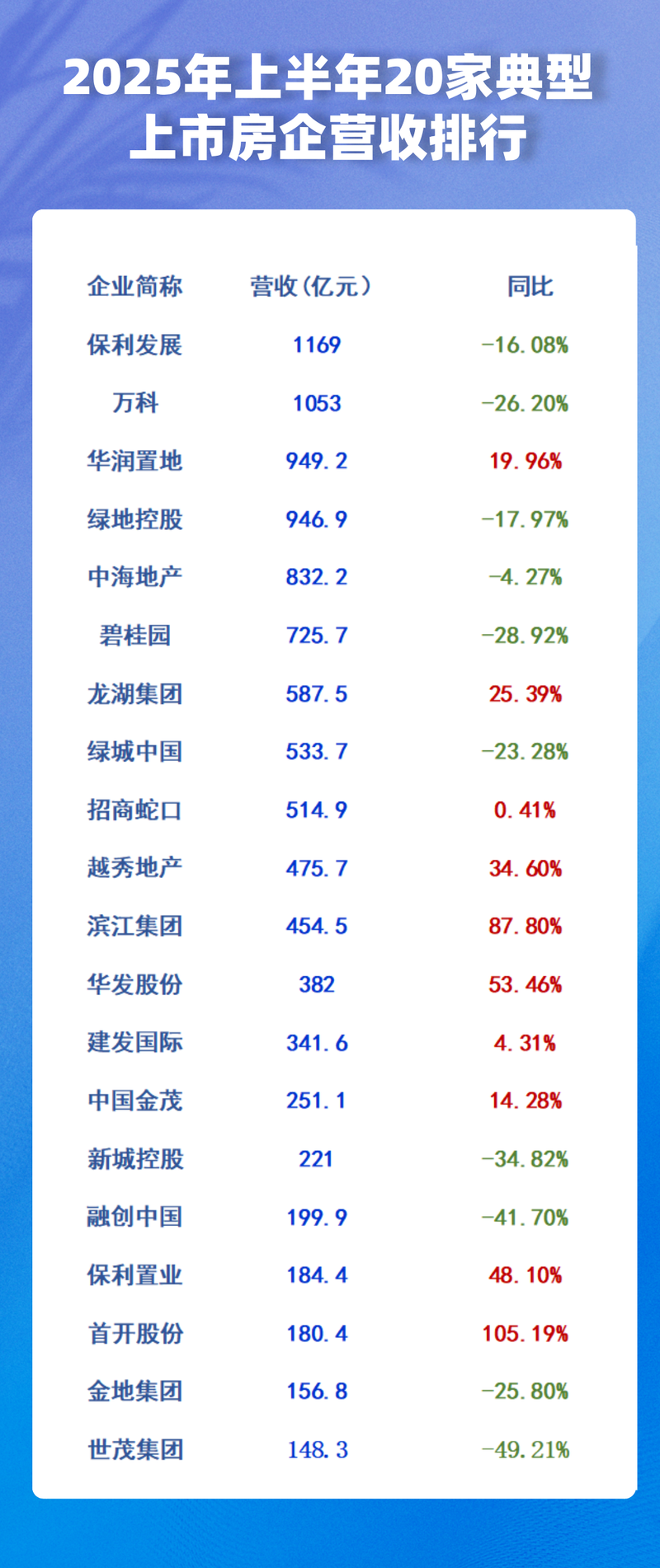
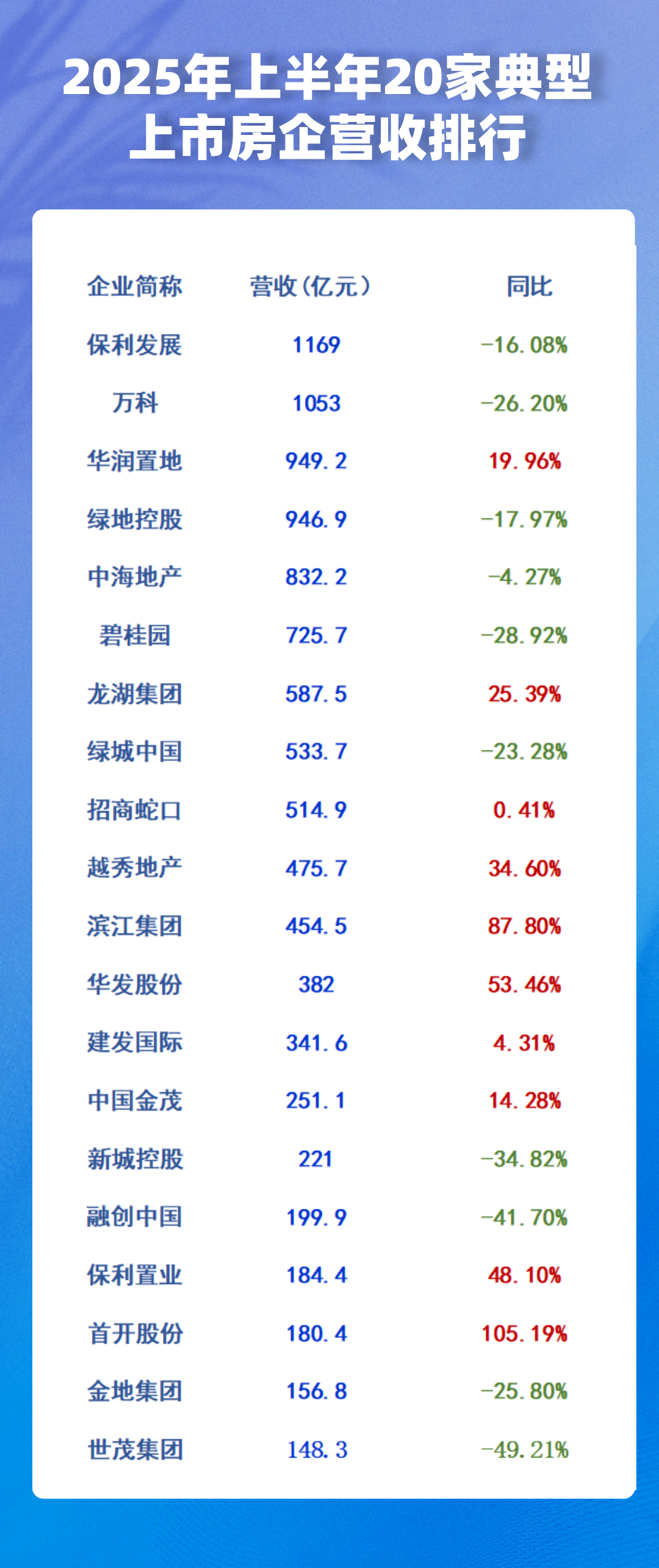
Core Viewpoint - The financial reports of listed real estate companies for the first half of 2025 reflect a significant industry transformation, moving from a "scale competition" phase to a "steady operation" phase, with ongoing deep adjustments and increasing differentiation among companies [1] Group 1: Revenue Performance - Only two companies, Poly Developments and Vanke, entered the "billion revenue club" with revenues of 116.9 billion and 105.3 billion respectively, while the average revenue growth rate for the 20 companies was only 7.72% [4][6] - Half of the listed real estate companies experienced revenue declines, with Shimao Group and Sunac China seeing declines close to 50% [1][6] - Notable revenue growth was observed in companies like Shoukai Co. and Binjiang Group, which reported growth rates exceeding 80% [1][6] Group 2: Revenue Breakdown - The first tier includes only Poly and Vanke, while the second tier consists of seven companies with revenues between 50 billion and 100 billion, including China Resources Land and Greenland Holdings [5] - The third tier includes 11 companies with revenues below 50 billion, featuring regional leaders and companies that have faced debt crises, such as Sunac China and Shimao Group [5] Group 3: Differentiation Among Companies - Significant differentiation in revenue growth rates is evident, with China Resources Land achieving nearly 20% positive growth, while Poly and Vanke saw declines of 16.08% and 26.2% respectively [6] - Companies like Binjiang Group and Yuexiu Property achieved growth rates of 87.8% and 34.6%, respectively, driven by strategic market positioning [6][7] Group 4: Challenges and Transformation - State-owned and central enterprises demonstrate stronger risk resistance, with stable revenues and lower financing costs, while private companies face significant pressures [7][8] - Many companies are shifting towards "second growth curves" through light asset transformation and non-development businesses, with China Resources Land's operational income contributing over 60% to its profits [8] - The industry is entering a new development phase characterized by declining scale and slower growth, necessitating improved financial management and debt restructuring among companies [8]

透视半年报|保利、万科稳居营收千亿俱乐部,首开、滨江增速领跑
Bei Ke Cai Jing· 2025-09-14 01:39
Core Viewpoint - The financial reports of listed real estate companies for the first half of 2025 reflect a new industry landscape, indicating a shift from "scale competition" to "steady operation" as the industry remains in a deep adjustment phase [1] Group 1: Revenue Performance - Only two companies, Poly Developments and Vanke, entered the "billion revenue club" with revenues of 116.9 billion and 105.3 billion respectively [4] - Half of the listed companies experienced revenue declines, with Shimao Group and Sunac China seeing declines close to 50% [1][11] - The average revenue growth rate for the 20 companies was only 7.72%, indicating weak growth overall [2][4] Group 2: Revenue Breakdown - The first tier includes only Poly and Vanke, while the second tier consists of seven companies with revenues between 50 billion and 100 billion, including China Resources Land and Greenland Holdings [5] - The third tier includes 11 companies with revenues below 50 billion, featuring regional leaders and companies that have faced debt crises, such as Sunac China and Shimao Group [6] Group 3: Divergence in Growth - Significant divergence in revenue growth is evident, with China Resources Land achieving nearly 20% growth while Poly and Vanke saw declines of 16.08% and 26.20% respectively [7] - Some mid-sized companies, like Binhai Group and Yuexiu Property, achieved growth rates exceeding 30%, with Binhai Group's growth at 87.8% and Shoukai's at 105.19% [8][10] Group 4: Challenges and Transformation - State-owned and central enterprises demonstrated stronger risk resistance, with stable revenues and lower declines compared to private companies [12][13] - Private companies, except for a few like Longfor Group and Binhai Group, continue to face significant pressures, with many experiencing revenue declines over 25% [14] - Companies are increasingly focusing on "second growth curves" through asset-light transformations and non-development businesses to drive revenue [14][16] Group 5: Future Outlook - The industry is entering a new development phase characterized by declining scale and slower speed, necessitating improved financial management and debt structure optimization [16] - The financial performance of these companies serves as a report card on their comprehensive risk resistance and future development potential, indicating a reshaped industry landscape [17]

头部房企转型迈入新阶段 加速布局经营性业务
Zheng Quan Ri Bao· 2025-09-06 02:48
Core Viewpoint - The real estate industry is under pressure but is transitioning towards a new growth model, focusing on product quality and operational resilience to navigate upcoming debt peaks [1][8]. Financial Performance - In the first half of the year, 286 listed real estate companies reported a total revenue of 1.85 trillion yuan and a net profit of 851.77 billion yuan, with 89 companies incurring losses totaling 191.2 billion yuan [2]. - Key reasons for performance pressure include a significant decrease in project settlement scale and low gross margins, alongside asset impairment provisions to accelerate inventory turnover [2][3]. Strategic Focus on Quality - The "good house" strategy is seen as both a policy direction and a future development goal for real estate companies, with many firms experiencing sales growth by enhancing product quality [3][4]. - Companies like Longfor Group and Yuexiu Property have successfully implemented strategies that emphasize product quality, resulting in increased sales prices and volumes [3][4]. Diversification into Operational Business - Many real estate firms are developing operational businesses as a second growth curve, with companies like China Resources Land achieving significant revenue from these sectors [5][6]. - Longfor Group reported record revenues from its operational services, while other firms are also expanding into commercial and property management sectors [6][7]. Debt Management and Financial Resilience - The industry faces a debt peak in the second half of 2025, with total debt due expected to reach 530.1 billion yuan, necessitating proactive debt management strategies [8][9]. - Companies are optimizing their debt structures and exploring diverse financing channels, such as operating property loans and public REITs, to enhance financial safety [9][10]. Future Outlook - The financing environment for quality real estate firms is improving, with a focus on stabilizing cash flows and reducing debt levels to navigate the upcoming challenges [10].